



Most cleaning businesses don't lose money in one dramatic event. They lose it in slivers. A crew clocks an extra 20 minutes that nobody questions. A card dispute slips past the response window. A recurring route quietly drops from three homes to two but keeps the same drive time. None of these will ruin you on their own. Together, across a year, they'll eat a chunk of margin you never see leave.
The problem with most "audits" is timing. Owners look at their numbers once a month, usually when the bookkeeper sends something over, and by then the trail has gone cold. You can see that payroll was high, but you can't reconstruct why. You can see chargebacks hit, but the evidence window closed two weeks ago. A monthly review tells you that you're bleeding. It rarely tells you where the cut is.
A proper profit protection audit for a cleaning business works in layers, each one catching what the last layer is too slow to see. Daily exceptions catch the fresh stuff while the evidence still exists. Weekly reconciliations verify that the small things actually got resolved and stitch four separate systems — payroll, billing, chargebacks, route margins — into one view. The monthly deep-dive stops firefighting and asks the structural questions. This piece lays out that layered system, gives you sample tolerances so you're not guessing what "normal" looks like, and shows you how to run the whole thing as a weekly owner ritual that takes under an hour once it's set up.
Why single-layer reviews always fail
The pattern that shows up across small operations again and again: an owner builds one review cadence, usually monthly, and expects it to do everything. Catch errors, verify fixes, spot trends — all at once. That's asking a single tool to do three jobs with three completely different time horizons.
Errors need to be caught within a day or two because the evidence is time-sensitive. A crew's GPS trail, a client's photo acknowledgment, a card processor's dispute clock — these all expire. Verification needs a weekly rhythm because that's the natural cycle a cleaning business runs on: routes repeat weekly, payroll periods land weekly or biweekly, recurring clients bill on weekly or monthly loops. Trend analysis needs a monthly or quarterly lens because you can't spot a route slowly going underwater by staring at one week of data.
When you jam all three into one monthly meeting, the fast stuff rots and the slow stuff gets lost in the noise. The owner spends the whole session reconstructing what happened three weeks ago instead of deciding what to do next. Layering isn't about doing more review work — it's about matching each check to the speed at which the underlying problem actually moves.
The prioritized loss-driver matrix
Before you build any audit cadence, you need to know what you're actually hunting. Not every loss deserves daily attention, and treating them all equally is how owners burn out on their own process. The matrix below ranks common loss drivers by how fast they move and how much they typically cost if left unchecked.
Never miss a cleaning appointment again.
Maidufy helps you book, confirm, and manage every cleaning service seamlessly.
- Centralized booking management
- Automated client reminders
- Optimized staff scheduling
No credit card required
| Loss driver | How fast it moves | Detection window | Typical annual bleed (small operation) | Audit layer |
|---|---|---|---|---|
| Payroll overstatement (rounding, buffer time, ghost minutes) | Daily | 1–2 days | $4k–$9k | Daily exceptions |
| Chargebacks / disputes past response window | Daily | 3–10 days | $2k–$6k | Daily exceptions |
| Billing errors (unbilled visits, wrong rate applied) | Weekly | 1 week | $3k–$7k | Weekly reconciliation |
| Route margin decay (shrinking stops, same drive cost) | Monthly | 4–8 weeks | $5k–$12k | Monthly deep-dive |
| Rate creep (costs rising, prices static) | Quarterly | months | varies widely | Monthly deep-dive |
| Supply / product overuse | Monthly | 4 weeks | $1k–$3k | Weekly reconciliation |
The numbers here are rough ranges from what small residential operations tend to see — not precise figures, and yours will vary with crew size and market. The ranking matters more than the exact dollars. Notice that the fastest-moving items — payroll and chargebacks — also have the shortest detection windows. That's not a coincidence. The things that move fast are the things you must catch fast, because the evidence to fix them disappears.
The biggest single line — route margin decay — moves slowly, which is exactly why it's so dangerous. Nobody notices a route slipping. It doesn't trigger an alert. It just quietly stops paying, and by the time it's obvious, you've been subsidizing it for two quarters.
Layer one: the daily exception scan
This is the fastest layer and the shortest. It should take a manager five to ten minutes at the end of each operating day, and it exists to catch time-sensitive problems while the trail is still warm.
You're not reconciling anything here. You're flagging exceptions — things that fall outside tolerance and need a second look. Three categories cover most of it:
-
Payroll exceptions Any shift where logged hours exceed scheduled hours by more than your tolerance (a common starting point is 10–12 minutes per visit, or roughly 8% over scheduled). Any missing clock-out. Any visit logged with no matching completed job.
-
Billing/dispute exceptions Any new chargeback or dispute notification — these get flagged today, not later, because the response clock is already running. Any completed visit with no invoice generated. Any client who's flagged a service issue that could turn into a refund request.
-
Route exceptions Any visit where travel time exceeded the norm by a meaningful margin, or any last-minute cancellation that left a crew idle.
The rule for this layer is simple: flag, don't fix. Fixing during the daily scan is how a five-minute check turns into an hour. You note the exception, capture the evidence that's about to expire (the GPS log, the photo timestamp, the dispute reference number), and park it for the weekly reconciliation. The one exception to "don't fix now" is a chargeback — those get their evidence package started immediately, because the window is unforgiving.
Capture the evidence that's about to expire (the GPS log, the photo timestamp, the dispute reference number) during the daily scan.
If disputes are a recurring drain, the approach in the pre-billing evidence and dispute-response playbook is worth building into this daily step directly.
Layer two: the weekly reconciliation ritual
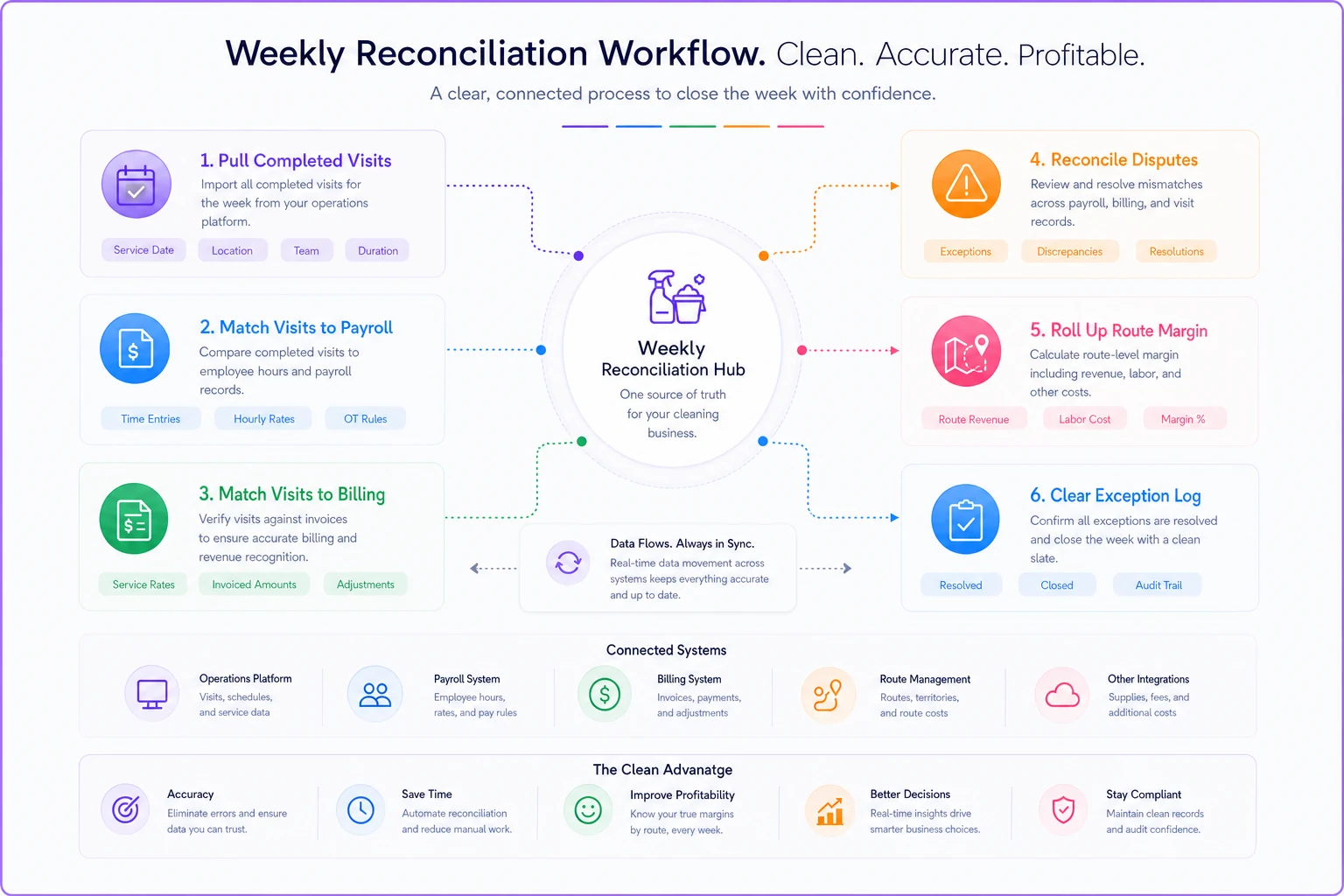
This is the heart of the system, and it's the layer most owners skip straight past. The weekly reconciliation does two things at once: it verifies that the week's flagged exceptions actually got resolved, and it stitches the four systems together so the numbers agree.
Running payroll, billing, chargebacks, and routes as separate silos means they never quite reconcile — and the gaps between them are where money hides. A visit that got completed but never billed. A payroll entry for a job that got canceled. A chargeback that was won but never credited back into your revenue tally. Each system looks fine on its own. It's only when you lay them side by side that the mismatch shows up.
A workable weekly reconciliation runs like this:
-
Pull the week's completed visits. This is your source of truth — every job the crews actually finished.
-
Match visits to payroll. Every paid hour should tie to a completed visit. Hours with no matching visit are your first red flag. This is the same discipline covered in the payroll leakage and field time-tracking guide — the weekly check is where those audit samples actually get used.
-
Match visits to billing. Every completed visit should have an invoice at the correct rate. Unbilled visits and wrong-rate invoices both surface here.
-
Reconcile disputes. Check the status of every open chargeback. Which ones need evidence submitted this week? Which resolved, and did the money actually land back?
-
Roll up route margin. For each route, compare revenue collected against labor plus estimated travel cost. You're not doing a deep analysis yet — just watching for any route that's drifting.
-
Clear the exception log. Every daily flag from the week gets a resolution: fixed, written off, or escalated to the monthly deep-dive.
A simple visual of the weekly reconciliation flow helps teams run it consistently.
The reconciliation only works if you set tolerances in advance. Without them, every tiny variance becomes a debate. Sample starting tolerances that work for most small operations:
-
Payroll
flag any variance over 8% or 15 minutes per visit, whichever is larger
-
Billing
zero tolerance on unbilled completed visits (all must be explained)
-
Rate accuracy
flag any invoice more than 5% off the expected rate
-
Route margin
flag any route below your minimum contribution threshold — often 25–30% after direct labor and travel
-
Dispute response
zero tolerance on missed evidence windows
Tolerances aren't permanent. Tighten them as your data gets cleaner. When you start, an 8% payroll tolerance might feel loose — but if half your visits are tripping it, you've got a scheduling or tracking problem to fix before you can tighten the screw.
Layer three: the monthly deep-dive
Weekly reconciliation keeps the books honest. It doesn't tell you whether the business is structured right. That's what the monthly deep-dive is for, and it asks harder questions than "did the numbers match?"
The core question is route economics. Weekly you're watching for drift; monthly you're deciding whether a route deserves to keep existing. A route can reconcile perfectly every week — every visit billed, every hour matched — and still be quietly unprofitable because the density has decayed. Three stops became two, but the crew still drives the full loop. The method for making the open/expand/sunset call is laid out in the route-profit decision guide, and the monthly deep-dive is exactly where you run it.
-
Recurring exception sources. If the same crew, same client, or same route keeps generating payroll flags, that's a structural issue — not a one-off. One repeat offender deserves more attention than ten random variances.
-
Dispute root causes. Not "how many chargebacks" but "why." Cleaning quality? Billing confusion? A specific booking channel that's pulling in bad-fit clients?
-
Rate vs. cost trend. Are your costs creeping up while prices sit still? This is the slow leak that doesn't trip any weekly tolerance until it's already a real problem.
-
Reserve and cash position. Whether the losses you've caught are being funneled into the right buffers. If you don't have deposit and reserve rules set, the financial controls guide for small cleaners is the piece to pair with this — the audit finds the leaks, the controls decide where the recovered money goes.
If you don't have deposit and reserve rules set, the financial controls guide for small cleaners is the piece to pair with this — the audit finds the leaks, the controls decide where the recovered money goes.
A real scenario: what the layers caught
A residential cleaning operation running around 330 monthly visits with four two-person crews was reviewing finances monthly and couldn't figure out why margins felt thin despite steady bookings. Revenue looked healthy. Payroll looked "about normal." Nothing screamed.
When they broke the review into layers, the picture sharpened quickly. The daily payroll scan started flagging a consistent pattern: two crews were logging 15–20 extra minutes per visit, mostly buffer time that had crept in and become habit. Across roughly 160 monthly visits between those crews, that was somewhere in the neighborhood of $600–$800 a month in soft payroll — not theft, just drift nobody had been watching.
The weekly reconciliation caught something else. Around six to eight completed visits a month were never getting invoiced — mostly last-minute add-ons the crews handled in person that never made it back into billing. Call it $500–$700 in monthly revenue simply disappearing.
The monthly deep-dive found the biggest one. Two routes on the edge of their service area had decayed from four stops to two or three, but the crews still drove the full loop. On paper the visits were profitable. Counting the drive time, both routes were running below a 20% contribution — one barely breaking even.
None of these were dramatic. Any single one was easy to miss for months, which is exactly what had happened. Stacked together and left alone, they were quietly costing somewhere in the range of $18k–$24k a year. Within two months of running the layered audit, the payroll drift tightened up, the add-on billing gap closed, and one of the two weak routes got restructured. Margins didn't explode overnight — but the leaks stopped, which is the whole point.
When this makes sense — and when it doesn't
When it's overkill: A solo operator with ten recurring clients doesn't need a daily exception scan. You already know every job, every client, every dollar. Forcing a layered audit onto that scale is just ceremony. A simple weekly glance at hours-versus-billed is enough until you add your first crew.
When it becomes essential: The moment you can no longer personally verify every visit — usually somewhere around the second or third crew — is when the layers stop being optional. That's the exact point where losses go invisible, because no single person is watching the whole operation anymore.
Who should not start here: If your underlying data is a mess — no reliable time tracking, no clean visit records, invoices scattered across tools — build the data foundation first. An audit is only as good as the records it checks. Running reconciliations against unreliable inputs just produces confident wrong answers.
Making the ritual stick
The reason most owners abandon audits isn't that they don't work — it's that pulling data from four disconnected systems every week is exhausting. When payroll lives in one tool, billing in another, disputes in your processor's dashboard, and routes in your head, the weekly reconciliation becomes an hour of manual copy-paste before you even start thinking. That friction kills the habit within a month.
This is where having your operational data connected in one place changes the math. When completed visits, logged hours, invoices, and dispute statuses all flow into a single system, the weekly reconciliation stops being a data-gathering exercise and becomes an actual decision-making session. The exceptions surface automatically against your tolerances; you spend your time resolving them, not hunting for them. Platforms that pull these threads together — payroll, billing, chargebacks, and route data in one operational view — turn what used to be a dreaded monthly reconciliation into a genuinely quick weekly check.
The tooling is secondary, though. The discipline is what actually protects your profit. Even on spreadsheets, an owner who runs daily exception scans, weekly reconciliations, and a monthly deep-dive will catch losses that a slicker monthly-only review misses every single time.
The takeaway
Profit protection in a cleaning business isn't about finding one big leak and plugging it. It's about building a system that catches the small ones continuously — fast enough that the evidence still exists, structured enough that the numbers actually agree, and deep enough to question whether the operation is shaped right in the first place. Daily catches what's fresh. Weekly verifies and stitches. Monthly diagnoses the structure. Run all three, set your tolerances honestly, and tighten them as your data improves. The slivers you've been losing add up to real money — and layered like this, they're finally visible enough to stop.
Ready to elevate your cleaning business?
Join 500+ cleaning services using Maidufy to save time, reduce scheduling errors, and deliver exceptional client satisfaction.