
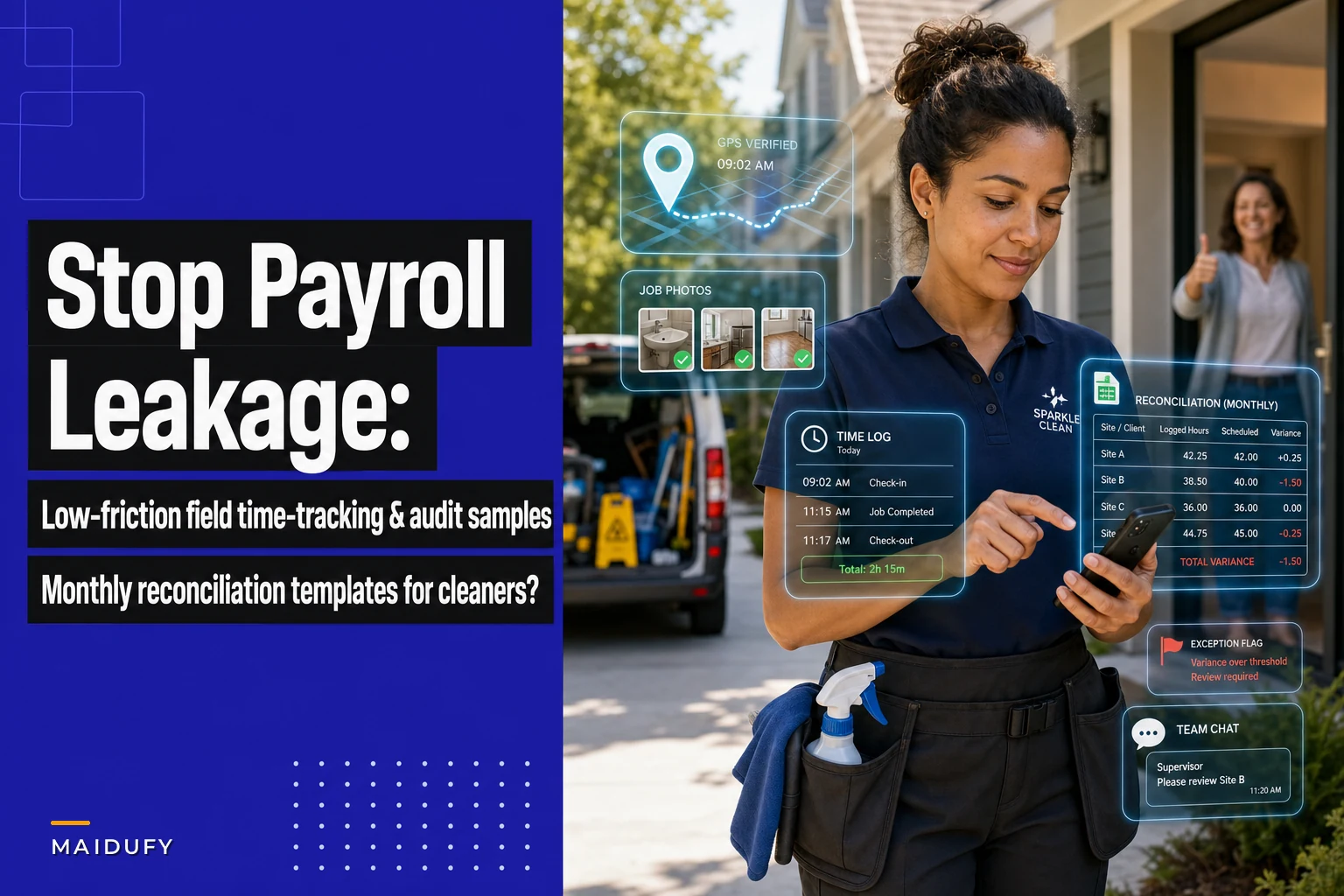

Your payroll runs $18,000 this month. Seems normal — same as last month, roughly what you budgeted. But here's what you don't see: Maria clocked out at 4:30 PM yesterday but actually left the Johnson residence at 3:45. Carlos marked eight houses complete on Tuesday when GPS shows he only hit seven. Those missing 45 minutes here, a phantom job there — they compound into thousands in overpayment over a year.
The monthly payroll mystery that drains cleaning businesses
Field time tracking for cleaners isn't about micromanaging your crews. It's about plugging the small leaks that quietly turn into floods. When you're running 15–20 cleaners across multiple territories, even a 5% time discrepancy means bleeding profit every single month.
The challenge with cleaning operations specifically is that your people work alone or in pairs, scattered across neighborhoods, often in homes where clients aren't present. Traditional punch clocks don't work. Office-style timesheets fall apart. You need field-specific methods that actually stick — and that your team will actually use.
Why manual timesheets fail cleaning operations
Manual paper timesheets seem simple enough. Hand them out Monday, collect them Friday, run payroll. Except cleaning businesses operate nothing like offices.
Never miss a cleaning appointment again.
Maidufy helps you book, confirm, and manage every cleaning service seamlessly.
- Centralized booking management
- Automated client reminders
- Optimized staff scheduling
No credit card required
Your cleaner arrives at the Henderson house at 9 AM but writes down 8:45 because they sat in the driveway checking messages. They finish at 11:30 but round up to noon because "it felt like a tough clean." These aren't malicious acts — just human nature when someone is self-reporting from memory.
The structural problem runs deeper than individual rounding. Cleaners fill out timesheets in their cars, at home, sometimes days after the actual work. Memory gets fuzzy. Times get estimated. That recurring Thursday client? They start writing the same hours every week regardless of what actually happened.
Paper timesheets also create reconciliation nightmares — handwritten times that don't match customer invoices, no way to verify if someone actually showed up, and zero audit trail when a discrepancy surfaces. One business I worked with discovered their highest-paid cleaner had been padding hours by 6–8 per week for several months. Nearly $4,000 in overpayment before anyone caught it.
Three field time-tracking methods that actually work
GPS-based tracking
GPS tracking through mobile apps gives you automatic clock-in/out when cleaners enter and exit job sites. Set up geofences around customer addresses and the system handles the rest.
The operational reality: GPS works well for standard residential routes but breaks down in certain situations. Apartment complexes confuse location services. Dense urban areas create false triggers. Rural properties with long driveways might not register arrival accurately. You'll need a backup verification method for roughly 10–15% of jobs depending on your market.
GPS also raises trust issues with some teams. Nobody loves feeling watched. Frame it as protection for both sides — accurate pay for honest work, documentation when customers claim shortened service. Most resistance fades after the first accurate paycheck resolves a dispute in the cleaner's favor.
Photo-evidence systems
Require before/after photos at each job site with timestamp verification. Cleaners snap a photo when arriving — usually the front door or entry area — and another when leaving, typically the completed checklist or packed-up supplies.
This method creates natural accountability without feeling invasive. Your cleaners probably already take photos for quality control or customer communication anyway. Adding arrival and departure shots barely changes their workflow, and the visual evidence helps substantially with customer disputes.
The downside is storage and organization. Twenty cleaners doing five houses a day generates around 200 photos daily. Without clear naming conventions and automated filing, you're drowning in images that nobody actually reviews. That's when the system quietly stops working.
Hybrid text check-ins
Simple SMS-based check-ins are surprisingly effective and underused. Cleaners text a specific number when arriving and leaving each job, including the customer's last name or a job code for cross-reference.
Text systems avoid app complications, work on any phone, and create timestamped records automatically. They're particularly useful for part-time cleaners or overflow staff who might resist installing tracking apps. The simplicity drives near-perfect compliance — texting takes three seconds.
The gap is that cleaners can text from anywhere, so you're still trusting location honesty to some degree. Text check-ins work best as your primary system with GPS or photos used for periodic spot verification rather than every job.
Monthly audit framework that catches discrepancies without destroying trust
Running audits feels adversarial, but done right, they actually protect your honest cleaners as much as the business. Your best people want accurate pay. They don't want to be underpaid because a coworker's padding skews your sense of what a job should take.
The 10% random sample method
Each month, randomly select 10% of all logged hours for deeper verification. If you're processing 3,000 hours monthly, audit 300. Use a random number generator to pick specific days and cleaners — this prevents targeting and keeps things defensibly fair.
For each sampled entry, verify:
-
Start/stop times against customer feedback
-
Travel time between jobs matches realistic estimates
-
Lunch breaks were actually taken
-
Overtime triggers were legitimate
Document everything in a simple spreadsheet. Note discrepancies without jumping to conclusions — patterns across multiple entries matter far more than a single isolated incident.
Audit workflow:
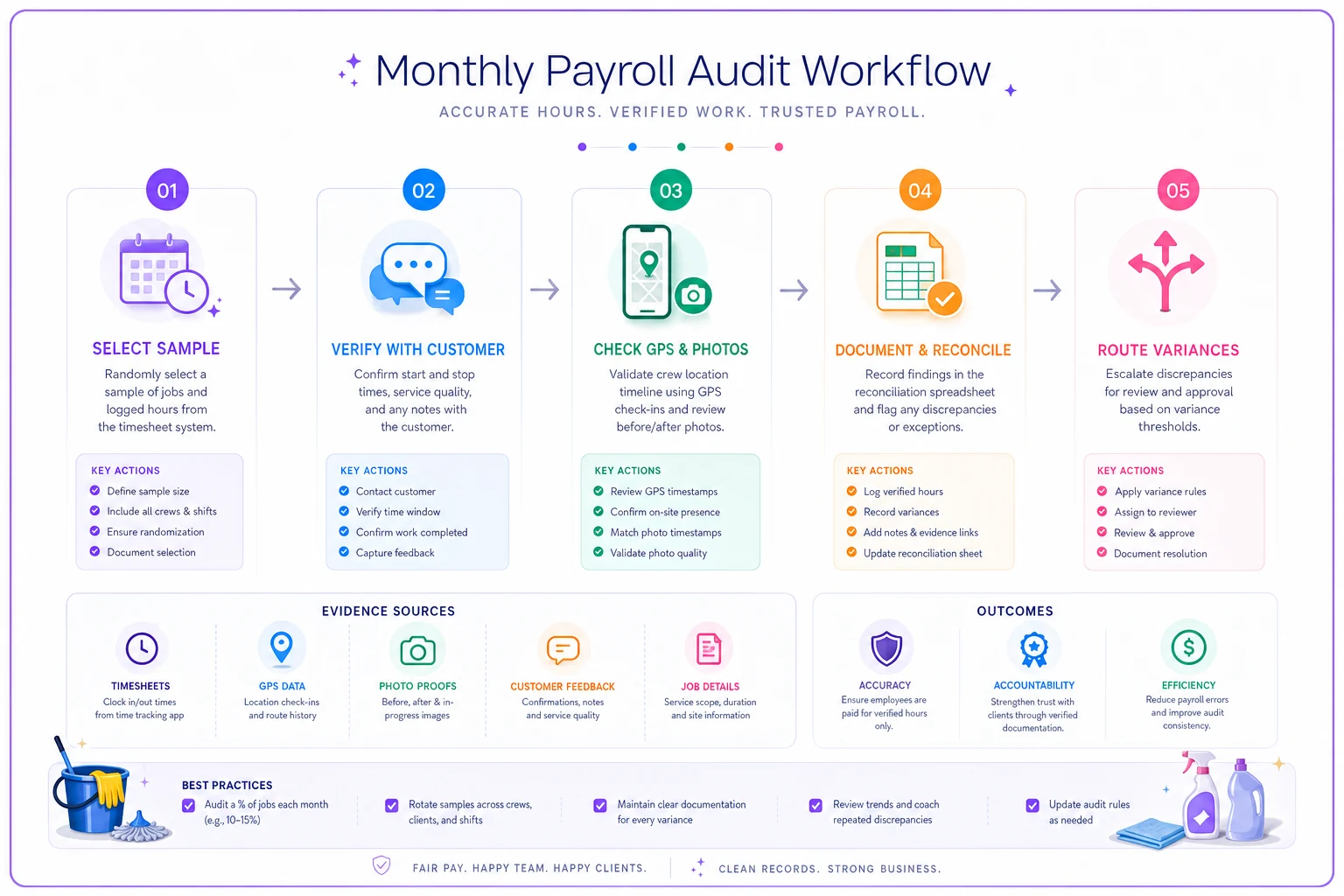
Use this flow to keep audits efficient and consistent while avoiding the perception of targeting individuals.
Establishing reasonable tolerances
Perfect accuracy doesn't exist in field work. Set tolerances that acknowledge reality while preventing systematic abuse:
Acceptable variances:
-
5 minutes early clock-in for setup
-
10 minutes late clock-out for equipment loading
-
15 minutes weekly cumulative rounding
-
30 minutes monthly for unusual circumstances
-
Consistent 15+ minute early arrivals
-
Pattern of rounding to the nearest half-hour
-
Travel times exceeding map estimates by 25% or more
-
Lunch breaks under 20 minutes (labor law risk in many states)
These aren't termination triggers — they're conversation starters. Maybe traffic patterns changed in a territory. Perhaps a specific client always runs late opening the door. Context matters before you draw conclusions.
The reconciliation template that saves hours
Build a standard monthly reconciliation sheet with these columns:
| Field | Purpose | Automation potential |
|---|---|---|
| Employee name | Basic identification | Pre-populated |
| Week dates | Period tracking | Auto-generated |
| Reported hours | What they submitted | Pulled from timesheets |
| Verified hours | What audit confirms | Manually entered |
| Variance | Difference calculation | Auto-calculated |
| Variance % | Proportion check | Auto-calculated |
| Notes | Context and patterns | Manual entry |
| Action required | Next steps | Dropdown selection |
Run this monthly, not weekly. Daily reconciliation wastes time on normal variation. Weekly creates unnecessary administrative burden. Monthly catches patterns while keeping the workload manageable for whoever runs payroll.
The reconciliation process itself should take a couple hours with this structure — not a full day. If it's taking longer, your data collection upstream is the problem, not the reconciliation template.
Corrective workflows that fix problems without breaking relationships
Discovering time discrepancies triggers uncomfortable conversations. How you handle them determines whether you fix the problem or lose good cleaners in the process.
First variance: educational conversation
When someone exceeds tolerance for the first time, assume ignorance over malice. Schedule a quick call or meeting, walk through the specific instances, and explain how proper time tracking protects their pay accuracy too.
Often you'll discover legitimate issues. Maybe they've been starting prep work before clocking in, thinking they're being helpful. Perhaps they don't understand how travel time policies work. This kind of conversation resolves the majority of first-time problems immediately.
Document the discussion but don't create a formal warning yet. Note the date, topic, and what was agreed. This protects you legally while keeping things collaborative.
Second variance: written documentation
Repeated issues after that first conversation require formal documentation. Create a straightforward improvement plan:
-
Specific examples of continued discrepancies
-
Clear expectations going forward
-
Consequences for non-improvement
-
A review timeline, usually 30 days
-
Signature lines for acknowledgment
Keep the tone professional but direct. Avoid accusatory language. Focus on business impact rather than personal character: accurate time tracking keeps operations sustainable and ensures fair pay across the whole team.
Third variance: transition planning
Persistent problems after coaching indicate either unwillingness or inability to comply. Start documenting everything thoroughly for potential termination. But also genuinely consider alternatives — maybe this otherwise strong cleaner needs different scheduling, a buddy system, or simplified routes before you write them off.
Sometimes the answer isn't termination but restructuring. A cleaner who can't manage time tracking independently might actually do well in a team lead role with a fixed salary. The part-timer with chronic lateness issues might work better on afternoon shifts. It's worth thinking through before making a move.
Technology integration without overwhelming small teams
The cleaning businesses that successfully implement field time tracking don't throw complex systems at the problem. They start simple and build up deliberately.
Begin with your highest-risk area. If you suspect time padding, start photo verification with your highest-hour employees first. GPS concerns? Try it with one willing team before broad rollout. Build some success stories before scaling to everyone.
Modern operational software built for cleaning businesses can centralize these tracking methods without creating a new layer of administrative work. Instead of managing GPS apps, photo folders, and text message threads separately, integrated platforms handle time tracking alongside your existing scheduling and routing. The automation flags variances automatically so you're investigating problems rather than manually hunting for them.
Start with your highest-risk area when piloting new verification methods.
That said, don't rush into full automation. Many cleaning companies run effective hybrid systems for years. GPS for full-timers, text check-ins for part-timers, photos only for new hires until trust develops. The right system is whatever your team actually uses consistently — not the most technically impressive option you can find.
Common implementation mistakes that derail field tracking
Starting with punishment instead of explanation. Rolling out time tracking with a "we're catching thieves" message guarantees failure. Your honest cleaners feel insulted. Your problematic ones find workarounds. Frame it as operational improvement — everyone gets paid accurately and the business stays healthy enough to provide stable work.
Ignoring technical literacy gaps. That veteran cleaner who's been with you eight years might genuinely struggle with smartphone apps. Don't assume everyone shares the same technical comfort level. Provide training, create simple reference guides, offer alternatives. Losing experienced cleaners over a technology rollout is an avoidable setback.
Over-engineering the solution. Some cleaning businesses build elaborate tracking systems with multiple redundant verification layers. Meanwhile, a competitor uses a shared Google Sheet and regular spot checks, hitting 95% accuracy with a fraction of the complexity. Start simple. Add sophistication only when simple stops working.
Forgetting exception handling. Every tracking system breaks sometimes. Phones die. GPS glitches. Customers change addresses without notice. Build exception workflows from day one — how does a cleaner report time when their phone breaks? What happens when GPS shows them at the wrong location? Without clear answers to these questions, your system creates more problems than it solves.
Monthly maintenance routine that keeps tracking accurate
Implementing time tracking isn't a one-time project. Like quality control systems, these need regular adjustment to maintain effectiveness.
Each month, review your tracking data for patterns:
-
Which cleaners consistently show variances?
-
Do certain customers create tracking challenges?
-
Are specific days or routes problematic?
-
Has overall compliance dropped below 90%?
Adjust tolerances based on what you're actually seeing. If everyone struggles with 10-minute windows, 15 minutes might make more operational sense. If photo uploads are causing job delays, switch to weekly batch uploads instead of daily requirements.
Keep communication going. Share positive examples when cleaners nail their tracking. Acknowledge months with minimal variances. Accuracy should feel like a team accomplishment, not individual surveillance — that framing shift matters more than most owners expect.
When precision matters less than practicality
Not every cleaning business needs tight time tracking. If you're running three cleaners on predictable routes with stable customers, simple text check-ins might genuinely be enough. The overhead of a complex system could exceed the savings.
But once you pass around 8–10 cleaners, especially with varied territories and growing operations, loose tracking gets expensive fast. Small leaks compound. Casual rounding culture becomes embedded. Fixing ingrained habits later proves significantly harder than starting right.
Consider your growth trajectory. If expansion is the plan, implement solid tracking before you actually need it. Training five cleaners on a new system is manageable. Retraining twenty while simultaneously onboarding new hires is a mess. Building accurate data collection early also gives you a foundation for smarter routing, better scheduling, and cleaner financials as you scale.
The investment in proper field time tracking typically pays back within two to three months through reduced payroll leakage alone. Factor in better customer billing accuracy, fewer disputes, and improved route planning, and the return accelerates from there.
Making time tracking stick in your cleaning business
The cleaning companies that successfully eliminate payroll leakage tend to share a few traits. They pick tracking methods that match their operational reality rather than theoretical best practices. They implement gradually with clear communication. They audit consistently but fairly. And they treat variances as operational data rather than character flaws.
Your cleaners want to do good work and get paid fairly. Your business needs accurate labor costs to price jobs profitably. Proper field time tracking bridges both without creating an adversarial dynamic — as long as you introduce it that way from the start.
Pick one method and run it with a small group next week. Gather feedback. Adjust. Build momentum through early success rather than forcing compliance through pressure. Within a few months, accurate time data becomes something your team relies on too, not just something you're tracking over them.
The money currently lost to time padding and honest rounding mistakes isn't just profit disappearing — it's capital that could fund better equipment, training, or crew benefits. Every percentage point of payroll accuracy you recover strengthens the whole operation.
Ready to elevate your cleaning business?
Join 500+ cleaning services using Maidufy to save time, reduce scheduling errors, and deliver exceptional client satisfaction.