



You start a cleaning business. First month, you're doing eight houses yourself. Six months later, you've got three cleaners working under you, maybe hitting $12k monthly. Things feel good. Then somewhere between year one and year two, everything starts breaking.
The schedule becomes a nightmare. Quality complaints spike. Your best cleaner quits. You're working more hours than when you were solo, making less per hour, and wondering how other companies manage 20+ cleaners across multiple cities.
The three distinct operational stages (and why skipping steps kills growth)
Companies don't grow linearly—they move through three distinct operational stages, each requiring different management structures, staffing ratios, and territory approaches.
Stage 1: Solo to First Team (up to $25k/month) You're still cleaning alongside your team. Maybe you've got 2-4 cleaners total. Everyone reports directly to you. Territory doesn't matter much because you're all working from the same general area. Your biggest challenge is maintaining quality while you're not physically present at every job.
Stage 2: Multi-Team Operations ($25k-$75k/month) This is where most companies stall hard. You need 8-15 cleaners organized into teams. Direct supervision becomes impossible. You need team leads, but most owners promote their best cleaner without any management training, then wonder why everything falls apart. Territory planning becomes critical—inefficient routing can eat 20% of your profit at this stage.
Stage 3: Multi-Location Scale ($75k+/month) Now you're running 20+ cleaners across multiple territories or cities. You need actual managers, not just team leads. Each territory needs to function semi-independently. The owner who was scheduling everything in their head at $10k/month now needs documented systems that others can execute without daily input.
You can't skip these stages. Try to jump from solo operator to multi-location without building proper team lead structures first, and you'll implode within six months.
Stage 1 Blueprint: Building your first sustainable team
Most solo cleaners hire their first employee when they're completely overwhelmed, usually around $8k-$12k monthly revenue. This reactive hiring creates immediate problems—no training system, no quality standards, no clear expectations. The new hire learns by shadowing for a few days, then gets thrown into houses alone. Quality drops. Clients complain. The owner ends up re-cleaning houses at night.
Never miss a cleaning appointment again.
Maidufy helps you book, confirm, and manage every cleaning service seamlessly.
- Centralized booking management
- Automated client reminders
- Optimized staff scheduling
No credit card required
The Working Configuration
-
Owner
cleaning 3-4 days/week, managing operations other days
-
2-3 cleaners
each handling 4-5 houses per day
-
Total weekly capacity
60-80 houses
-
Territory
15-20 mile radius maximum
The critical ratio here is supervision time. For every 10 hours of cleaning your employees do, you need roughly 2 hours of quality checking, training, and operational management. Skip this, and small problems compound into client losses.
Key Operational Checkpoints
-
Documented cleaning checklists for every service type
-
Basic quality control system (checking 20% of cleans minimum)
-
Simple scheduling system beyond paper or memory
-
Defined territory boundaries
-
Written employment agreements with clear expectations
-
Basic supplies inventory tracking
-
Client communication standards
The biggest mistake at this stage? Hiring too fast. One cleaning company owner went from solo to five employees in three months because demand was strong. Within six weeks, she'd lost 30% of her clients to quality issues and had to rebuild almost from scratch. Get your operations right with 2-3 cleaners before adding more bodies.
Most owners underestimate how much work goes into training someone properly. A new cleaner should shadow for at least three full days, then work with oversight for another week. Cut this short, and you'll pay for it later in quality complaints and client turnover.
New cleaners should shadow for at least three full days, then work with oversight for another week.
Get your operations right with 2-3 cleaners before adding more bodies.
The team lead transition (where 70% of companies get stuck)
Somewhere around $20k-$30k monthly, you hit an operational ceiling. You can't personally supervise everyone anymore. You need team leads. But this is where things get messy.
You promote Maria, your best cleaner. She's reliable, clients love her, she knows your standards. Seems logical. Except Maria has never managed anyone. She doesn't know how to handle conflicts. She feels awkward telling her former peers what to do. Within two months, she's either quit or asked to go back to cleaning.
Building Team Lead Capability
The successful transition requires treating team leads as a distinct role, not just senior cleaners with a title.
-
Quality checking 3-4 houses daily
-
Training new cleaners (minimum 3-day process)
-
Supply inventory management for their team
-
First-line client issue resolution
-
Daily team coordination and routing
Team Lead Compensation:
-
Base cleaning rate plus $3-5/hour lead premium
-
OR salary at 130-140% of cleaner wages
-
Small percentage (1-2%) of team revenue after quality targets
The ratio that consistently works: one team lead for every 4-5 cleaners. Try to stretch it to 7-8 cleaners per lead, and quality crashes.
The Delegation Sequence
-
Month 1
Quality checking only
-
Month 2
Add supply management
-
Month 3
Add new hire training
-
Month 4
Add schedule coordination
-
Month 5
Add client communication
-
Month 6
Full team lead autonomy
Skip steps or rush this process, and you'll overwhelm your leads. They'll make poor decisions under pressure, creating more problems than they solve.
Stage 2 Blueprint: Multi-team coordination and territory management
Once you've got functioning team leads, the next challenge hits: coordinating multiple teams across expanding territory. This typically happens between $40k-$60k monthly revenue.
The Multi-Team Structure
-
Owner/Operations Manager
oversight and strategy
-
2-4 Team Leads
each managing 4-5 cleaners
-
10-20 Cleaners
organized in stable teams
-
1 Office Coordinator
scheduling and client communication
-
Weekly capacity
200-400 houses
The critical addition here is the office coordinator role. Without someone dedicated to scheduling and client communication, the owner stays trapped in daily operations instead of focusing on growth and quality systems.
Territory Division Strategy
-
Each team owns a defined geographic zone
-
Zones balanced by house density, not geographic size
-
20-minute maximum travel between houses within a zone
-
Border flexibility for schedule optimization
-
Monthly rotation to prevent team territorial behavior
An actual territory map for a mid-sized city might look like: Team A: Downtown and East (80 houses/week) Team B: North suburbs (75 houses/week) Team C: West and Southwest (85 houses/week) Team D: South and Southeast (70 houses/week) Notice the house count varies slightly—that's intentional. Perfect balance is impossible and trying to achieve it creates more problems than accepting minor variations.
Quality Control at Scale
-
Team leads check 25% of their team's cleans
-
Operations manager spot-checks 5-10% across all teams
-
Client feedback system captures issues between checks
-
Monthly team quality scores tracked and posted
-
Quality bonuses tied to team, not individual performance
This distributed approach maintains standards without bottlenecking on owner availability.
Below is a simple workflow visualization for coordinating teams, territories, routing, and quality checks.
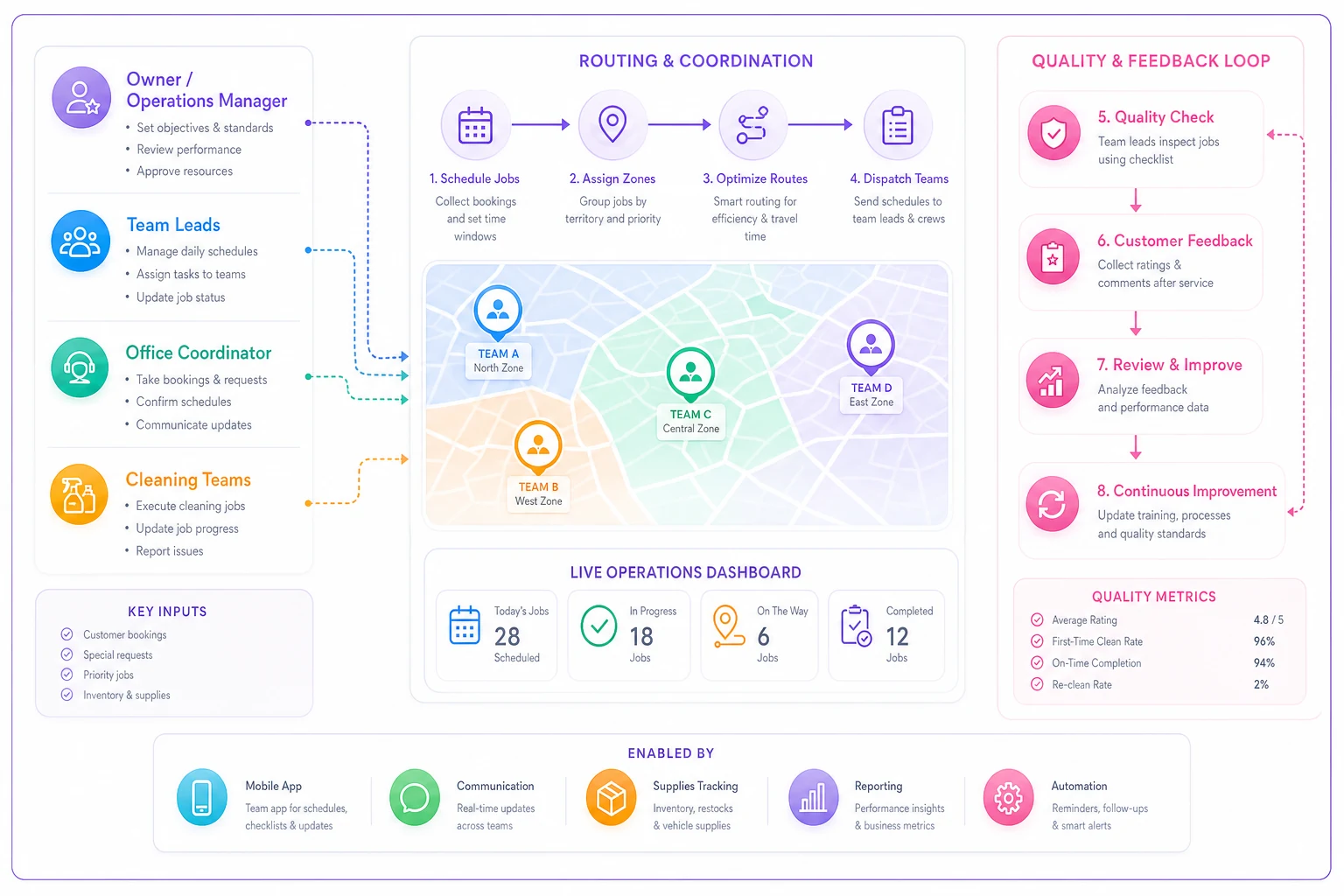
The diagram shows the flow between central oversight, team leads handling day-to-day quality and routing, and the office coordinator managing scheduling and client communication.
The management layer (transitioning from owner-operator to CEO)
Around $75k monthly revenue, another fundamental shift occurs. Team leads can't handle all management duties anymore. You need an actual management layer between the owner and team leads.
The Operations Manager Role
This hire makes or breaks your scaling potential. Most owners try to promote a team lead to operations manager, but the skill sets rarely overlap. Good team leads excel at hands-on quality control and team coordination. Operations managers need strategic thinking, data analysis, and multi-team coordination abilities.
-
Hospitality or restaurant management
-
Retail multi-store management
-
Military logistics backgrounds
-
Other service industry operations roles
Their core responsibilities include team lead development and support, territory optimization and routing, quality system oversight, hiring and training standardization, operational reporting and analysis, and technology implementation.
A competent operations manager costs $50k-$70k annually, depending on market. That seems expensive when you're at $75k monthly revenue. But without this role, you'll stay stuck at that level indefinitely.
The operations manager becomes your operational brain while you shift focus to growth strategy, major client relationships, and business development.
Stage 3 Blueprint: Multi-location expansion without losing control
The jump to multiple locations or cities represents the final major operational transition. This typically happens around $150k+ monthly revenue.
The Hub and Spoke Model
-
Location Manager
full P&L responsibility
-
2-3 Team Leads
managing 15-20 cleaners total
-
Office Coordinator
local scheduling and client relations
-
15-25 Cleaners
organized in stable teams
The central office maintains financial oversight and reporting, marketing and sales strategy, technology platforms and training, quality standards and auditing, and HR and legal compliance.
Staffing Ratios at Scale
| Role | Stage 1 Ratio | Stage 2 Ratio | Stage 3 Ratio |
|---|---|---|---|
| Cleaners to Team Lead | N/A | 4-5:1 | 5-6:1 |
| Team Leads to Ops Manager | N/A | 3-4:1 | 3:1 |
| Total Staff to Admin | 8:1 | 12:1 | 15:1 |
| Houses to Cleaner (weekly) | 20-25 | 18-22 | 20-23 |
Notice how administrative efficiency actually improves at scale—but only if you've built proper systems at each previous stage.
The Standardization Imperative
-
Universal cleaning checklists and quality standards
-
Centralized scheduling and dispatch systems
-
Consistent training programs and materials
-
Standardized supply lists and vendor relationships
-
Uniform pricing and service offerings
-
Shared operational metrics and reporting
Location managers need autonomy to respond to local market conditions, but too much variance makes the business impossible to manage. The balance point usually falls around 80/20—80% standardized processes with 20% local flexibility.
Technology evolution through growth stages
The software and systems that work at $10k monthly revenue actively prevent scaling beyond $50k. But most owners keep band-aiding their initial systems instead of acknowledging when fundamental changes are needed.
Stage 1 Technology Stack
Basic scheduling (Google Calendar, paper, or simple app), spreadsheet for client tracking, manual invoicing and payment collection, text/phone communication, and personal banking account.
This works fine up to about 80-100 clients. Beyond that, you're spending more time on administration than cleaning.
Stage 2 Requirements
The transition period is painful. You're learning new systems while managing growing operational complexity. Most owners delay this transition too long, creating unnecessary operational stress.
You need professional scheduling software with routing, automated invoicing and payment processing, team communication platform, basic reporting and analytics, inventory tracking system, and payroll service.
Stage 3 Infrastructure
At multi-location scale, consumer-grade tools completely break down. You need enterprise scheduling with multi-location support, integrated CRM and service history, advanced routing and territory optimization, real-time team tracking and communication, comprehensive reporting across locations, and automated quality control and feedback systems.
This is where AI-powered operational software becomes genuinely transformative. Instead of five different systems barely talking to each other, modern platforms can coordinate scheduling, routing, quality control, client communication, and reporting in one integrated system. The reduction in administrative overhead alone can improve margins by 10-15%.
The failure patterns that kill growth at each stage
Stage 1 Failure: The Quality Death Spiral
Owner hires too fast without systems. Quality drops. Clients leave. Revenue shrinks. Owner fires employees and goes back to solo. This cycle repeats every 6-12 months, trapping the business below $20k monthly.
Stage 2 Failure: The Complexity Collapse
Business grows to 10-15 employees without proper management structure. Owner tries to directly manage everyone. Communication breaks down. Teams lack coordination. Good employees quit from frustration. Operations become chaotic. Business shrinks back to Stage 1 size.
Stage 3 Failure: The Margin Evaporation
Company expands to multiple locations without standardized systems. Each location operates differently. Costs spiral. Quality varies wildly. Unable to maintain profitability despite high revenue. Forced to close locations and retreat.
Building your scaling roadmap
The path from solo operator to multi-location cleaning business isn't linear, but it is predictable. Your current revenue tells you which stage you're in. Your operational checkpoints tell you if you're ready to advance.
If you're under $25k monthly: Focus entirely on Stage 1 fundamentals. Build your training systems. Document your processes. Establish quality control. Don't hire your fifth employee until your first four are operating smoothly with minimal daily oversight.
If you're between $25k-$75k monthly: Your priority is management structure. Develop team leads methodically. Implement territory planning. Upgrade your technology stack. Resist geographic expansion until your current territory runs efficiently.
If you're approaching or above $75k monthly: Start planning for multi-location capability even if you're not ready to expand. Build standardized systems. Hire true management talent. Invest in enterprise-grade operational software. Create the infrastructure that makes expansion possible, not chaotic.
The cleaning businesses that successfully scale all share one characteristic: they respect the operational requirements of each stage. They don't try to run a $100k/month operation with $20k/month systems. They invest in management, technology, and systems before they desperately need them.
The alternative is predictable. The business hits a revenue ceiling, quality deteriorates, profits evaporate, and eventually contracts back to a manageable but smaller size. Sometimes this cycle repeats multiple times before owners either figure out proper scaling or give up entirely. Your cleaning business can absolutely scale beyond solo operation. But it requires accepting that what got you to $20k monthly won't get you to $200k. Each stage demands new systems, new roles, and new thinking. Build those foundations properly, and sustainable growth becomes not just possible but predictable.
Ready to elevate your cleaning business?
Join 500+ cleaning services using Maidufy to save time, reduce scheduling errors, and deliver exceptional client satisfaction.