


Most cleaning companies lose somewhere between 12-15% of recurring clients every month, and roughly half those cancellations trace back to quality inconsistency, not outright cleaning failures. Your teams probably clean well. The problem is Tuesday's clean looks nothing like Friday's clean, and nobody catches the drift until Mrs. Henderson calls to cancel after her fourth "off" service in a row.
The real killer is quality inspections that treat a weekly maintenance clean exactly like a move-in deep clean. Or worse, inspections that only happen when someone complains, instead of systematically catching problems before clients notice them.
Why standard checklists fail recurring services
Traditional checklists work fine for one-time jobs. Check the boxes, move on. Recurring services are a completely different animal that most inspection systems aren't built for.
Think about what happens in a typical home over four weeks. Week one, the client's kids are at camp—minimal mess, quick maintenance. Week two, birthday party aftermath in the living room. Week three, normal week, but the client mentions guests are coming. Week four, pre-guest panic mode.
Your cleaner shows up week four with the same 90-minute slot and standard checklist. The client expects magic. The cleaner does the routine because that's what the checklist says. Nobody inspected week three to catch that expectations were shifting. The client feels ignored, cancels the service, and you're stuck wondering what went wrong.
This pattern shows up across roughly 30% of recurring clients within their first six months. Not because cleaning quality dropped, but because the inspection system never distinguished between maintenance standards and periodic deep-clean needs.
The anatomy of a tiered inspection system
A working inspection system needs three distinct tiers, not one universal checklist. Each tier serves a different purpose and catches different types of problems.
Never miss a cleaning appointment again.
Maidufy helps you book, confirm, and manage every cleaning service seamlessly.
- Centralized booking management
- Automated client reminders
- Optimized staff scheduling
No credit card required
Tier 1: Quick-check maintenance inspections
These happen on 15-20% of regular cleans, randomly selected. Takes 5-7 minutes max. You're checking consistency, not perfection. Did the cleaner follow client-specific preferences? Are high-touch areas actually getting attention? Is quality drifting from the baseline?
Tier 2: Periodic deep-clean verification
Every 8-12 visits—roughly quarterly for weekly clients—you need an inspection that checks whether the home is accumulating issues that maintenance cleans miss. Dusty baseboards, shower glass developing buildup, grimy cabinet fronts.
Tier 3: Full baseline resets
Twice a year, minimum. Complete inspection against original service standards. Takes 30-45 minutes. You're re-evaluating whether the service still matches what the client actually signed up for. This catches the slow drift—furniture that's been moved and never cleaned behind, new areas that need attention, changed household patterns affecting cleaning needs.
A quick visual of this tiered inspection workflow clarifies how selection and frequency map to client risk and complaints.
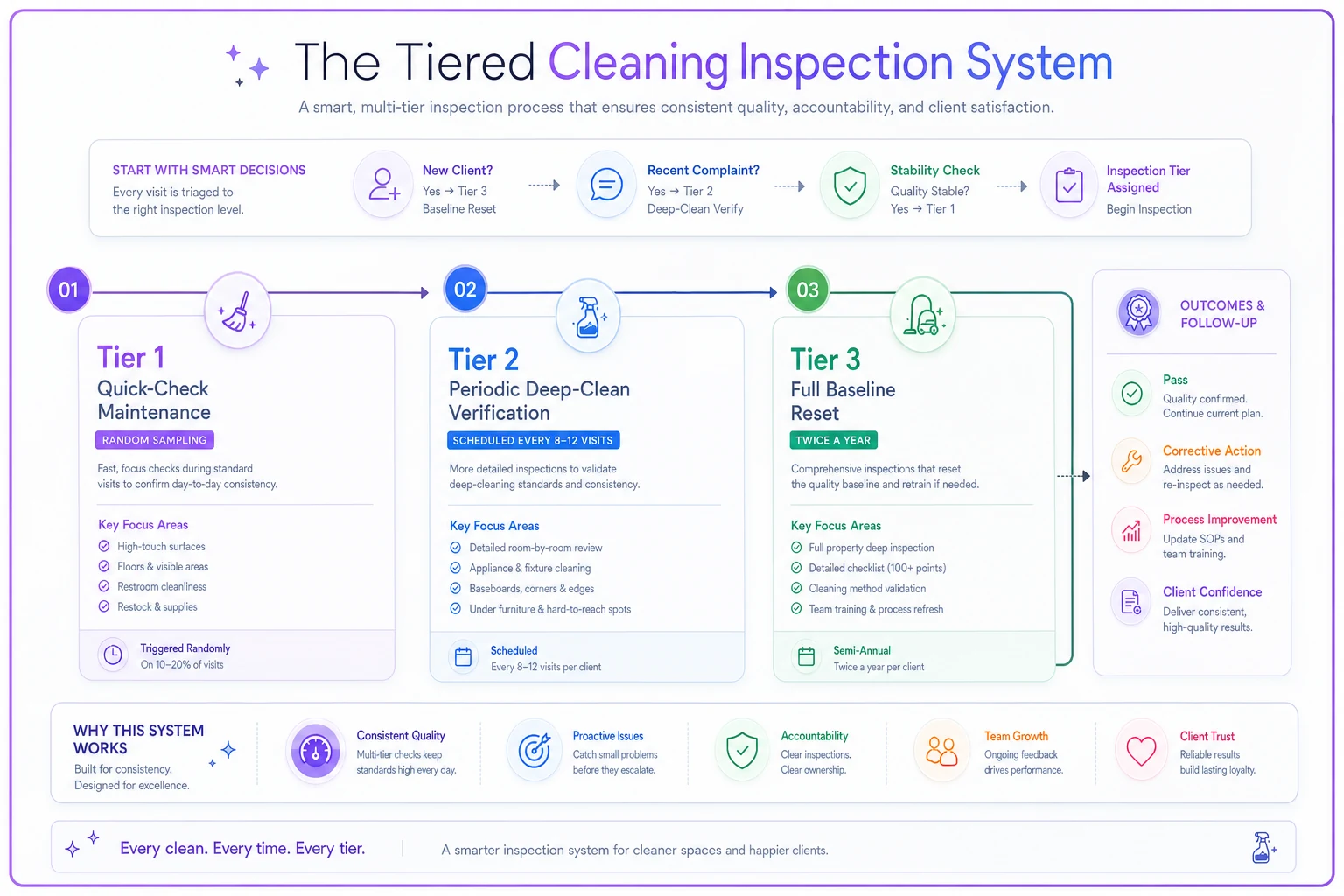
Focus areas should shift based on client history. New clients get checked every week for the first month. Stable clients might get checked monthly. Anyone with a recent complaint gets checked every visit until the issue is resolved.
Building a scoring system that actually drives improvement
Point-based scoring sounds good until you realize most systems weight everything equally. Missed toilet? 5 points off. Streaky mirror? 5 points off. Except clients absolutely do not weight these the same way.
A functional scoring system needs weighted categories based on client impact:
Critical items (40% of score):
-
Bathrooms fully sanitized
-
Kitchen surfaces food-safe clean
-
Floors actually clean, not just vacuumed
-
Client-specific must-dos completed
Visible quality (35% of the score):
-
Surfaces dust-free
-
Glass and mirrors streak-free
-
Straight vacuum lines
-
Organized appearance
Completeness (15% of score):
-
All rooms serviced
-
All tasks completed
-
Time targets met
Client experience (10% of score):
-
Arrival window met
-
Supplies restocked
-
Doors locked properly
-
Notes followed
Missing a critical item drops the score below passing regardless of everything else. A toilet not cleaned isn't the same as a crooked pillow.
Scoring drives different actions at different thresholds:
-
95-100%
Excellence bonus eligible
-
85-94%
Standard pass
-
75-84%
Coaching required
-
65-74%
Re-clean triggered
-
Below 65%
Immediate supervisor intervention
Track trends, not just individual scores. A cleaner dropping from a consistent 92% to 85% needs attention even though they're technically still passing. A team averaging 87% that suddenly scores 78% on one home might point to a client-specific issue, not a quality problem across the board.
| Category | Weight | Examples |
|---|---|---|
| Critical items | 40% | Bathrooms fully sanitized; Kitchen surfaces food-safe clean; Floors actually clean, not just vacuumed; Client-specific must-dos completed |
| Visible quality | 35% | Surfaces dust-free; Glass and mirrors streak-free; Straight vacuum lines; Organized appearance |
| Completeness | 15% | All rooms serviced; All tasks completed; Time targets met |
| Client experience | 10% | Arrival window met; Supplies restocked; Doors locked properly; Notes followed |
Most content items should be PARAGRAPH items.
Photo evidence standards that protect everyone
"Take photos" is not a quality control system. Random bathroom shots and blurry corner photos create data without any real information. You need photo standards that serve an operational purpose.
Every inspection needs six standard photos at minimum:
-
Kitchen sink and counters (wide angle showing overall state)
-
Primary bathroom toilet and floor area
-
Living area main view (showing vacuum lines and surface care)
-
Problem area before (if any issues found)
-
Problem area after (showing correction)
-
One client-specific focus area (varies by home)
Consistent angles and lighting matter. Train inspectors to stand in the same spot each visit. Kitchen photos from the doorway. Bathroom from the entrance. Living room from the main traffic path. That consistency lets you compare over time and actually spot gradual changes.
Train inspectors to stand in the same spot each visit to ensure comparable photos over time.
Time-stamp everything, but more importantly, tie photos to specific scores. A 75% bathroom score needs a photo showing what drove that number. Soap scum? Water spots? Missed areas? The photo becomes training material, not just documentation.
Store photos for at least 90 days, organized by client and date. When a client claims their bathroom hasn't been properly cleaned in months, you can pull three months of inspection photos showing exactly what it looked like after each service. That's the kind of thing that stops subjective complaints from turning into retention problems.
SLA-based escalation that prevents meltdowns
Service Level Agreements sound corporate, but they're really just clear promises about what happens when things go wrong. Most cleaning companies have informal versions—"we'll make it right"—but without specific triggers and timelines, problems fester until clients quit.
Level 1 issues (fix within 24 hours):
-
Score below 75% on any inspection
-
Critical item missed (bathroom, kitchen)
-
Client complaint about specific area
-
Safety concern identified
Response: Team lead contacts client within 2 hours. Re-clean scheduled within 24 hours. Follow-up inspection mandatory.
Level 2 issues (address within one week):
-
Score between 75-84% twice in a row
-
Pattern of minor misses
-
Client mentions dissatisfaction without formal complaint
-
Deep-clean indicators showing accumulation
Response: Operations manager reviews last four service records. Cleaner gets coached on specific issues. Next two services get inspected. Client receives a personal check-in call.
Level 3 issues (systematic intervention):
-
Three scores below 85% in 30 days
-
Client considering cancellation
-
Team showing pattern problems across multiple homes
-
Inspection trends declining over 60 days
Response: Full service evaluation. Possible team reassignment. Client gets service credit or complimentary deep clean. Management builds a specific recovery plan with measurable targets.
Document every escalation, but more importantly, track what triggered it. If photo evidence keeps showing the same problems, you have a training issue. If scores drop on specific days, you might have a scheduling problem. If certain teams trigger escalations consistently, dig into their workflows.
Corrective actions that stick
Finding problems means nothing if the fixes don't last. Most corrective actions fail because they address symptoms rather than causes.
A cleaner misses baseboards. The lazy correction: "Remember to clean baseboards." The real correction: figure out why it got missed. Running behind schedule? Unclear on frequency? Don't actually see the dirt? Each reason has a different fix.
Time-based misses: A cleaner consistently scores lower on homes scheduled after 2 PM. They're likely rushing to finish. Adjust their route instead of just reminding them to slow down.
Specific area blindness: The same cleaner keeps losing points on glass and mirrors. They might need technique training with immediate visual feedback, or even just better lighting awareness.
Client-specific drops: Scores fine everywhere except two homes. There's probably a relationship issue or unclear expectation. Send a manager on a ride-along to identify the disconnect.
Gradual decline: Scores dropping 2-3% monthly over three months. Classic burnout or disengagement pattern. Consider role rotation, responsibility changes, or an honest conversation about job fit.
Track correction effectiveness at 7, 14, and 30 days. If the problem returns within two weeks, the correction didn't address the root cause. If it comes back after a month, you likely need systemic changes, not individual fixes.
The retention math most companies miss
Quality consistency drives retention more than perfection. A client who gets 85% quality every single visit stays longer than one who alternates between 95% and 75%.
Run these numbers for your own operation. Take monthly recurring revenue. Calculate 12% monthly churn—roughly industry average. Now calculate 8% churn, which is achievable with consistent quality systems. The difference typically works out to 30-40% more annual revenue without acquiring a single new client.
A 50-client operation doing weekly $100 cleans generates around $260,000 annually at 12% churn. Drop to 8% churn through quality consistency and you're looking at closer to $295,000. That $35,000 difference covers a lot of inspection time.
What also matters but rarely gets calculated: consistent quality reduces complaint handling time by roughly 60%. Your office staff spends less time on damage control. Managers spend less time on emergency re-cleans. Your good cleaners don't burn out from constantly fixing other people's mistakes.
When inspection systems become operational weapons
Cleaning companies that scale past 100 recurring clients without falling apart tend to share one thing: inspection data drives their operations, not just their quality control.
They know which teams need more training before clients complain. They catch homes needing deep-clean touchups before clients notice anything. They spot cleaners heading toward burnout before quality crashes. They identify which clients are flight risks based on score trends, not just complaints.
That kind of operational intelligence only emerges from tiered inspections with consistent scoring and documentation. One-size-fits-all checklists and random spot checks create quality theater without any real operational value.
Modern cleaning operations software can automate inspection scheduling, photo organization, score calculations, and escalation triggers. Instead of managers trying to remember which homes need checking or manually tracking scores in spreadsheets, the platform assigns inspections based on risk factors, calculates weighted scores automatically, and triggers escalations when thresholds are crossed. The same system can track correction effectiveness and flag pattern problems across teams—turning quality control from reactive scramble into proactive retention management.
Making inspection systems stick in real operations
Rolling out a tiered inspection system usually fails because companies try to inspect everything at once. Start with your highest-risk accounts: new clients, recent complaints, and high-value recurring services.
Build the habit with around 10 inspections per week. Get scoring consistent. Establish photo standards. Test escalation triggers. Then expand gradually. Most operations can reach full inspection coverage within 60 days without disrupting anything.
Train inspectors separately from cleaners. They're genuinely different skills. Your best cleaner might be terrible at objective scoring. Your detail-oriented office person might be an excellent inspector. Some companies use semi-retired cleaners who know quality standards but can no longer handle the physical work.
Budget 3-5% of service time for inspections. For a team doing 200 services weekly, that's 6-10 hours of inspection time. Sounds like a lot until you calculate how many hours currently go toward re-cleans, complaint calls, and recruiting replacements for churned clients.
The companies getting this right treat quality inspection like a profit center, not a cost. Every retained client represents 12-24 months of additional revenue. Every prevented complaint saves roughly 45 minutes of management time. Every caught problem prevents a negative review that ends up costing five potential new clients.
Your inspection system is either actively improving retention or it's expensive theater. The difference comes down to having distinct tiers for different service types, weighted scoring that reflects client priorities, photo evidence that serves real operational purposes, and escalation triggers that prevent small issues from becoming cancellations.
Stop treating every inspection like a final exam. They're early warning systems for retention problems.
Clients don't leave because one clean was bad—they leave because nobody caught the pattern before it became a problem.
Ready to elevate your cleaning business?
Join 500+ cleaning services using Maidufy to save time, reduce scheduling errors, and deliver exceptional client satisfaction.