
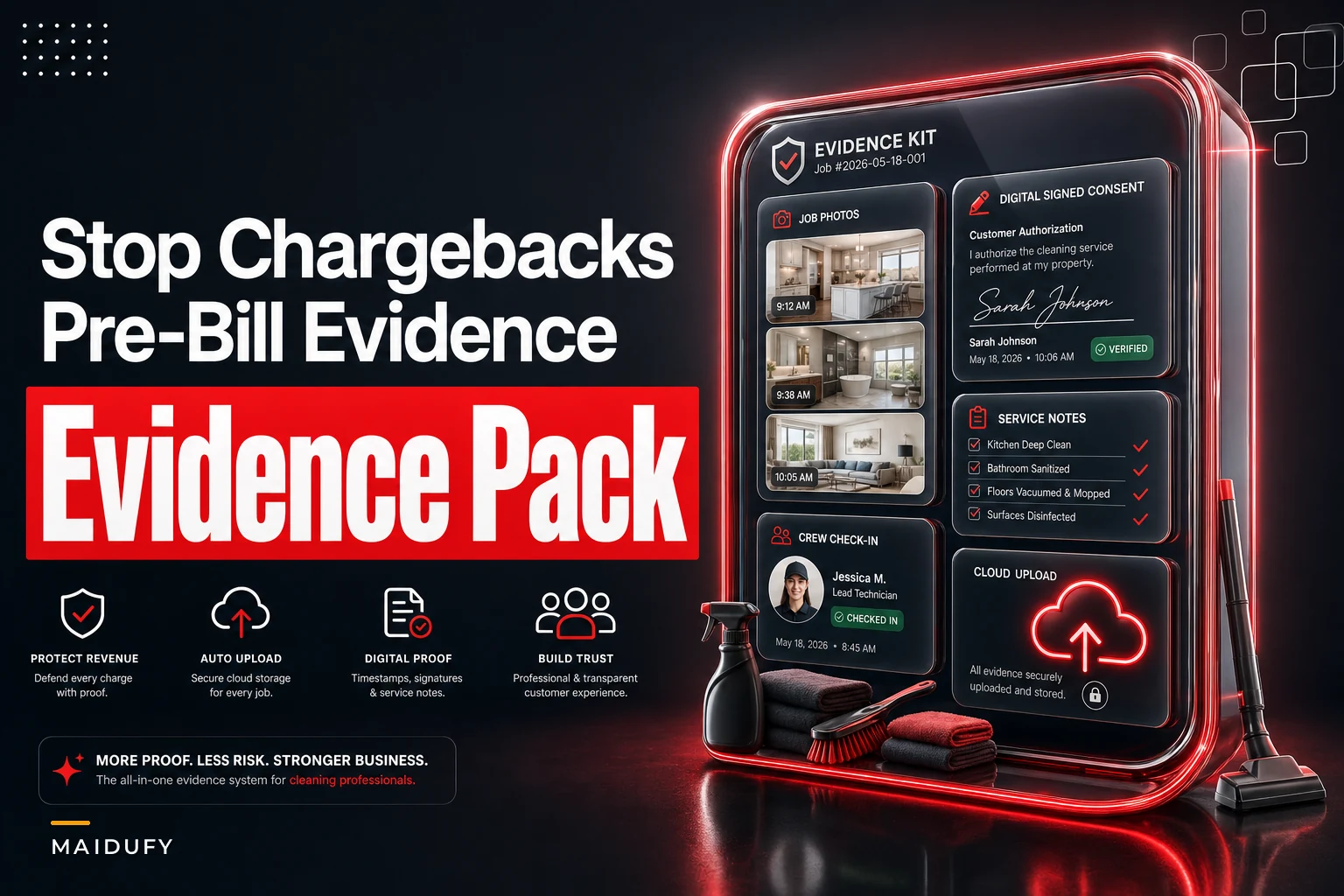

Chargebacks feel like theft. A client gets their house cleaned, the charge shows up on their statement, and suddenly they're disputing it with their bank. You did the work. Now you're scrambling to prove it while your processor freezes your funds.
The worst part? Most cleaning services lose these disputes because they never built an evidence system before the chargeback hit. By the time you're piecing together photos, service notes, and consent forms from three months ago, the bank has already sided with the customer.
The pattern is pretty obvious once you've watched it play out enough times. The companies that consistently win disputes do one thing differently—they build their evidence package before billing, not after a dispute lands in their inbox.
Why cleaning services get targeted for chargebacks
Cleaning services have chargeback vulnerabilities that most other service businesses don't deal with. Your crews work inside private homes, often when nobody's there. There's no signed receipt at point of service like at a restaurant. No tracking number like e-commerce. Just your word against theirs about what happened inside someone's house.
The dispute reasons tend to fall into the same buckets. "Service wasn't completed" shows up when clients claim you never arrived, even though your crew spent two hours scrubbing their bathrooms. "Not as described" when they expected a deep clean but booked a standard service. "Unauthorized charge" when the spouse who didn't make the booking sees the statement and disputes it without asking questions first.
| Dispute reason | Typical claim |
|---|---|
| Service wasn't completed | shows up when clients claim you never arrived, even though your crew spent two hours scrubbing their bathrooms. |
| Not as described | when they expected a deep clean but booked a standard service. |
| Unauthorized charge | when the spouse who didn't make the booking sees the statement and disputes it without asking questions first. |
Then there's the timing problem. Most chargebacks arrive 30–90 days after service. By then, your crew has cleaned hundreds of other homes. Details blur. That one-time client who seemed fine when they left? You can't remember if photos were taken or if anything was signed.
The real cost beyond the lost payment
Say you're running 500 cleanings a month at an average ticket of $140. Even a 0.5% chargeback rate means you're eating roughly $4,200 a year in lost revenue. That's just the surface number.
Never miss a cleaning appointment again.
Maidufy helps you book, confirm, and manage every cleaning service seamlessly.
- Centralized booking management
- Automated client reminders
- Optimized staff scheduling
No credit card required
Each chargeback also triggers a $25–50 fee from your processor, win or lose. Push your chargeback ratio above 1% and your processor might hold 10% of all transactions as a reserve, which wrecks your cash flow. Cross 1.5% and they'll likely drop you entirely, leaving you hunting for high-risk processing at double the rates.
The operational drag is its own problem. Fighting each chargeback takes 2–3 hours of pulling evidence, writing responses, and following up. That's time not being spent on growth or on clients who actually pay.
Your crew takes a hit too. People who did good work feel accused when chargebacks come in without any clear response from management. The better employees start wondering if the company has their back. Some leave.
Building your pre-billing evidence package
Service confirmation photos
Generic before-and-after shots don't do much. You need timestamped photos that prove your crew was physically at the property at the scheduled time. The entry shot should include something unique to that address—a welcome mat, house number, a distinctive door. A hand or a cleaning supply in frame helps establish it's not pulled from Google Street View.
During the job, capture 3–5 progress shots focused on the areas that generate the most complaints: kitchen counters, bathroom fixtures, floors. Phone photos are fine. What matters is the metadata showing time and location.
The completion photo should include your branded supplies being loaded back into the vehicle, with the property visible in the background. Simple, but it shows you actually finished and left.
Digital consent forms
Paper forms signed at the door disappear. You need digital forms completed before service that clearly state what the client is agreeing to.
Cover the basics: the specific service type and scope, the exact charge amount, confirmation that service will happen on the scheduled date, your cancellation and refund policies, and permission to photograph the property for quality documentation purposes.
The form should also capture their IP address, timestamp, and device information automatically. When someone disputes a charge months later claiming they never authorized anything, that technical record is hard to argue with.
Service completion tracking
Real-time notes beat recollections every time. Crews should log arrival time, any access issues, deviations from the standard checklist, client-specific requests, and departure time with a final status.
Build this into the workflow while they're still at the property—not as an end-of-day memory exercise. A simple mobile form they fill out while walking back to the vehicle captures details before they fade. Include prompts for common situations:
-
was the client home?
-
were there pets?
-
were any areas inaccessible?
-
were there special requests?
Track who performed each task. When a dispute comes in about a specific bathroom not being cleaned, you should be able to show exactly who was assigned to it and when they marked it complete.
Here's a quick visual of the evidence collection workflow.
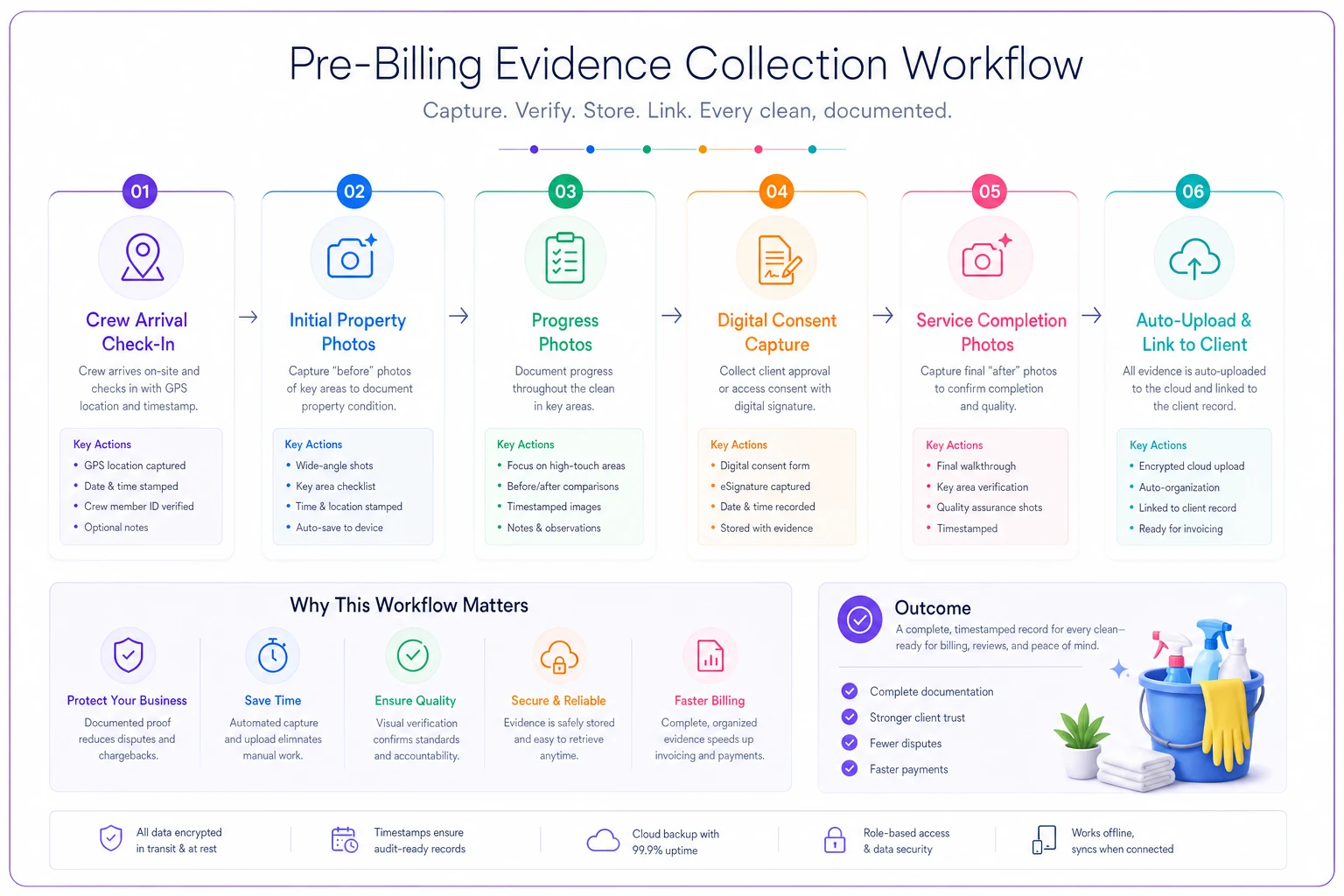
This visual maps the steps crews should follow to collect evidence before billing.
Response templates mapped to processor timelines
Different disputes need different evidence strategies, and timing matters more than most businesses realize.
"Service not provided" disputes
You typically have 10 days, but these are best handled within 72 hours with proof of presence up front.
Start with: "Service was completed as scheduled on [DATE] by [CREW NAMES] from [START TIME] to [END TIME]."
Attach the photo timeline—arrival, progress, departure. Include GPS-tagged check-in data from your crew's device. Add the service completion notes showing specific tasks.
Then add the consent trail: "Client explicitly authorized this service on [DATE] via our booking system, agreeing to the scope and payment amount of $[AMOUNT]." Attach the digital consent form with IP address and timestamp.
"Not as described" disputes
These need detailed scope documentation, ideally within 7 days.
Lead with what they actually booked: "Client booked our Standard Cleaning Service, which includes [LIST]. This service does not include [EXCLUDED ITEMS]."
Include the booking confirmation highlighting the service description. Pull your website's service menu showing the clear distinction between service levels. Attach the consent form where they acknowledged the specific type of service.
If they wanted a deep clean but booked standard, show the price gap: "The service provided was $120 as booked and authorized. The deep cleaning they claim to have expected costs $280 and requires a separate booking."
"Unauthorized charge" disputes
These need to be answered within 48 hours. Slow responses on unauthorized disputes often result in automatic losses.
Open with: "This charge was explicitly authorized by the cardholder on [DATE] for cleaning services to be performed on [SERVICE DATE]."
Layer your authorization evidence: the booking confirmation, IP and device data from the booking session, the digital consent form with timestamp, email communication confirming the appointment, and service reminder confirmations they didn't cancel.
Include your terms clearly showing when charges are processed and what the cancellation policy looks like.
The 10-minute morning evidence check
Before crews leave in the morning, someone should spend ten minutes verifying evidence packages for that day's jobs. It's a small investment that prevents hours of dispute work later.
Check that consent forms are complete for every booking. Flag anything missing—crews shouldn't start service without one. Verify the service type matches what was authorized. Mismatches cause disputes even when the work is done well.
Flag incomplete consent forms immediately and don't let crews start service without one.
Make sure crews have the photo checklist and understand the documentation requirements. New hires especially need this drilled in early—capturing the entry shot, progress photos, and departure image becomes habit only if it's reinforced consistently.
At the end of the day, confirm that everything is uploaded and stored properly. Photos sitting on someone's phone don't help when a dispute comes in six weeks later. Service notes on paper vanish. Everything needs to be digital, searchable, and connected to the client record.
Evidence storage and the 180-day rule
Banks can initiate chargebacks up to 180 days after a transaction. Your storage system needs to account for that.
Organized, dated folders beat generic naming every time. "Johnson123MainSt03-15-24" is useful under pressure. "Tuesday pics" is not. Each folder should hold the booking confirmation, consent form, service photos with metadata, crew notes, and any client communications.
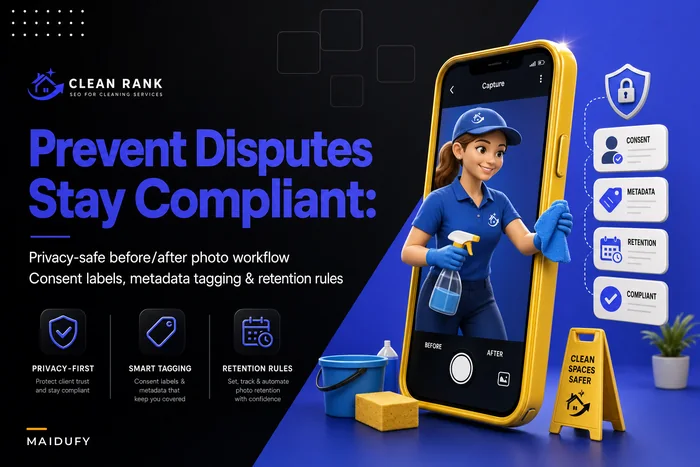
This is also where proper photo workflow systems matter for both dispute prevention and privacy compliance. Fast access is important, but so is making sure client data is handled correctly.
Back everything up. Cloud storage costs a fraction of a single lost chargeback. Keep both local and cloud copies, with retention policies that align with your processor's requirements.
When evidence automation matters
Manual evidence collection works up to a point. Around 50 cleanings a week, the cracks start showing. Crews forget photos. Consent forms get skipped. Notes come in incomplete. Those gaps turn into expensive losses.
AI-powered operational software changes the math on chargeback prevention. Instead of hoping crews remember every documentation step, the system walks them through required evidence collection—automatic photo uploads with timestamp verification, digital consent forms that block service until completed, note fields that won't submit without the required information.
The real payoff is response speed. When a chargeback hits, you need evidence assembled in hours. Operational platforms with AI automation can pull a complete evidence package for any job almost instantly—consent forms, timestamped photos, service notes, communication history. What used to take three hours of digging becomes a five-minute export.
Some cleaning operations have cut chargeback losses by 70–80% just by implementing consistent evidence collection through their operational software. The automation closes the gaps that manual processes leave open.
Winning the evidence game before disputes start
Cleaning companies that rarely lose chargebacks aren't lucky. They're prepared. They treat evidence collection as part of service delivery, not something they scramble to reconstruct when problems show up.
Build these systems now, before your next dispute. Every cleaning without proper documentation is a potential loss. Make evidence collection part of crew training—as routine as loading the van.
When clients know you document everything professionally, frivolous disputes drop. When processors see consistent, organized evidence packages in response, they start taking your submissions seriously.
That $12,000 annual figure isn't an exaggeration—it's what chargeback losses, fees, and reserve holdbacks add up to for a mid-sized operation without solid documentation systems. Building these evidence packages takes real effort upfront. But it's far less painful than explaining to your crew why payroll is short because another dispute went the wrong way.
Stop treating chargebacks as an unavoidable cost of doing business. Proper documentation makes most of them preventable.
That $12,000 annual figure isn't an exaggeration—it's what chargeback losses, fees, and reserve holdbacks add up to for a mid-sized operation without solid documentation systems. Building these evidence packages takes real effort upfront. But it's far less painful than explaining to your crew why payroll is short because another dispute went the wrong way.
Stop treating chargebacks as an unavoidable cost of doing business. Proper documentation makes most of them preventable.
Ready to elevate your cleaning business?
Join 500+ cleaning services using Maidufy to save time, reduce scheduling errors, and deliver exceptional client satisfaction.