



Most cleaning companies don't fail because they can't find clients. They stall out because money moves through the business faster than anyone can track it. Cash comes in from twelve directions, payroll goes out on a fixed date whether the deposits cleared or not, and somewhere in the middle the owner is approving a $600 vacuum purchase over text while driving between jobs.
The businesses that survive past the six-crew mark almost always have one thing in common: a small set of financial rules that don't require the owner to be involved in every decision. Not an accounting department. Not fancy software. Just a control system tight enough to prevent the expensive mistakes and loose enough that it doesn't slow down the day.
That's what this covers — deposit handling, who can approve what, how much cash to hold in reserve, and a reconciliation rhythm that actually fits a company running mobile crews and hourly payroll.
Why financial controls in a cleaning business break differently
Most of what's written about financial controls is built for retail or SaaS — models where money enters through one channel and leaves through predictable expenses. A cleaning company doesn't work like that.
Revenue arrives as a mix of deposits, prepaid recurring plans, card-on-file charges, tips, and the occasional cash job. Outflow is dominated by labor that's already been performed and can't be clawed back. And a significant chunk of spending happens in the field — supplies, gas, a replacement mop head from a hardware store between appointments — by people who aren't anywhere near the office.
That combination creates a specific failure pattern. The owner has visibility into the bank balance but not into commitments. There's $9k in the account, so it feels fine to approve a new pressure washer. What the balance doesn't show is the $6,400 payroll run hitting in four days and the $1,100 in supply reorders three crews already placed. By Friday the "healthy" account is dangerously thin.
Controls aren't about restricting spending. They're about making commitments visible before they become surprises.
Start with deposit rules, because that's where trust and cash flow collide
Deposits are the first place a control system either works or quietly leaks. The problem isn't collecting them — it's what happens to that money between collection and service, and who has authority to bend the rules.
Never miss a cleaning appointment again.
Maidufy helps you book, confirm, and manage every cleaning service seamlessly.
- Centralized booking management
- Automated client reminders
- Optimized staff scheduling
No credit card required
The pattern that causes trouble: a company takes a 50% deposit on deep cleans, but the front-desk person waives it for "regulars" or shaves it down to close a hesitant lead. No single waiver is a disaster. Across a busy month, though, you end up with a dozen jobs on the calendar that carry real labor cost and near-zero collected cash. Then two of those clients cancel and there's nothing to hold against the crew hours already scheduled.
-
A fixed default that nobody negotiates verbally. Deep cleans and move-outs require a deposit (somewhere in the 30–50% range), recurring plans bill card-on-file the morning of service, one-off standard cleans require card-on-file but no upfront deposit.
-
A written waiver path. If a deposit gets reduced or skipped, it needs a reason code and a name attached. Not to punish anyone — just so the pattern is visible.
-
A separation between "collected" and "earned." A deposit collected in advance isn't your money yet. Treat it as a liability until the job is done. This one shift prevents owners from spending next month's booked work today.
The thing most people miss: deposit rules aren't really about protecting against cancellations. They're a cash-timing tool. Well-designed deposits pull money in before the payroll cost of that job goes out, which smooths the exact mismatch that sinks small cleaners.
The approvals matrix: stop being the bottleneck without losing control
The most common control failure in a growing cleaning company is that every spending decision routes back to the owner. It feels safe. It's actually the opposite — because when the owner is the only approver, they either become a bottleneck that slows everything down, or they start rubber-stamping requests they didn't really review.
The fix is an approvals matrix. It's just a table that says who can spend what without asking. The whole point is to push small, routine decisions down and out while keeping the genuinely risky ones close.
| Spend type | Amount | Who can approve | Documentation required |
|---|---|---|---|
| Field supplies (routine) | Up to ~$75 | Crew lead | Receipt uploaded same day |
| Field supplies (restock order) | Up to ~$400 | Ops manager | PO or order confirmation |
| Equipment repair | Up to ~$500 | Ops manager | Photo + vendor quote |
| New equipment / capex | Over ~$500 | Owner | Quote + reserve check |
| Client refund / credit | Up to ~$150 | Ops manager | Ticket + reason code |
| Client refund / credit | Over ~$150 | Owner | Ticket + owner note |
| Payroll adjustment | Any | Owner + one other | Timesheet reference |
The dollar thresholds matter less than the principle: routine and reversible decisions get delegated, large or irreversible ones stay gated. A crew lead buying a $40 bottle of enzyme cleaner shouldn't need a text thread. A $900 floor machine should never happen without the owner checking the reserve first.
Require receipts be uploaded the same day for routine field purchases to avoid duplicate orders.
One detail worth enforcing: payroll adjustments should always require two sets of eyes. Not because of trust — because payroll errors are the most expensive and hardest-to-reverse mistakes in this business. If you want to understand how those errors creep in from the field side, the mechanics of low-friction field time-tracking and reconciliation are worth reading alongside this. The approvals matrix is only as good as the time data feeding it.
Capex and reserve formulas that fit a fleet you actually own
Reserve math is where most cleaning owners either overthink it or ignore it entirely. You don't need a CFO model. You need two buckets and two simple formulas.
Bucket one: the operating reserve. This covers the gap between when money goes out and when it reliably comes back in. For a labor-heavy business, the safest anchor is payroll. A practical target is holding 1.5 to 2 payroll cycles in reserve at all times. If your bi-weekly payroll runs around $7k, you want roughly $11k–$14k sitting untouched. That's what lets you survive a slow week, a big client paying late, or a chargeback wave without borrowing.
Bucket two: the capex/replacement reserve. Equipment wears out on a schedule you can predict, so fund it on a schedule too. A simple formula: > Monthly capex set-aside = (Total replacement cost of your gear ÷ average useful life in months) × 1.15 The 1.15 is a cushion for price inflation and the machine that dies early. If you've got roughly $9,000 of equipment across your crews with an average useful life of about 30 months, that's around $345/month you quietly move into the capex bucket. When the backpack vacuum finally quits, it's a non-event instead of an emergency card swipe.
A realistic sequencing of these two reserves, in order of priority:
-
Fund the operating reserve first, even partially, before anything else.
-
Once the operating reserve hits one full payroll cycle, start the capex set-aside in parallel.
-
When the operating reserve reaches your 1.5–2 cycle target, redirect the extra toward capex catch-up.
-
Only after both buckets are funded should surplus cash flow to owner draw or growth.
This ordering is the part people consistently get wrong. They fund growth or take a draw while the reserves are empty, then a $700 repair and a delayed payment land in the same week and the whole thing wobbles. It's not a cash flow problem at that point — it's a sequencing problem.
The monthly reconciliation cadence for mobile crews
Reconciliation in a cleaning business isn't just matching the bank statement. With money entering through deposits and card-on-file, and leaving through field spend and payroll, reconciliation has to tie jobs to cash — otherwise you're just confirming the bank did its math right, which was never the real risk.
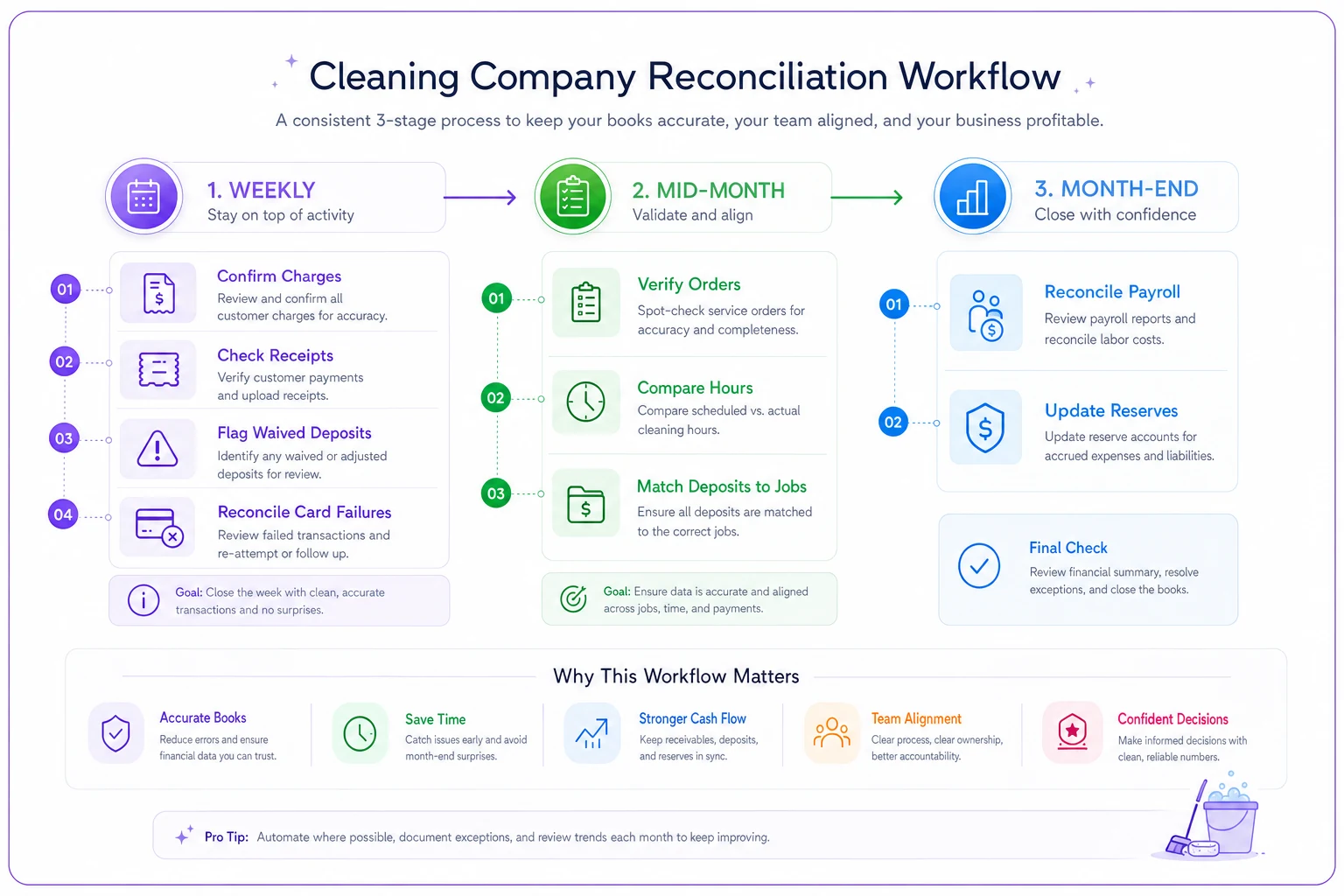
The diagram shows the three checkpoints and the key tasks to run at each cadence.
-
Weekly (15 minutes) - Confirm every completed job has a matching charge or deposit applied - Check that field receipts were uploaded against approved spend - Flag any waived deposits from the week
-
Mid-month (30 minutes) - Reconcile card-on-file failures — declined cards are a silent revenue leak - Verify supply orders match the approvals matrix - Compare hours logged vs. hours billed on a sample of jobs
-
Month-end (60–90 minutes) - Match all deposits collected to jobs completed; anything still "collected but not earned" stays flagged as a liability - Reconcile payroll against approved timesheets, with the two-person check - Update both reserve buckets and check them against target - Review refund/credit reason codes for patterns
The reason to break it into chunks is practical: month-end reconciliation done in isolation surfaces problems too late to fix. A declined card caught on day 4 gets re-run and collected. The same decline found on day 30 is usually a write-off.
There's a real connection here to pricing too. When reconciliation consistently shows jobs where billed hours exceed quoted hours, that's not a controls problem — it's a costing problem. The reproducible costing method for cleaners pairs naturally with this cadence, because your reconciliation is where underquoted work first shows up as a number.
A short real scenario
A residential cleaning company running five crews, doing somewhere around $60k–$68k in monthly revenue, kept ending months confused about where the money went. The bank never showed anything obviously wrong, but the owner's draw was inconsistent and twice they'd nearly missed comfortable payroll.
The problems, once they dug in, were unglamorous. Deposits were being waived informally on roughly a third of deep cleans. Field supply spend had no ceiling, so crews were reordering whenever they felt low — a few hundred dollars a month in duplicate ordering. And there was no reserve at all; every dollar that came in was in play.
They put in three things: a fixed deposit rule with a written waiver path, the approvals matrix above, and a two-bucket reserve funded in the sequence described earlier. Nothing fancy.
Over the next couple of months, the "collected but not earned" confusion disappeared because deposits were tracked as liabilities. Duplicate supply orders dropped noticeably once crew leads had a $75 ceiling and anything above went through the ops manager. Within about a quarter they had close to a full payroll cycle in reserve — not the full target, but enough that a slow week stopped being a source of stress. The owner's draw became predictable, which was the thing they'd actually wanted the whole time.
When a tighter control system makes sense — and when it's overkill
When this actually makes sense: You've got more than a couple of crews, money enters through multiple channels, and you're no longer personally seeing every dollar move. The moment you delegate field spending or hire an ops manager, you need the matrix and the reserve math. That's usually the three-to-four-crew zone.
When it's a bad idea: If you're a solo operator or running one crew, most of this is overhead you don't need. You are the control system at that stage. Build the deposit habit and the reserve buckets early — those scale with you — but skip the formal approvals matrix until there's actually someone else spending money.
Who should not do this: Owners who will build the matrix and then override it constantly. A control system you ignore is worse than no system, because it trains your team to treat the rules as suggestions. If you're not going to respect the $500 capex gate yourself, don't set it.
Where the tooling quietly helps
None of this requires software to exist — plenty of owners run it on a spreadsheet and a shared folder. But it does require the pieces to stay connected, and that's where things fall apart manually. Receipts live in one person's phone. Deposit waivers happen in a text thread nobody logs. The reserve buckets only get updated when someone remembers.
A workflow platform that ties job completion to billing, captures field receipts against approval limits, and flags failed card charges automatically removes the two weakest links: the delay between something happening in the field and it actually being recorded, and the human tendency to skip the boring reconciliation step. The rules are still yours. The system just stops you from finding out about problems a month too late.
Bringing it together
A control system for a small cleaning business isn't a binder of policies. It's four connected habits: deposits that pull cash in ahead of payroll, an approvals matrix that pushes routine decisions down and keeps risky ones gated, reserve formulas that fund the two things most likely to sink you, and a reconciliation rhythm that catches leaks while they're still small enough to fix.
Each piece reinforces the others. Deposits feed the reserve. The matrix keeps field spend inside the numbers your reconciliation checks. Reconciliation tells you when your pricing or your deposit rules need adjusting. Build them as one system and the business stops feeling like it's running on hope between paydays — which, for most cleaning owners, is the whole point.
A control system for a small cleaning business isn't a binder of policies. It's four connected habits: deposits that pull cash in ahead of payroll, an approvals matrix that pushes routine decisions down and keeps risky ones gated, reserve formulas that fund the two things most likely to sink you, and a reconciliation rhythm that catches leaks while they're still small enough to fix.
Ready to elevate your cleaning business?
Join 500+ cleaning services using Maidufy to save time, reduce scheduling errors, and deliver exceptional client satisfaction.