

Most cleaning businesses treat their SOPs like they're set in stone. Someone writes up a bathroom cleaning process, prints it out, sticks it in a binder, and that's the gospel for the next three years. Until someone gets hurt. Or a client complains about inconsistent service. Or you realize half your team is doing things completely differently than what's written down.
The other extreme isn't much better—companies that build elaborate documentation systems with approval chains, version control software, and quarterly review cycles that nobody actually follows. Six months later, the official SOPs are collecting dust while everyone operates on tribal knowledge and WhatsApp messages.
What cleaning businesses actually need is something in the middle. A lightweight system that keeps procedures current without creating a second full-time job for someone. The pattern is pretty consistent across cleaning operations that struggle with this: you need just enough structure to maintain consistency, but not so much that it becomes another burden nobody wants to touch.
The Four-Stage SOP Lifecycle That Actually Works
Author → Pilot → Publish → Audit
This framework keeps procedures alive without overwhelming your team. Each stage has a clear purpose and specific outputs.
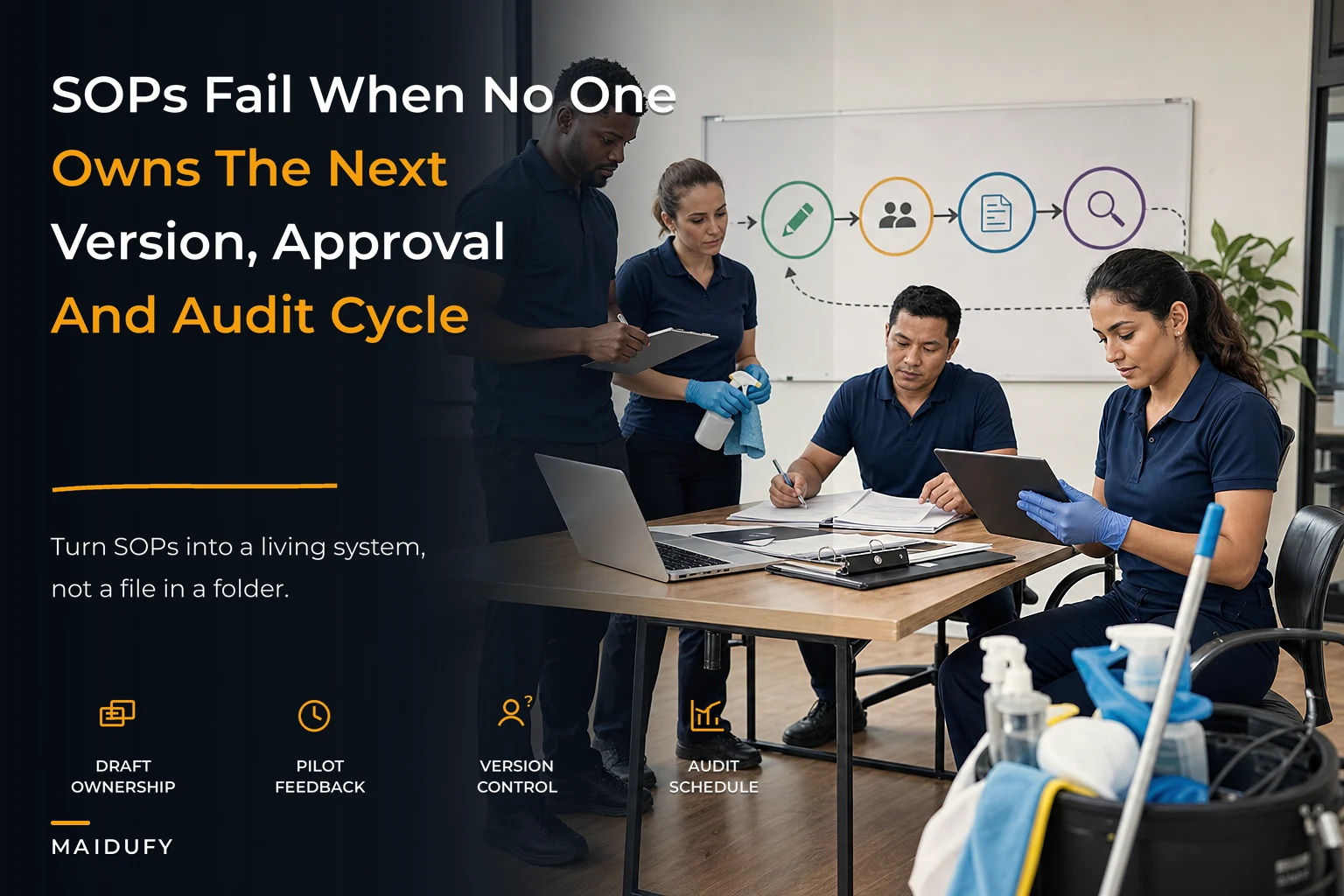
> Workflow Overview: The SOP lifecycle moves linearly through four stages — Author (field staff draft the procedure), Pilot (tested on 2–3 real jobs), Publish (versioned, assigned an owner, distributed), and Audit (scheduled review that either confirms the SOP or triggers a revision loop back to Author).
Here's a simple diagram of the lifecycle.
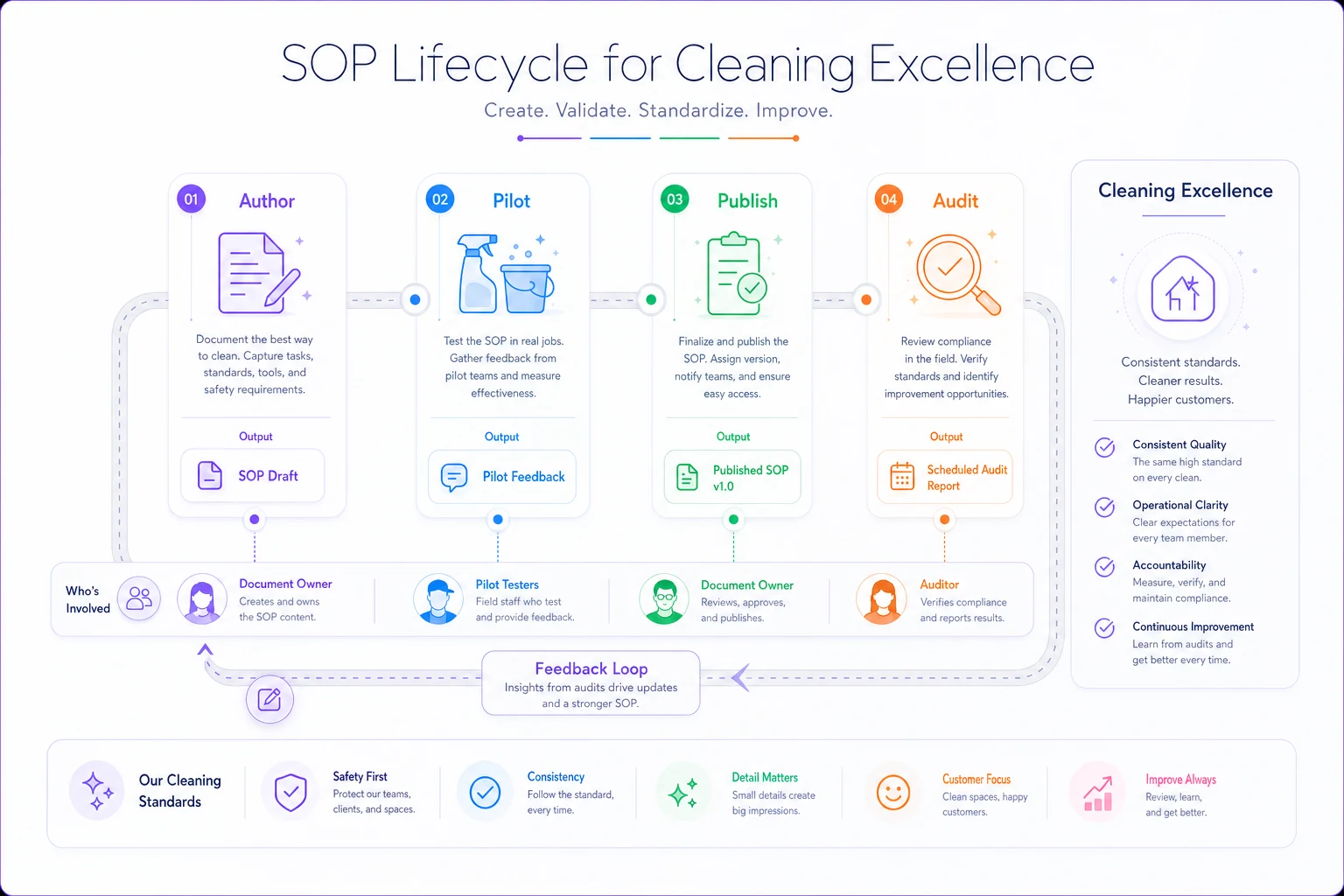
Use this to visualize handoffs and decision points.
Author Stage
Someone who actually does the work writes the first draft. Not a manager who hasn't touched a mop in five years. The person cleaning bathrooms every day knows where the problems hide—which surfaces need extra attention, which product works on which stain, which steps get skipped when you're running behind.
Give them a simple template: task name, supplies needed, step-by-step process, common problems, time estimate. Nothing fancy. A Google Doc works fine. The goal is capturing what really happens, not what management thinks should happen.
Pilot Stage
Before anything becomes official, test it with 2–3 different cleaners on real jobs. Not training scenarios—actual client homes. Track three things: Can they follow it? Does it take the estimated time? Does it produce consistent results?
During one pilot test for a move-out cleaning SOP, the original author's method for cleaning oven racks required a specific degreaser that wasn't in the standard supply kit. Another cleaner had a different technique using items already on every truck. The final SOP incorporated both approaches, giving teams options based on what they had available.
Publish Stage
Once piloted and refined, the SOP gets a version number (start with 1.0), an owner name, and an official publish date. Store it somewhere everyone can actually access—shared Google Drive, Notion, even a WhatsApp group with pinned messages if that's what your team genuinely uses.
The critical piece: create both a detailed version for training and a quick-reference version for the field. Your bathroom cleaning SOP might be two pages for onboarding purposes, but the field version is a laminated card with 8 bullet points that fits in a supply caddy.
Audit Stage
This is where most SOP systems fall apart. Companies either never audit (SOPs become fiction) or over-audit (monthly reviews that change nothing and waste everyone's time).
Set a simple rhythm: high-risk or high-frequency procedures get checked quarterly, everything else annually. An audit isn't a compliance exercise—it's asking "does this still match what's actually happening?" If your team has naturally evolved better methods, update the SOP to reflect what's working.
Versioning Without the Headache
Forget complex versioning schemes. You need exactly three pieces of information:
Never miss a cleaning appointment again.
Maidufy helps you book, confirm, and manage every cleaning service seamlessly.
- Centralized booking management
- Automated client reminders
- Optimized staff scheduling
No credit card required
Version Number: Major changes bump the whole number (1.0 to 2.0), minor tweaks add decimals (1.0 to 1.1)
Change Date: When this version went live
Change Summary: One sentence explaining what changed ("Added microfiber color coding for cross-contamination prevention")
Here's what this looks like in practice:
| SOP Name | Current Version | Last Updated | Key Change |
|---|---|---|---|
| Standard Bathroom Clean | 2.1 | Oct 2024 | Added procedure for touchless fixtures |
| Kitchen Deep Clean | 1.3 | Sept 2024 | Updated degreaser dilution ratios |
| Move-out Clean | 3.0 | Nov 2024 | Complete rewrite for furnished units |
| Supply Restock Process | 1.1 | Aug 2024 | Added inventory count requirements |
Keep previous versions accessible but clearly marked as outdated. When something goes wrong, you need to know whether someone was following old procedures or just winging it entirely.
The RACI Matrix That Prevents Finger-Pointing
RACI (Responsible, Accountable, Consulted, Informed) sounds corporate, but it solves a real problem: nobody knows who owns what. For cleaning businesses, simplify it:
Responsible: Who does the work (field cleaners for cleaning SOPs, office manager for booking SOPs)
Accountable: Who ensures it gets done right (team lead, operations manager)
Consulted: Who provides input before changes (experienced cleaners, QA lead)
Informed: Who needs to know when things change (entire team for cleaning procedures, customer service for pricing SOPs)
One mid-sized cleaning company mapped this out for their top 10 procedures and immediately found gaps. Their carpet cleaning SOP had no official owner—three different people assumed someone else managed it. Their customer complaint process had two people marked as accountable, which led to contradictory responses to the same client issues.
Sample Audit Checklist That Gets Used
Most audit checklists are worthless because they check for compliance rather than effectiveness. This one focuses on what actually matters:
Quarterly SOP Audit (15 minutes per procedure)
-
Watch someone actually perform the task
-
Does the SOP match what they're doing?
-
If not, is the SOP wrong or the execution wrong?
-
Track actual time vs. SOP estimate
-
If off by more than 20%, investigate why
-
Are listed supplies actually available?
-
Are teams using different products that work better?
-
Review QA failures related to this task
-
Check customer complaints tied to this area
-
Ask cleaners
"What's the most annoying part of this process?"
-
No changes needed (document check date)
-
Minor updates needed (schedule for next month)
-
Major revision needed (restart author → pilot process)
One company found through audits that their mirror cleaning SOP took about 40% longer than estimated. The culprit was a specific buffing technique that looked great but wasn't visible to the vast majority of clients. They ended up creating two versions: standard (faster) and premium (detailed) for high-end services. Simple fix that saved real time across dozens of jobs per week.
Training Integration Without Extra Work
Your SOPs are worthless if nobody knows they exist. But don't create separate training materials—that's exactly how things get out of sync.
New Hire Training
-
Week 1
Shadow experienced cleaner using current SOPs as checklist
-
Week 2
Perform tasks with trainer checking against SOP
-
Week 3
Solo work with spot-checks against procedures
Ongoing Training
-
Monthly team meetings
Review one SOP that's been problematic
-
After QA failures
Re-train on the specific SOP that was violated
-
When updated
5-minute video or before-shift huddle on what changed
Smart companies tie this directly to their QA process—when inspections reveal consistent failures in specific areas, that triggers automatic SOP review and retraining.
The QA Connection Most Companies Miss
Quality checks should directly reference SOPs. Instead of vague inspection criteria like "bathroom looks clean," tie each checkpoint to specific procedure steps:
"Toilet cleaning (per SOP 2.1):"
-
Bowl scrubbed with proper brush technique
-
All surfaces disinfected in correct order
-
Base and behind cleaned
-
Toilet paper folded per standard
When QA failures happen, you can immediately identify whether it's an SOP problem (procedure unclear or wrong) or an execution problem (procedure not followed). That distinction matters. It tells you whether to fix the document or fix the behavior—and those require completely different responses.
This data also drives your audit cycle. Procedures with frequent QA failures get reviewed first. It's a feedback loop that keeps your most important SOPs accurate without requiring you to manually track everything.
When Digital Tools Actually Help
The right software can make SOP governance close to automatic, but only after you have the basic system working manually. An AI-powered operations platform can track which procedures get accessed most, flag SOPs that haven't been reviewed in months, and surface patterns from QA data that would take hours to spot manually.
More practically, it can push the right SOP to the right person at the right time. A cleaner heading to a pet-friendly home gets the pet hair removal procedure automatically. Someone doing their first move-out clean gets the detailed version with photos. The system tracks who's viewed what, so new procedures actually reach the field instead of sitting in a folder nobody opens.
But software won't fix broken processes. Get your four-stage lifecycle running manually first, then let automation handle the administrative overhead.
Who Owns What: Clear Ownership Without Committee Hell
Avoid SOP-by-committee. Each procedure needs one owner who makes final decisions. For most cleaning businesses, this breaks down like:
Field Operations Manager: Owns all cleaning technique SOPs
Office Manager: Owns booking, scheduling, customer communication SOPs
Safety Lead (or operations manager wearing that hat): Owns chemical handling, equipment SOPs
Owner/GM: Owns pricing, employee management, quality standards SOPs
The owner doesn't write every word—they coordinate input, make final calls, and ensure updates happen. When something goes wrong, everyone knows exactly who to talk to about fixing the relevant procedure.
The Compliance Bridge Nobody Talks About
SOPs aren't just about consistency—they're your defense when things go sideways. A cleaner gets injured? OSHA wants to see your safety procedures. Client claims damage? Insurance wants your protocols. Employee says they were never trained? Documentation protects you.
The trap is over-documenting for compliance, which creates procedures nobody actually follows. The better approach is building compliance requirements into your operational SOPs, not creating a separate stack of compliance documents that lives in a drawer.
Your bathroom cleaning SOP includes the required PPE. Your chemical handling procedure covers Right-to-Know requirements. Your equipment maintenance SOP includes safety lockout steps. One document serves both operational and compliance needs. Less duplication, less confusion.
Why Most Cleaning Businesses Give Up
Three months into an SOP initiative, most cleaning companies abandon it. The procedures are outdated, nobody follows them, and maintaining them feels like overhead without any visible return. This happens when businesses treat SOPs as a one-time project rather than an ongoing operational rhythm.
The companies that stick with it build SOP maintenance into regular operations. Quarterly QA reviews include SOP audits. Team meetings include procedure updates. New hire training reinforces current standards. It becomes part of how you operate—not extra work bolted on top.
The Hidden Cost of SOP Chaos
A 15-person cleaning company can easily lose $2,000–3,500 monthly to inconsistent procedures:
-
Rework from quality failures
-
Extra supply costs from inefficient techniques
-
Training time spent on conflicting methods
-
Customer churn from inconsistent service
-
Liability from undocumented safety practices
Good SOP governance doesn't eliminate these costs entirely, but cutting them by 60–70% is realistic within six months. The savings more than fund the time required to maintain the system.
Build Your Governance Framework This Week
Start small. Pick your five most critical procedures—probably bathroom cleaning, kitchen cleaning, supply management, customer entry/exit, and chemical safety.
Run them through the four-stage lifecycle:
-
Have your best performer write what they actually do
-
Test with 2–3 other cleaners
-
Publish with version 1.0 and clear ownership
-
Schedule the first audit for 90 days out
Start with the procedures that trigger the most QA failures to get immediate impact.
Create your simple RACI for just these five procedures. Who writes, who decides, who needs input, who gets informed? Takes an hour, prevents months of confusion.
Set up basic version tracking—a spreadsheet works fine. Document what exists now as version 1.0, even if it's imperfect. You can't improve what you're not tracking.
The cleaning businesses that get this right don't aim for perfection. They aim for steady improvement—procedures that evolve with the business, stay grounded in reality, and actually help teams deliver consistent service. If your SOPs make the work harder instead of easier, you're either documenting the wrong things or documenting them the wrong way.
Most cleaning businesses need 20–30 core SOPs maximum. Everything else is either too granular (belongs in training materials) or too situational (should be guidelines, not rigid procedures). Focus on what directly impacts service quality, safety, and customer satisfaction. Get those right, keep them current, and the rest of the operation tends to follow.
Ready to elevate your cleaning business?
Join 500+ cleaning services using Maidufy to save time, reduce scheduling errors, and deliver exceptional client satisfaction.