


Most cleaning companies expand territories the expensive way. They pick a neighborhood that looks promising, dump marketing dollars into it, hire cleaners before they have enough work, and then scramble when bookings don't materialize fast enough to cover costs.
The businesses that actually grow profitably follow a different pattern. They test demand before committing resources, seed territories through specific channels in the right order, track acquisition costs per channel from day one, and have clear metrics that tell them when to accelerate or pull back.
Having watched hundreds of cleaning operations expand — and contract — their service areas, the difference between sustainable growth and expensive failures usually comes down to one thing: a systematic rollout sequence. Not gut feelings about which neighborhood to try next, but actual data on demand signals, channel performance, and operational readiness.
The real cost of territory expansion mistakes
Territory expansion failures in cleaning businesses follow predictable patterns. You hire cleaners for a new area, then struggle to fill their schedules. Drive time between sparse bookings kills efficiency. Your best crew leader gets stretched covering multiple territories. Customer acquisition costs spike because you're competing cold in a new market. And suddenly that "growth opportunity" is bleeding $2–3k monthly.
The operational strain often hits harder than the financial losses. Existing territory performance drops because management attention splits. Quality issues emerge in both territories. Cleaners get frustrated with inconsistent schedules. The new territory becomes a distraction that weakens your core business instead of strengthening it.
What makes this particularly painful for cleaning businesses is the fixed cost structure. Unlike digital services that can test new markets cheaply, cleaning operations require real people, real vehicles, and real supply investments upfront. Once you've hired for a territory, you're committed to several thousand in monthly overhead whether bookings materialize or not.
The timing pressure makes everything worse. You need to book enough jobs quickly to keep new hires busy, but rushing acquisition means accepting unprofitable customers. You lower standards to fill schedules. Bad customers create operational headaches. Your new territory develops a reputation problem before it even gets established.
Why standard expansion advice fails for cleaning operations
Generic business expansion advice assumes flexibility that cleaning operations don't have. "Test the market with minimal investment" sounds reasonable until you realize a cleaning business needs actual cleaners in the actual territory to deliver actual service. You can't gradually scale up — either you can service an area reliably or you can't.
Never miss a cleaning appointment again.
Maidufy helps you book, confirm, and manage every cleaning service seamlessly.
- Centralized booking management
- Automated client reminders
- Optimized staff scheduling
No credit card required
The usual digital marketing playbook falls apart too. Running Facebook ads to "test demand" tells you nothing about whether those leads will convert to recurring customers at profitable rates. A hundred form fills might produce ten initial cleanings and two recurring customers. Meanwhile, you've committed to territory coverage based on misleading signals.
Real estate wisdom about "following the demographics" misses operational realities. That affluent suburb forty minutes from your base might have perfect customer demographics, but the drive time economics destroy margins. Cleaners spend more time in traffic than cleaning. Vehicle costs explode. Scheduling becomes a mess.
Even experienced operators fall into the franchise trap — assuming what works in one territory automatically transfers to another. Every territory has different competitive dynamics, different customer expectations, different labor availability, different referral networks. The playbook that dominates one area might completely fail three miles away.
The cleaning business expansion playbook needs to account for the actual constraints of physical service delivery. It's not about market opportunity in abstract terms. It's about whether you can profitably deliver quality service to that market given your specific operational capabilities.
Demand validation before resource commitment
Smart cleaning businesses validate real demand through specific, measurable actions before making any hiring or equipment commitments. This isn't about running surveys or analyzing demographics — it's about getting actual customers to take actions that prove they'll pay for service in that territory.
Start with a soft launch offer to your existing customer base. "We're considering expanding to [territory name]. If we serviced your area, would you refer us to neighbors?" Track not just interest but actual referral names and contact information provided. When existing customers give you three or more specific referrals, that's a real signal.
Next, run limited-time, premium-priced offers in the target territory. Price these 20–30% above your standard rates. If people book at premium prices, demand exists. If they don't, you've saved yourself from entering a price-sensitive market that would crush margins. This test costs maybe $300–500 in targeted ads but saves potentially tens of thousands in failed expansion costs.
Partner with a complementary business already operating in the territory. Real estate agents, home organizers, or carpet cleaners can provide immediate demand signals. Offer them a generous referral fee for the first three months. If they can't generate five qualified leads monthly, the territory lacks the referral infrastructure you need.
Track inquiry-to-booking conversion rates during validation. Your existing territories might convert around 30% of inquiries to bookings. If the new territory converts below 20%, something's off — either the demand isn't real, the competition is too strong, or the market expectations don't match your service model.
| Signal | Points |
|---|---|
| 10+ referrals from existing customers | 3 |
| 15+ bookings at premium prices | 3 |
| 5+ partner referrals monthly | 2 |
| 25%+ inquiry conversion rate | 2 |
Don't proceed to resource commitment unless you hit 8 points. This prevents expensive wishful thinking.
The pilot neighborhood selection matrix
Choosing the right pilot neighborhood determines whether your expansion succeeds or becomes an expensive lesson. The best operators evaluate neighborhoods across multiple operational dimensions, not just demographics or competition.
Drive time economics matter more than any other factor. A wealthy neighborhood 45 minutes from your base will rarely be profitable. Cleaners spend 90 minutes daily just commuting. Add another 30 minutes moving between houses. Suddenly a 6-hour cleaning day includes 2 hours of unbillable windshield time. Map out 15-minute drive radiuses from your current territory edges — only consider neighborhoods within these boundaries for initial expansion.
Density patterns predict scheduling efficiency. Suburban sprawl with half-acre lots means more driving between jobs. Dense townhouse communities or apartment-friendly areas let you stack multiple cleanings without vehicle moves. Calculate potential bookings per square mile, not just total market size. A smaller dense territory beats a larger sparse one every time.
Look for neighborhood anchors that indicate stability — schools, community centers, established local businesses. High rental turnover or lots of "for sale" signs mean constant customer churn. You want neighborhoods where people invest in services like cleaning because they're staying put.
Evaluate the competitive landscape through specific signals. How many cleaning vehicles do you spot during weekday afternoons? Are competitors' vehicles newer or older models? Do you see branded vehicles or unmarked personal cars? Check Nextdoor for complaint patterns about existing services. Lots of older, unmarked vehicles suggest price-sensitive competition. Fewer, newer branded vehicles indicate quality-focused competition. Pick territories where you can compete on your strengths.
-
10–15 minutes from your current territory edge
-
300+ homes within a 1-mile radius
-
Mix of working families and retirees
-
Established neighborhood (10+ years old)
-
2–3 visible competitors, not 0 or 10+
That last point matters more than people think. Zero competitors usually means no real market. Ten-plus means you'll get buried competing on price.
Channel sequencing and acquisition costs
The order you activate customer acquisition channels dramatically impacts both costs and territory sustainability. Most cleaning businesses blast all channels simultaneously, burning cash while creating operational chaos. The profitable ones follow a specific sequence that builds momentum while controlling costs.
The channel rollout sequence:
-
Referral seeding — Offer your best existing customers in adjacent territories a $50 credit for each neighbor referral that books. These customers already trust you through social proof — they convert at 60–70% versus 20–30% for cold leads. Referred customers also tend to stick around, typically showing meaningfully higher lifetime value than paid acquisition customers.
-
Partner channels — Real estate agents need move-in cleanings. Home organizers need ongoing maintenance. Property managers need turnover cleanings. Structure deals that pay partners only after the second cleaning, ensuring they refer quality customers rather than just anyone. Partner-sourced customers should cost $30–50 to acquire and generate $800+ in lifetime value when this works properly.
-
Local digital advertising — Only after referral and partner channels show traction. Start with neighborhood-specific Facebook groups and Nextdoor, where you can target precisely and build local presence. Cost per acquisition here runs $60–80, but these customers need more nurturing to reach the same lifetime value as referrals.
-
Door hangers and direct mail — These come last, despite what traditional advice suggests. They can work, but only after you have social proof in the neighborhood. "New to the area" messaging rarely lands. "Now serving 15 families in [Neighborhood Name]" does. These channels run $100–150 per acquisition, so use them to fill specific schedule gaps, not as primary drivers.
Track channel performance weekly using this matrix:
| Metric | What it tells you |
|---|---|
| Cost per lead | Channel efficiency |
| Lead to booking conversion | Offer and market fit |
| First to second cleaning rate | Service quality signal |
| Three-month retention rate | Customer fit |
| Six-month customer value | True channel profitability |
When a channel's metrics slip, pause it rather than trying to optimize your way out. The territory might be saturating for that channel while others still have room.
ACV targets and go/no-go scoring
Annual Customer Value (ACV) targets separate sustainable territories from money pits. Too many cleaning businesses celebrate booking volume while ignoring whether those customers generate actual profit over time.
Set minimum ACV thresholds by channel before you launch. Referral customers should generate $1,200+ annually. Partner-sourced customers need to hit $1,000+. Paid acquisition customers must reach $800+ to justify their higher acquisition costs. When a channel consistently delivers customers below these thresholds, you're quietly buying yourself into a cash flow problem.
The math gets uncomfortable fast. If you spend $80 acquiring a customer who generates $600 annually and your gross margin is 35%, you net $210 per year before overhead. Factor in management time, quality issues, and scheduling complexity, and you're likely losing money. Yet cleaning businesses do this constantly, celebrating "growth" while margins erode.
Build your go/no-go scoring model with both acquisition and operational metrics:
-
Average ACV above threshold
+2 points
-
Cost per acquisition below target
+2 points
-
Conversion rate above 25%
+1 point
-
Referral rate above 20%
+1 point
-
Route density (3+ cleanings per day)
+2 points
-
Drive time under 20% of day
+2 points
-
Cleaner utilization above 80%
+1 point
-
Quality scores match main territory
+1 point
Score weekly for the first three months. Below 8 total points after month one, slow down. Below 6 points after month two, pause and diagnose. Still below 8 points after month three, exit the territory. This framework prevents the slow bleed where you keep hoping things turn around while losses stack up.
The expansion continues only when both acquisition and operations maintain positive momentum. One without the other creates unsustainable pressure that eventually breaks something.
The critical bridge between sales and operations
Where most territory expansions actually fail is the handoff between successfully acquiring customers and profitably delivering service. Sales promises what operations can't deliver. Operations constraints limit what sales can sell. Nobody owns the intersection, and the territory struggles despite real demand.
Create explicit operational capacity triggers before sales can accelerate. For example, sales can only book 10 cleanings weekly until the territory hits 25 recurring customers. Then 15 weekly until you reach 40. This prevents the feast-or-famine scheduling that burns out cleaners and disappoints customers.
Route density requirements must constrain sales geography, not the other way around. Sales wants to say yes to every interested customer. Operations needs clusters of customers to maintain efficiency. Set hard boundaries: no customers more than 10 minutes from existing customers until you have 20+ in the core area. This frustrates salespeople initially but prevents the scattered territory problem that destroys margins.
Quality standards can't slip during expansion, even when you're desperate to fill schedules. The moment you accept a customer you'd reject in your main territory, the quality death spiral begins. Bad-fit customers complain more, require more management time, and refer similar customers. Soon your new territory reputation is damaged before it ever had a chance.
Implement a territory scorecard that both sales and operations review weekly. Track new customer quality score (based on home size, expectations, payment history), geographic clustering score, schedule density score, cleaner satisfaction score, and customer satisfaction score. When any metric drops below acceptable levels, both teams diagnose and fix it before pursuing more growth. Shared accountability prevents the finger-pointing that typically emerges when territories struggle.
The real test: can your operations manager and sales lead explain exactly why the territory is or isn't working, using the same metrics and the same framework? If they give different answers, you don't have alignment, and the territory will eventually fail.
Partner and referral seeding strategies
Building referral networks in new territories requires different tactics than maintaining them in established areas. You don't have customer success stories yet. You don't have local reputation. You need to manufacture initial momentum through strategic partner relationships.
Property managers control massive referral potential but need specific incentives. Don't pitch them on referral fees — they can't always accept them. Instead, offer to be their emergency cleaning backup. When their regular cleaners flake, you'll handle it within 24 hours. Do this reliably twice, and you'll typically start seeing steady turnover cleaning referrals. These sometimes convert to residential customers when tenants see your work.
Real estate agents want to look good to clients, not earn referral money. Offer them a "client gift program" where their buyers get a free initial cleaning as part of their gift. You cover the cleaning cost but gain a premium customer with a built-in referral source. Agents who refer three customers tend to refer many more over time.
Local Facebook group dynamics determine digital referral success. Don't join and immediately promote. Spend two weeks answering cleaning questions helpfully without pitching. Share relevant tips. Explain how to handle specific stains. When you eventually mention you serve the area, group members already know who you are.
Nextdoor works differently because neighbors vouch for each other. Find one satisfied customer willing to be your local advocate. Have them post about their experience, then respond thanking them and mentioning limited availability. One strong Nextdoor advocate can generate 10–15 qualified leads.
School and community partnerships offer bulk referral opportunities. A fundraising program where the PTA gets 10% of revenue from referred families for the first year can generate 30–40 customers from a single partnership — enough to justify the entire territory expansion. These customers also cluster geographically, which helps route density.
Track referral source quality carefully.
| Partner Type | Acquisition Cost | Typical ACV | Watch Out For |
|---|---|---|---|
| Property managers | $30–50 | $900–1,100 | Unrealistic expectations |
| Real estate agents | $40–60 | $1,000–1,300 | One-time bookings |
| School/PTA programs | $50–70 | $800–1,000 | Price sensitivity |
| Nextdoor advocates | $10–20 | $1,100–1,400 | Slow to scale |
Real estate referrals might book once then disappear. School referrals might be price-sensitive. Property manager referrals might have unrealistic expectations. Adjust your partner strategy based on actual customer quality, not just volume.
Measuring true territory performance
Revenue per territory tells you almost nothing about actual performance. A territory generating $20k monthly might be losing money while one generating $12k monthly throws off strong profits. True territory measurement requires operational metrics most cleaning businesses ignore.
Contribution margin per route day is the number that matters. Calculate all revenue from a typical route day in the territory. Subtract direct costs: cleaner wages, vehicle costs, supplies, drive time pay. Then subtract allocated overhead: scheduling time, quality checks, customer service. What remains is contribution margin. Strong territories generate $200+ per route day. Weak ones barely break $100.
Customer acquisition payback period varies dramatically by territory. In your established base, referrals might pay back acquisition costs within 45 days. A new territory might take 120 days because you're relying on paid channels. When payback extends beyond 90 days, you're essentially financing growth with working capital you may not have.
Cleaner retention in the territory is an underrated indicator of long-term viability. High turnover in specific territories isn't random — it usually signals structural problems. Maybe drive times frustrate them. Maybe customer types stress them. Maybe schedule inconsistency destroys income stability. When cleaner turnover exceeds 20% monthly in a territory, something is fundamentally broken.
The lifetime value to acquisition cost ratio needs to exceed 3:1 for sustainable territory growth. Below that, you're grinding for minimal profit. Established territories might run 5:1 or higher. New territories starting at 2:1 need rapid improvement or they'll drain resources indefinitely.
-
Contribution margin per route day
-
Acquisition payback period
-
Cleaner retention rate
-
LTV
CAC ratio
-
Schedule density (cleanings per square mile)
-
Quality scores versus main territory
Territory problems compound quickly. By the time monthly reports show issues, you've often already burned thousands in unnecessary costs.
When to accelerate versus pull back
The decision to double down or retreat from a territory isn't emotional — it's mathematical. Yet most cleaning businesses make these calls based on optimism or pessimism rather than clear decision rules.
Acceleration triggers should be explicit and measurable. When you hit all of these simultaneously, pour fuel on the fire:
-
Three consecutive weeks of positive contribution margin
-
Customer acquisition payback under 60 days
-
Cleaner retention stable for 30 days
-
Route density exceeding 4 cleanings per day
-
Quality scores within 5% of main territory
Until you hit all five, keep growth controlled. This frustrates aggressive operators but prevents premature scaling that kills territories.
Pull back when you see early warning signals, not after disasters strike. If acquisition costs spike 30% above plan, pause paid channels immediately. Don't wait to "see if it improves." If cleaner turnover hits 15% in a month, freeze new customer acquisition until you understand why. If quality scores drop 10% below main territory, stop adding customers and fix operations before reputation damage spreads.
The partial retreat option saves more territories than people realize. Instead of abandoning the entire territory, shrink to a profitable core. Keep the dense neighborhood with good customers. Drop the scattered outskirts. Maintain referral relationships. Pause paid acquisition. This approach lets you preserve what works while cutting what doesn't.
Set hard exit triggers to prevent emotional attachment from clouding judgment:
-
Negative contribution margin for 6 consecutive weeks
-
Customer acquisition payback exceeding 120 days
-
Cleaner turnover above 25% for 2 months
-
Unable to maintain 3+ cleanings per route day
-
Quality scores 20% below main territory
When you hit any two exit triggers, begin winding down. Transfer customers to competitors if needed. Reassign good cleaners to strong territories. Don't throw good money after bad hoping things turn around on their own.
Building your territory expansion system
The difference between cleaning businesses that scale profitably versus those that implode comes down to systematic execution versus chaotic opportunism. Building your complete territory expansion system before you need it prevents expensive mistakes when growth opportunities emerge.
Document your expansion criteria explicitly. What population density do you need? What income levels? What competitive dynamics work for you? What drive time limits will you accept? When everyone knows the criteria, you waste less time evaluating obviously bad territories.
Create templates for each expansion phase — the demand validation checklist, the pilot neighborhood scorecard, the channel activation sequence, the go/no-go scoring model, the operational readiness assessment. Having these ready means you execute consistently rather than reinventing the process each time.
When you're managing growth beyond a single territory, AI-powered platforms can track performance metrics across territories automatically, flag when territories deviate from targets, and help you spot which territories are trending toward trouble before problems become expensive.
Below is a visual of the territory expansion workflow.
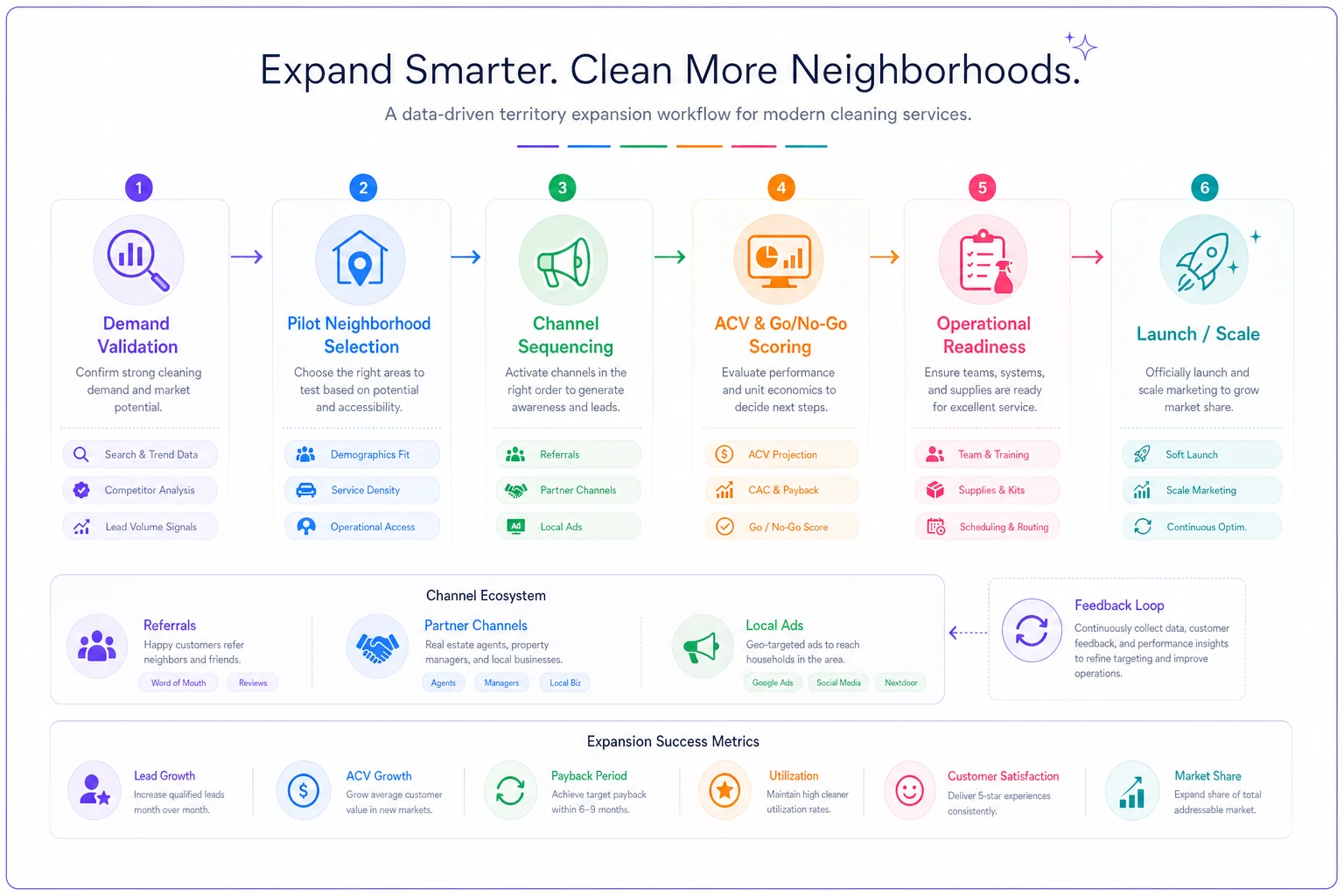
Modern operational platforms help you maintain visibility across territories without drowning in spreadsheets. They can automatically calculate contribution margins by territory, track customer acquisition costs by channel, monitor cleaner utilization rates, and alert you when metrics drop below your thresholds. That kind of real-time visibility prevents the slow bleeds that kill territory expansions.
Beyond dashboards, AI automation in your operational software can surface patterns that are genuinely hard to catch manually. Maybe Tuesday route density in Territory B consistently underperforms. Maybe customers acquired through one channel in a specific territory churn at twice the rate. Maybe quality scores dip whenever a certain cleaner combination works together. These insights let you adjust before small issues become territory-wide problems.
The investment in proper operational infrastructure pays for itself by preventing even one failed territory expansion. That $15k you'd lose on a bad territory covers years of software that makes every expansion more predictable.
Making territory expansion repeatable
The cleaning businesses that successfully expand to 5, 10, or 20+ territories don't get better at guessing. They get better at following a proven system. Every territory teaches them something that refines the playbook for the next one.
Build learning loops into your expansion process. After each territory launch, document what surprised you. Which assumptions proved wrong? Which channels performed differently than expected? Which operational challenges caught you off guard? This territory retrospective becomes more valuable than any market research.
Your second territory expansion should go roughly 30% faster than your first. Your fifth should take about half the time. Not because you're cutting corners, but because you've eliminated uncertainty. You know which signals matter. You know when to accelerate or retreat. You know how to bridge acquisition and operations.
The goal isn't just adding territories — it's building a system that predictably identifies, validates, launches, and scales profitable territories while quickly killing unprofitable ones. That system becomes your competitive advantage. While competitors guess and hope, you execute with confidence.
Your lead-to-booking funnel becomes the first component of this system. Your route profitability analysis becomes another. Your territory expansion playbook ties them together into a complete growth engine.
Territory expansion in cleaning businesses doesn't have to be an expensive gamble. With the right playbook — demand validation, pilot neighborhood selection, channel sequencing, clear ACV targets, and go/no-go scoring — you can grow predictably without betting the business on each new area.
The companies that build sustainable multi-territory operations aren't necessarily smarter or better funded. They follow a system that prevents expensive mistakes while accelerating what works. They measure what matters. They act on data, not hope. They scale what's proven.
Start with one new territory. Follow the playbook. Learn and refine. Then repeat. Territory expansion stops being a risky adventure and starts being one of the more reliable growth levers in your business.
Ready to elevate your cleaning business?
Join 500+ cleaning services using Maidufy to save time, reduce scheduling errors, and deliver exceptional client satisfaction.