

Your phone rings. Someone needs a deep clean before their in-laws visit. They sound interested, ask about pricing, then nothing. They never book. Never call back. Just gone.
This happens to cleaning businesses somewhere in the 40-60% range. Not because your prices are wrong or your service is bad. The gap between initial contact and confirmed booking kills more cleaning businesses than bad Yelp reviews ever could.
Most cleaning services treat lead capture like fishing with a torn net. They answer calls, send quotes, maybe follow up once, then wonder why their calendar stays half-empty while competitors are booked out.
The broken funnel most cleaners actually use
Here's what passes for a lead funnel at most cleaning operations:
Someone calls or fills out a contact form. You call back (eventually). Quote a price. They say they'll think about it. You maybe text once. End of funnel.
No review capture before they decide. No strategic form fields that pre-qualify. No landing pages built for booking intent. No real follow-up for the hesitant ones.
The typical cleaning business converts maybe 15-20% of inquiries into actual bookings. Not because people don't need cleaning - they called you, after all. The funnel just leaks at every stage.
Phone leads get quoted prices before you understand their actual situation. Web forms ask for name and number, missing critical qualifying info. Landing pages talk about your 20 years of experience instead of addressing what the visitor actually came there for. Follow-up stops after one attempt.
Meanwhile, that person who needed the deep clean booked with someone else who made it easier.
Review capture changes the trust equation
Before someone books a stranger to enter their home, they need proof you won't steal their jewelry or break their grandmother's vase. Reviews solve this, but not quite the way most cleaners think.
Never miss a cleaning appointment again.
Maidufy helps you book, confirm, and manage every cleaning service seamlessly.
- Centralized booking management
- Automated client reminders
- Optimized staff scheduling
No credit card required
Waiting passively for Google reviews means depending on the roughly 5% of happy customers who bother leaving them. Smart operators capture reviews at multiple touchpoints, especially right after service when satisfaction is highest.
The timing matters more than the ask itself. Text customers about 2 hours after service completion - while the house still smells clean. Not the next day when life has already moved on.
The message matters too. Skip the formal "please rate our service" approach. Something like: "Quick question - how'd we do today? Mind sharing what you thought about the deep clean?" gets a much better response rate.
Pro-tip: Text review requests about 2 hours after service when satisfaction is highest.
But what most people miss is where those reviews actually get displayed. Not buried on a testimonials page. Right on the booking form. Next to the "Book Now" button. In follow-up texts to leads who haven't responded yet.
One cleaning operation in Phoenix started texting review screenshots to leads who hadn't booked within 48 hours. Conversion jumped from 22% to 31%. No price changes. No special offers. Just proof that real people trusted them.
Form fields that qualify without overwhelming
Contact forms kill more bookings than they create when done wrong. The standard name-email-phone approach tells you nothing useful and creates zero urgency.
Here's the field structure that actually converts:
Required fields:
-
First name only (last name kills conversions noticeably)
-
Phone number
-
Service type dropdown (Regular, Deep, Move-in/out)
-
Approximate square footage (ranges, not exact)
-
Preferred start date (creates urgency)
Smart optional fields:
-
"Biggest cleaning challenge right now" (text field)
-
Number of pets (affects pricing and crew assignment)
-
Last professional cleaning (Never, 1-3 months, 3-6 months, 6+ months)
Fields to absolutely avoid:
-
Street address (get this after booking)
-
Budget (discuss after qualifying)
-
How did you hear about us (nobody answers this accurately anyway)
The square footage dropdown deserves attention. Use ranges like "Under 1,000 sq ft" or "1,000-1,500 sq ft" instead of asking for exact numbers. People guess anyway, and ranges feel less committal.
That "biggest cleaning challenge" field is genuinely useful. When someone writes "can't get pet hair off couches," your follow-up addresses that exact problem. Suddenly you're not just another cleaning service quoting a number.
Landing pages built for booking intent
Your Google Ads send traffic to your homepage. So do your Facebook campaigns. That homepage talks about your family business, eco-friendly products, insurance and bonding. Meanwhile, visitors came to book a cleaning, not read your backstory.
High-intent landing pages work differently. They assume the visitor already decided they need cleaning. The only question: will they book with you?
Structure that converts:
Above the fold:
-
Headline addressing their immediate need ("Book Your Deep Clean for This Week")
-
3 recent 5-star review snippets
-
Form with those qualifying fields
-
"Book in 60 seconds" promise
Below the fold:
-
Specific service details (what's included and what isn't)
-
Pricing structure or a simple quote calculator
-
More reviews, especially ones mentioning reliability
-
A simple 3-step booking process visual
What NOT to include:
-
Company history
-
Team photos
-
Mission statements
-
Awards and certifications (move these to footer)
-
Long paragraphs about your cleaning philosophy
A cleaning service in Denver tested this against their standard homepage with the same ad spend and same targeting. The focused landing page converted at 34% versus the homepage's 11%. Triple the bookings from identical traffic.
The key is matching the page to the visitor's mindset. Someone searching "emergency cleaning service today" doesn't care about your 20 years of experience. They care about whether you're available.
The follow-up cadence that recovers lost leads
Most cleaning businesses follow up once, maybe twice, then move on. This leaves a lot of potential revenue sitting there untouched.
Here's the cadence that actually recovers leads without becoming annoying:
| Day | Action |
|---|---|
| Day 0 (Initial contact) | Send quote and availability within 2 hours. Include one strong review screenshot. |
| Day 1 | Text: "Hi [Name], just making sure you got the quote for your [service type]. The [preferred date] slot is still open. Any questions?" |
| Day 3 | Email with subject "Your cleaning quote (expires tomorrow)" |
| Day 5 | Text with a different angle: "Hey [Name], noticed you were looking for help with [their biggest challenge from form]. Here's how we typically handle that: [specific 2-sentence solution]. Still interested?" |
| Day 8 | Final email: "Last check - should we release your held slot?" Include a discount option: "If timing wasn't right, here's 15% off when you're ready" |
| Day 14 | Add to monthly newsletter. Stop individual pursuit. |
Day 3 include:
-
Original quote
-
3 more review screenshots
-
Gentle urgency
"Holding your slot until tomorrow"
This kind of sequence recovers roughly 20-25% of leads that would otherwise go cold. Not all at full price - some take the discount. But something beats nothing.
Scripts that actually get responses
Generic follow-up scripts sound robotic. Here's what tends to work in practice:
For the price shopper who ghosted:
"Hey Sarah, totally get that you're comparing options. Just wanted to mention - we include baseboards and ceiling fans in our standard deep clean, which most others charge extra for. Changes the math a bit. Still available Tuesday if interested."
For the hesitant first-timer:
"Hi Mike, know it's a little weird letting strangers in your house. If it helps, we can start with just your main living areas this first time - kitchen, living room, main bathroom. You can see our work before committing to the whole house. Sound better?"
For the detail-oriented prospect:
"Hey Lisa, saw you asked about our process for [specific concern from form]. Here's exactly how we handle that: [specific 3-step explanation]. We can also send photos after each room if that helps. Your Thursday slot is still available."
For the busy non-responder:
"Hi David, guessing things got hectic. Your quote for the move-out clean is attached again. We can still fit you in before your walkthrough - just need a quick yes/no so we can release the slot if needed."
What these don't do: beg, immediately discount, or sound desperate. They address specific hesitations and add something useful.
When the funnel makes sense vs. when it's overkill
This whole system works when you're handling 20+ leads weekly. Below that, you're optimizing something that barely exists.
This funnel makes sense when:
-
You spend money on ads (Google, Facebook, etc.)
-
You get regular organic traffic
-
You have capacity for more bookings
-
Your average booking value exceeds $150
-
You serve residential, not commercial
Skip this complexity if:
-
You're fully booked for weeks
-
You only do commercial contracts
-
Your leads come entirely from referrals
-
You're a true solo operator at capacity
For the fully booked solo cleaner, this funnel creates busywork instead of solving problems. For the growing operation trying to scale, it becomes essential infrastructure.
The automation that makes this sustainable
Running this funnel manually means someone's job becomes chasing leads all day. That's where operational software actually earns its keep.
Modern platforms can trigger review requests automatically a couple hours post-service. They can send follow-up sequences without anyone remembering to do it. They can pull specific form field responses into email templates so messages feel personal without being written from scratch every time.
Visual of the automated workflow:
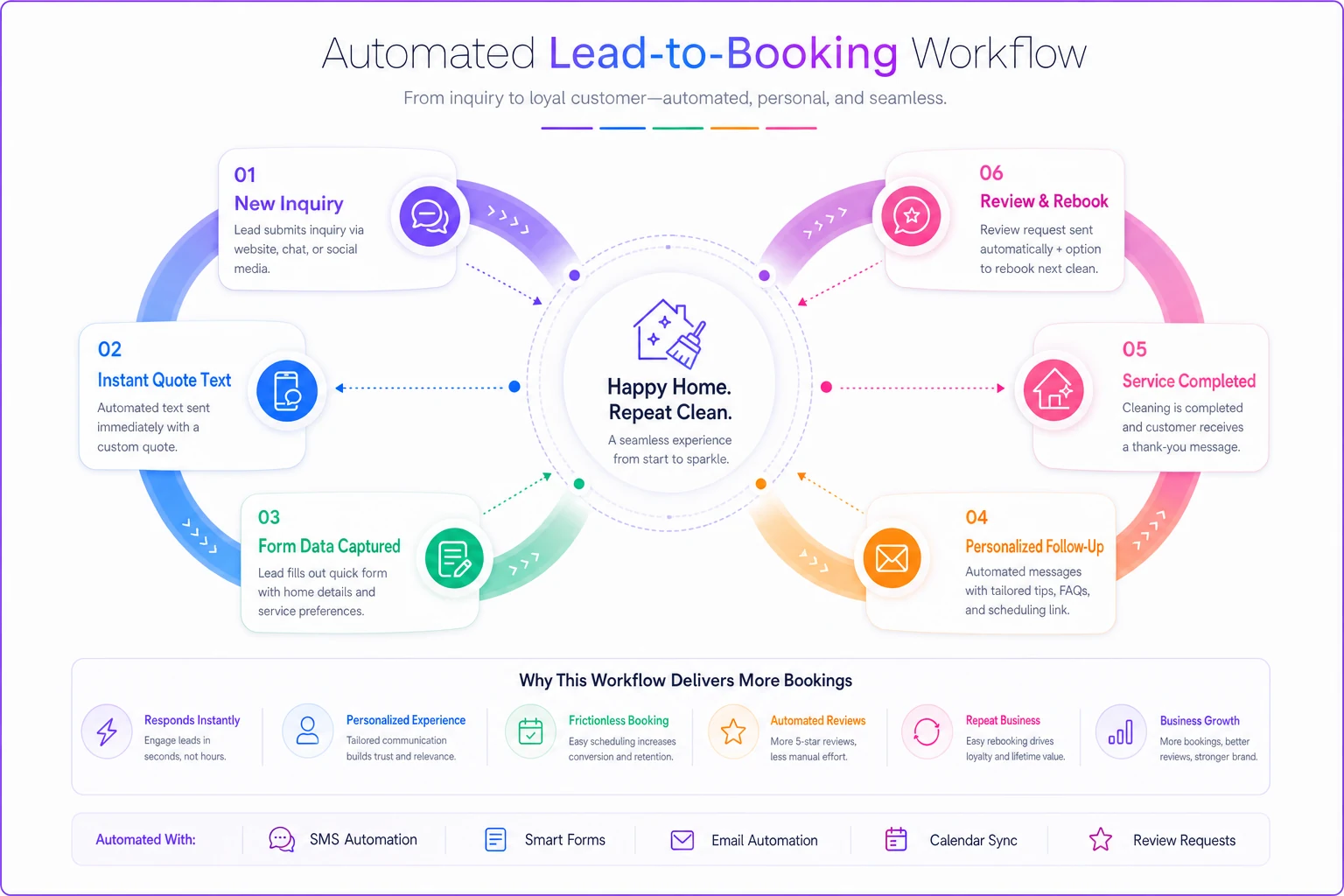
The shift is managing the system rather than managing each lead individually. Conversion improves while the manual workload shrinks.
One cleaning operation in Austin implemented an automated version of this funnel through their operations platform. Lead-to-booking conversion went from 19% to 34%, and they recovered about 22% of previously cold leads in the first month.
The person who needed a deep clean before her in-laws arrived? In an automated funnel, she gets a text 90 minutes after her inquiry, an email that evening with reviews from similar last-minute jobs, then a follow-up that addresses her specific concern about pet hair on furniture. By day 3, she's booked.
Making it actually happen this week
You don't need to implement all of this at once. Start with one piece - review capture, or form optimization, or just one follow-up message. Get that working. Then add the next thing.
Most cleaning businesses that try to roll everything out simultaneously end up with none of it working properly. Starting small and building from there gets you results faster.
That lead sitting in your inbox right now who hasn't responded? Send them the "totally get that you're comparing options" script and see what happens. Then do it again with the next one.
The gap between interest and booking doesn't have to be where good leads disappear. With the right funnel - capturing reviews strategically, qualifying through smarter forms, landing pages that match booking intent, and systematic follow-up - those vanishing leads start turning into actual bookings.
Your cleaning business probably doesn't need more leads. It needs to stop letting the ones it already has slip through. This funnel, implemented even partially, starts fixing that this week.
Ready to elevate your cleaning business?
Join 500+ cleaning services using Maidufy to save time, reduce scheduling errors, and deliver exceptional client satisfaction.