

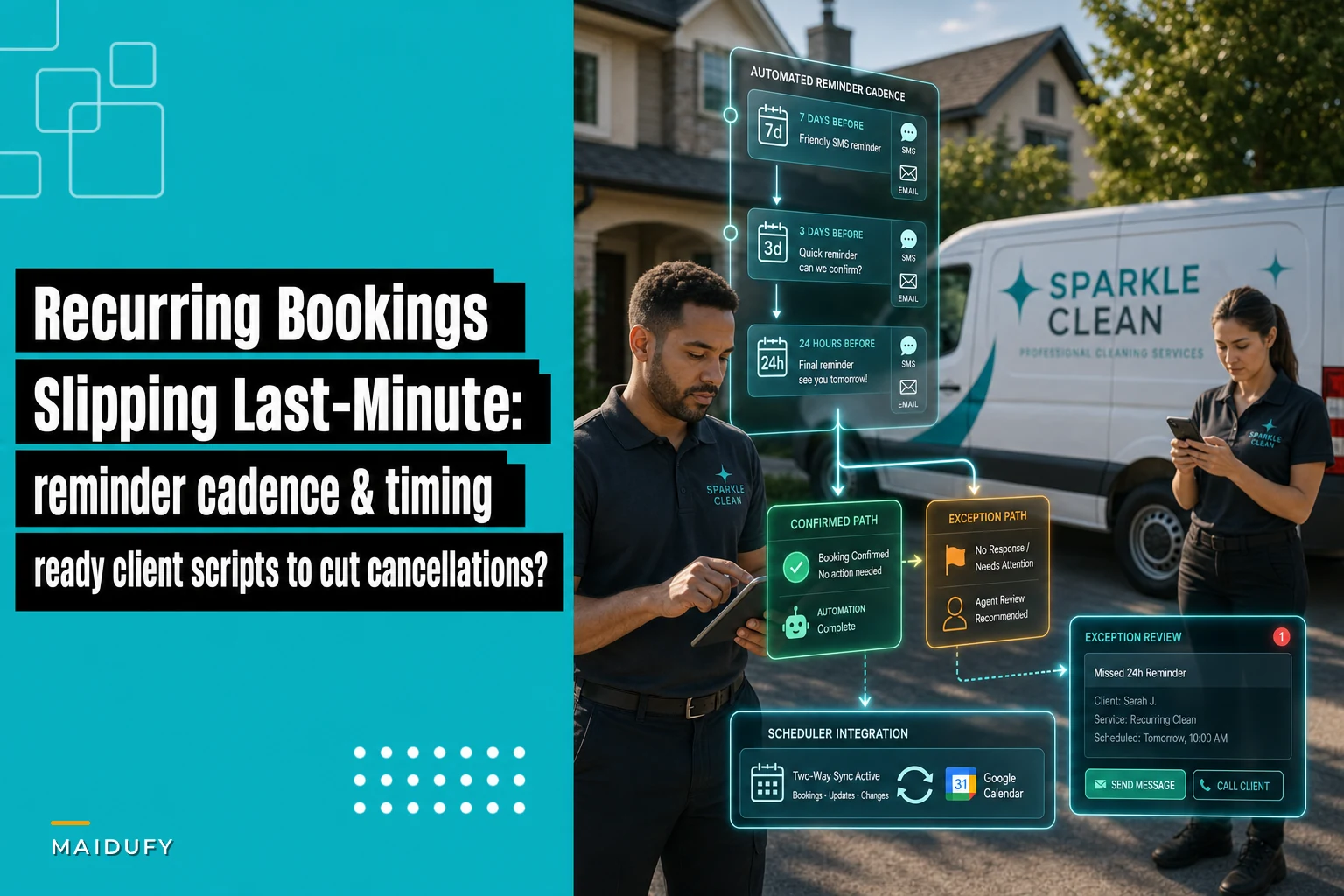

You've got Mrs. Henderson scheduled every other Thursday at 2pm. She's been your client for eighteen months. Never misses. Then suddenly, three cancellations in six weeks. Not rescheduling either — just vanishing with a text sent 90 minutes before arrival.
This pattern destroys cleaning businesses in ways most owners don't fully grasp until they're staring at $4,000+ in monthly gaps with no explanation.
The hidden math of cancellation damage
A typical residential cleaning operation with 85 recurring clients sees roughly 11-14% monthly cancellation rates. Sounds manageable until you actually run the numbers:
-
85 clients × 2 cleanings monthly = 170 appointments
-
14% cancellation rate = 24 lost appointments
-
Average cleaning value
$120
-
Monthly revenue loss
$2,880
-
Annual impact
$34,560
But the real damage runs deeper. Those 24 gaps mean wasted drive time, idle crews, and scheduling chaos that ripples through your entire day. Your team shows up, loads supplies, drives 25 minutes across town... for nothing.
Why standard reminder systems fail cleaning businesses
Generic appointment reminders don't work for home services the way they work for dentists or hair salons. The psychological barriers are completely different.
Never miss a cleaning appointment again.
Maidufy helps you book, confirm, and manage every cleaning service seamlessly.
- Centralized booking management
- Automated client reminders
- Optimized staff scheduling
No credit card required
A dental appointment just requires the customer to show up. A cleaning appointment requires them to prepare their home, secure pets, possibly work from a coffee shop for a few hours, and trust strangers with their space. Each one of those friction points compounds the likelihood of a last-minute bail.
Most cleaning companies send one reminder 24 hours out. Some send two — maybe 48 hours and morning-of. That approach ignores how cancellation psychology actually works in residential services.
The escalating commitment framework
The most effective way to reduce cleaning cancellations is building psychological commitment through progressive touchpoints. Not nagging — strategic engagement that makes canceling feel increasingly difficult as the appointment gets closer.
Here's the cadence that consistently drops cancellation rates below 6%:
7 days before: Initial soft touch. Not a reminder — a preparation message. SMS Template: "Hi [Name], looking forward to your cleaning next Thursday! Quick question – any specific areas you'd like extra attention on this visit? Just reply with any requests."
This does three things: confirms the appointment exists, creates engagement, and nudges the client to mentally prepare for the service.
3 days before: The logistical confirmation. Email Template: Subject: Your Thursday cleaning crew assignment Hi [Name], Maria and James will be handling your home this Thursday, arriving between 2:00-2:30pm. Reminders:
-
Please secure any valuables
-
Kitchen/bathroom counters cleared help us clean more thoroughly
-
Let us know if you need to reschedule by Wednesday noon to avoid fees
See you Thursday! [Company] Notice the crew names. Canceling feels different when you know Maria and James have planned their Thursday around your home.
24 hours before: The commitment lock. SMS Template: "Hi [Name], Maria and James have your home on tomorrow's route, arriving 2:00-2:30pm. Reply CONFIRM to verify access will be available. Reply CHANGE only if you need to reschedule (rescheduling fee applies after 2pm today)." This message requires action. Passive cancellation becomes impossible — they must actively confirm or actively cancel.
Morning of (2 hours before): The final operational message. SMS Template: "Good morning! Maria and James are starting their route to your area. They'll arrive between 2:00-2:30pm. We'll text when they're 15 minutes away."
15 minutes before: "Your cleaning crew is 15 minutes away! Please ensure doors are unlocked or access is available."
Naming the crew in early messages builds personal obligation and reduces passive cancellations.
The 7-day and 3-day messages create engagement, while the 24-hour message forces an explicit choice — the combination builds escalating commitment.
The enforcement conversation nobody wants to have
Chronic cancelers need different treatment. After a second last-minute cancellation within 30 days, this conversation framework works:
Phone call (not text): "Hi [Name], I wanted to touch base about your cleaning schedule. We've had two last-minute cancellations recently, which creates some real challenges for us. Maria and James drive 25 minutes to your area, and when appointments cancel last-minute, we can't fill that time or redirect them efficiently. I want to keep you on our schedule, but I need to find something that works for both of us. Would any of these help:"
-
Moving to a different day/time that's more predictable for you?
-
Switching to on-demand scheduling instead of recurring?
-
Trying a 4-week rotation instead of biweekly?
Or, if your needs have changed, I completely understand if you need to pause service for now. Key elements here: you're acknowledging the human impact (Maria and James), offering solutions instead of ultimatums, and giving them a graceful exit that leaves the door open for future service.
Message framing that reduces defensive reactions
The language you use in cancellation conversations determines whether clients get defensive or cooperative.
Avoid:
-
"You've canceled on us twice"
-
"This is unacceptable"
-
"Our policy states..."
-
"You need to give us more notice"
Use instead:
-
"We've had some scheduling challenges"
-
"I want to find something that works better"
-
"Help me understand what's making Thursdays tough"
-
"What would make this easier for you?"
The shift from accusatory to collaborative changes everything. Clients who feel attacked ghost you permanently. Clients who feel heard often become your most reliable long-term accounts.
Automated sequences vs human touchpoints
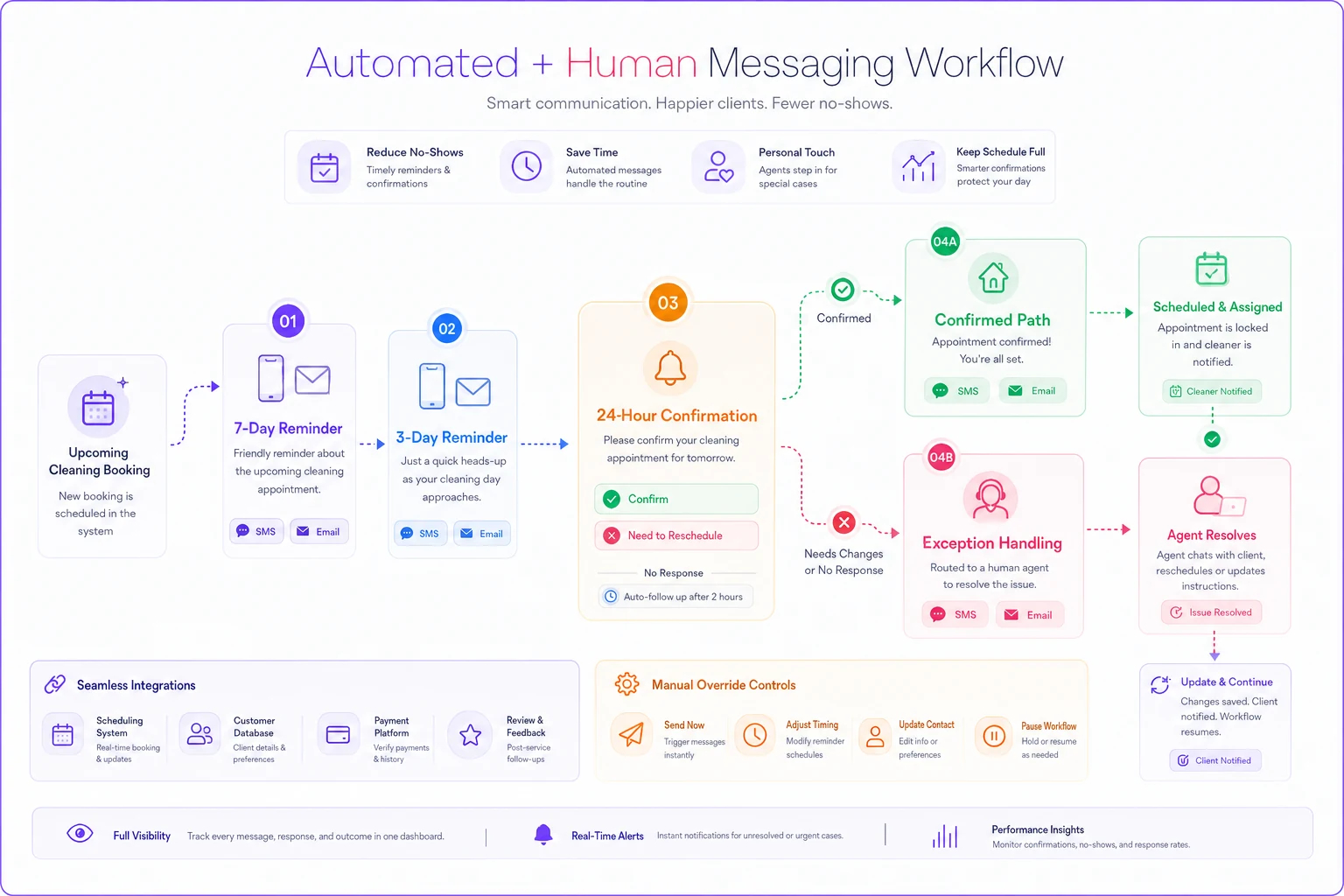
Not every message should be automated. The 7-day and 3-day messages work fine as automated sequences. But the 24-hour confirmation and any actual cancellation conversations need a human involved.
Automation can't read context. When Mrs. Henderson replies to your 24-hour confirmation with "My mother is in the hospital," an automated system might fire off the standard cancellation fee notice. A human recognizes that requires empathy, not enforcement.
The balance looks like:
-
Automated
Initial touchpoints, standard reminders, basic confirmations
-
Human
Confirmation responses, cancellation conversations, special circumstances
-
Hybrid
Automated send with human monitoring of responses
Use automation to scale predictable work and humans to handle exceptions and empathy.
The pre-payment solution most owners resist
Nothing reduces cancellations like money already spent. But most cleaning companies resist pre-payment because they expect client pushback.
Clients who pre-pay monthly cancel roughly 73% less than pay-after-service clients. The psychological weight of already-spent money outweighs the minor inconveniences that usually trigger a last-minute cancellation.
Implementation approach:
-
Start with new clients only
-
Position as a "membership" with perks (priority scheduling, rate lock, no cancellation fees for emergencies)
-
Offer 5% discount for monthly pre-payment
-
Gradually migrate existing clients during renewal conversations
The resistance you expect rarely materializes. Professional clients understand pre-payment from every other service industry. The ones who push back hardest were probably your problem cancelers anyway.
Building the technical infrastructure
Managing this level of communication manually becomes impossible past 30 or so clients. You need systems that handle the complexity without creating more administrative work for you.
Here's a visual of the automated-human workflow for messaging, confirmations, and overrides.
-
Multi-channel messaging (SMS and email)
-
Conditional logic (different messages for different client types)
-
Response tracking
-
Manual override options
-
Integration with your scheduling system
The setup investment pays off quickly. One saved cancellation per week covers most platform costs. The bigger gain is operational — not chasing confirmations, not manually firing off reminders — you get hours back every week that you can actually use.
Real numbers from a Dallas cleaning service
A 12-person operation in Dallas implemented this exact framework:
| Before | After |
|---|---|
| 340 monthly appointments | 355 monthly appointments (grew due to better availability) |
| 49 monthly cancellations (14.4% rate) | 19 monthly cancellations (5.4% rate) |
| $5,880 monthly revenue loss | $2,280 monthly revenue loss |
| 3 crew members frequently idle | Consistent crew utilization |
The drop in cancellations didn't just recover revenue — it improved crew morale, reduced scheduling stress, and created capacity to grow without immediately needing to hire.
Common implementation mistakes
Starting too aggressive: Don't roll out all seven touchpoints at once with existing clients. Phase it in over 5-6 weeks.
Inconsistent enforcement: If you charge cancellation fees, charge them every time. Selective enforcement breeds resentment faster than the fee itself.
Robotic language: Templates are starting points. Your 5-year client should get different messaging than someone on their second cleaning.
Ignoring response patterns: Track which messages actually get replies. If nobody's confirming at 24 hours, the message or timing needs adjustment.
Abandoning during busy seasons: December cancellations spike everywhere. That's a seasonal pattern, not a system failure.
Who shouldn't implement this system
Single operator cleaners: You don't have the volume to justify the infrastructure. Simple 24-hour reminders are enough.
Premium estate services: Clients paying $500+ per cleaning need white-glove communication, not automated sequences.
On-demand only operations: Without recurring schedules, this framework doesn't really apply.
The mindset shift that matters most
Stop treating cancellations as client problems. They're operational problems with operational solutions.
Every cancellation represents a gap somewhere in your commitment-building process. Maybe you scheduled them at an unsustainable time. Maybe your reminder cadence made passive cancellation too easy. When you own the problem, you can actually fix it.
Most cleaning businesses accept 12-15% cancellation rates as industry standard. But that standard reflects operators who never systematically addressed the problem. Recurring bookings can be as reliable as commercial contracts — you just need the right framework and the discipline to follow through.
The combination of strategic timing, psychological commitment building, and appropriate automation typically cuts cancellations by 60% or more within 90 days. For an average operation, that's $3,600+ recovered monthly. More importantly, it's the kind of predictability that lets you grow confidently, hire strategically, and stop dreading Thursday mornings.
Your 2pm Thursday slots shouldn't feel like question marks. With the right approach to reduce cleaning cancellations, they become the stable foundation your entire operation builds on.
Ready to elevate your cleaning business?
Join 500+ cleaning services using Maidufy to save time, reduce scheduling errors, and deliver exceptional client satisfaction.