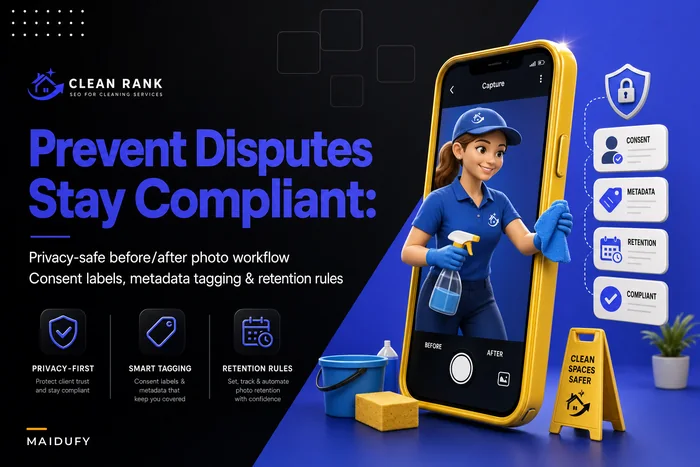



Most cleaning businesses don't have a data problem until the moment they really, really have one. A client disputes a charge and you can't find the before photos. A manager leaves and takes the only clean copy of the client notes with them. An insurer asks for proof of a completed deep clean from fourteen months ago and you're scrolling through a shared phone's camera roll at 11pm.
The frustrating part? Most owners already have a policy. "We keep before/after photos." "We delete client data when they cancel." "Payroll records stay for X years." The policy exists in someone's head or buried in a Google Doc nobody reads. What's missing is the bridge between the policy and the system that actually does it. That's the whole game of data governance for a cleaning business — not writing rules, but making the rules runnable.
This piece is about building that bridge. We'll cover machine-friendly schemas (especially for photo and evidence metadata), retention tiers that match how your business actually operates, and copyable export/ETL recipes simple enough to hand to a bookkeeper or a cheap contractor and have them work. The point isn't to turn you into a data engineer. It's to stop the slow leak of lost records, duplicate files, and "where did that go" moments that quietly cost you disputes and hours.
Why written policies almost never get followed
The gap is almost always between the policy and the field. A policy says "every deep clean needs before/after photos." The reality is a cleaner finishing a job, tired, uploading twelve blurry photos to a shared album with no job ID, no room label, and no timestamp that survives the upload. Six months later, nobody can tell which photos belong to which visit.
What you see across a lot of small operations is that governance fails for three structural reasons, not because people are careless:
-
Policies describe outcomes, not fields. "Keep good records" tells nobody what to actually capture.
-
The capture tool and the storage tool are different. Photos live on phones, invoices live in QuickBooks, notes live in a scheduling app. Nothing links them.
-
Nobody owns the schema. When there's no agreed structure for what a record looks like, every person invents their own, and the data becomes un-queryable.
The result is data that technically exists but can't be used. You have 4,000 photos and no way to pull the three you need. That's the difference between having data and having governance.
If you've already worked through data maturity — the metrics, storage patterns, and decision cadences owners can adopt, think of this as the layer underneath it. Maturity is about using data to make decisions. Governance is about making sure the data is clean, findable, and legal enough to use in the first place.
Start with the schema, not the policy
Here's the shift that makes everything else work: write the schema first, then let the policy point at it. A schema is just the agreed shape of a record — the required fields, their names, and what counts as valid.
Never miss a cleaning appointment again.
Maidufy helps you book, confirm, and manage every cleaning service seamlessly.
- Centralized booking management
- Automated client reminders
- Optimized staff scheduling
No credit card required
The highest-leverage schema for a cleaning business is the photo/evidence record, because it's what settles disputes, backs up insurance claims, and proves service was delivered. Most owners capture photos but capture zero usable metadata around them.
A minimal but machine-friendly evidence schema looks like this:
| Field | Type | Example | Why it matters |
|---|---|---|---|
evidence_id | string (unique) | ev_2024-0417-A3 | Lets you reference one exact record |
job_id | string | job_88214 | Links photo to the visit and invoice |
client_id | string | cl_0391 | Enables per-client retention rules |
capture_timestamp | ISO 8601 | 2024-04-17T14:32:05Z | Survives file renaming; proves timing |
stage | enum | before / after / issue | Makes disputes searchable |
roomorarea | string | master_bath | Finds the one photo you need fast |
captured_by | string | tech_jrod | Accountability and payroll cross-check |
consent_status | enum | granted / declined / n_a | Legal gate before any marketing use |
retention_tier | enum | dispute / standard / marketing | Drives auto-deletion later |
storage_uri | string | s3://evidence/2024/04/... | Where the actual file lives |
Most of these fields can be captured automatically. Timestamp, capturedby, and storageuri can be filled by the app. Jobid and clientid come from whatever the tech has open when they shoot the photo. Only stage, roomorarea, and consent_status need a human tap. That's the whole philosophy — the schema is rich, but the field burden on the person in the field is tiny.
Getting consent_status right at the moment of capture is what keeps you out of trouble later. The privacy side of this — consent language, who can appear in a shot, how long you hold images — is covered in depth in the privacy-safe before/after photo workflow with consent language and retention rules, and it pairs directly with the schema above.
Retention tiers that match how the business actually runs
The reason most retention policies get ignored is that they're written as one blunt rule — "keep everything for seven years" or worse, "keep everything forever." Forever is a cost and a liability. Seven years for a blurry photo of a kitchen counter is absurd.
Governance gets practical when you sort records into tiers by why you'd ever need them again. Three tiers cover almost every cleaning business:
A simple retention map:
| Tier | Example records | Typical hold | Deletion trigger |
|---|---|---|---|
| Dispute / Legal | incident photos, payroll, signed receipts | state statute + buffer (often 4–7 yrs) | scheduled, after hold expires |
| Operational | routine photos, job notes | 12–24 months | rolling auto-purge |
| Marketing | consented images | while consent valid | consent withdrawn or campaign ends |
One thing worth calling out: a single photo can move between tiers. A routine after shot sits in Tier 2 — until the client disputes the charge, at which point it gets promoted to Tier 1 and its deletion clock pauses. Your governance system needs that promotion path, or you'll auto-delete the exact evidence you're about to need. Build the promotion rule once and it protects you quietly going forward.
Mapping each policy to a runnable action
This is where policy-to-automation stops being abstract. Every governance policy should break down into a trigger, a condition, and an action — three things a machine can execute without judgment calls.
Take the policy "delete routine photos after 18 months unless under dispute." Decomposed:
-
Trigger a nightly scheduled job.
-
Condition
retentiontier = standardANDcapturetimestampolder than 18 months ANDdispute_flag = false. -
Action move to a 30-day soft-delete holding bucket, then purge.
A policy that used to live in someone's head is now three lines that run while you sleep. The soft-delete buffer matters — never hard-delete on the first pass, because the one time your dispute flag didn't sync, you'll want that 30-day window to recover.
A workable sequence for turning any policy into automation:
-
Write the policy in one plain sentence.
-
Identify the record type and the schema fields it touches.
-
Define the trigger (time-based, event-based, or manual).
-
Write the condition using only fields that exist in the schema.
-
Define the action, and make the first version reversible.
-
Add a human checkpoint for anything destructive or legal.
-
Log every run so you can prove what happened and when.
Step 7 is the one owners skip and regret. A deletion that isn't logged is indistinguishable from data loss when someone asks about it later. The log is part of the governance, not an optional extra.
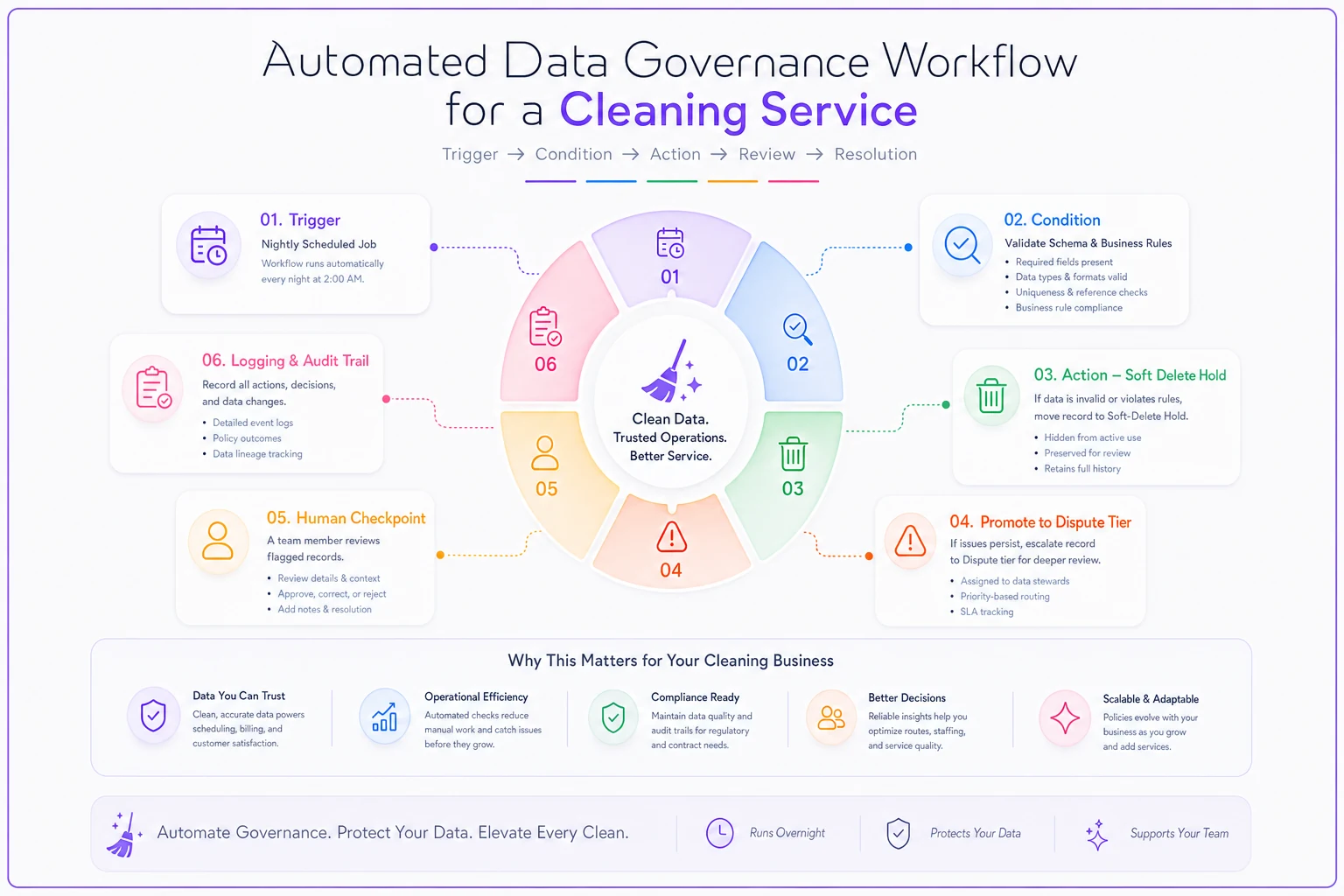
This visual summarizes the trigger → condition → action flow and where a human checkpoint and logging slot into the sequence.
Copyable export and ETL recipes
Governance isn't only about holding and deleting — it's about getting your data out in a clean shape when you need it. The three moments every cleaning business eventually hits: an insurance or legal request, switching software, and feeding a bookkeeper or accountant.
Keep the recipes boring and repeatable. A good export recipe has four parts: source, filter, transform, destination.
Recipe A — Dispute evidence package.
-
Source
evidence records
-
Filter
job_id = X -
Transform
bundle photos + metadata into a dated folder, include a one-page index (timestamps, stages, captured_by)
-
Destination
a single zipped export you can hand to a card processor or attorney
Recipe B — Monthly payroll + job reconciliation feed.
-
Source
job records + time entries
-
Filter
completed jobs in the pay period
-
Transform
join on
job_id, flatten to one row per job with tech, duration, and revenue -
Destination
CSV for the bookkeeper
Recipe C — Clean handoff export (software migration).
-
Source
clients, jobs, evidence index
-
Filter
active clients + last 24 months of jobs
-
Transform
normalize field names, strip Tier-3 marketing images without valid consent
-
Destination
structured CSVs plus a linked photo archive
The pattern that saves you: always export the metadata index alongside the files, never the files alone. A folder of 600 photos with no index is noise. The same 600 photos with a CSV mapping each to a job, room, and date is evidence. Your cash-flow and reconciliation work gets far cleaner when job and payment data export in this structured way too — it connects directly to the kind of forward planning covered in the owner cashflow forecasting playbook for mobile cleaning businesses.
A real scenario: the dispute that governance would've won
A two-crew residential cleaner, roughly 330 recurring visits a month, got hit with a chargeback on a $420 move-out deep clean. The client claimed the kitchen was never touched. The owner knew the crew had done it — the tech remembered — but the proof was scattered. Photos were in a shared phone album with no job labels. The visit note was in the scheduling app. The signed acceptance was a text message.
Reassembling the evidence took about three hours and still looked weak to the processor, because nothing linked together. They lost the dispute and ate the $420, plus the processor's fee.
After that, they adopted the evidence schema above. Every photo now carried a jobid, stage, timestamp, and capturedby at the moment of capture. Six weeks later, a near-identical dispute came in. The owner ran Recipe A, exported a single dated package in under ten minutes, and the processor reversed in their favor. Over the next year they estimated the structured evidence saved them somewhere in the $1,500–$2,500 range in disputes they'd previously have conceded — not a dramatic number, but pure margin they used to hand away.
The outcome that mattered more than the dollars: the owner stopped dreading disputes. When the data is governed, a chargeback is a ten-minute export, not a three-hour panic.
When this makes sense — and when it doesn't
When it's worth building now: you're past the solo stage, you have more than one person capturing data in the field, and you've already lost at least one dispute or record to disorganization. Multiple hands touching data is the real trigger — that's when inconsistent capture quietly compounds.
When it's premature: if you're a true solo operator doing a handful of jobs a week, a full tiered governance system is over-engineering. Capture clean photos with job references and keep a simple folder structure. Don't build machinery for a problem you don't have yet.
Who should be careful: anyone tempted to automate deletion before their capture is consistent. If half your records are missing retentiontier or consentstatus, an auto-purge rule will either delete too much or nothing at all. Fix capture first, automate deletion second. Governance built on messy input just automates the mess.
Making it stick
The failure mode isn't building the system — it's letting it rot. Schemas drift when a new hire invents their own labels. Retention rules quietly stop running when software changes. Consent flags go stale.
Three habits keep it alive:
-
One owner for the schema. Someone has to approve any change to the required fields. Without that, drift is guaranteed.
-
A quarterly spot-check. Pull ten random records. Are all required fields present? Did last quarter's deletions actually run and get logged? Fifteen minutes, four times a year.
-
Capture at the source. Every field you can auto-fill is one less thing to enforce. Every field that needs a human tap should take under two seconds.
Make the quarterly spot-check a calendar recurring task and keep a one-page checklist to speed the review.
Data governance for a cleaning business isn't a document you write once and file away. It's the quiet infrastructure that decides whether your records work for you when a dispute, an audit, or a migration shows up. Build the schema, sort your retention into tiers, map each policy to something a machine can run, and keep your export recipes copyable. Do that, and the next "where did that go" moment turns into a ten-minute export instead of a lost afternoon and a lost dispute.
Data governance for a cleaning business isn't a document you write once and file away. It's the quiet infrastructure that decides whether your records work for you when a dispute, an audit, or a migration shows up. Build the schema, sort your retention into tiers, map each policy to something a machine can run, and keep your export recipes copyable. Do that, and the next "where did that go" moment turns into a ten-minute export instead of a lost afternoon and a lost dispute.
Ready to elevate your cleaning business?
Join 500+ cleaning services using Maidufy to save time, reduce scheduling errors, and deliver exceptional client satisfaction.