



Most cleaning owners don't run out of money because the business is unprofitable. They run out because the money shows up on the wrong days. You can be making a solid 18% margin on paper and still have a Thursday where payroll clears before three big invoices settle, and suddenly you're moving money off a personal card to cover your own team.
That gap — between profit and cash in the account on a specific date — is the whole game. This playbook is built around that gap. It's not a lecture on what a cashflow forecast is. It's a set of scenario models and decision triggers you can copy into a spreadsheet this weekend and actually use to make calls: when to hire, when to open a route, when to stop, and when to protect payroll at all costs.
If you already track unit economics, good. This sits on top of that. If you don't yet have a clean read on per-job margins, fix that first — the forecasting below assumes you roughly know what each job type earns you. The owner-ready unit-econ dashboard breakdown is the right starting point before you model anything here.
Why cashflow forecasting breaks differently in cleaning businesses
Cashflow forecasting for a cleaning business isn't like forecasting for a shop with inventory. You don't have raw materials eating cash months ahead. Your biggest, most rigid outflow is payroll — weekly or biweekly and non-negotiable. Your inflows are lumpy and delayed: card settlements lag 1–3 days, invoiced commercial clients pay net-15 to net-45, and a chunk of your residential work is recurring but cancellable with 24 hours notice.
So the forecast that matters for cleaners is a weekly cash position model, not a monthly P&L dressed up. Monthly views hide the exact problem that kills small cleaners: the intra-month trough. You can finish a month up $6k and still have bounced through a -$1,800 low point on the 12th that forced a bad decision.
-
They forecast revenue (optimistically) but not the timing of when that revenue actually lands in the bank.
-
They treat payroll as a monthly number instead of mapping it to actual pay dates against actual settlement dates.
-
They have no trigger rules — so decisions get made emotionally when the balance looks scary, not when a pre-set threshold is hit.
Stop forecasting "how much" and start forecasting "how much, on what day, and what I do when it drops below X."
The base model: a 13-week rolling cash view
Thirteen weeks is the sweet spot. Long enough to see a seasonal dip coming, short enough that your estimates aren't fantasy. Build it as a rolling model — every Monday you drop the oldest week and add a new one at the far end.
Never miss a cleaning appointment again.
Maidufy helps you book, confirm, and manage every cleaning service seamlessly.
- Centralized booking management
- Automated client reminders
- Optimized staff scheduling
No credit card required
Here's the skeleton you want in a spreadsheet. One column per week, these rows:
| Row | What goes in it |
|---|---|
| Opening cash | Actual bank balance Monday morning |
| Recurring residential (collected) | Expected collections after settlement lag |
| One-off/deep cleans (collected) | Only what you realistically expect to clear that week |
| Commercial invoices (collected) | Based on invoice date + payment terms, not job date |
| Total inflow | Sum of the above |
| Payroll | Gross + employer taxes, on actual pay dates |
| Subcontractor payouts | On their actual payout schedule |
| Fixed costs | Rent, insurance, software, vehicle payments |
| Variable/supplies | Averaged, bumped for known big jobs |
| Tax set-aside | A real line, not an afterthought |
| Total outflow | Sum |
| Net weekly | Inflow − outflow |
| Closing cash | Opening + net |
| Lowest point hit | Your real intra-week low, flagged |
That last row matters more than closing cash. If your closing balance is $4k but you dipped to $300 mid-week before a Friday settlement, your true safety number is $300. Forecast the trough, not the Friday photo.
The single most common mistake: people put revenue in the week the job was done. Put it in the week the cash clears. A deep clean completed Friday on a card that settles Tuesday belongs in next week. Get this one thing right and your forecast suddenly matches your bank app.
Modeling seasonality without guessing
Cleaning demand isn't flat, and pretending it is wrecks Q1 for a lot of owners. The patterns are regional but the shape repeats: a strong late-spring through early-summer run, a holiday spike in November–December (deep cleans before guests), and then the January–February slump where recurring clients "pause for a bit" and one-offs dry up.
You don't need a fancy model. You need last year's actual weekly collections, adjusted. If you have 12+ months of history, build a simple seasonal index:
-
Take each month's total collected revenue.
-
Divide by your average monthly collected revenue.
-
That ratio is your seasonal index for that month (1.0 = average, 0.78 = 22% below average).
-
Apply the index to your forward base case.
A typical residential cleaner's indices land somewhere around: May–June near 1.15–1.25, November–December around 1.10–1.20, and January–February down near 0.75–0.85. If your January index is 0.80, you should be modeling a 20% revenue drop and checking whether payroll stays flat — it usually does, because you don't want to lose good cleaners over a slow month.
That mismatch — flat payroll against dropped revenue — is the entire reason January hurts undercapitalized cleaners. The model's job is to show you that trough in November so you can build a reserve for it, not discover it in real time.
Worth noting: seasonal modeling really earns its keep once you're past roughly $15k–$20k monthly revenue with a real payroll. Below that, you can almost feel the seasonality by instinct. Above it, the swings are too big to hold in your head.
Payroll-timing calendars and protection rules
Payroll is the line you never miss. Not because it's legally the sharpest (it is), but because the second your team doesn't trust the check, your best cleaners start taking calls from competitors. Retention and payroll reliability are basically the same thing.
Build a payroll-timing calendar that maps every pay date for the next 13 weeks against your forecasted cash position on that exact date. Biweekly payroll is especially sneaky — twice a year you hit a three-payroll month, and owners who budget for "two payrolls a month" get blindsided.
Mark on your calendar:
-
Every pay date (and the 2–3 days before, since you fund the account ahead).
-
The three-payroll months, highlighted.
-
Any pay date that lands within 3 days of a large fixed cost — rent, insurance, quarterly tax.
Those collision dates are your danger zones. A pay date sitting next to rent with a net-30 commercial invoice not yet collected is exactly where a profitable business writes a bad check.
The payroll-protection rule set
-
Reserve floor Keep at least 1.5× your single largest payroll in a separate account, untouched. Two payrolls' worth is better.
-
Funding lead time Fund payroll 2 business days early, always. Never rely on a same-day settlement to cover same-day wages.
-
Collision override When a pay date collides with a major fixed cost, that fixed cost gets paid after payroll, even if it means a late fee. A $35 late fee beats a missed check.
-
No-dip line Define a balance below which you do not spend on anything optional — supplies restock, marketing, new equipment — until it recovers. Everything optional pauses.
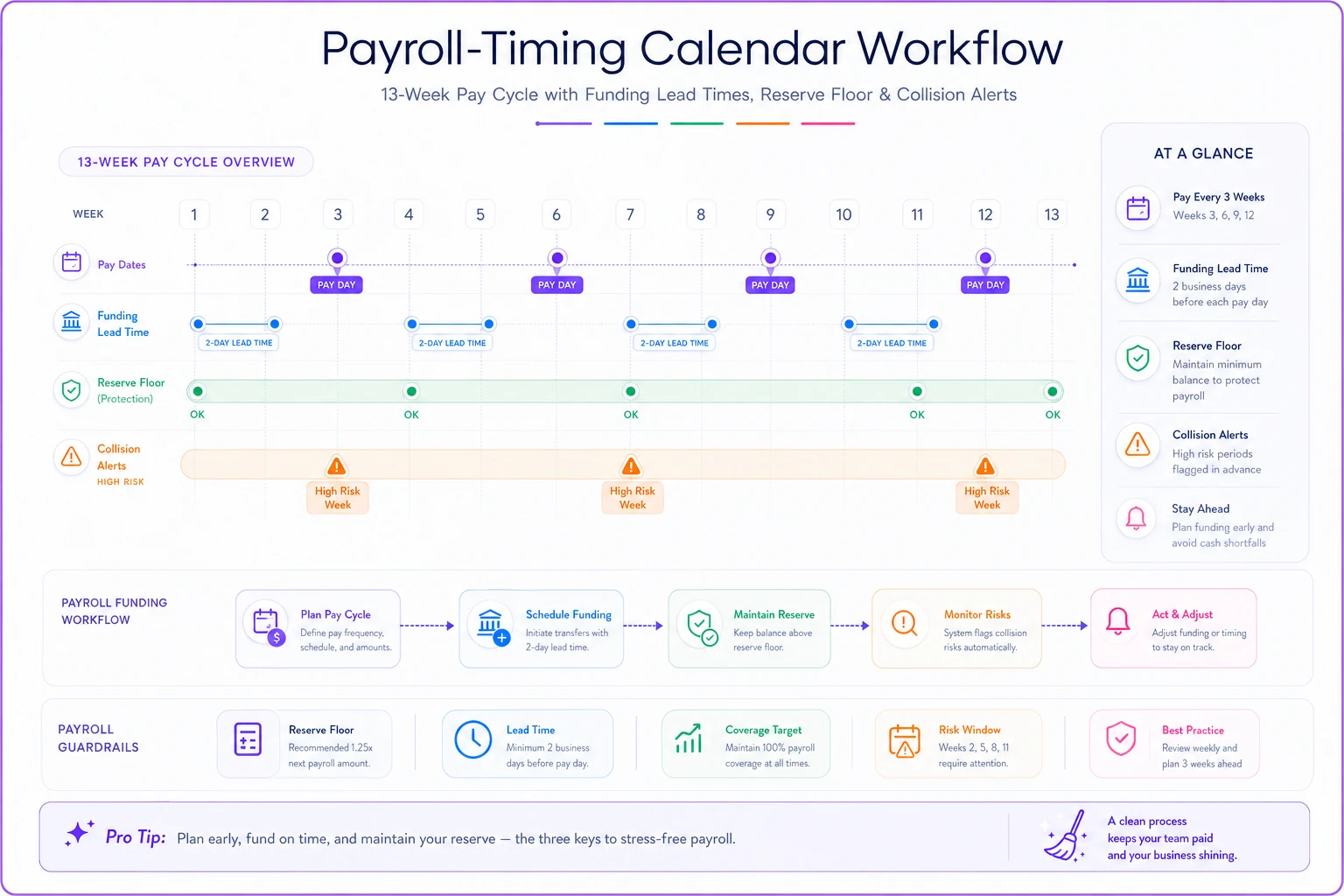
This diagram shows the steps for creating and maintaining a payroll-timing calendar and the protections to layer around pay dates.
Automate calendar reminders and pre-fund payroll two business days early to avoid last-minute funding gaps.
If you want the deeper logic behind reserve sizing and approval limits, the financial controls framework for small cleaners lays out deposit rules and reserve formulas that pair directly with these payroll protections.
Settlement-lag triggers (the silent cash killer)
There's a pattern that trips up growing cleaners constantly: revenue grows, cash gets tighter. It feels backwards. What's happening is the settlement lag scaling with you. When you were small, a 2-day card lag on $8k of weekly revenue tied up a few hundred dollars. At $25k weekly, that same lag is sitting on thousands in float at any given moment — and it grew fastest right when you added commercial clients on net-30.
Track settlement lag as its own metric, not buried in revenue. For each payment type, log:
-
Average days from service to cash-in-bank.
-
The dollar amount currently "in transit" — earned but uncollected.
Then set triggers:
-
If average commercial collection creeps past your terms by more than roughly a week, that's a trigger to pause taking new net-30 work until you tighten collections or require deposits.
-
If "in transit" dollars exceed your reserve floor, you're effectively financing clients out of your safety buffer — trigger to shift some commercial clients toward deposits or shorter terms.
-
If a single client is more than around 20% of outstanding receivables, that's a concentration risk trigger. One slow payer shouldn't be able to threaten your payroll.
A typical example: a cleaner adds two office contracts worth about $4k/month combined, net-30. Feels like a win. But now there's a 30–40 day gap between paying cleaners weekly to service those offices and actually getting paid. For the first six weeks or so, that growth costs cash. If the forecast didn't account for the lag, that's the month the owner panics and blames expenses.
Expansion and runway scenarios
This is where the forecast stops being a safety tool and becomes a growth tool. Before any big move — a new hire, a second crew, a new route, a van — run it as a scenario against the 13-week model and see what the trough does.
Build three columns next to your base case:
-
Conservative new revenue ramps slowly (assume the new route fills to around 60% in 90 days), costs hit immediately.
-
Expected realistic ramp based on how your last expansion actually went.
-
Downside new revenue barely materializes, costs are fully loaded.
The question is never "will this be profitable eventually." Almost everything is eventually. The question is: in the downside scenario, does my cash trough ever go below my reserve floor? If yes, you either delay, stage the move smaller, or line up a buffer first.
A new crew is the classic trap. You pay two new cleaners for weeks before the route is full. If you add two people at roughly $3,000–$3,500/month combined loaded cost, and the new route only brings in around $1,500 the first month, you're carrying $1,500–$2,000 of drag monthly until it ramps. Three months of that is $5k–$6k of cash you need to have before you hire — not revenue you're hoping to earn.
Deciding whether a specific route even deserves the investment is its own analysis. The method for scoring whether to open, expand, or sunset a territory is worked through in the route-profit decision guide, and it feeds directly into which scenario you model here.
Run expansion scenarios before any commitment that exceeds roughly one payroll's worth of cash. If the move requires taking on debt or dipping toward your reserve floor in any of the three scenarios, stage it smaller — you're not ready for the full version yet.
The go/no-go decision matrix
This is the part most owners never build, and it's the part that saves you from gut-driven mistakes. You pre-decide what action you take when cash hits certain levels. When the number comes up, you just execute — no agonizing at 11pm.
Define your levels relative to your largest payroll (call it P):
| Cash position (after reserve) | Status | Pre-decided actions |
|---|---|---|
| Above 3× P | Green | Normal ops. Consider staged expansion scenarios. Marketing spend on. |
| 1.5×–3× P | Yellow | Hold expansion. Tighten collections. Review receivables weekly, not monthly. |
| Reserve floor to 1.5× P | Orange | Pause all optional spend. Push for deposits on new work. Chase overdue invoices daily. No new hires. |
| Below reserve floor | Red | Payroll protection mode. Owner draw stops first. Defer every non-payroll, non-essential payment. Call slow payers personally. |
The point isn't the exact thresholds — yours will differ. The point is that the decision is made before the emotion hits. When you're in orange, you don't debate whether to pause marketing. You already paused it. The rule did.
Owners who hit red almost never got there from one bad event. They got there by making three "small" yellow-zone decisions — a hire, a van, a marketing push — in the same six weeks without re-running the forecast between them. The matrix exists to stop the stacking.
A real scenario
A residential cleaning business, around $32k monthly revenue, three cleaners plus the owner, biweekly payroll. Profitable on paper — roughly 16% net margin. But every six to eight weeks the owner was moving $1,000–$2,000 from a personal account to cover payroll, then paying it back once invoices landed. Stressful, and it felt like the business was failing even though it wasn't.
The problem wasn't profit. It was three things stacking: deep-clean revenue was being counted in the bank the week of service when it actually cleared 2–4 days later, two commercial clients on net-30 were quietly stretching to net-40, and the three-payroll months weren't on anyone's calendar.
The fix was unglamorous. Built the 13-week rolling model with cash dated to clearing, not service. Put the three-payroll months in red on the calendar. Set a reserve floor at 1.5× the largest payroll and physically moved that money to a separate account. Added a deposit requirement for deep cleans over a certain size, and shortened one commercial client to net-15 in exchange for a small discount.
Within about two months, the personal-account transfers stopped. Nothing about the revenue or margin really changed. The business was always fine — the timing was broken. Seeing the trough three weeks ahead instead of discovering it on payday was the whole difference.
How to keep the model from rotting
A forecast is only useful if it stays current, and this is where most owners quietly abandon it. Week two is great. Week nine it's stale and nobody trusts it.
The sustainable rhythm:
-
Every Monday (15 min) Update opening cash with the real balance. Roll the window forward one week.
-
Every Monday Compare last week's forecast to what actually happened. Where was it off? Adjust your assumptions — especially settlement lag and recurring-client cancellation rates.
-
Before any spending decision over roughly one payroll Re-run the three scenarios. Check the trough against your matrix.
-
Monthly Refresh seasonal indices if you've got new data. Re-check which month the next three-payroll cycle hits.
The weekly compare step is what keeps it honest. A forecast you never check against reality drifts into fiction. One you reconcile weekly gets sharper every month, because you're constantly correcting lag and cancellation assumptions with real numbers.
The reason this is hard to sustain manually is the data pull — balances, settlements, pending invoices, pay dates all live in different places, and copying them in every Monday is the chore people skip. This is where operational software that already holds your bookings, invoicing, and payment data starts pulling real weight: when inflows, settlement timing, and payroll dates feed the model automatically, the Monday update drops from a dreaded half-hour to a two-minute glance. The model stays alive because keeping it alive stopped being work.
Cashflow forecasting for a cleaning business isn't about predicting the future precisely. It's about seeing the trough before you fall into it, and deciding — in advance, cold-headed — exactly what you'll do when the number drops. Profit tells you the business works. The forecast tells you whether you survive the Tuesday it works badly.
Start with the 13-week rolling model, date everything to when cash actually clears, protect payroll with a hard reserve floor, and write your go/no-go matrix before you need it. Do those four things and most of the late-night money stress goes away — not because you're earning more, but because you stopped being surprised.
Ready to elevate your cleaning business?
Join 500+ cleaning services using Maidufy to save time, reduce scheduling errors, and deliver exceptional client satisfaction.