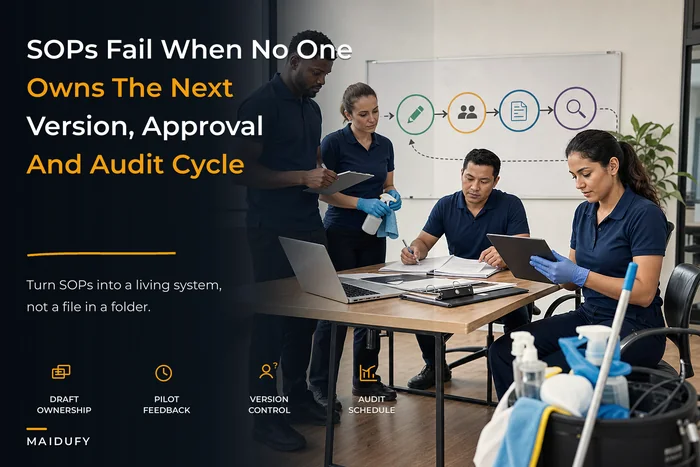



Most cleaning businesses don't fail because of one broken thing. They fail because thirty small things are each managed separately, by different people, with no shared logic connecting them. Pricing lives in the owner's head. SOPs live in a Google Doc nobody opens. Decision-rights land wherever the loudest argument settles that week. And margin? Margin is whatever's left after all of that fights it out.
That's the core problem with how most owners run operations. They treat pricing, standards, scheduling, payroll, and escalation as separate problems instead of a single connected system. When those pieces don't talk to each other, you get the thing every owner eventually recognizes: the business technically works, but only when you're watching it.
An operations fabric is what you build when you're tired of being the glue. It's the connective layer that stitches your unit economics, SOP governance, and decision-rights into one executable thing — a playbook a manager can actually run without texting you every forty minutes. This post is about how that fabric holds together, where it tears, and what changes as you scale.
Why the pieces drift apart in the first place
In the early days, you are the fabric. You know the margin on every job because you quoted it. You know the standard because you set it. You know who decides what because every decision is yours. Nothing needs to be written down — it's all in one head.
Then you hire. And the first thing that breaks isn't quality. It's consistency of logic.
Here's what that looks like in practice. A new manager reprices a recurring client who complained. Reasonable on its own. But that client was priced low on purpose — they're a referral anchor in a dense route. The manager didn't know the logic behind the number, just saw a number and a complaint. One decision, made without the economics attached, quietly broke a profitable route.
That's the pattern across almost every growing cleaning business: decisions get delegated before the logic behind the decisions does. People inherit the authority to act without inheriting the reasoning that should guide it. So they improvise. And improvisation at scale is just entropy with a payroll.
The fabric exists to stop that. It carries the "why" alongside the "what." A price isn't just a number — it's a number tied to a costing rule, a margin floor, and a decision-right that says who's allowed to move it. An SOP isn't just a checklist — it's a standard tied to a QA threshold and an escalation path for when that threshold gets missed.
The three threads that have to be woven together
Think of the fabric as three threads. On their own, each is useful. Woven together, they become executable.
Never miss a cleaning appointment again.
Maidufy helps you book, confirm, and manage every cleaning service seamlessly.
- Centralized booking management
- Automated client reminders
- Optimized staff scheduling
No credit card required
Thread one: unit economics. What each job type actually costs, what it earns, and where the margin floor sits. If you haven't built this yet, that's the starting point — your owner-ready unit-econ dashboard is the raw material the whole fabric is cut from. Without real per-job economics, every other rule is guessing.
Thread two: SOP governance. Not just having SOPs, but having them governed — versioned, approved, and auditable so the standard doesn't quietly rot the moment you stop personally enforcing it. A lightweight SOP governance lifecycle is what keeps things consistent whether it's a quiet Tuesday in March or a chaotic holiday week with three callouts.
Thread three: decision-rights. Who decides what, within what limits, and when something has to escalate. This is the thread most owners skip entirely, and it causes the most expensive confusion. A clear decision-rights map turns "ask the owner" into "follow the rule."
The fabric isn't any one of these. It's the weave. Unit economics sets the limits. SOP governance sets the standard. Decision-rights determines who moves inside those limits without asking. When one thread is missing, the other two fray.
A quick way to see the dependency:
| Thread present | Thread missing | What actually happens |
|---|---|---|
| Economics + SOPs | Decision-rights | Everyone follows the standard but nobody can act — every edge case bottlenecks on the owner |
| Economics + Decision-rights | SOP governance | People act fast and confidently, but quality drifts because the standard keeps mutating |
| SOPs + Decision-rights | Economics | Clean, confident decisions that slowly destroy margin because nobody knows the floor |
That middle row is worth paying attention to. It's the trap fast-growing owners fall into — they empower people, they move fast, and twelve months later they're busier than ever and making less per job than when they started.
The artifact pack: making the fabric executable
A fabric you can't run is just a philosophy. The point is a small set of artifacts a manager opens on a normal workday and uses without needing to interpret anything. Four artifacts do most of the work.
1. The ritual calendar
This is the heartbeat. It answers: what operational decision gets made, by whom, on what day. Not a to-do list — a cadence of decisions.
-
Daily (manager, 10 min) callout coverage, same-day reschedules, any job flagged below QA threshold
-
Weekly (manager + owner, 30 min) route profitability check, repeat-client risk list, pricing exceptions logged that week
-
Monthly (owner) margin-floor review by job type, SOP change requests, decision-rights adjustments
-
Quarterly (owner) territory open/expand/sunset calls, reserve and capital review
The insight most owners miss: a decision without a scheduled home will always get made reactively. If "review pricing exceptions" doesn't have a slot on the calendar, it only happens after a client blows up. The ritual calendar converts reactive firefighting into scheduled, boring, predictable review. Boring is the goal. Boring is what margin looks like.
Lock pricing-exception and route-review slots on the ritual calendar before adding other recurring tasks so they don't drift.
2. Allocation rules
This is where economics and scheduling actually meet. Allocation rules decide which jobs get which resources — crew, time, protected recurring slots — based on what each job is actually worth.
-
Recurring clients above the margin floor get protected weekly slots that one-offs cannot bump.
-
One-off deep cleans get scheduled only into capacity that doesn't threaten a protected slot.
-
Any job that falls below the margin floor for two consecutive visits triggers a repricing review — it doesn't just quietly keep running.
-
New clients in a dense route get priority over equal-value clients in a sparse one, because route density is margin.
The common mistake is allocating by who asked first or who complained loudest instead of by economics. When allocation ignores unit economics, your best crews end up burning drive time on your worst jobs. Making the allocation logic explicit — and tying it to the numbers rather than the noise — is usually where the quickest margin recovery happens.
3. Escalation ladders
An escalation ladder answers the question that quietly costs the most money: when does a problem stop being the manager's and become the owner's?
-
Level 0 — crew handles a missed trash can, a forgotten request. Fix on the spot, log it.
-
Level 1 — manager handles a client complaint, a reschedule conflict, a credit under a set dollar limit.
-
Level 2 — manager handles + logs to weekly review repeat complaint on the same client or crew, a job below margin floor twice.
-
Level 3 — owner decides anything involving a refund over a threshold, a client cancellation of a protected recurring slot, a safety or compliance incident, a territory-level decision.
The point isn't the exact tiers — it's that the line is drawn in advance. When the line exists before the problem does, a manager doesn't have to guess whether to call you. The ladder already answered it.
4. The decision-rights map
This is the artifact that makes the other three safe to delegate. It names, per decision type, the limit a role can act within. Price moves up to X% without approval. Credits up to Y dollars. Schedule changes within the protected-slot rules. Everything beyond the limit escalates.
Authority should always come with a number attached. "You can handle pricing" is how routes die quietly. "You can adjust pricing within 8% of the standard rate, above the margin floor, logged weekly" is a fabric.
The four artifacts together form a closed loop — economics inform allocation, allocation rules surface exceptions, exceptions route through the escalation ladder, and the decision-rights map tells everyone what they're allowed to do without asking. Each artifact makes the others more useful.
What breaks at each stage of scale
[GRAPH: Workflow diagram showing operations fabric stress points by growth stage — from solo owner through first hire, first manager, multiple crews/routes, and multi-territory — with arrows indicating which thread (economics, SOP governance, or decision-rights) tears first at each transition point]
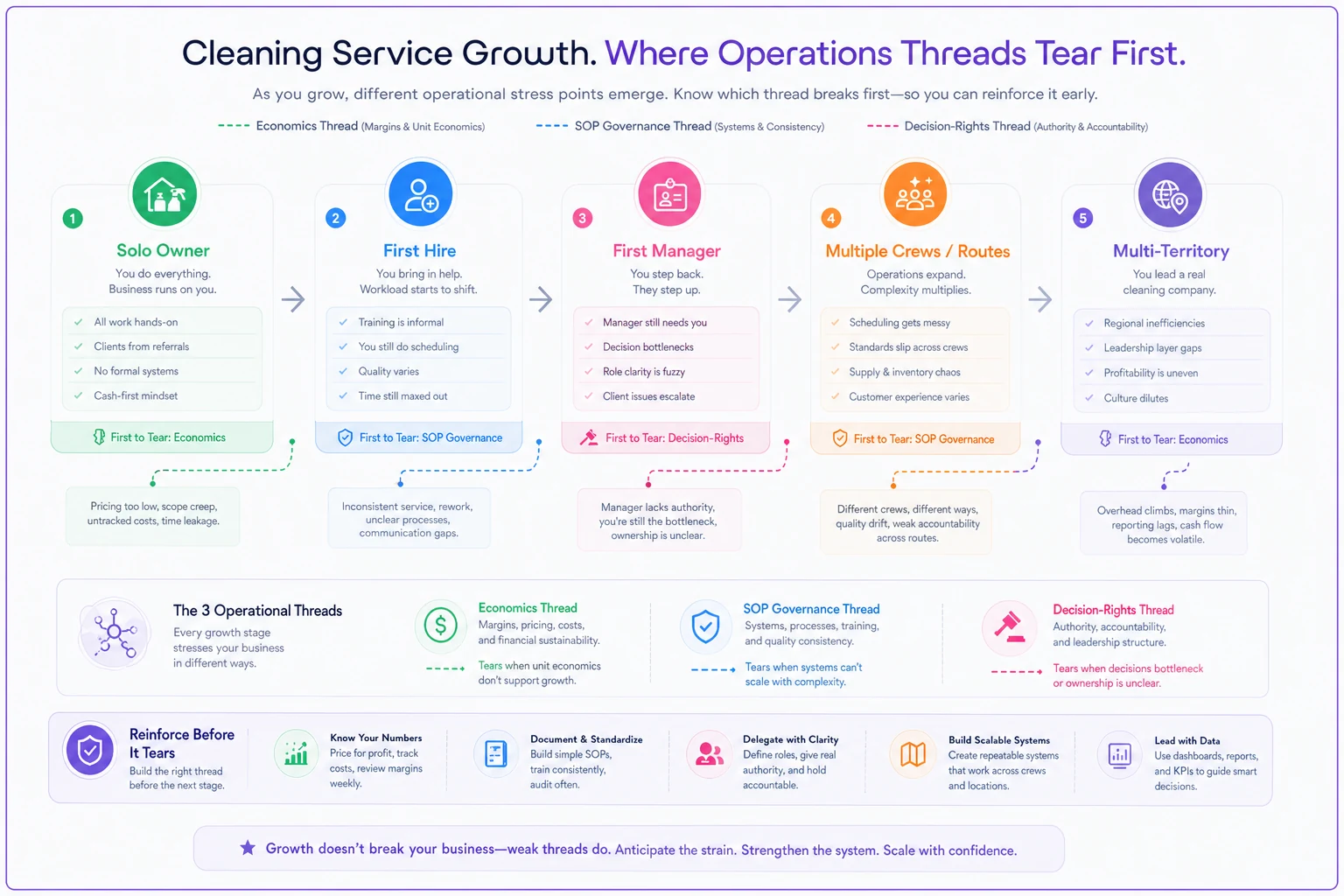
Solo to first hire. The tear here is tacit knowledge. Everything you know isn't written, so your first hire reconstructs your logic badly. SOP governance has to exist even if it feels like overkill for one employee. Writing it down for one person costs almost nothing. Not having it when you hit five people is expensive.
First manager. The tear is decision-rights. You delegate tasks but not authority, so either everything still funnels to you — meaning you didn't actually delegate — or the manager makes economics-blind calls because you delegated without limits. The escalation ladder and decision-rights map are what make this stage survivable.
Multiple crews, multiple routes. The tear is allocation. Now you have competing demands on finite capacity, and without explicit allocation rules tied to economics, scheduling becomes a popularity contest. Margin per route starts diverging wildly — some routes carry the business while others quietly bleed, and nobody can see which is which because the logic isn't written anywhere.
Multi-territory. The tear is the ritual calendar itself. You can no longer personally sit in on every review, so the cadence has to run without you in the room. If the weekly and monthly rituals only work when the owner drives them, you don't have a fabric — you have a dependency wearing a fabric costume.
A real scenario
A residential cleaning business running around 330–360 recurring visits a month, two crews plus a part-time float, had a profit problem they couldn't locate. Revenue was fine. The owner felt busy and broke at the same time — the classic symptom of a missing fabric.
When they laid it out, the threads were all disconnected. Pricing was set per-quote with no margin floor. SOPs existed but hadn't been updated in over a year, so QA complaints were climbing. And their one manager escalated everything, which meant the owner was approving $30 credits at 9pm while a slowly dying route went unnoticed for months.
They didn't buy anything new or hire anyone. They built the four artifacts. A margin floor by job type based on actual costs. A ritual calendar with a 30-minute weekly route-and-pricing review. Allocation rules protecting recurring slots. An escalation ladder with a credit limit and a hard owner-only line for refunds and protected-slot cancellations.
Over the next quarter, the owner's decision volume dropped sharply — most of the small stuff the manager now handled inside clear limits. One route that had been running below floor for months got flagged in the second weekly review and repriced, recovering probably a few thousand dollars a quarter that had been invisible. Margin per job didn't explode, but it stabilized — which was the actual goal. Predictable beat occasionally-great.
The owner's own summary was the part worth keeping: the business finally ran the same whether or not they were paying attention that week.
When building a full fabric actually makes sense
This isn't free. The artifacts take real thought to build, and over-engineering them for a one-person operation is a waste.
When it makes sense:
-
You've made your first non-crew hire (manager, coordinator, office help)
-
You're running more than one crew or more than one route
-
You catch yourself approving small decisions constantly
-
You can't quickly say which routes or job types carry your margin
When it's premature:
-
You're still solo and the "fabric" would just be you talking to yourself in a spreadsheet
-
You don't yet have real unit economics — build the unit-econ dashboard first, because allocation rules and margin floors are meaningless without it
-
You're trying to systematize before you've figured out what your actual standard is
One group who should hold off entirely: owners whose core problem is demand, not operations. If you don't have enough work, a decision-rights map won't help you. Get the pipeline stable first, then build the fabric that protects the margin on the work you win.
How the pieces run together on a normal week
Monday morning the manager opens the ritual calendar. Two callouts overnight — the escalation ladder says that's Level 1, manager handles, so they reassign coverage using the allocation rules (protected recurring slots stay protected, the one-off deep clean that could've absorbed the gap gets pushed). No owner involvement needed.
Midweek a client complains about price. The decision-rights map says the manager can adjust within 8% above the margin floor. This client's a sparse-route single, already near the floor — adjusting would push below it. That makes it Level 3: it escalates to the owner's weekly review instead of getting fixed on impulse.
Friday's 30-minute review surfaces that same client plus a route that dipped below floor twice. Both get decided with the economics on the table, not in a vacuum. The SOP change a crew lead requested goes into the governed approval flow rather than someone just editing the doc.
Nobody improvised. Nobody guessed where the line was. The owner touched exactly two decisions all week — the ones that actually needed them.
Predictable margin isn't a pricing achievement. It's a systems achievement. You can have perfect prices and still bleed money if allocation ignores them, if standards drift, or if decisions get made without the economics attached. The reason owners stay stuck in the business is almost never a single broken part — it's that the parts were never woven together into something that runs on its own logic.
Build the fabric while it's small and cheap to build. Tie your economics to your standards to your decision-rights, give it a cadence and a set of limits, and write it down so it survives the next hire. The business that results isn't necessarily bigger. It's calmer — and far more of its revenue actually makes it to the bottom line.
Ready to elevate your cleaning business?
Join 500+ cleaning services using Maidufy to save time, reduce scheduling errors, and deliver exceptional client satisfaction.