

Most cleaning businesses don't fail because the owner picked the wrong goal. They stall because the goal never travels. The owner decides "we're focused on cashflow this quarter," says it in one team meeting, and then goes back to bidding jobs and putting out fires. Three weeks later a supervisor is comping a client because nobody told her the comp budget changed, a crew is running an extra 40 minutes on a job that should've been repriced, and the owner is confused why cashflow didn't move.
That gap — between what the owner wants and what actually happens in the field on a Tuesday — is the real subject of operations governance for a cleaning business. Governance isn't a binder. It's the wiring that carries a single decision from the owner's head down into weekly rituals, checklists, and the moment a crew lead has to decide whether to call someone or just handle it.
This piece maps that wiring. One goal, translated all the way down, with the artifacts you can copy into your own shop.
Why the goal doesn't travel (and what that costs)
Owners think in outcomes. Managers work in actions. "Improve cashflow" is an outcome. A manager can't do "improve cashflow" on Monday morning. What they can do is chase the three deep-clean invoices that are 20 days late, hold two jobs until deposits clear, and stop authorizing free re-cleans over $75 without a photo.
When you don't translate the goal into those specific actions, one of two things happens. Either the manager guesses — and half their guesses point the wrong direction — or they default to whatever they were doing last month, which is usually "keep everyone busy." Busy is not the same as aligned.
The pattern gets obvious the moment you have more than one supervisor. Two managers, same vague instruction, produce two completely different operations. One tightens scheduling, the other loosens it to fill gaps. Both think they're helping. Neither is exactly wrong — they just never got decision rights that pointed the same way.
The cost of this isn't dramatic. It's a slow leak. A few points of margin here, a slightly-too-generous comp there, a manager who escalates everything because they're afraid to decide, or one who escalates nothing and creates messes the owner finds out about a month late.
The one-page map: goal → rituals → audits → escalation
Here's the whole model before we break it apart. Every owner goal has exactly four things hanging off it, and if any one of them is missing, the goal doesn't stick.
Never miss a cleaning appointment again.
Maidufy helps you book, confirm, and manage every cleaning service seamlessly.
- Centralized booking management
- Automated client reminders
- Optimized staff scheduling
No credit card required
| Layer | What it answers | Who owns it | Cadence |
|---|---|---|---|
| Owner goal | What are we optimizing this quarter — cashflow, growth, or quality? | Owner | Quarterly |
| Manager weekly rituals | What does the manager do every week to push the goal? | Manager | Weekly |
| SOP audits | Are the frontline steps actually being followed? | Manager / lead | Weekly or biweekly |
| Escalation ladder | When something breaks, who decides and how fast? | Everyone, by tier | Real-time |
You pick one primary goal. Not three. You can't optimize cashflow, growth, and quality at the same time with an eight-person crew — the trade-offs point in opposite directions. Growth means saying yes to marginal jobs; cashflow means saying no to some of them. Quality means slowing down; growth means speeding up. The owner's real job is to pick the constraint and let the rest of the org align behind it.
Below, all three goals run through the same layers so you can see how things shift depending on what you chose.
Goal one: cashflow
If cashflow is the constraint, the manager's week gets reorganized around cash movement, not just service delivery.
Weekly rituals become concrete: pull the aging report Monday, flag anything past 15 days, and make collection calls before noon. Review deposit compliance for the week — which jobs went out the door without a deposit and why. Check that no discretionary spend went out without hitting the approval limit.
SOP audits focus on the money-touching steps. Did every deep clean collect its deposit? Did anyone re-clean for free without documenting a reason? Are crews closing out jobs same-day so invoices go out same-day instead of in a Friday batch? That last one alone can shave a week off your average collection time.
Escalation ladder for cashflow is tight at the top. A crew lead can waive up to $30 in add-on time. A supervisor can approve a re-clean or comp up to $100. Anything above that — or any client asking for extended payment terms — goes to the owner. The point isn't to control every dollar. It's to make sure the pattern of small decisions doesn't quietly drain the account.
A useful gut-check: if you don't already have a clear view of unit economics per job, cashflow governance is mostly guessing. Building an owner-ready unit-econ dashboard first makes the cashflow map significantly sharper, because now the manager knows which jobs to hold and which to fast-track.
Goal two: growth
Growth flips the manager's incentives. Now the ritual is about capacity and conversion, not collection.
Weekly rituals center on the funnel and the schedule. How many leads came in, how many got quoted within 24 hours, how many booked. Where are the open slots next week and how do we fill them? Is anyone on the crew close to being ready to lead their own route — because growth stalls the second you run out of people who can run a job unsupervised.
SOP audits during a growth push shift toward onboarding consistency. Every new client onboarded the same way? Every new hire trained against the same checklist, not just "shadowing whoever's free"? Growth is where sloppy onboarding turns into churn — you win five new recurring clients and lose four because the first clean set the wrong expectation.
Escalation ladder loosens deliberately. During growth you want supervisors making more calls faster, because speed is the point. Raise the comp authority, let managers approve same-week schedule changes, and reserve owner escalation for genuinely new situations — a new service line, a corporate account, a territory question.
The subtle mistake: owners announce "growth" and then keep the cashflow-era approval limits, so every manager still has to check in for a $60 decision. The org can't move at growth speed with cashflow-speed brakes. If you picked growth, your escalation ladder has to actually reflect it.
Goal three: quality
Quality is the goal most owners say they want and least often build governance for. Calling yourself a premium service and never auditing the work is how you end up premium-priced and mediocre.
Weekly rituals become inspection-driven. The manager runs a structured QA review every week — not "how'd it go," but scored checklists against real jobs. This is exactly what a 30-minute weekly ops board is built for: pull the week's misses, look for the pattern, assign one fix. The ritual is what keeps quality from drifting between the good weeks and the busy ones.
SOP audits are the core of a quality goal. This is where SOP governance matters — not just having procedures, but making sure the version crews are following is the current one, that changes get approved instead of whispered, and that you can trace why a step exists. A lightweight SOP versioning and approval lifecycle is what separates "we have SOPs" from "our SOPs actually govern the work." Under a quality goal, audit frequency goes up and the manager spends real time here.
Escalation ladder for quality is different in character — it's about speed of recovery, not spend authority. A client complaint about work quality shouldn't wait for the Monday meeting. Tier it: crew lead handles minor touch-ups on the spot, supervisor owns any complaint that reaches the client a second time, owner gets looped on any client threatening to cancel a recurring contract. The clock matters more than the dollar amount here.
The artifacts pack you can drop in
The map above is useless if it lives in your head. Here's the compact set of documents that make governance real. Keep these thin enough that a manager actually uses them.
-
- RACI grid — one page. For each recurring decision (comps, reschedules, hiring, pricing exceptions), who is Responsible, Accountable, Consulted, Informed. Most cleaning shops have zero of these written down, which is why the same argument about "who was supposed to call the client" happens every month.
-
- Decision matrix — the dollar-and-scenario thresholds. "Comp up to $X: supervisor. Above $X: owner." Print it. Tape it in the office. Ambiguity is what makes managers freeze.
-
- Meeting agendas — a fixed weekly agenda per goal, so the manager isn't reinventing the meeting every week. Cashflow week looks at aging; quality week looks at QA scores. Same slots, every time.
-
- Experiment tracker — a simple log
what we changed, when, what we expected, what actually happened. This is how you tell whether a schedule tweak or a script change actually moved anything, instead of running on vibes.
-
- Escalation ladder card — the tiered "who decides what, and how fast" for your chosen goal.
Keep each artifact to one page or a single card so managers actually refer to them during the week.
A simple weekly rhythm to run all of it
-
1. Monday, 20 minutes — Manager reviews the goal-specific dashboard (aging, funnel, or QA scores depending on the quarter's goal) and picks the top three issues.
-
2. Monday — Run the fixed meeting agenda for that goal. Assign one owner and one deadline per issue. No open-ended "we should look into that."
-
3. Midweek — Manager does the SOP audit sample. Not every job — pull 3 to 5 and check them against the current checklist.
-
4. Any day, real-time — When something breaks, whoever hits it uses the decision matrix and escalation card. No matrix hit? Then it's a policy gap; log it.
-
5. Friday, 10 minutes — Update the experiment tracker. What did we try this week, what happened.
-
6. Quarter end — Owner reviews the tracker, confirms or changes the primary goal, and re-issues the decision matrix if the goal changed.
That's the whole loop. It's boring on purpose. Boring is what survives a busy month.
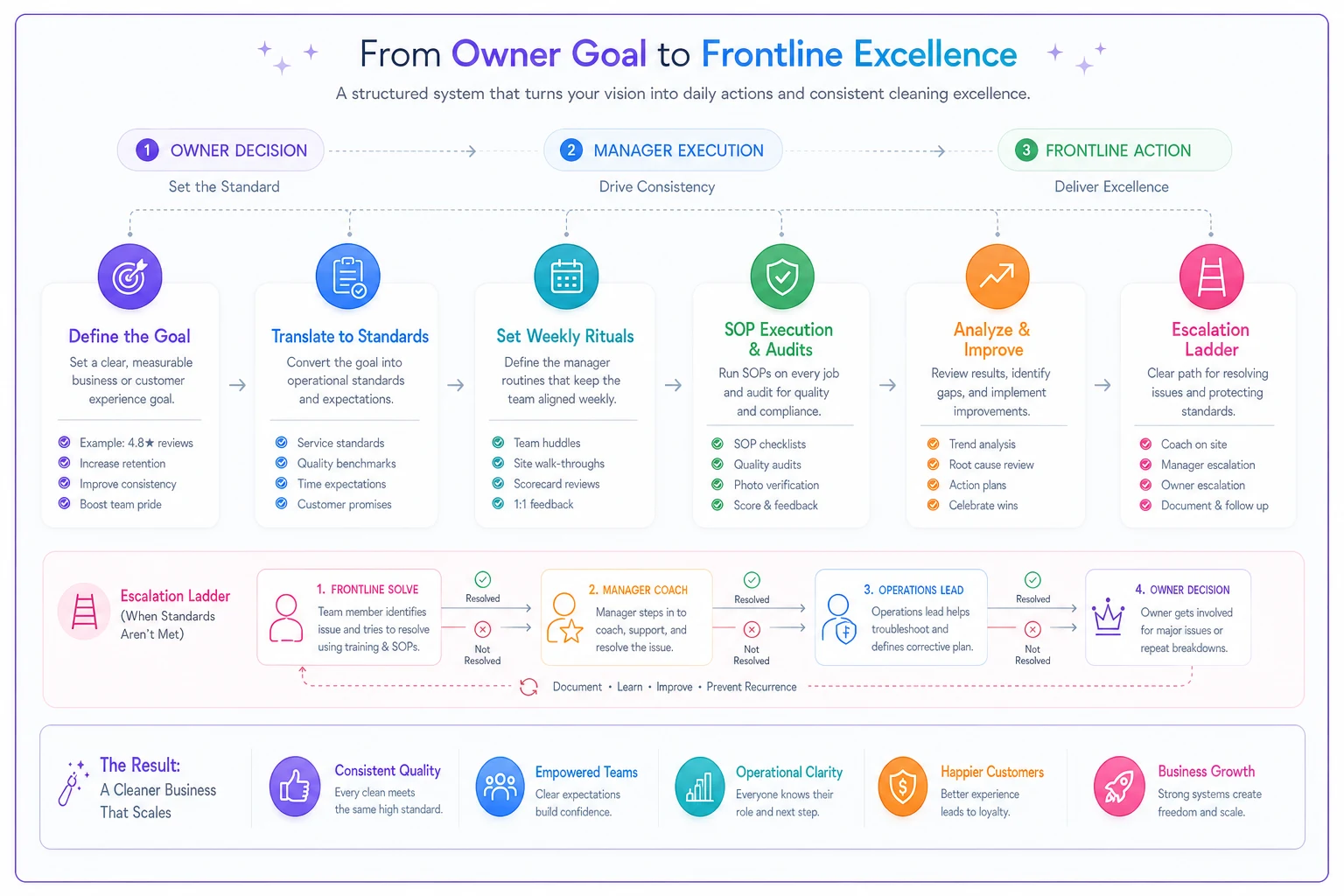
A compact diagram like this helps managers see the chain from the owner's single constraint down to the decisions a crew lead makes on the job.
When to formalize this — and when not to
When this actually makes sense: you have at least one manager or lead making decisions without you in the room. The moment someone other than the owner is comping, rescheduling, or handling complaints, you need the map. Two-supervisor shops are the sweet spot — that's where misalignment starts costing real money.
When it's a bad idea to over-build: if you're still a solo operator or a two-person crew, a full RACI grid is theater. You are the escalation ladder. Write down the decision matrix and skip the rest until you actually have someone to delegate to.
Who should skip this entirely: owners who won't commit to a single goal. If you genuinely won't pick cashflow, growth, or quality and stick to it for a quarter, the map just becomes three contradictory sets of instructions — which is exactly the mess you started with.
A real scenario
A residential cleaning operation running around 300–330 recurring jobs a month, two supervisors, no written decision rights. The owner said the goal was cashflow but the actual behavior said otherwise — supervisors were comping freely, deposits were inconsistent, and invoices went out in a Friday batch.
They spent one afternoon building the pack: a cashflow decision matrix (comp caps at $30 lead / $100 supervisor), a same-day close-out SOP with a weekly 5-job audit, and a Monday aging ritual. Nothing fancy.
Over the next couple of months, average collection time dropped by roughly a week, discretionary comps fell by more than half, and — the part the owner didn't expect — the supervisors reported feeling less stressed. Not because they had less authority, but because they finally knew where their authority ended. The ambiguity was the thing wearing them down.
The point
Operations governance in a cleaning business isn't about control. It's about making a single decision travel — from the owner picking a constraint, down through the manager's week, into the checklist a crew lead follows, and into the split-second call someone makes when a client is unhappy at the door.
Pick one goal. Translate it into rituals, audits, and an escalation ladder. Write the artifacts thin enough to actually use. Then let the map do the work of keeping everyone pointed the same direction, so you're not the only wire carrying every decision.
Operations governance in a cleaning business isn't about control. It's about making a single decision travel — from the owner picking a constraint, down through the manager's week, into the checklist a crew lead follows, and into the split-second call someone makes when a client is unhappy at the door.
Pick one goal. Translate it into rituals, audits, and an escalation ladder. Write the artifacts thin enough to actually use. Then let the map do the work of keeping everyone pointed the same direction, so you're not the only wire carrying every decision.
Ready to elevate your cleaning business?
Join 500+ cleaning services using Maidufy to save time, reduce scheduling errors, and deliver exceptional client satisfaction.