


Most cleaning businesses don't lose margin because of bad cleaners. They lose it because the person between the owner and the field — the manager — is operating without a real scorecard, without a predictable rhythm, and usually without a bonus structure that connects their paycheck to route profitability.
That gap is invisible until you hit about 3 crews. Below that, the owner is still close enough to catch problems. Above it, the owner is relying on a manager's judgment they've never actually measured, and the business quietly starts bleeding money in places nobody is watching.
This piece is about fixing that layer. Not with more meetings or more spreadsheets, but with an actual governance system: a KPI scorecard, a weekly cadence, bonus formulas that pay for margin (not activity), guardrails so nobody games the numbers, and worked examples a manager can run themselves. The phrase people search for is manager governance cleaning business, but what they're really after is a way to make the manager role predictable instead of personality-dependent.
Why the manager layer quietly breaks margins
Here's the pattern that shows up across a lot of growing cleaning operations. The owner promotes their best cleaner or best coordinator into a manager role. They're good with clients, good with the crews, everyone likes them. So the owner stops looking closely.
Six months later, margins on half the routes have slipped two or three points and nobody can say exactly when it happened.
Why? Because the manager was optimizing for the things they could feel — happy clients, no complaints, crews that showed up — and ignoring the things they couldn't see: drive time creeping up, deep cleans getting under-scoped, overtime slowly becoming normal, discounts handed out to keep a grumpy client quiet.
None of those are firing offenses. They're small decisions that felt reasonable in the moment. But a manager without a scorecard has no reason to weigh a 15-minute favor to a client against the route margin it eats. The reasonable-in-the-moment decision almost always wins, because it's the one standing right in front of them.
The real problem isn't the manager. It's that nobody ever defined what "good" looks like in numbers. You can't hold someone accountable to a standard that only exists in the owner's head.
The manager KPI scorecard: what to actually measure
A manager scorecard should be short enough to fit on one screen and specific enough that two people reading it would agree on the number. Vanity metrics — "client satisfaction," "team morale" — don't belong here unless you can tie them to something countable.
Never miss a cleaning appointment again.
Maidufy helps you book, confirm, and manage every cleaning service seamlessly.
- Centralized booking management
- Automated client reminders
- Optimized staff scheduling
No credit card required
What tends to work best is a scorecard built around five or six numbers, grouped into three buckets: margin, quality, and reliability. If a metric doesn't fall into one of those, it's probably noise.
| Metric | Bucket | Target (example) | Why it matters |
|---|---|---|---|
| Route gross margin % | Margin | 38–45% | The whole point. Catches scope creep and overtime drift. |
| Labor cost as % of revenue | Margin | ≤ 33% | Flags overtime and over-crewing before payroll does. |
| Rework / callback rate | Quality | < 4% of visits | Redone jobs are pure margin loss plus a trust hit. |
| QA inspection pass rate | Quality | ≥ 90% | Ties the field to your actual standards, not vibes. |
| On-time start rate | Reliability | ≥ 92% | Late starts cascade through the whole route. |
| Recurring client retention | Reliability | ≥ 90% quarterly | The manager owns the relationship that keeps revenue predictable. |
A couple of things that matter more than the exact targets:
The numbers should be manager-controllable. Don't grade a manager on something they can't influence. If marketing sets the price and the owner approves discounts, don't put raw revenue on the manager's scorecard — put margin, which they actually steer through scheduling, scoping, and labor.
The targets should be ranges, not single points. A route running 44% one month and 39% the next isn't a crisis. A route sliding 44 → 41 → 38 → 36 over four months is. The scorecard exists to show trend, not to punish normal variance.
If you've already built out your staffing ratios and delegation structure, this scorecard sits right on top of that. The people architecture that protects margins as you scale defines who owns what; the scorecard defines how well they're doing it.
The weekly governance calendar
A scorecard nobody looks at is just a document. What makes it operational is a fixed rhythm — the same review happening at the same time every week, whether things are on fire or not.
The mistake most owners make is only pulling numbers when something goes wrong. That turns every review into a confrontation, and managers start hiding problems instead of surfacing them. A predictable calendar does the opposite: it makes reviewing the numbers boring and routine, which is exactly what you want.
Here's a cadence that works for an operation running 3–8 crews:
-
Monday, 15 min — Number pull. The manager (or the system) pulls last week's scorecard numbers before anyone talks. No discussion, just data on the table.
-
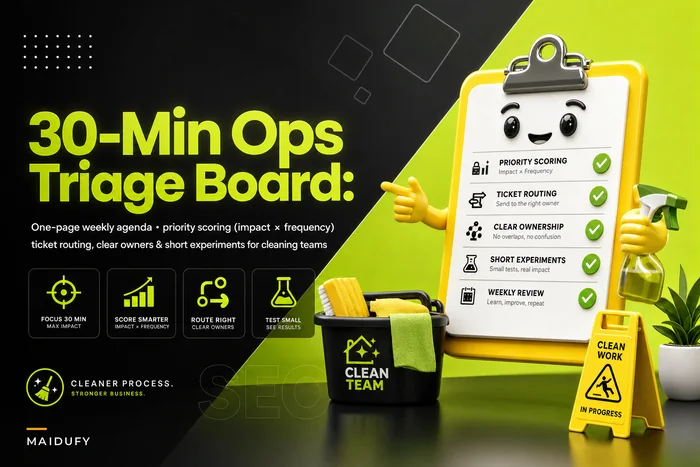
Monday, 30 min — Ops review. Manager and owner walk the scorecard. Anything out of range gets a one-line reason and a next step. This is where the 30-minute weekly ops board agenda fits naturally — same meeting, QA triage included.
-
Wednesday, async — Mid-week flag. Manager posts any route trending the wrong way so there's time to fix it before the week closes. No meeting, just a short written update.
-
Friday, 10 min — Close-out. Confirm the week's numbers landed, note anything to carry into Monday.
-
Monthly, 45 min — Trend + bonus check. Review the four-week trend, run the bonus calculation, and look at anything the weekly view is too zoomed-in to catch.
The async Wednesday flag is the piece most people skip and the one that probably saves the most money. A route margin problem caught on Wednesday is fixable that week. The same problem discovered at month-end is already baked into payroll and client expectations.
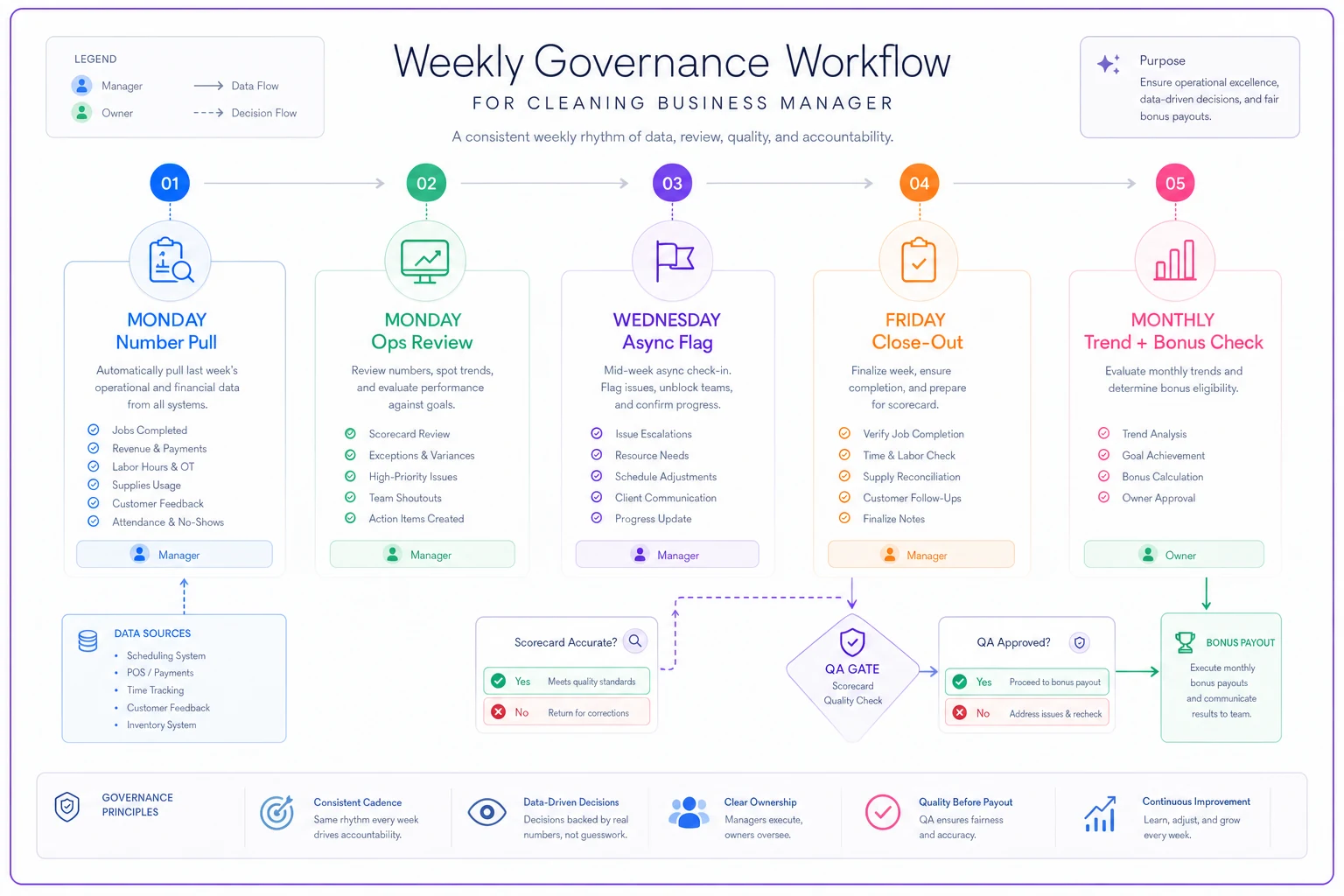
Keep the rhythm consistent whether things look fine or not — that's how problems get surfaced early instead of compounded.
Bonus formulas tied to route margin
This is where governance either works or quietly falls apart. If your manager bonus is tied to revenue, you've just paid someone to grow the top line regardless of what it costs you. Managers can hit every revenue target while margin craters, because nothing connected their comp to the number that actually feeds the business.
Tie the bonus to margin. Specifically, to margin above a floor, so the manager only gets paid on profit the business can afford to share.
Bonus = (Portfolio gross margin % − Floor %) × Portfolio revenue × Share rate
-
Floor % is the margin level you need to cover overhead and owner profit. Below this, no bonus — the manager is just doing the baseline job.
-
Share rate is the slice of margin above the floor you'll pay out, usually somewhere between 5% and 12%.
-
Portfolio means all routes the manager owns, blended — not cherry-picked wins.
A worked example a manager can actually run
Say a manager runs a portfolio doing roughly $62,000 in monthly revenue across their routes. The margin floor is 35%, and the share rate is 8%.
Month 1: portfolio margin comes in at 38%. Margin above floor is 3% (38% − 35%), which on $62,000 works out to $1,860 of shareable margin. Bonus: $1,860 × 8% = about $149.
Month 2: the manager tightens scheduling and cuts overtime, margin hits 42%. That's 7 points above floor — $4,340 shareable. Bonus: about $347.
That jump from $149 to $347 is the whole point. The manager can see, in plain math, that squeezing four points of margin out of the portfolio roughly doubled their bonus. They don't need you to explain why drive time matters — the formula explains it for them.
Keep the math simple enough that the manager can run it on their phone. If they can't calculate their own bonus, it won't change their behavior.
Anti-gaming guardrails
The second you attach money to a number, people optimize for the number — sometimes in ways that hurt the business. This isn't cynicism, it's just how incentives work. Good governance assumes gaming will happen and designs around it.
-
Skimping on labor. Sending two cleaners where three are needed. Margin looks great this month; callbacks and burnout show up next month.
-
Cherry-picking routes. Dumping hard, low-margin clients onto someone else so the "portfolio" looks clean.
-
Deferring costs. Skipping supply restocks or equipment maintenance to make the month's numbers.
-
Quality shortcuts. Rushing visits to pack in more stops, trading inspection scores for revenue.
The guardrails that neutralize these are worth spelling out clearly.
-
Pair margin with quality gates. No bonus pays out if rework rate or QA pass rate falls below threshold, regardless of how good margin looks. This single rule kills most gaming instantly.
-
Lock the portfolio. Route assignments are fixed for the bonus period. No reshuffling mid-month to game the blend.
-
Use a trailing window on quality. Measure callbacks over a rolling 60 days so a manager can't borrow against next month to inflate this one.
-
Clawback on deferred costs. If skipped maintenance or supply gaps show up later, it adjusts the prior bonus. Managers stop deferring when deferring doesn't pay.
The principle underneath all of these: never let a single metric stand alone. A margin number guarded by a quality gate is honest. A margin number by itself is an invitation.
Experiment mapping: how managers improve the numbers without guessing
A scorecard tells a manager what is off. It doesn't tell them what to do about it. Left to guess, managers either do nothing or change five things at once and learn nothing from any of it.
Experiment mapping fixes this. Every underperforming metric gets one small, testable change, run for a defined window, with a clear before/after comparison. One variable at a time.
-
Metric off Labor cost running at 36% on Route B.
-
Hypothesis Crew is over-staffed for the actual job size.
-
Experiment Drop from 3 cleaners to 2 on the four smallest stops for 3 weeks.
-
Guardrail watched QA pass rate and on-time start — if either drops, revert.
-
Result after 3 weeks Labor cost on Route B down to ~32%, QA held steady, one client noted no difference.
That's a documented win the manager can repeat and roll out to similar routes. Over a year, a manager accumulates a dozen proven adjustments instead of a dozen hunches.
Graduate proven experiments into SOPs so the whole team benefits, not just the route they were tested on.
This is where your SOPs come in. A proven experiment should graduate into a standard procedure so the whole team benefits, not just the route it was tested on. The SOP governance lifecycle — versioning, approvals, audit is where successful experiments go to become permanent, documented practice instead of tribal knowledge that walks out the door when the manager does.
A real scenario
A residential cleaning company running 5 crews and roughly $71k in monthly revenue had a manager everyone trusted. Clients liked her. Crews stayed. But blended route margin had drifted from the high 30s down to about 33% over two quarters, and the owner couldn't pinpoint why.
They put a scorecard in place — six metrics, Monday review, margin-based bonus with a 35% floor and quality gates. The first month was rough: three of five routes were below floor, so the bonus came out near zero. But the review surfaced the actual causes — one route had quietly accumulated 20% overtime, two deep-clean clients were being under-scoped every visit, and one route's drive time had ballooned after a client moved.
Nothing dramatic got fixed. The manager re-scoped the deep cleans, pulled overtime back in line, and re-sequenced the long-drive route. Over the next three months, blended margin climbed back to around 40%. The manager's bonus went from near-zero to a few hundred dollars a month — and for the first time, she could explain exactly what she'd done to earn it.
The business didn't change its prices or its clients. It changed what the manager was measured and paid on. That was the whole intervention.
When this makes sense — and when it doesn't
This makes sense when you've got at least 3 crews and a real manager layer between you and the field. At that scale, the owner can no longer catch everything by instinct, and the cost of an unmeasured manager starts compounding.
This is overkill when you're still owner-operated with one or two crews. You're close enough to the work that a formal scorecard adds process without adding much insight. Keep it simple until the distance between you and the field is real.
Who should not rush into this: owners who haven't defined their own route costs yet. A margin-based bonus is only as good as your margin data. If you can't confidently state the true cost of a route — labor, drive, supplies, overhead allocation — build that first. A bonus formula sitting on bad cost data just pays people for your accounting errors.
Pulling it together
The manager layer is where cleaning businesses either scale cleanly or quietly fall apart. Most owners treat it as a trust problem — find a good person, hope they do right. Trust doesn't scale, and it doesn't survive the owner stepping back.
What scales is a system: a scorecard that defines "good" in numbers, a weekly rhythm that makes review routine, a bonus that pays for margin instead of motion, guardrails that keep the numbers honest, and experiments that turn problems into documented improvements. None of it requires expensive software or complicated math. It requires deciding, once, what you actually expect from the person running your crews — and then measuring it every single week.
Do that, and the manager role stops being a bet on someone's character and becomes a repeatable part of the business. That's the difference between a company that depends on one good manager and one that can hire, train, and hold any manager to a standard that protects the margin you worked to build.
Ready to elevate your cleaning business?
Join 500+ cleaning services using Maidufy to save time, reduce scheduling errors, and deliver exceptional client satisfaction.