

Most cleaning businesses don't lose control of labor because they hired the wrong people. They lose control because the decisions that govern labor — how many crews to staff, what to pay, when to call in a floater, how high to push surge — all live in different heads, get made at different times, and never talk to each other.
The owner forecasts demand in their gut. The dispatcher staffs each morning off whatever yesterday looked like. Pay rates got set two years ago and drift upward through one-off exceptions. Floaters get called when someone's already panicking at 7:40am. And surge pricing, if it exists at all, is a number someone picks because it "feels right" for a holiday week.
None of these are bad decisions on their own. The problem is that they aren't governed. There's no cadence connecting the forecast to the staffing plan, no table connecting the role to the pay band, no SLA connecting a callout to a floater showing up. That's what labor capacity governance actually means for a cleaning company — the rulebook that ties forecasting, pay, backfill and manager accountability into something an owner can hand off without the wheels coming off.
This article walks through how that system fits together, where it breaks as you scale past a handful of crews, and the specific allocation rules and tables you can operationalize this quarter.
Why labor decisions drift apart as you grow
When you're running two or three crews yourself, governance is invisible because you are the governance. You know who's reliable, you remember what everyone makes, you feel demand coming because you answer the phone. The coordination happens inside one brain.
The trouble starts somewhere around the fourth or fifth crew, usually when you've handed dispatch to a manager but haven't handed them a system. Now two people are making labor calls with different information. The manager staffs conservatively because an understaffed day is their problem to clean up. You, looking at the P&L, see idle labor and wonder why margins slipped. Neither of you is wrong. You're just governing the same resource with different incentives and no shared rules.
-
- Pay compression. New hires get bumped to close a gap, nobody adjusts the veterans, and six months later your best cleaner makes a dollar more than someone who started last month. Morale erodes quietly.
-
- Floater chaos. There's no defined trigger for when a floater gets activated, so they either sit unused or get burned out covering every no-show in the territory.
-
- Forecast blindness. Staffing reacts to yesterday instead of anticipating next week, so every seasonal swing feels like a surprise even though it happens on the same calendar every year.
-
- Surge guesswork. Peak pricing gets set emotionally. Sometimes you leave money on the table; sometimes you price yourself out and the crew sits.
The deeper issue is that these aren't separate failures. They're symptoms of the same missing layer. The forecast should drive the staffing plan, which should respect the pay bands, which should define when floaters activate, which should interact with surge caps. When that chain isn't written down, each link improvises.
If you've already read our take on people architecture to protect margins as cleaners scale, think of this as the operating layer that sits on top of your org chart — the rules that make the roles actually run.
The four pieces that have to connect
1. Forecasting cadence
Never miss a cleaning appointment again.
Maidufy helps you book, confirm, and manage every cleaning service seamlessly.
- Centralized booking management
- Automated client reminders
- Optimized staff scheduling
No credit card required
Your forecast is the trigger for everything downstream. Most owners either forecast too rarely — once a year, then they're flying blind — or not at all. The sweet spot for a residential cleaning operation is a rolling two-week forecast refreshed weekly, with a longer seasonal view updated monthly.
The weekly refresh is what lets you staff proactively. Every Thursday or Friday, you look at confirmed recurring jobs, booked one-offs, expected cancellations based on your historical rate, and known seasonal pressure. That produces a demand number in crew-hours, not just job counts — because a four-bedroom deep clean and a studio maintenance visit aren't the same labor unit.
A typical example: an operation running around 330 recurring visits a month knows, from its own data, that roughly 8–11% of recurring slots shift or cancel inside a week. So the forecast doesn't staff to 100% of booked — it staffs to expected delivered demand plus a small buffer. That single adjustment stops the chronic overstaffing that quietly eats a point or two of margin.
2. Pay-band tables
Once you know the labor you need, you need rules for what that labor costs. A pay-band table removes the single most corrosive labor-governance failure: discretionary, in-the-moment pay decisions.
| Role | Band floor | Midpoint | Ceiling | Advancement trigger |
|---|---|---|---|---|
| Trainee cleaner | $16.50 | — | $17.75 | 30 days + passing QA |
| Cleaner | $17.75 | $19.50 | $21.00 | QA score + tenure gates |
| Lead / crew lead | $21.00 | $23.00 | $25.50 | Crew reliability + inspection pass rate |
| Floater (premium) | Cleaner band + 8–12% | — | — | Flexibility differential, not a separate ladder |
Two things matter more than the exact numbers. First, floaters get a differential, not a separate career track — they're paid more because flexibility is worth more, not because they're senior. Second, advancement triggers are tied to measurable things like QA scores, which connects your pay governance directly to your quality system. If you want the quality side of that equation built out, our piece on manager standards that scale teams and protect margins covers the inspection standards these triggers should reference.
3. Floater activation SLAs
A floater is only valuable if there's a rule for when they get used and how fast they respond. Without an SLA, floaters become either a luxury that sits idle or a firefighter who's always on call and burns out in four months.
-
1. What triggers activation? Example rule
a floater activates when a crew drops below minimum staffing for a route with more than X billable hours that day, OR when a same-day cancellation would otherwise leave a recurring client unserved.
-
2. How fast must they be assigned? Example
floater assignment confirmed within 30 minutes of a confirmed no-show, before 7:30am for morning routes.
-
3. Who has authority to activate? The dispatcher activates up to a defined daily cap; anything beyond that needs manager sign-off. This keeps floater spend from quietly ballooning.
The hidden win here is that a clear activation rule actually reduces floater cost. When dispatch knows the exact trigger, they stop calling floaters for problems a route reshuffle could fix, and they stop hesitating on problems that genuinely need coverage.
4. Surge caps
Surge is where owners either overreach or underreact. A surge cap is simply the maximum multiplier dispatch or sales can apply without owner approval, tied to demand conditions.
-
- Standard demand no surge. List price holds.
-
- Elevated demand (holiday weeks, move-season spikes)
surge up to +15–20%, dispatcher-authorized.
-
- Constrained capacity (you're turning work away)
surge up to +30%, manager-authorized, with a hard cap above which the answer is "we're booked" rather than a higher number.
The cap matters because unbounded surge erodes trust with recurring clients, and recurring clients are the whole margin engine. Surge is for overflow and one-offs, not for punishing your base.
How the four pieces run as one workflow
None of those pieces do anything useful in isolation. They only create governance when they run on a shared cadence.
Weekly Forecast Refresh ↓ Crew-Hour Demand vs. Known Capacity ↓ Gap Analysis: Structural or Seasonal? ↓ ┌─────────────────────────────────┐ │ │ Activate Authorize Surge Flag Hiring Need Floaters (Shed Low-Value (Structural Gap) (SLA Rules) Demand) └─────────────────────────────────┘ ↓ Day-to-Day Dispatch Runs Inside Pre-Set Rules ↓ Manager Reviews Exceptions Only
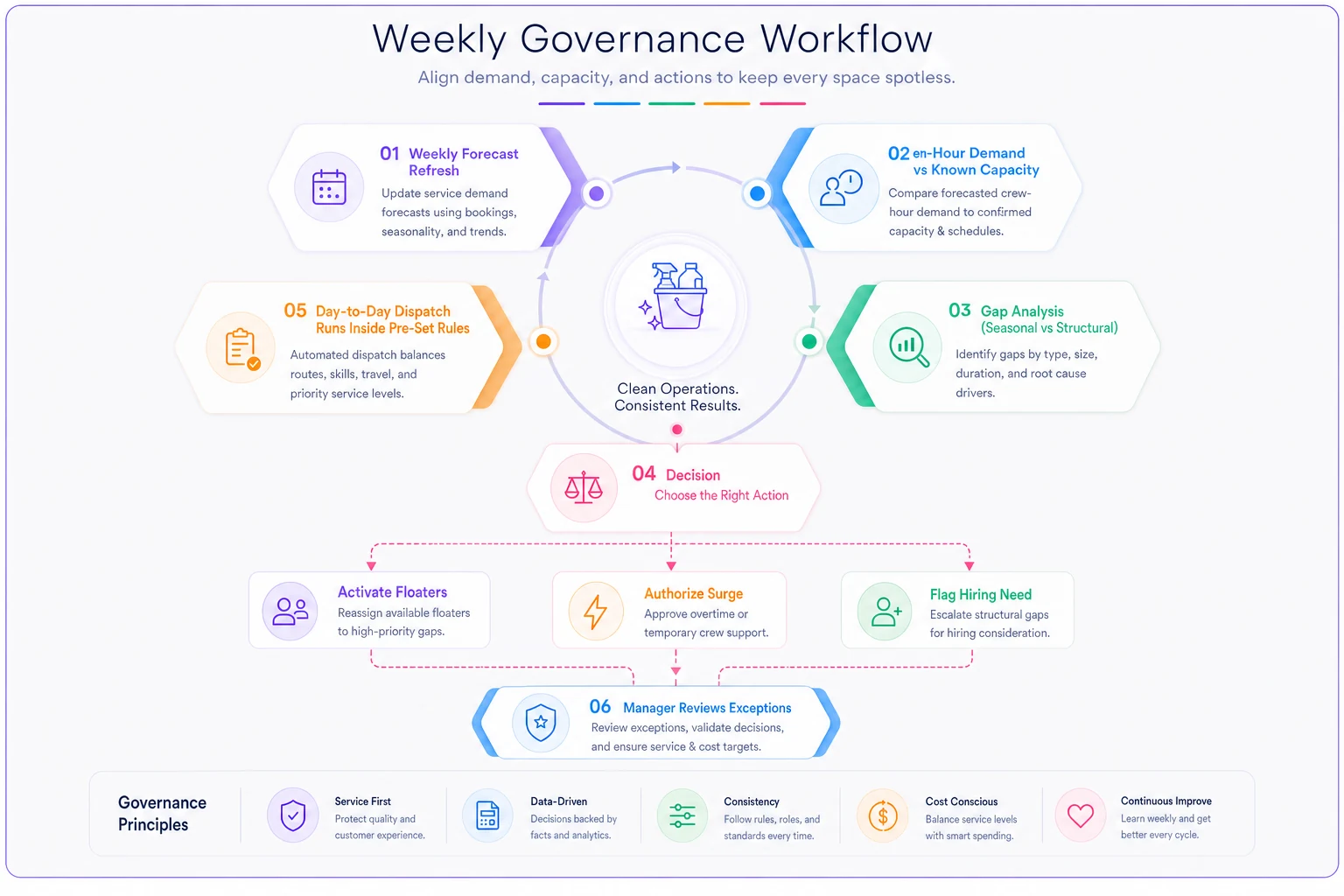
Every week, the forecast refreshes and produces a crew-hour demand number for the next two weeks. That number gets compared against known crew capacity at current pay bands. The gap — if there is one — is where the system decides between three levers: activate floaters, authorize surge to shed low-value demand, or flag a hiring need if the gap is structural rather than seasonal.
Day-to-day, dispatch operates inside those pre-set rules. When a no-show hits, they don't improvise — they check the floater SLA. When demand spikes mid-week, they don't negotiate — they apply the surge tier that's already authorized. The manager isn't making individual calls all day; they're reviewing the exceptions that fall outside pre-authorized bands.
That's the whole point of governance: routine decisions run on rules, and human judgment gets reserved for genuine edge cases. A dispatcher who has to think about pay, backfill and pricing from scratch every morning will make expensive mistakes by 9am.
This is also where the right operational software earns its place — not as a magic button, but as the thing that holds the rules in one place. When your forecast, pay bands, floater triggers and surge tiers live inside a platform that flags gaps automatically, dispatch sees "crew 4 is short 6 hours Thursday, floater eligible" instead of discovering it at 7:40am. AI-assisted scheduling tools are genuinely useful for the pattern-matching side of this — predicting likely cancellations from historical behavior, surfacing which routes are trending understaffed — so a manager spends their attention on decisions instead of data entry. But the governance itself is yours. The software enforces the rules; it doesn't invent them.
Manager KPIs that keep the system honest
Rules decay if nobody owns the outcome. The manager running dispatch needs KPIs tied directly to these four pieces — otherwise they'll optimize for whatever they are measured on, usually "no angry clients today," at the expense of everything else.
-
- Forecast accuracy — delivered crew-hours vs. forecast, measured weekly. Chronic over-forecasting means you're overstaffing; chronic under means you're scrambling.
-
- Floater utilization — percent of floater hours actually deployed vs. paid. Too low means you're carrying expensive idle flexibility; too high means you're under-staffed structurally.
-
- Pay-band compliance — percentage of active staff paid inside their band. Any out-of-band pay should require a documented reason.
-
- Surge capture — revenue from authorized surge vs. estimated demand turned away. This tells you whether your caps are too tight or too loose.
-
- Same-day coverage rate — percent of recurring visits delivered despite disruptions. This is the client-facing proof the whole system works.
A manager hitting forecast accuracy but tanking coverage rate is forecasting fine and executing poorly. A manager with perfect coverage but floater utilization through the roof is papering over a hiring gap. The KPIs only mean something together — which, again, is the recurring theme of governance. No single number tells the story.
A real scenario
A maid agency running about seven crews across two suburbs had a familiar problem: margins looked fine on paper but kept slipping, and the owner couldn't pin down why. Three things surfaced at once. Staffing ran about 12% above delivered demand most weeks because the dispatcher staffed to booked, not expected-delivered. Pay had drifted — four cleaners were out of band, two of them below floor, which was a retention risk sitting right there in plain sight. And surge was essentially random; holiday weeks got whatever number the owner typed that morning.
They put in a weekly forecast refresh, a two-tier pay-band table with documented advancement triggers, a floater SLA with a 30-minute assignment target, and a three-tier surge cap. Nothing exotic. The forecast adjustment alone pulled staffing closer to real demand and recovered most of that 12% overstaffing. The floater SLA cut the morning scramble because dispatch finally had a rule instead of a panic. Surge, once it had tiers, stopped being a guess — the agency captured noticeably more on peak weeks without a single recurring client complaint, because the base price never moved.
The owner said afterward that the business didn't feel bigger, it felt quieter. That's usually the sign governance has taken hold — the volume of daily firefighting drops even though the volume of work didn't.
When this level of governance makes sense — and when it doesn't
This system is overkill for a solo operator or a two-crew shop. At that size, the overhead of maintaining tables and SLAs costs more than the drift they prevent. You are the governance, and that's fine. If you're still at that stage, our breakdown of what changes after you grow past the solo-operator phase is the more relevant starting point.
Where it becomes essential is the moment you've handed dispatch to someone else and you're running enough crews that you can't personally remember who makes what or who's covering which route. That's the inflection point where informal governance stops scaling and silent margin leakage begins.
Worth noting: implementing all four pieces at once when your data is a mess is a bad idea. Forecasting against garbage booking history just produces confident wrong numbers. Fix your data hygiene first, then layer in forecasting, then pay bands, then floater SLAs and surge last. Rushing the whole stack in a week usually means nobody trusts it and everyone reverts to improvising.
Fix your data hygiene first, then introduce each governance layer one at a time so people can trust the rules.
Where it becomes essential is the moment you've handed dispatch to someone else and you're running enough crews that you can't personally remember who makes what or who's covering which route. That's the inflection point where informal governance stops scaling and silent margin leakage begins.
The connective tissue, not the tips
Labor capacity governance isn't a list of individual best practices — it's the connections between them. A forecast with no pay-band discipline just tells you how expensively you'll overstaff. Pay bands with no floater SLA leave you perfectly priced and perpetually short-handed. Surge caps with no forecast behind them are pricing in the dark.
The owners who scale cleanly are the ones who stop treating these as four separate problems to firefight and start treating them as one system that runs on a cadence. Build the forecast rhythm, write the tables down, define the triggers, hold the manager to KPIs that span all of it — and dispatch stops being a daily emergency and becomes something you can actually hand off.
The owners who scale cleanly are the ones who stop treating these as four separate problems to firefight and start treating them as one system that runs on a cadence. Build the forecast rhythm, write the tables down, define the triggers, hold the manager to KPIs that span all of it — and dispatch stops being a daily emergency and becomes something you can actually hand off.
Ready to elevate your cleaning business?
Join 500+ cleaning services using Maidufy to save time, reduce scheduling errors, and deliver exceptional client satisfaction.