


Most cleaning companies don't fail at getting a new channel to work once. They fail at keeping it running after the novelty wears off. A property manager sends you five apartment turnovers, the crew scrambles, the jobs get done, everyone's happy — and then nothing repeatable happens. Three months later you're back to relying on the same referral trickle, and the "partnership" that felt promising is just a folder of old invoices.
The gap between a pilot and a durable stream isn't luck. It's an operating model. What most owners skip is the boring middle layer — the part where a channel's promises get translated into acceptance criteria, staffing rules, pricing anchors, and a monthly review that decides whether the thing lives or dies.
This is the piece nobody writes down. So let's write it down.
Why channels stay stuck in pilot mode
A channel — Airbnb turnovers, realtor move-outs, commercial nightly contracts, a lead-gen platform, a franchise-style referral relationship — behaves nothing like your walk-in residential clients. It has different cadence, different payment terms, different definitions of "done," and a different tolerance for mistakes.
The reason pilots don't graduate is almost always the same: the business treats the new channel as more of the same work, just from a new source. The dispatcher schedules it like a normal clean. The crew shows up with the normal checklist. The invoice goes out on the normal terms. And then friction appears in a hundred small places nobody planned for.
A realtor needs a same-day turnaround and photos within an hour of completion. An Airbnb host cares about linen counts and staging, not deep scrubbing. A commercial account has a formal SLA with penalty language buried in a PDF nobody on your team has read. When you run all of these through one generic workflow, quality slips in ways that are invisible to you but very visible to the client — and the channel quietly dries up.
If you haven't already mapped out the money side of this, the channel economics playbook for cleaning business owners covers the unit-level math that should sit underneath everything here. This article is about the operating layer that turns those economics into something your team can actually run week to week.
The core idea: every channel gets its own operating spec
Think of a channel operating model as a one-page (or one-tab) spec per channel that answers a fixed set of questions. Not a strategy deck. An operational document your dispatcher, your crew leads, and your bookkeeper can all point to.
Never miss a cleaning appointment again.
Maidufy helps you book, confirm, and manage every cleaning service seamlessly.
- Centralized booking management
- Automated client reminders
- Optimized staff scheduling
No credit card required
At minimum, each channel spec needs six components:
-
Acceptance criteria — what counts as a job you'll take, and what "complete" means
-
SLA-to-ops translation — the client's promises rewritten as internal rules your team can execute
-
Pricing anchors — the floor, the target, and the walk-away number
-
Staffing template — who works this channel and in what ratio
-
Rapid-quote worksheet — how to price a new request in under five minutes
-
Monthly scorecard — the numbers that decide go/no-go for the next 30 days
A quick workflow for how a channel spec is applied:
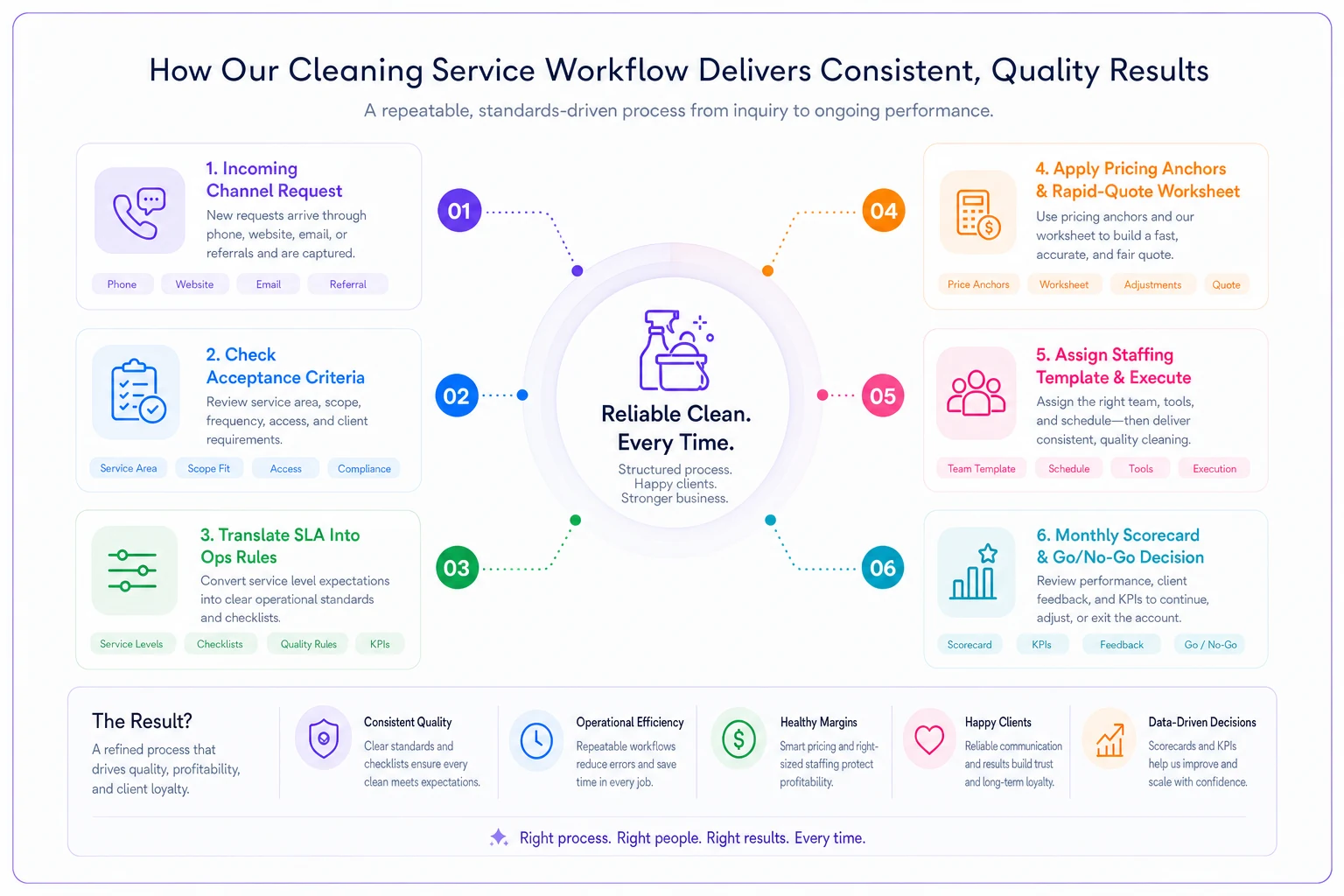
The whole point is that a new request coming through a mature channel shouldn't require thinking. It should require matching — you check it against the spec and either it fits or it doesn't.
Each piece matters, because the details are where this either works or falls apart.
Acceptance criteria: deciding what you'll actually take
This is the component owners resist the most, because saying "we don't do that" feels like leaving money on the table. But acceptance criteria are what protect a channel's margin over time.
A move-out channel from realtors sounds great until you realize half the requests are hoarder-adjacent condition units that eat four times the labor you quoted. If your acceptance criteria don't include a condition threshold and a photo-first requirement, your crew leads absorb the surprise — and their day blows up, along with three other appointments downstream.
Good acceptance criteria for a channel usually cover:
-
Condition limits — the state of the property you'll accept at the quoted rate, with a clear "this triggers a re-quote" line
-
Geographic bounds — the zip codes or drive-time radius where this channel is profitable (a channel that's great 15 minutes out can be a money-loser 40 minutes out)
-
Timing windows — the turnaround you can actually commit to without breaking your recurring schedule
-
Scope definition — what's included and what's explicitly not, written in the channel's language
If a job regularly triggers re-quotes, tighten the condition threshold rather than patching schedule gaps.
Channels with fuzzy acceptance criteria don't just lose money on bad jobs. They corrupt your scheduling for everyone, because the surprise jobs pull crews and time away from clients who were already on the books.
SLA-to-ops translation: the step everyone skips
Commercial and property-management channels come with service level agreements. Residential platform channels come with implied ones — response times, rating thresholds, rebooking rules. Either way, the SLA is written for the client's benefit, in the client's terms. Your job is to translate it into internal operations before you sign anything.
Here's what that translation actually looks like in practice:
| SLA promise (client language) | Ops translation (internal rule) |
|---|---|
| "Turnovers completed same day before 3pm check-in" | Jobs from this channel must be scheduled in the AM block only; hard cutoff for accepting a same-day request is 9:30am |
| "Response to service issues within 2 hours" | A named person owns this channel's inbox during business hours; escalation path if they're in the field |
| "99% on-time completion" | Buffer 20% extra time on this channel's route; no back-to-back stacking without a float crew |
| "Photo documentation on every visit" | Proof-of-service capture is a hard gate — job isn't marked complete without it |
The failure mode is signing an SLA that reads fine on paper but has no matching internal rule. Six weeks in, you miss a couple of response windows, your rating drops, and you're wondering why a "good" channel is punishing you. It wasn't the channel. It was the missing translation layer.
The other thing to watch: penalty clauses. A lot of commercial agreements have quiet penalty language — credits, discounts, or termination triggers tied to missed SLAs. Price those penalties into your rate as a risk cost, or you're carrying an exposure you never accounted for.
Pricing anchors: floor, target, walk-away
Every channel needs three numbers before you take a single job:
-
Floor — the absolute lowest rate where the job still clears your fully-loaded cost plus a thin margin. Below this you're paying to work.
-
Target — the rate you're actually aiming for, the one that makes the channel worth managing.
-
Walk-away — the point where you politely decline. Having this number written down is what keeps you from getting negotiated into unprofitable "volume."
The mistake here isn't setting bad anchors — it's not setting them at all, then pricing each request emotionally based on how much you want the account. A property manager dangling "20 units a month" will get a discount that feels justified in the moment and quietly destroys the channel's economics over a year.
A realistic set of anchors for a mid-size residential move-out channel might look like: floor at roughly $180 for a standard 2-bed unit, target around $240, walk-away below $170. Those aren't universal numbers — yours depend on your labor loading and drive times — but the structure is what matters. Three numbers, decided in advance, applied every time.
Rapid-quote worksheet: pricing in five minutes
Channels die when quoting is slow. A realtor sending a same-day request doesn't want a callback in four hours — they'll text the next cleaner on their list. So each channel needs a worksheet that produces a price fast and consistently, regardless of who's at the desk.
A workable rapid-quote flow:
-
Identify the base unit — bed/bath count, square footage band, or unit type
-
Pull the channel base rate — the pre-set anchor for that unit size
-
Apply condition modifier — light / standard / heavy, each with a fixed multiplier
-
Add access and travel factors — parking, stairs, drive-time band
-
Check against floor — if the number lands below the floor, it auto-triggers a re-quote conversation instead of an acceptance
-
Lock and send — quote out, with acceptance criteria attached so scope is clear
The value of a worksheet isn't just speed. It's consistency across staff. When your dispatcher quotes the same request the same way your office manager would, the channel stops depending on any one person's judgment. That's what makes it survive turnover.
Staffing templates: who runs the channel
Different channels reward different crew structures. A high-volume Airbnb turnover channel wants small, fast, standardized two-person teams who do the same unit types repeatedly and get scary-good at speed. A commercial nightly account wants a stable, vetted crew with keys and alarm codes — continuity matters more than raw speed.
A staffing template answers:
-
How many crews are dedicated vs. shared with other work
-
The skill tier required (a heavy move-out isn't a trainee job)
-
The float/backup rule when someone calls out — because a channel with an SLA can't just "reschedule for next week"
-
The crew-lead ownership
who's accountable for this channel's quality
A pattern that shows up in growing companies: they launch a channel with dedicated crews, it works, then as they get busy they start borrowing those crews for overflow residential work. Quality on the channel slips, the SLA gets missed, and nobody connects the dots back to the staffing decision. The staffing template exists so that borrowing is a conscious choice, not a silent drift.
Channel P&L: seeing each stream on its own
You cannot manage a channel you can't see. Blending all revenue into one P&L hides the channel that's quietly losing money behind the two that are winning.
A simple per-channel P&L for a single month might look like this:
| Line | Airbnb Turnovers | Realtor Move-Outs |
|---|---|---|
| Revenue | ~$14,800 | ~$9,200 |
| Direct labor | $6,400 | $4,700 |
| Supplies/linen | $1,900 | $600 |
| Travel/fuel | $1,100 | $1,400 |
| Channel fees/commission | $1,300 | $0 |
| Rework/callbacks | $400 | $850 |
| Contribution | ~$3,700 | ~$650 |
Look at what this surfaces. The Airbnb channel throws off healthy contribution. The realtor channel looks comparable on revenue but is bleeding through travel and rework — those move-outs are spread across town and the condition surprises are triggering callbacks. Without the split view, you'd never know the realtor channel is barely paying for itself.
This is exactly the kind of analysis that connects to deciding when a territory or route is worth keeping. The logic in when a route stops paying applies at the channel level too — sometimes the right call is to sunset a stream, not fix it.
Monthly channel scorecard and go/no-go scoring
This is the discipline that holds the whole model together: once a month, every channel gets scored, and each score produces a decision — continue, fix, or exit.
A practical scorecard tracks maybe six to eight metrics per channel:
-
Contribution margin (from the channel P&L)
-
On-time completion rate (your SLA translation, measured)
-
Rework/callback rate
-
Quote-to-booking conversion
-
Client rating or satisfaction where available
-
Volume trend vs. last month
Then you attach a go/no-go rule. Something as blunt as: green on contribution and SLA = continue as-is; one red = fix with a named owner and a 30-day recheck; two or more reds = pause new intake and decide on exit.
The scoring matters more than the metrics themselves. Owners look at channel numbers all the time and feel concerned without doing anything. A go/no-go rule forces a decision on a schedule, which is the only thing that stops a slowly-dying channel from limping along for a year while you quietly subsidize it.
A real scenario: turnovers that finally paid
A four-crew residential company had been doing short-term rental turnovers as a side stream for about eight months. Roughly 60 turnovers a month, decent revenue, but the owner couldn't tell if it was actually worth the chaos — crews complained about it constantly, and there were last-minute scrambles almost every week.
They built a channel spec. Acceptance criteria limited turnovers to a defined cluster of neighborhoods, cutting out the far-flung ones that ate drive time. The SLA translation created a hard 9:30am cutoff for same-day requests and made linen counts a completion gate. Two crews were assigned as the dedicated turnover team, no borrowing.
Three months later the channel's monthly contribution had gone from roughly break-even to somewhere around $3,000–$3,500 — not because they raised prices much, but because they stopped taking the jobs that lost money and stopped disrupting the rest of the schedule. The callback rate dropped noticeably once the same two crews were doing the same unit types every day. The channel didn't get bigger. It got manageable.
When this is worth doing — and when it isn't
Building a full operating model per channel makes sense when a channel is generating meaningful, recurring volume and starting to interact with the rest of your schedule in ways that create friction. If you're getting steady weekly work from a source and it's straining your operations, the spec pays for itself fast.
It's overkill for a channel that's still genuinely experimental. Three jobs from one realtor isn't a channel yet, it's a lead. Don't write a scorecard for something you can't measure. Run the pilot loose, and only formalize once there's enough repetition to have patterns worth capturing.
Some owners shouldn't be chasing multiple channels at all yet. If your core residential operation still has quality inconsistency or scheduling breakage, adding channels just multiplies the mess. Fix the base first. That sequencing — stabilize, then expand — is the same thinking behind predictable territory growth, and it applies just as much to channels as it does to geography.
Keeping the model alive without drowning in spreadsheets
The honest challenge with a per-channel operating model is upkeep. Six specs across six channels, each with its own P&L and monthly scorecard, is a lot of manual assembly if you're pulling numbers from job records, payroll, and invoicing by hand every month.
This is where operational software that ties bookings, crew time, and job costing together earns its keep — not because it makes the decisions for you, but because it makes the numbers visible without a monthly data-entry marathon. When your channel P&L and scorecard populate from the work your team is already logging, the monthly go/no-go review takes an hour instead of a weekend. The decisions stay human. The assembly stops being a chore.
The goal isn't a fancier dashboard. It's that the model actually gets run every month, instead of built once and abandoned — which is the fate of most operating docs that live in a spreadsheet nobody opens.
The takeaway
A channel operating model is the difference between hoping a new revenue stream sticks and actually engineering it to. Acceptance criteria protect your margin. SLA translation keeps you from silently breaking promises. Pricing anchors and rapid-quote worksheets make the channel run without depending on any one person. Staffing templates keep quality from drifting. And the monthly scorecard with a go/no-go rule forces the decisions that keep a channel healthy — or ends it cleanly before it drains you.
Pilots are easy. Anyone can do a job well once. The businesses that build durable channels are the ones that took the boring middle layer seriously and wrote it down.
A channel operating model is the difference between hoping a new revenue stream sticks and actually engineering it to. Acceptance criteria protect your margin. SLA translation keeps you from silently breaking promises. Pricing anchors and rapid-quote worksheets make the channel run without depending on any one person. Staffing templates keep quality from drifting. And the monthly scorecard with a go/no-go rule forces the decisions that keep a channel healthy — or ends it cleanly before it drains you.
Ready to elevate your cleaning business?
Join 500+ cleaning services using Maidufy to save time, reduce scheduling errors, and deliver exceptional client satisfaction.