



Most cleaning owners decide where to grow based on gut and whatever the last busy week felt like. Airbnb turnovers felt profitable last month, so you lean into short-term rentals. A commercial account walked in the door, so now you're chasing office contracts. The problem is that "felt profitable" and "actually profitable after everything" are two very different numbers, and the gap between them is where a lot of cleaning businesses quietly bleed cash while thinking they're growing.
Channel economics for a cleaning business isn't just "what do we charge." It's the full chain: what it costs to win the customer, what the job actually nets after labor and travel, what it costs you to hold the service level that channel demands, and whether your operation can even run more of it without falling apart. Skip any one of those four and your scorecard lies to you.
This is the playbook I'd hand an owner deciding between doubling down on recurring residential, expanding into STR turnovers, or going after commercial. It's built around one comparable scorecard so you're not comparing apples to lawnmowers.
The four numbers that actually decide a channel
Everyone tracks revenue per channel. Almost nobody tracks the four numbers that determine whether that revenue is worth chasing.
Acquisition CPA (cost to win a paying customer). Not cost per lead — cost per booked, paying customer. If you spend $600 on local ads and get 30 leads, but only 4 turn into customers, your CPA is $150, not $20. Channels differ wildly here. Commercial has a long sales cycle with site walks and bids; STR often comes through property managers who bring 8 units at once; recurring residential usually converts off referrals and reviews at a much lower cost.
Job-level margin. What one job nets after direct labor, payroll burden, supplies, and travel time. This is where owners fool themselves most, because a $220 deep clean can carry less margin than a $110 recurring visit once you count drive time and the extra crew hour.
SLA cost. The cost of holding the promise the channel requires. STR turnovers have brutal SLAs — same-day, tight windows between checkout and check-in, photo proof, zero tolerance for a missed slot because a guest is arriving at 4pm. That SLA has a real cost: standby capacity, faster QA, backup crews. Commercial has after-hours access and security requirements. Recurring residential is the gentlest SLA of the three. Most scorecards ignore this entirely, and it's often the deciding factor.
Operational readiness. Can your current system absorb more of this without breaking? Scheduling, dispatch, QA, billing, dispute handling. A channel you can't operate cleanly at 2x volume isn't a growth channel — it's a future fire.
The mistake is treating these as separate reports. They're one equation. A channel with great margin and terrible SLA cost can net worse than a boring channel with mediocre margin and near-zero SLA overhead.
Why owners pick the wrong channel
A pattern shows up again and again: the channel that feels best is usually the one with the most visible cash and the least visible cost.
Never miss a cleaning appointment again.
Maidufy helps you book, confirm, and manage every cleaning service seamlessly.
- Centralized booking management
- Automated client reminders
- Optimized staff scheduling
No credit card required
STR turnovers feel amazing because the invoices are frequent and the property manager pays fast. What's hidden is the SLA tax — the standby crew you keep loose on Fridays and Sundays, the reclean rate when a guest complains, the fact that a single blown turnover can cost you the whole account. When you actually load those costs in, a lot of STR portfolios run thinner than the owner believes.
Commercial feels stable because it's contracted and recurring monthly. What's hidden is the acquisition drag and the margin compression on multi-year contracts that don't reprice with your wage costs. Win a 12-month office contract at a rate that looked fine in January, and after a mid-year wage bump you're cleaning it at breakeven.
Recurring residential feels slow because each customer is small. What's hidden is that it's usually your best blended channel — low CPA once referrals kick in, forgiving SLA, and margin that compounds because a retained client costs almost nothing to keep. The problem is it doesn't produce big impressive invoices, so owners under-invest in it while chasing the flashier channels.
The other reason owners pick wrong: they never separate the numbers by channel at all. Everything gets averaged into one P&L, and the average hides the fact that one channel is subsidizing another.
The comparable scorecard
Here's the format that makes channels actually comparable. Fill this in with your own numbers — the values below are illustrative of a small owner-operator running a few crews, not a benchmark to copy.
| Metric | Recurring Residential | STR Turnover | Commercial |
|---|---|---|---|
| Blended CPA per new customer | ~$40–$70 | ~$90–$140 | ~$300–$600 |
| Avg revenue per job | ~$110–$150 | ~$85–$130 | ~$180–$400 |
| Direct labor + burden % of job | ~45–52% | ~50–58% | ~48–55% |
| Travel/dead time per job | Low (batched) | Medium-High | Medium |
| Job-level margin after direct costs | ~28–35% | ~18–26% | ~20–30% |
| SLA cost overhead (standby, reclean, penalties) | Low | High | Medium |
| Effective margin after SLA cost | ~26–32% | ~10–18% | ~15–24% |
| Retention / revenue durability | High | Medium | High (if repriced) |
| Readiness load on current ops | Low | High | Medium |
The row that changes decisions is effective margin after SLA cost. On paper STR often shows the punchiest per-job numbers, but once the SLA tax comes out, recurring residential quietly wins on durable margin for most small operators. Commercial can beat both — but only if you win it at a defensible rate and reprice on schedule.
Two things worth noticing. First, the CPA range for commercial is 5–10x residential, which means every commercial loss hurts far more, and a churned commercial account after 3 months can be a net loss on acquisition alone. Second, the SLA cost line is where your gut is worst — it's the number nobody has in a spreadsheet, so estimate it honestly even if the estimate is rough.
How SLA cost actually shows up in the numbers
Since SLA cost is the piece most owners have never quantified, here's how to build it.
-
Standby/idle capacity you hold specifically for that channel's windows (e.g., a crew you keep loosely booked on turnover-heavy days).
-
Reclean and callback rate for that channel — hours spent redoing work × loaded labor cost.
-
Penalty and lost-account cost — missed windows, refunds, discounts given to keep the client.
-
Faster-QA overhead — if a channel demands photo proof or a stricter inspection, that's real minutes per job.
Divide by the number of jobs in that channel. That's your per-job SLA cost. Subtract it from job-level margin and you finally have effective margin.
A typical example: an operator running about 40 STR turnovers a month held one crew semi-idle for last-minute Sunday jobs, ran roughly a 12% reclean rate, and gave a couple of goodwill discounts. Loaded up, that came to somewhere around $18–$24 per turnover in SLA cost — enough to drop what looked like a 24% margin channel down into the mid-teens. The turnovers were still worth keeping, but not worth expanding over recurring work, which the owner had been about to de-prioritize.
Operational readiness gates
Margin tells you if a channel is worth more. Readiness tells you if you can actually take more without wrecking service. Before expanding into any channel, it should clear these gates. If it fails one, fix that gate before you scale — don't scale into the crack.
Scheduling gate. Can you add 30–50% more volume in this channel without manual rescheduling chaos? If your current schedule already breaks when one crew calls out, more volume just multiplies that. Protecting recurring slots while absorbing variable STR and commercial work is its own discipline — this ties directly into keeping recurring schedules from collapsing under one-off demand.
When testing added STR volume, reserve at least one semi-flex crew to absorb weekend volatility before committing more recurring slots.
Dispatch and travel gate. Does adding volume keep jobs geographically batched, or does it scatter crews across the map? A channel that forces long drives eats the margin you thought you were gaining. If routes are already marginal, read when a route stops paying before adding more to them.
QA and SLA gate. Can your inspection and proof-of-service process keep up at higher volume? STR and commercial both punish quality misses harder than residential. If QA is already stretched, more volume drops your effective margin through recleans.
Billing and dispute gate. Faster job cycles mean faster billing cycles and more dispute surface. Can you invoice and collect cleanly at 2x?
People gate. Do you have the crew depth and supervisor coverage to hold service level, or are you one resignation away from missing SLAs?
A channel that passes on margin but fails readiness isn't a "no" — it's a "not yet." That distinction saves a lot of businesses from expanding into failure.
A pilot before you commit
Never expand a channel off a spreadsheet alone. Run a small, bounded pilot and measure the real four numbers, not the projected ones. Here's a checklist to run one cleanly:
-
[ ] Define the pilot scope
a fixed number of jobs (e.g., 15–25).
-
[ ] Tag every pilot job so it's isolated from your blended numbers.
-
[ ] Track true CPA — every dollar and hour spent winning those specific customers.
-
[ ] Log job-level margin per pilot job, including travel and burden.
-
[ ] Track SLA events
missed windows, recleans, standby hours, goodwill given.
-
[ ] Note every operational friction point (schedule conflicts, dispatch scrambles, billing hiccups).
-
[ ] Measure early retention signals — rebooking rate, complaint rate, review sentiment.
-
[ ] Compare pilot effective margin against your existing best channel, not against zero.
The pilot's real job is to surface the SLA and readiness costs that spreadsheets always underestimate. If a channel still looks good after a real pilot with real friction baked in, that's a channel worth scaling.
Visual workflow for running the pilot:
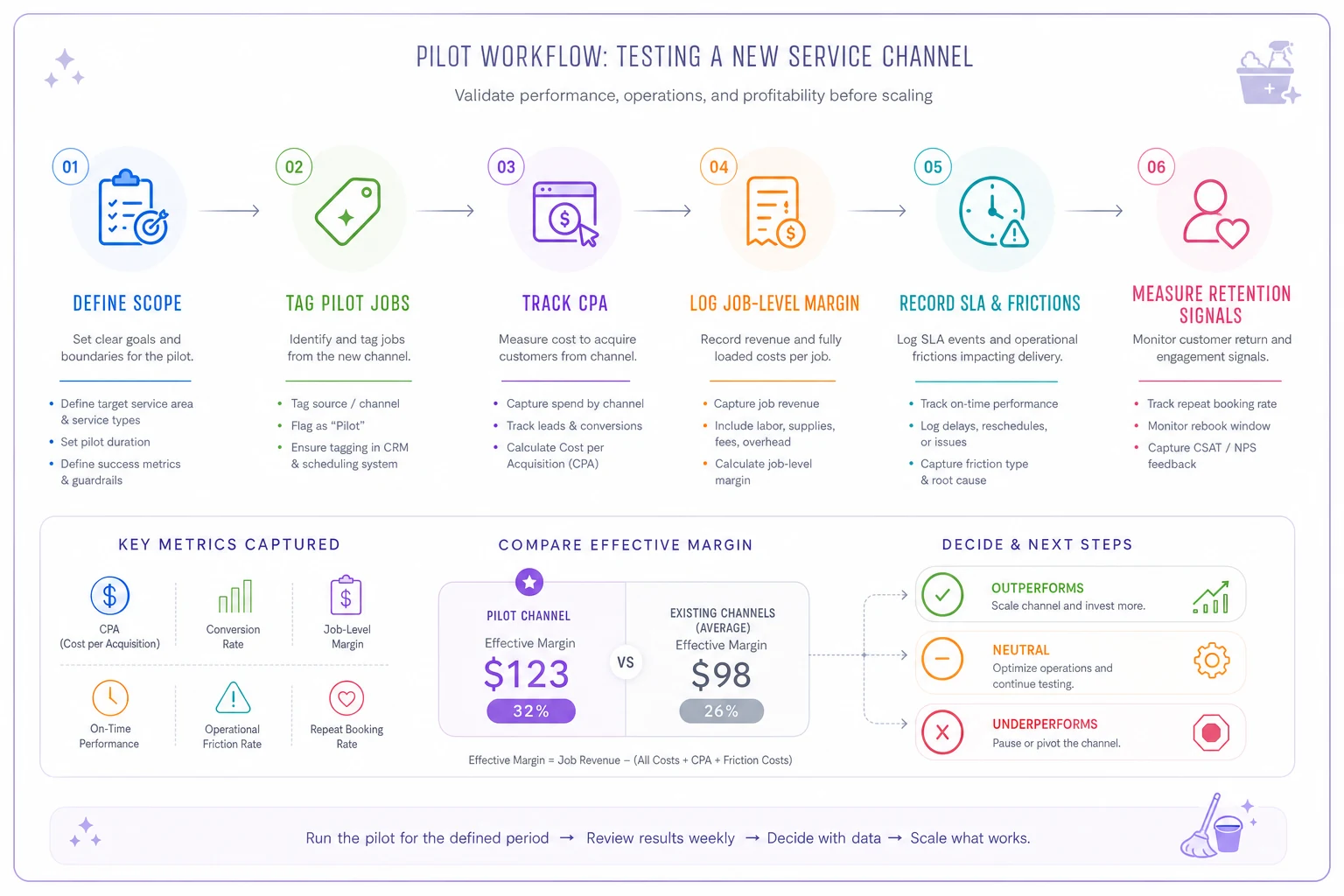
Use the workflow to keep the pilot disciplined and ensure you capture SLA and readiness signals.
Go / no-go scoring
Once the pilot is done, score the channel. Keep it simple — rate each dimension 1 to 5, weight the ones that matter most for a small operator, and total it.
-
Effective margin after SLA cost (weight ×3)
Is durable margin at or above your current best channel?
-
Acquisition efficiency (weight ×2)
Is CPA recoverable within the first 1–2 jobs, or does it take many months?
-
Retention / durability (weight ×2)
Will this revenue stick, or churn out before it pays back CPA?
-
Operational readiness (weight ×2)
Did the pilot run without breaking scheduling, dispatch, QA, or billing?
-
Strategic fit (weight ×1)
Does it stack cleanly with existing routes and crews, or fragment them?
A rough rule: if effective margin (the ×3 line) scores a 2 or below, it's a no-go regardless of total — the channel doesn't pay, and a high score elsewhere is just enthusiasm covering for weak economics. If margin is strong but readiness is a 2, it's a "not yet": fix the operational gate, then rescore.
The point of weighting margin heaviest is to stop the flashy-invoice trap. STR and commercial will often win on excitement and lose on the ×3 line. Let the weighting protect you from yourself.
A real scenario
A three-crew residential cleaner outside a mid-size metro was about to shift most of their capacity toward STR turnovers because the invoices were coming in fast and a property manager had offered them a block of units. On the surface, turnovers looked like the growth engine — roughly $110 per job, steady volume, quick pay.
They ran the scorecard before committing. Recurring residential was sitting at an effective margin in the high-20s. STR looked like mid-20s on paper — but once they loaded the standby crew they were holding for Sunday windows, a reclean rate hovering around 10–12%, and two goodwill discounts to keep the account happy, effective STR margin landed closer to the mid-teens. On top of that, the readiness check showed their scheduling already strained on turnover-heavy weekends.
The decision flipped. Instead of pivoting to STR, they kept it as a capped channel — enough units to stay useful to the property manager, not enough to blow up their schedule — and reinvested in referral-driven recurring growth where CPA was low and SLA cost was near zero. Over the following couple of quarters, blended margin improved noticeably and the weekend fire drills mostly disappeared. The turnovers were never the problem; treating them as the primary growth channel would have been.
Where this connects
Channel economics isn't a one-time analysis — it's a decision cadence.
Rerun the scorecard when wages move, when a big account signs, or when you're about to open a new area. It pairs naturally with a broader rollout plan; if you're mapping where to grow next, the channel and rollout playbook for predictable territory growth covers the geographic side, while this scorecard covers the economic side. Together they answer where and whether.
The core discipline is refusing to average your channels together. The moment you separate CPA, job margin, SLA cost, and readiness by channel — and score them honestly — the right place to expand usually stops being a guess. Sometimes the boring channel wins. Most of the time, actually. And the businesses that grow cleanly are the ones willing to trust the effective-margin line over the exciting invoice.
Ready to elevate your cleaning business?
Join 500+ cleaning services using Maidufy to save time, reduce scheduling errors, and deliver exceptional client satisfaction.