

Most cleaning businesses don't have a collections problem. They have a timing problem. The invoice goes out, the client means to pay it, life happens, and by day 40 the conversation has already gotten awkward. Then the awkwardness itself becomes the reason nobody calls.
What makes residential and small-commercial cleaning different from, say, a plumbing one-off is that your past-due client is usually still on your route. You're sending a crew back to their house next Tuesday whether or not last month's invoice cleared. That changes everything about how you collect. You're not just trying to recover money — you're trying to recover it without poisoning a recurring relationship that's worth far more than the overdue balance.
That tension is what this playbook is built around. The goal isn't to be aggressive. It's to be consistent and early so that collecting feels like a system the client expects, not a confrontation they resent.
Why cleaning collections go sideways
The pattern is almost always the same. A card expires or an ACH bounces. Nobody notices for a week because the owner is doing payroll, not reconciliation. By the time it surfaces, two more visits have happened. Now the client owes for three cleanings instead of one, and the number is big enough that bringing it up feels uncomfortable.
The deeper issue is that most small cleaning operations treat collections as an event — something you do when a balance gets "too high" — instead of a scheduled sequence that starts the moment a payment fails. The event-based approach means every late account gets handled differently depending on the owner's mood, how busy the week is, and whether they like the client. That inconsistency is what actually damages retention, not the act of asking for money.
There's also a quieter driver: a lot of cleaning owners are uncomfortable separating "the service relationship" from "the billing relationship." They worry a firm payment reminder will make the client cancel. In practice the opposite tends to be true. Clients who are confused about what they owe — or who've been allowed to drift 60 days behind — are more likely to churn, because the relationship now carries baggage.
What a late invoice actually costs you
The real damage isn't the one unpaid invoice. It's what sits underneath it.
Never miss a cleaning appointment again.
Maidufy helps you book, confirm, and manage every cleaning service seamlessly.
- Centralized booking management
- Automated client reminders
- Optimized staff scheduling
No credit card required
When you keep cleaning a non-paying account, you're paying your crew real wages against revenue you haven't collected. A typical residential clean might carry $55–$75 in direct labor. Run three visits for a client who's quietly 50 days behind and you've funded somewhere around $165–$225 of payroll out of pocket — for one account. Multiply that across five or six slow-pay clients and you've got a cash hole that shows up right when payroll is due.
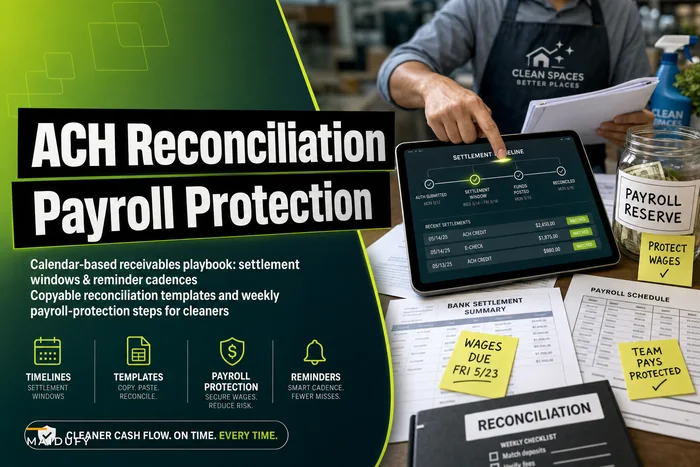
That's the core reason timing matters so much here. Payroll doesn't wait. If you want to keep your crews paid on schedule without dipping into reserves, the collections sequence has to move faster than your pay cycle. This ties directly into how you handle bounced payments — if your ACH and e-check reconciliation process is slow, your collections clock starts late and you're already behind before the first message even goes out.
The six-step staged sequence
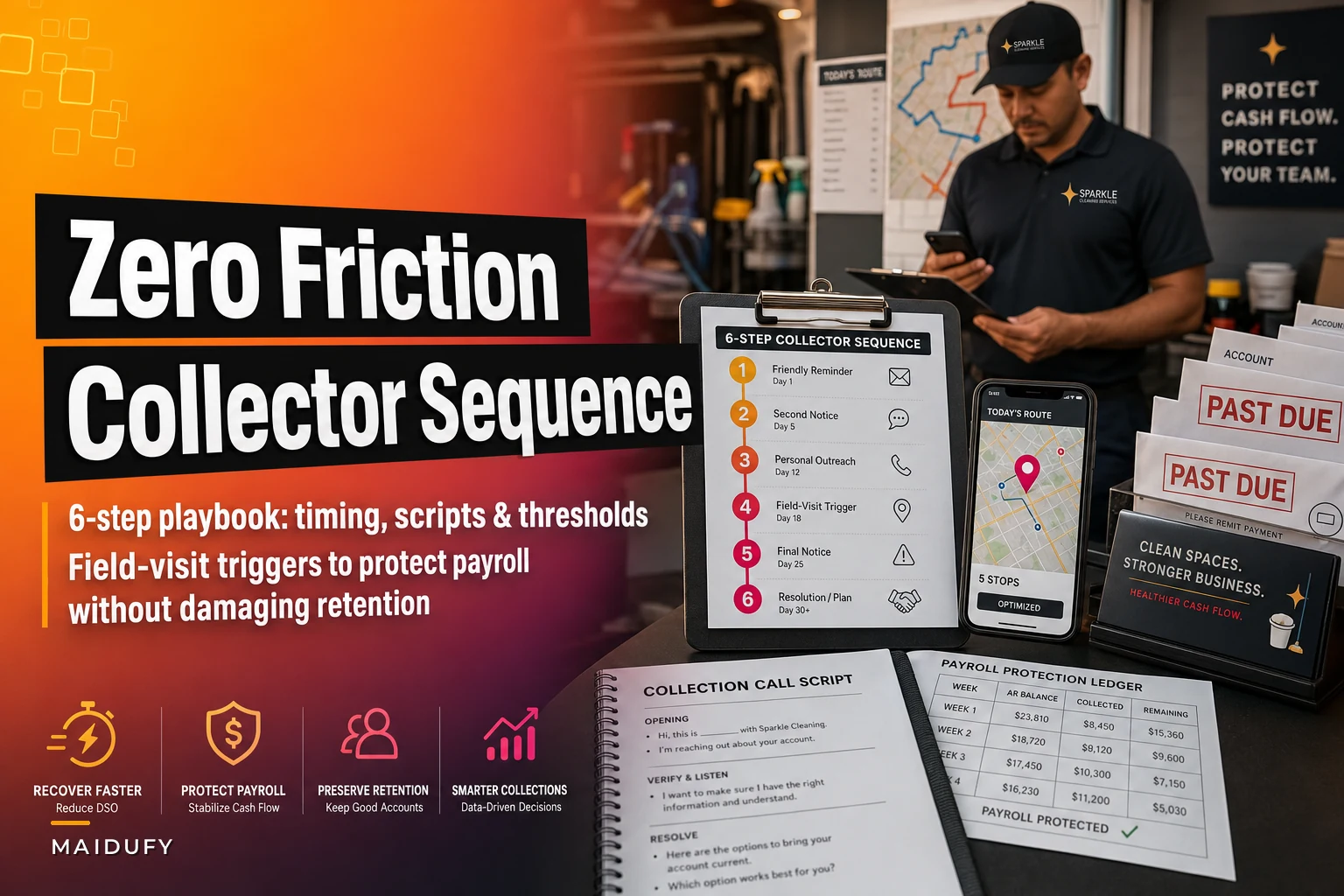
Below is the structure. Each step has a trigger day, a channel, and a tone. The tone shifts deliberately — friendly and assumptive early, firmer and more specific later. The key discipline is that you don't skip steps and you don't stall on them.
| Step | Timing | Channel | Tone | Core message |
|---|---|---|---|---|
| 1 | Day 1 (payment fails/invoice due) | Automated email/SMS | Neutral, assumptive | "Heads up, payment didn't go through" |
| 2 | Day 4 | SMS | Friendly reminder | "Quick nudge — here's the link" |
| 3 | Day 8 | Email + SMS | Slightly firmer | "Balance is now past due" |
| 4 | Day 14 | Phone call | Personal, warm | "Want to make sure nothing's wrong" |
| 5 | Day 21 | Email (formal) + pause notice | Direct | "Service pause scheduled if unpaid" |
| 6 | Day 28–30 | Field visit or final notice | Firm, respectful | In-person resolution or account hold |
The pacing matters more than the exact days. What breaks collections is letting step 4 slide to day 25 because you were busy. Keeping the steps compressed is what keeps the balance small and the conversation manageable.
Step 1 — Day 1: The silent-failure catch
This is the step almost everyone misses, and it's the most valuable one. The moment a payment fails or an invoice hits its due date, the client hears about it. Not day 10. Day 1.
> "Hi [Name] — quick note that your payment for [date] cleaning didn't process. No worries, these things happen. You can update your card here: [link]. Let us know if you have any questions!"
Pure assumption-of-good-faith. The majority of day-1 failures are expired cards or bank holds, not refusal. Catching them this early means the balance is still one cleaning, which is the easiest number in the world to collect.
Step 2 — Day 4: The light nudge
> "Hi [Name], just following up on last week's cleaning payment — here's the link whenever you get a sec: [link]. Thanks!"
SMS gets read. Email at this stage disappears into inboxes. If you only use email through day 8, you'll convince yourself the client is ignoring you when they genuinely haven't seen it.
Step 3 — Day 8: Naming it
> "Hi [Name], your balance of $[amount] from [date] is now past due. We'd love to get this cleared up — you can pay here: [link]. If there's an issue with the invoice, just reply and we'll sort it out."
That last line matters. You're giving them an off-ramp to dispute rather than disappear. A surprising share of slow-pays are actually quiet disputes — they thought the clean was short, or they got charged for an add-on they didn't expect. Surfacing that at day 8 is far better than finding out at day 40.
Step 4 — Day 14: The human call
This is where automation stops and a person picks up the phone. Two weeks is the sweet spot — late enough to be serious, early enough that the number is still manageable and the client isn't yet defensive.
> "Hi [Name], it's [you] from [company]. I noticed a couple of invoices are still open and I wanted to check in — is everything okay, and is there anything on our end we need to fix?"
You lead with concern, not accusation. In practice, this call resolves the majority of accounts that made it this far, because most people who've ignored three digital messages just needed a human voice to make it feel real.
Step 5 — Day 21: The service-pause notice
> "Hi [Name], we still show an outstanding balance of $[amount]. To avoid pausing your upcoming service on [date], we'll need the balance cleared by [date]. We value having you as a client and want to keep things on schedule."
You're framing the pause as something they can prevent, and you're still signaling you want to keep them. This is the single most effective retention-safe pressure point in the whole sequence. Pausing service is almost always more motivating than any late fee.
Step 6 — Day 28–30: Field visit or final hold
This is the threshold step, and it deserves its own section.
When to escalate to a field visit (and when not to)
A field visit means someone from your team physically shows up — often the crew that already services the property, or the owner — to collect, resolve, or formally hold the account. It works in cleaning specifically because you already go to their house. That's an advantage most service businesses don't have.
But a field visit costs time and sometimes a crew slot, so it only makes sense above certain thresholds.
-
The balance exceeds one to two full cleaning cycles of value (for most residential operators that's roughly $150–$300)
-
The client has gone non-responsive through steps 1–5 — no payment, no reply, no dispute
-
The account is still on an active route, so a visit adds near-zero travel cost
-
There's a recurring relationship worth saving and you believe it's a cash-flow hiccup, not a refusal
Do NOT send a field visit when:
-
The balance is small — under roughly a single cleaning. The visit costs more than you'd recover.
-
The client has explicitly disputed the service. That's a resolution conversation, not a collection visit, and showing up unannounced will make it worse.
-
The property is off-route or far, making the trip a dedicated expense.
-
You've had any safety or hostility signal. Never send a crew member into a tense situation to collect money. That's an owner's job or a formal-notice situation.
The practical move is to attach collection to an already-scheduled touchpoint when you can. If the crew is in the neighborhood, the owner swings by. If not, weigh the dollar amount against a half-day of logistics and often a formal final notice makes more sense than the visit.
Attach collection to an already-scheduled touchpoint when possible — it usually keeps incremental cost near-zero and reduces customer friction.
The practical move is to attach collection to an already-scheduled touchpoint when you can. If the crew is in the neighborhood, the owner swings by. If not, weigh the dollar amount against a half-day of logistics and often a formal final notice makes more sense than the visit.
A simple decision workflow for the day-28 fork
By day 28 every unpaid account falls into one of three buckets. Walk it through like this:
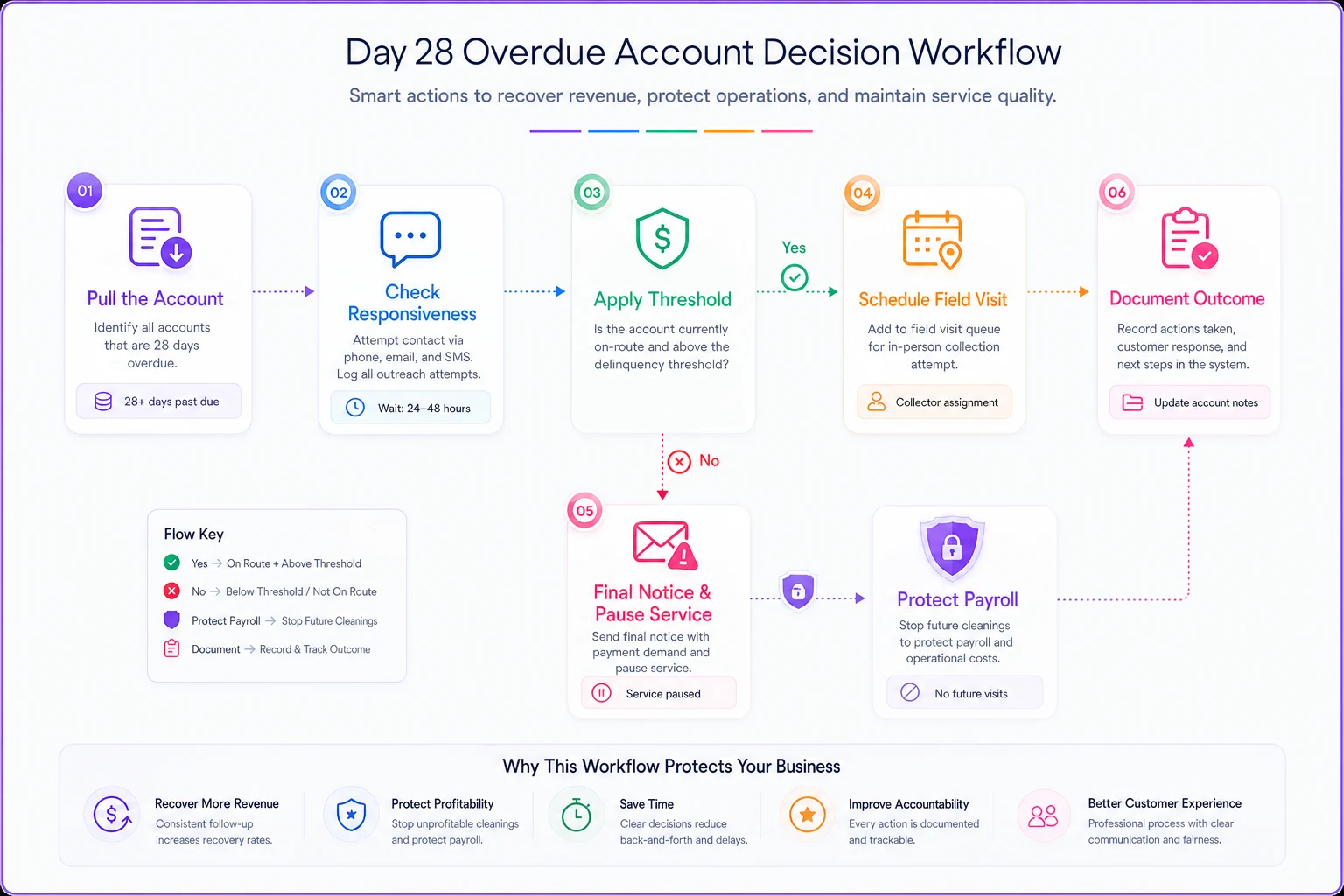
Use the flow visually to speed decisions — it's five minutes per account when you follow it.
-
Pull the account. Confirm total balance, number of open invoices, and whether the client is still on an active route.
-
Check responsiveness. Did they reply to any message in steps 1–5? A single reply changes the whole posture — that's a negotiation, not a chase.
-
Apply the threshold. Balance above your field-visit floor and on-route and non-responsive → schedule the visit alongside existing route work. Below the floor, or off-route → formal final notice and pause service instead.
-
Protect payroll first. Regardless of path, stop future cleanings for any account past day 28 with no payment plan. You never fund a fourth visit for an account that hasn't paid for three.
-
Document the outcome. Paid, payment-plan, disputed, or written-off — tag it so it stops living in your head.
Running through these steps in order takes maybe five minutes per account. The owners who skip it are the ones who keep cleaning non-paying clients because the decision felt uncertain in the moment.
This is where owners lose the most money, because the default behavior is to do nothing and keep cleaning. Pausing service at this stage isn't harsh. It's the thing that keeps your crew's paychecks whole.
A real scenario
A three-crew residential cleaning company with around 180 recurring clients was running collections entirely by memory. The owner would "get to it" when the balances felt big. By the time anyone looked, there was consistently $4k–$6k in aging receivables floating past 45 days, and two or three clients being cleaned every week while owing for a month of past service.
They put in the staged sequence above — automated for steps 1 through 3, a scheduled Tuesday call block for step 4, and a strict day-28 service-pause rule. Nothing fancy. The biggest change was simply that the day-1 failure message went out automatically, so expired cards got fixed before they snowballed.
Within about two months, aging receivables dropped to under $1,500 at any given time. More interesting: churn didn't rise. A couple of clients grumbled about the pause notice, cleared their balance, and stayed on. The owner stopped quietly funding crew wages against money that hadn't arrived, and payroll weeks stopped being stressful. The money was mostly always collectible — it was just being collected 40 days too late.
The checklist to run this without thinking about it
Day-1 payment-failure message fires automatically — no manual trigger
-
Day-1 payment-failure message fires automatically — no manual trigger
-
SMS is used, not just email, in the early steps
-
"Past due" language doesn't appear until day 8
-
A human phone call happens around day 14
-
Service-pause notice goes out at day 21
-
Every account past day 28 with no plan gets future service paused
-
Field visits are reserved for on-route, non-responsive, above-threshold balances
-
Disputed accounts are pulled out of the collections track entirely
-
Every outcome gets tagged so nothing lives only in your head
Every outcome gets tagged so nothing lives only in your head
Where this connects to the rest of your cash controls
A collections sequence works best when it sits on top of clean payment rules — clear deposit requirements, approval limits, and reserve buffers so a slow week doesn't become a payroll emergency. If you haven't tightened those yet, the financial controls framework for small cleaners covers the deposit and reserve side that makes this whole sequence less necessary in the first place. The fewer accounts that ever fail, the fewer you have to chase.
Collections in a recurring-service business is really about rhythm. Clients don't resent being asked to pay. They resent inconsistency, surprises, and awkward silence that stretches for weeks. A sequence that moves fast, stays warm early, and gets firm only when it needs to will recover more money and keep more clients than the alternative — which, for most cleaning owners, is quietly hoping the balance sorts itself out while the crew keeps showing up for free.
Collections in a recurring-service business is really about rhythm. Clients don't resent being asked to pay. They resent inconsistency, surprises, and awkward silence that stretches for weeks. A sequence that moves fast, stays warm early, and gets firm only when it needs to will recover more money and keep more clients than the alternative — which, for most cleaning owners, is quietly hoping the balance sorts itself out while the crew keeps showing up for free.
Ready to elevate your cleaning business?
Join 500+ cleaning services using Maidufy to save time, reduce scheduling errors, and deliver exceptional client satisfaction.