


Most cleaners think shorter visits come from cleaning faster. They don't. The fastest way to shave time off a visit happens before your crew even parks the van — and it depends almost entirely on what the client did (or didn't do) with the space in the 12 hours before you show up.
Every cleaner has walked into this: a kitchen counter buried in mail and cereal boxes, a bathroom floor covered in laundry, a dog nobody warned you about, and a client who's confused about whether you're doing the fridge today. You didn't lose time cleaning. You lost time dealing with the house before you could clean it.
That gap between "arrive" and "actually start cleaning" is one of the most under-measured time sinks in residential work. And it's fixable with a checklist you send the client, not one your crew follows. That's what a client pre-visit checklist for cleaners actually solves — not client education for its own sake, but reclaiming minutes that already belong to you.
The part of a visit nobody times
When people benchmark cleaning times, they measure the cleaning. Time-per-room, deep-clean modifiers, crew size — that stuff gets tracked. What almost nobody tracks is the pre-clean overhead on a given job.
Pre-clean overhead is everything that eats clock before productive work starts:
-
Moving clutter off surfaces you're supposed to clean
-
Figuring out access (lockbox code that changed, gate, garage)
-
Managing pets that should've been crated
-
Clarifying scope on the doorstep ("wait, are you doing the oven today?")
-
Waiting for the client to finish a call, get out of the shower, or move the car
In real operations, this usually runs 8–15 minutes on a standard recurring visit and can balloon past 25 on first-time or messy jobs. Nobody bills for it. Nobody schedules for it. It just quietly compresses the actual cleaning window or pushes the crew late to the next stop.
The insight most owners miss: a huge chunk of this overhead is client-controllable. The client can clear counters. The client can crate the dog. The client can confirm the code the night before. They just don't, because nobody asked them clearly and nobody made it easy.
Why the pre-visit gap happens
It's rarely because clients are lazy. A few patterns show up over and over:
Never miss a cleaning appointment again.
Maidufy helps you book, confirm, and manage every cleaning service seamlessly.
- Centralized booking management
- Automated client reminders
- Optimized staff scheduling
No credit card required
The client doesn't know what "ready" looks like. They assume you'll handle the clutter because "that's cleaning, right?" To them, tidying and cleaning are the same job. To you, one is billable skilled work and the other is 12 minutes of moving someone's Amazon boxes.
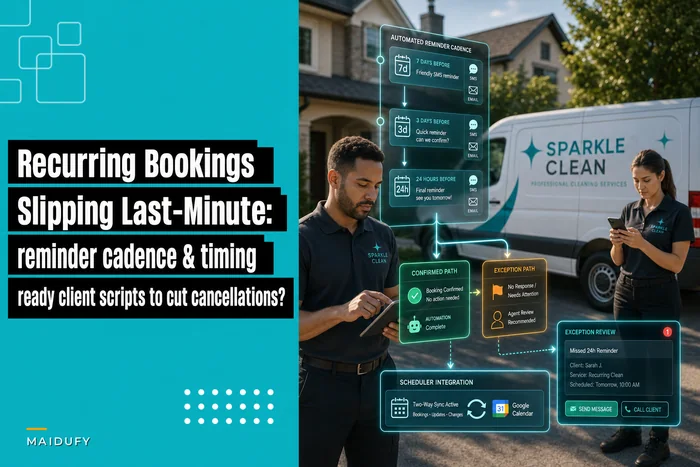
The reminder they got said the wrong thing. Most reminder systems confirm the appointment — "See you tomorrow at 10!" — but say nothing about preparation. A confirmation is not a prep instruction. If your reminders only do the first thing, you're missing the entire lever. And if your reminders themselves are inconsistent, that's a separate problem worth fixing first — we broke that down in the reminder cadence post on cutting last-minute cancellations.
Scope lives in your head, not in writing. The client thinks fridge and oven are included. You know they're add-ons. You find this out on the doorstep, which is the worst possible time to renegotiate.
Access details rot. Codes change, someone new moved in, the gate now has a latch. Access surprises are among the most expensive because they can cost you the entire visit if you can't get in.
What this costs over a month
Here's the math that makes owners pay attention. Say pre-clean overhead averages 10 minutes per visit, and a two-person crew runs 6 jobs a day, 5 days a week.
| Metric | Before checklist | After checklist |
|---|---|---|
| Overhead per visit | ~10 min | ~4 min |
| Crew-minutes saved per visit | — | ~12 (2 people × 6 min) |
| Jobs per day | 6 | 6 |
| Overhead reclaimed per crew/day | ~120 crew-min | — |
| Reclaimed per crew/week | ~10 crew-hours | — |
Ten crew-hours a week is not a rounding error. Depending on your average job length, that's roughly one to two additional visits per crew per week you could fit without hiring anyone — or the same number of jobs done with less overtime and less running late.
Even if you don't add jobs, the buffer alone changes the day. Crews that aren't burning an hour daily on other people's clutter finish on time, and clients stop getting the frazzled "we're running behind" texts that erode trust over time.
A quieter cost: doorstep scope confusion is where a lot of disputes start. When the client expected the fridge and you didn't do it, that becomes a bad review or a refund ask — regardless of what the booking actually said.
The pre-visit checklist that actually moves minutes
The message the client receives should not read like a chore list. It should read like help. Frame every item as "so we can spend our time on the deep cleaning instead of tidying."
Send it the evening before, not the morning of. Morning-of is too late for anyone to act on it.
Pre-visit prep — sent the night before:
-
✅ Clear the counters (kitchen + bathrooms). Anything left out we'll clean around, so clearing = a deeper clean in the same time.
-
✅ Floors picked up — toys, laundry, shoes. We can't mop what we can't see.
-
✅ Pets secured in a crate or a closed room. Let us know if there's a pet so the crew's ready.
-
✅ Confirm access — is the code still
____? Any gate/garage notes? -
✅ Today's scope Standard clean. Not included: inside fridge / inside oven / interior windows. Reply "add fridge" or "add oven" and we'll quote it before we arrive.
-
✅ Anything you want prioritized? Reply with one thing and we'll make sure it's spotless.
Notice what each line is doing. The first two reclaim tidying time. The third kills the pet surprise. The fourth prevents lockouts. The fifth freezes scope in writing before the doorstep. The last one is a small retention move — clients love feeling heard, and it costs you nothing.
Attaching minutes-saved estimates (so you can actually manage it)
The reason to put rough minute estimates on each item isn't to show the client. It's for you — so you can measure whether the checklist is working and coach crews on where overhead is still leaking.
-
Counters cleared → saves ~3–5 min per kitchen/bath
-
Floors picked up → saves ~2–4 min per room mopped or vacuumed
-
Pet secured in advance → saves ~2–8 min (huge variance; a loose dog can wreck a visit)
-
Access confirmed → saves 0 min on a good day, saves the entire visit on a bad one
-
Scope frozen in writing → saves ~2–4 min of doorstep negotiation, plus avoids disputes
Have crews note on the job ticket whether the home was "prepped / partial / not prepped." After a few weeks you'll see which clients consistently prep and which never do. That data is useful — it tells you which recurring jobs are secretly under-scheduled and might need a time or price adjustment.
A quick workflow that keeps it running
You don't need anything fancy to run this. The flow looks like:
The evening before each visit, a prep message goes out to the client with the checklist tailored to their job type. The client either replies — to add a service, flag a pet, confirm the code — or doesn't. If they reply with a scope change, it lands in front of whoever quotes it before dispatch, so the crew rolls out with correct scope and pricing. When the crew arrives, they log a one-tap "prep status" on the ticket. That status feeds a weekly glance at which clients prep well and which don't.
Automate the night-before message once you have ~40 recurring clients to avoid missed sends and manual errors.
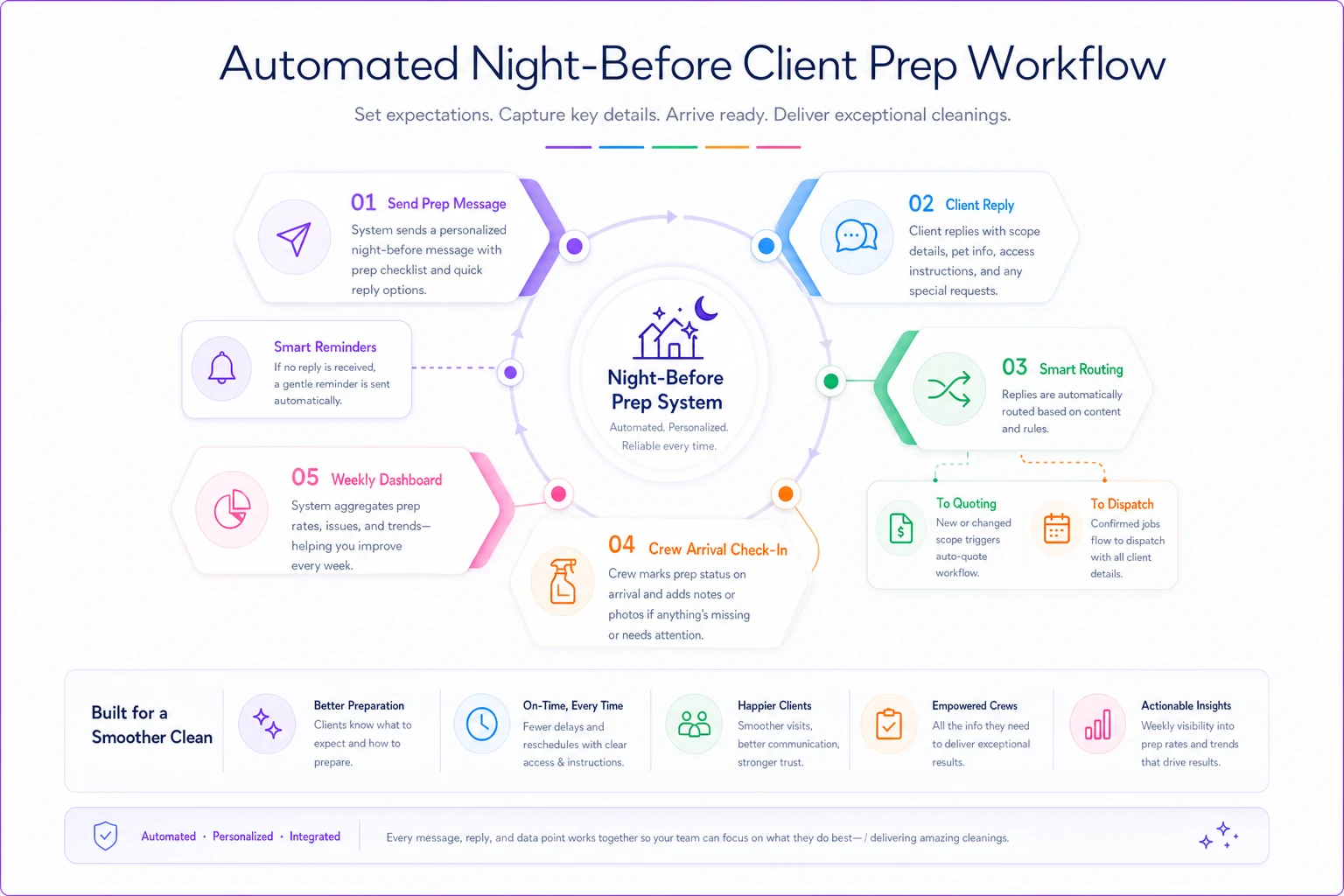
If you're sending these by hand across 40+ recurring clients, it falls apart fast — someone forgets, codes get pasted wrong, replies get missed. This is exactly the kind of repetitive task where operational software earns its keep: the prep message fires automatically the night before with the right scope for each client, replies route to the right person, and prep status rolls up without anyone building a spreadsheet.
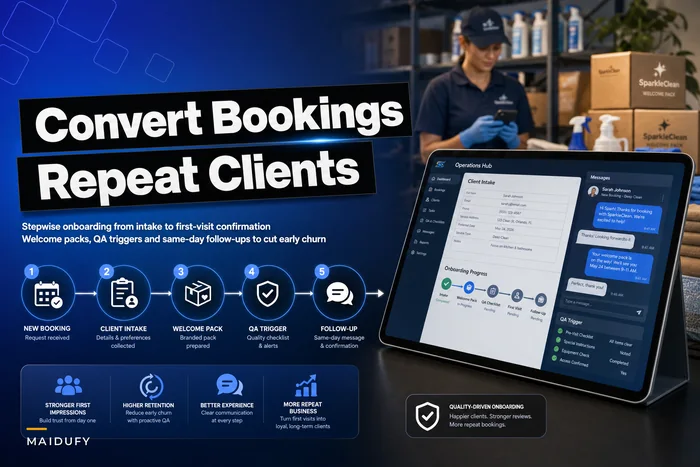
This pairs naturally with a solid onboarding flow, since the best time to set prep expectations is when a client first signs on — we covered that in the piece on turning new bookings into repeat clients.
A real-world example with the numbers
A three-crew residential operation running around 300–330 recurring visits a month kept running late on afternoon jobs. Crews blamed traffic. The actual culprit, once they started logging prep status, was overhead — mornings ran clean, but by the third or fourth stop, clutter-heavy homes were adding 12–18 minutes each and the delays stacked.
They started sending a night-before prep checklist with a scope confirmation line. Within about six weeks:
-
Homes logged as "prepped" went from roughly 40% to around 75%
-
Average overhead dropped from ~11 minutes to ~5
-
Afternoon crews stopped running the daily 30–45 minute late stack
-
Doorstep scope arguments — which were happening maybe twice a week — basically disappeared
They didn't add a single job at first. They just stopped bleeding time and paying occasional overtime to finish late routes. A month or two later, with the reclaimed buffer, one crew picked up an extra recurring client on Tuesdays without stretching the day. The checklist didn't make them clean faster. It made the client hand back the time.
When this makes sense — and when it doesn't
This is worth doing if you run recurring residential work, your crews sometimes run late, or you get doorstep scope surprises. The overhead problem compounds across a route, so the more stops per day, the bigger the payoff.
This matters less if you mostly do large one-off deep cleans where you expect the mess and price for it anyway. In deep-clean work the "clutter" often is the job.
Don't overdo it. A checklist with 15 items reads like homework and gets ignored. Six lines, framed as help, sent the night before — that's the whole thing. Longer isn't better here because compliance drops the moment it feels like a burden.
Who should skip the pet/scope lines: if a client never has pets and their scope truly never changes, trim their message down. A checklist that lists irrelevant items trains people to stop reading it.
The takeaway
Shorter visits usually aren't a speed problem — they're a readiness problem. The clock starts long before your crew picks up a cloth, and a big slice of that pre-clean time is sitting in the client's hands, waiting for someone to ask clearly.
Send the checklist the night before. Frame it as help, not homework. Track prep status so you know where minutes are still leaking. Do the capacity math for your own route and you'll probably find several reclaimable crew-hours a week you're currently giving away for free — no faster cleaning, no new hires, just a two-minute message that gets the house ready before you get there.
Ready to elevate your cleaning business?
Join 500+ cleaning services using Maidufy to save time, reduce scheduling errors, and deliver exceptional client satisfaction.