

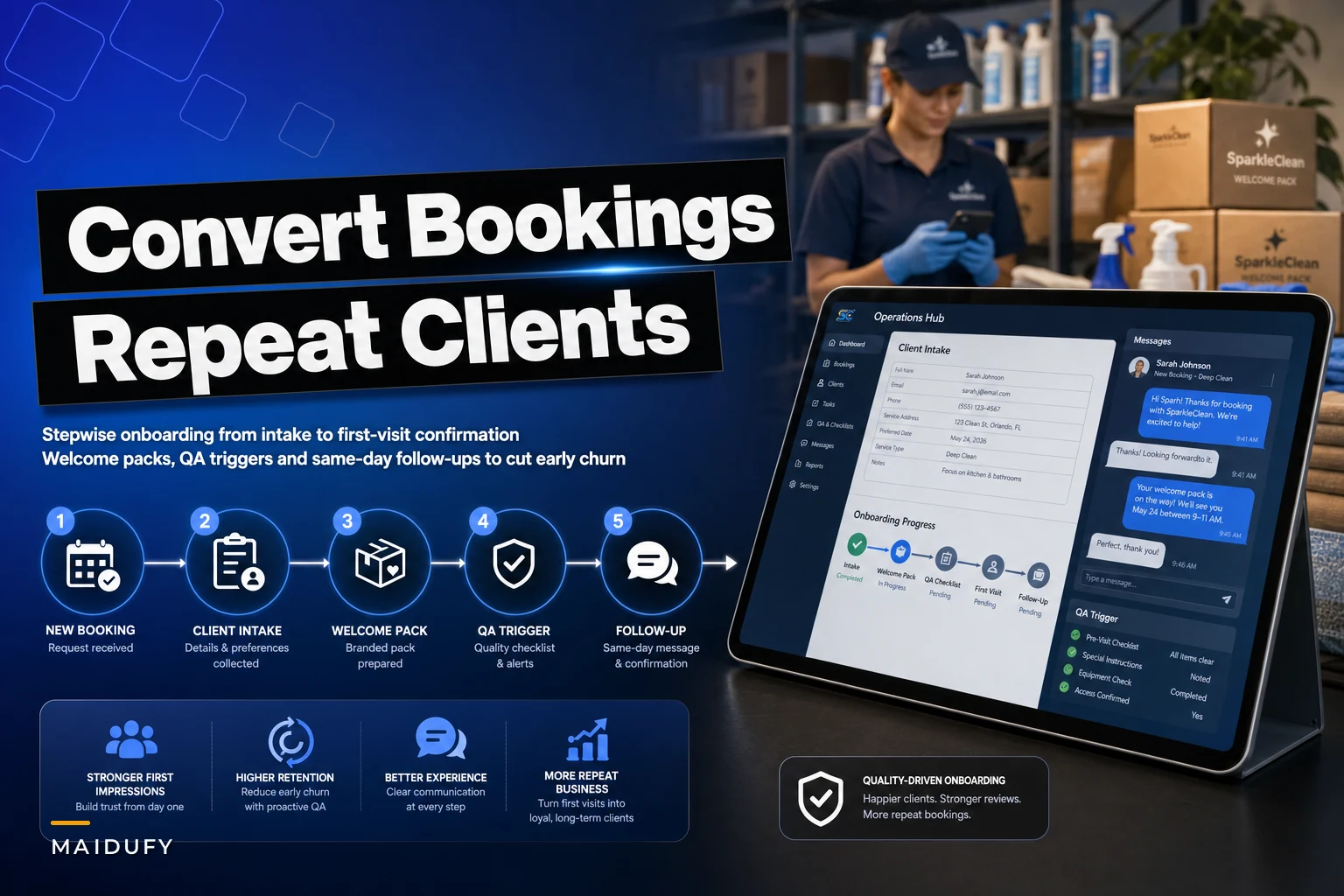

Your cleaning client onboarding process starts the moment someone books their first appointment. Most cleaning businesses lose around 40% of new clients before the third visit—not because of poor service quality, but because their onboarding feels disjointed and unprofessional.
The difference between a cleaning business that converts 30% of first-time clients into recurring customers versus one that converts 65% usually comes down to what happens between booking and the morning after that first clean. It's not about impressing them with fancy tech or overwhelming them with information. It's about creating a predictable sequence that builds confidence while gathering the operational details you actually need.
The intake form mistake that creates chaos on arrival day
Every cleaning business needs client information, but the typical approach—sending a basic contact form or worse, gathering details over the phone—creates immediate problems. Your cleaner shows up not knowing if there's a territorial German Shepherd, which door to use, or that the client specifically requested no bleach products because of their toddler's sensitivity.
This isn't just inconvenient. It forces your team to make judgment calls they shouldn't have to make. They either interrupt the client repeatedly or guess wrong and create friction from day one.
A proper intake form collects three categories of information:
Access and logistics
-
Primary entry method (lockbox code, hidden key location, garage code)
-
Parking situation and any restrictions
-
Best number for day-of issues
-
Pets and their typical behavior with strangers
-
Alarm codes and instructions
Service preferences
-
Areas to avoid or handle specially
-
Product sensitivities or preferences
-
Priority rooms if time runs short
-
Items that shouldn't be moved
-
Preferred communication style (text vs email vs phone)
Operational needs
-
Billing details and autopay setup
-
Service frequency preference
-
Preferred day and time windows
-
Other services they might want (inside oven, inside fridge, baseboards)
The timing matters here. Send this immediately after booking confirmation, not three days later when they've mentally moved on. You want responses while they're still engaged and thinking about the upcoming service.
Welcome packs that actually reduce cancellations
After collecting intake information, most cleaning businesses go silent until the day before service. This dead zone is where doubt creeps in. New clients start wondering if they really booked correctly, if the company is legitimate, whether they should have gone with the bigger franchise down the street.
Never miss a cleaning appointment again.
Maidufy helps you book, confirm, and manage every cleaning service seamlessly.
- Centralized booking management
- Automated client reminders
- Optimized staff scheduling
No credit card required
A welcome pack isn't marketing fluff—it's operational insurance against cold feet. Send it within two hours of receiving their completed intake form.
Structure your welcome pack around answering unspoken concerns:
What happens next
-
Exact timeline from now until service day
-
When they'll hear from you again
-
Who their cleaner will be (name and photo if possible)
-
What the cleaner will do upon arrival
Service details
-
Typical duration for their home size
-
Exactly what's included in their service type
-
Common add-ons they might consider for next time
-
Your supplies versus what they need to provide
Practical preparation
-
Simple prep checklist (dishes away, valuables secured, clear surfaces)
-
What doesn't need to be done (we'll handle the rest)
-
Day-of communication protocol
-
How to modify or cancel if needed
Keep it under 800 words total. Format it as a PDF with your branding, not a wall of email text. Include your direct phone number—not just the booking line—for questions.
Building the 72-hour communication cadence
The cleaning client onboarding process needs strategic touchpoints, not constant pestering. After the welcome pack, there are three critical windows to maintain engagement without seeming desperate.
24 hours after booking — Intake form follow-up
If they haven't completed the intake form, send a friendly nudge. Not "You haven't filled out our form" but "Quick question about Friday's service—can you let us know the best way to access your home?" Make it about solving their problem, not completing your checklist.
48 hours before service — Confirmation and prep reminder
This isn't just "See you Wednesday at 2pm." Include their cleaner's first name, an estimated arrival window, one specific detail pulled from their intake (something like "We'll make sure to avoid disturbing your home office"), a link to reschedule if needed, and a gentle reminder about basic prep.
Morning of service — Final touchpoint
Send this 2–3 hours before arrival. Something like "Maria is heading your way, currently scheduled to arrive between 2–2:30pm," along with a direct contact number for day-of issues and a quick note on what to expect in the first few minutes.
Each message should feel helpful, not transactional. You're building trust through predictability.
First-visit QA triggers that catch problems early
The first clean sets expectations for the entire relationship. Most cleaning businesses treat it like any other appointment though—send the crew, hope for the best, wait to see if the client complains.
Build automatic quality checks into that first visit instead. Here's a simple workflow showing how those touchpoints connect:
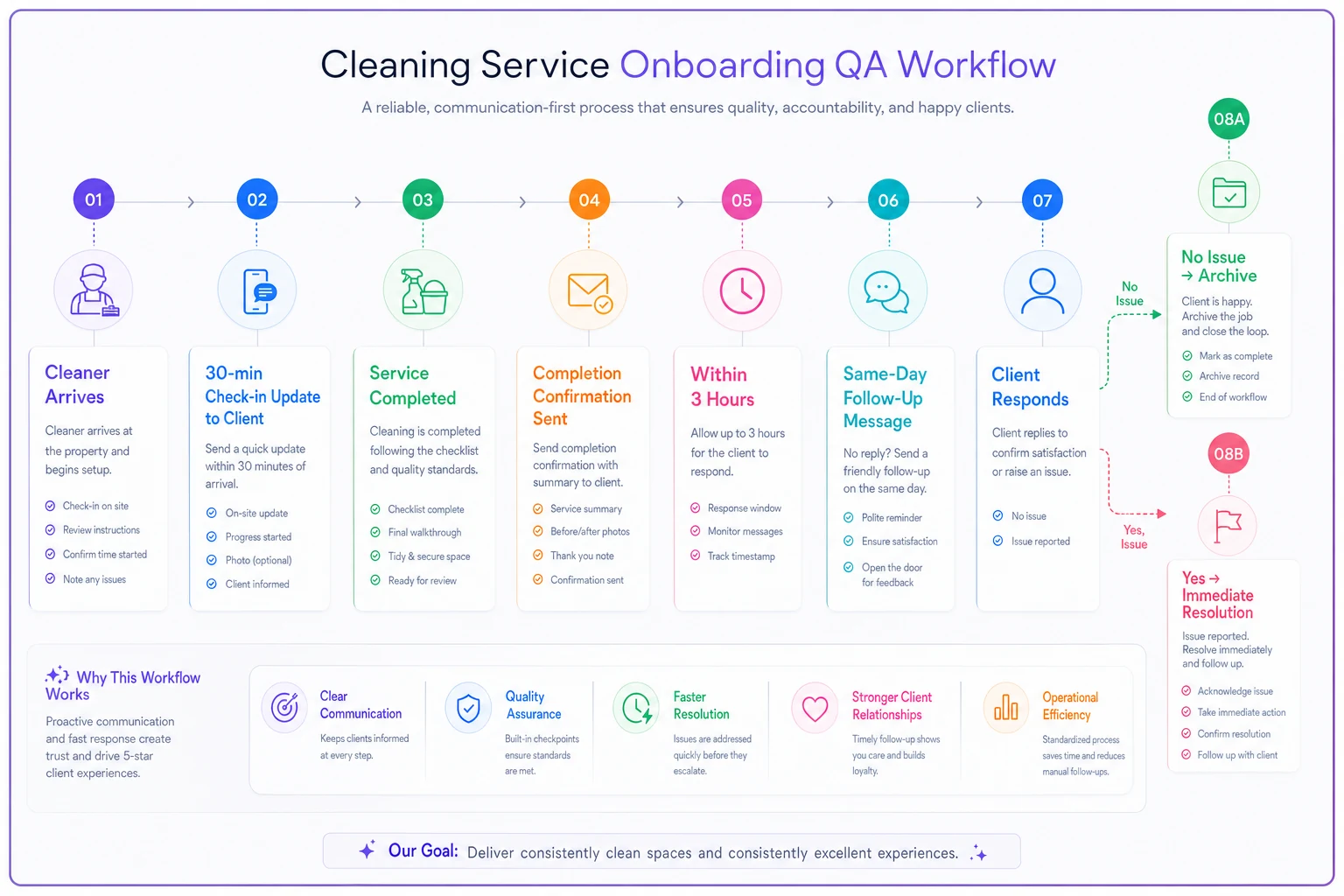
During-service check (30 minutes in): Have your cleaner send a quick update—"Started on the upstairs, everything going smoothly. Should be done around 3:30." This reassures anxious first-timers and creates a natural communication touchpoint if something unexpected comes up.
Completion confirmation (immediately after): Before leaving, cleaners should send a structured update covering areas completed, any issues encountered, anything they couldn't address and why, and optionally a photo of one visibly improved area if the client gave permission.
Same-day follow-up (within 3 hours): Don't wait three days to check satisfaction. Send a brief message—something like "Just wanted to make sure everything met your expectations today. If anything needs attention, let me know and we'll handle it right away."
This early intervention catches the small irritations that grow into cancellations. Maybe they expected the inside of the microwave to be included. Maybe the cleaner accidentally used the wrong bathroom towels. Fix it immediately and you've turned a potential loss into a demonstration of responsiveness.
The automation layer that makes this sustainable
Running this cleaning client onboarding process manually for every new booking would eat hours daily. But the personalization matters—clients can tell when something is fully generic.
The solution is selective automation with human touchpoints. Your intake form should auto-populate into your operational system. Welcome packs should generate automatically but pull specific details from their intake. Reminder messages should trigger based on service timing but include personalized elements.
| Process Step | Automation Level | Human Touch Required |
|---|---|---|
| Intake form delivery | Fully automated | None |
| Welcome pack generation | Template with variables | Review unusual requests |
| 48-hour reminder | Automated with merge fields | Add personal note for high-value bookings |
| Day-of notifications | Fully automated | Cleaner adds specific updates |
| QA follow-up | Automated trigger, manual response | Respond personally to any concerns |
Use template variables for names and arrival windows to keep messages personal.
The key is maintaining the feeling of personal attention while keeping your time investment minimal. Operational software powered by AI automation handles this balance well—form responses populate into service notes, which feed into automated messages, which trigger follow-up workflows based on how clients respond.
Tracking what actually predicts retention
Not all onboarding metrics matter equally. Three specific indicators tend to predict whether a first-time client becomes recurring:
Response time to intake form: Clients who complete intake within 4 hours of booking convert to recurring at nearly double the rate of those who take over 24 hours. This isn't causation—it's an engagement indicator. Fast responders are mentally committed.
Interaction with welcome pack: If your welcome pack includes a PDF attachment, track opens. Clients who actually read it tend to stick around noticeably longer. Consider embedding a simple "confirm receipt" button to measure engagement.
Day-one communication: Clients who respond to any message on service day—even just "Thanks!"—are significantly more likely to book again. The act of communication creates psychological investment in the relationship.
Common onboarding modifications for different client types
Your standard cleaning client onboarding process needs flexibility for different situations.
Move-in/move-out clients: These are transactional by nature, but roughly 15% become recurring if you handle onboarding right. Skip the frequency preferences in your intake. Instead, ask about their new home's regular cleaning needs. Include local area information in your welcome pack. Follow up a week after move-in with a "settling in" discount for regular service.
Vacation rental hosts: Modify intake to capture check-in/out schedules, linen service needs, and specific staging requirements. Welcome packs should include your emergency contact for last-minute bookings. Build QA triggers around photo documentation and inventory checks.
Post-construction cleanup converting to maintenance: These often become your best ongoing accounts. Intake should identify facility management needs going forward. Welcome packs should emphasize your range of services. QA triggers should document the initial state thoroughly—this becomes your baseline for ongoing work.
Each client type has different expectations coming in, and a generic onboarding flow is going to miss that. Small adjustments to what you ask and what you send go a long way.
The hidden profit in proper onboarding
Most cleaning businesses obsess over lead generation while ignoring client onboarding. Fixing your onboarding is essentially free money. Consider the math:
A cleaning business with 20 new bookings monthly and 35% retention keeps 7 clients. Improve retention to 55% through better onboarding and you keep 11. At $200 monthly revenue per client, that's an additional $800 in monthly recurring revenue. Over a year, you're looking at close to $15,000 in additional revenue from the same marketing spend.
It compounds because properly onboarded clients also refer more frequently. They understand your service better, trust your business, and can actually articulate your value to friends. A client who received a professional welcome pack and a smooth first-service experience becomes an advocate. One who figured things out through trial and error stays quiet.
Building your implementation timeline
Don't try to overhaul your entire cleaning client onboarding process at once. Start with the highest-impact changes:
-
Week 1 — Create your comprehensive intake form. Any form builder works initially—Google Forms is fine. Focus on getting the questions right before worrying about automation.
-
Week 2 — Write your welcome pack content. Create a simple PDF template. Start sending manually to test the messaging and format.
-
Week 3 — Establish your communication cadence. Set calendar reminders if needed. Track open rates and responses to figure out what's actually resonating.
-
Week 4 — Add QA triggers for first visits. Train your team on the new check-in process. Start capturing feedback systematically.
-
Month 2 — Layer in automation where it makes sense. Connect your intake form to your scheduling system. Set up automatic message triggers. But maintain the ability to personalize when it counts.
The businesses that thrive aren't necessarily those with the most elaborate processes. They're the ones that recognize how much those first few interactions matter and build their operations around it. Your cleaning client onboarding process is where that conversion happens—treat it accordingly.
The businesses that thrive aren't necessarily those with the most elaborate processes. They're the ones that recognize how much those first few interactions matter and build their operations around it. Your cleaning client onboarding process is where that conversion happens—treat it accordingly.
Ready to elevate your cleaning business?
Join 500+ cleaning services using Maidufy to save time, reduce scheduling errors, and deliver exceptional client satisfaction.