
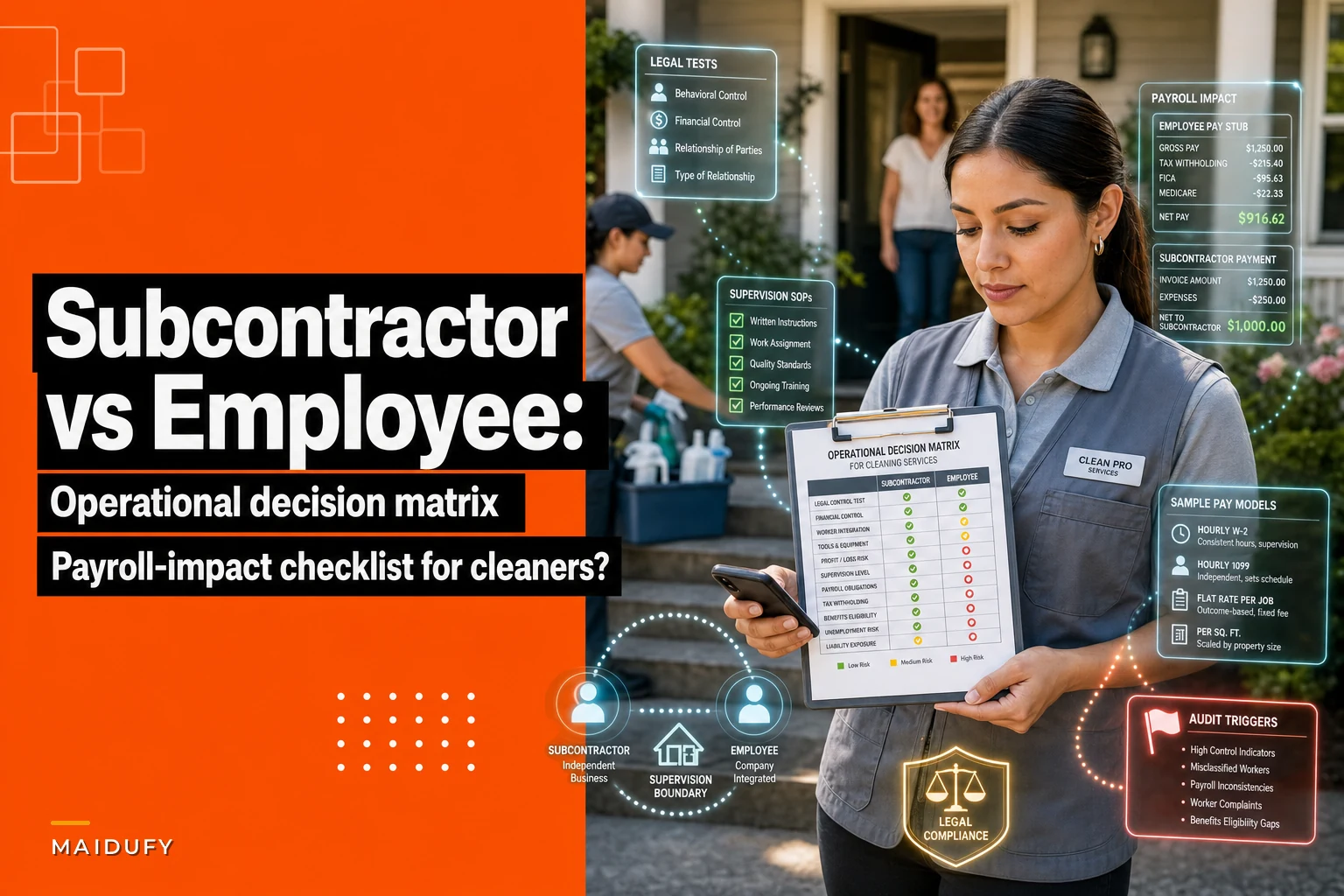

The subcontractor vs employee decision isn't just legal semantics—it's an operational choice that directly shapes your growth trajectory, profit margins, and daily headaches. Get it wrong, and you're looking at payroll costs jumping 30-40% overnight when the IRS reclassifies your workforce, plus penalties that can reach $50 per unfiled W-2 and 1.5% of unpaid wages.
Most cleaning business owners approach this backwards. They start with tax savings, then try to force their operations into whatever classification seems cheaper. That's exactly how you end up with a structure that fights itself—1099s who need constant supervision but legally can't receive it, or W-2s whose payroll burden makes bidding competitive rates nearly impossible.
The real operational tradeoffs
Running cleaners as 1099 subcontractors means accepting constraints that most owners only discover after the fact. You can't dictate cleaning methods. You can't require specific arrival times beyond general appointment windows. You can't mandate branded shirts or cleaning supplies. You can't even insist they turn down competitor work during your slow periods.
A cleaning business in Phoenix found this out the hard way after eighteen months. They'd built their entire quality promise around detailed checklists, specific product requirements, and strict supervision protocols. When the state labor board came knocking, the reclassification audit hit them with $47,000 in back payroll taxes and another $12,000 in penalties. The owner said the financial hit hurt less than realizing their whole operational model was legally unsustainable from day one.
Going the W-2 route gives you full operational control, but the burden is real. Beyond the obvious 7.65% employer FICA contribution, you're looking at workers' comp premiums running 3-8% of payroll depending on your state, unemployment insurance starting around 2.7% for new employers, plus the ongoing overhead of running payroll every two weeks. That $15/hour cleaner realistically costs $19-21/hour before you factor in benefits, paid time off, or the time spent managing compliance.
Decision matrix: When each model actually works
1099 Subcontractor Model Works When:
Never miss a cleaning appointment again.
Maidufy helps you book, confirm, and manage every cleaning service seamlessly.
- Centralized booking management
- Automated client reminders
- Optimized staff scheduling
No credit card required
Your market dynamics support it:
-
Average job value exceeds $150-200
-
Clients book sporadically (monthly or quarterly deep cleans)
-
Geographic spread makes route density impossible
-
Local competition uses a similar model (level playing field)
Your operational structure allows independence:
-
Cleaners bring their own supplies and equipment
-
You assign jobs, not methods
-
Quality control happens through client feedback, not supervision
-
Each cleaner operates as a genuinely independent business
Financial indicators align:
-
Gross margins need to exceed 40% to be sustainable
-
You can handle 25-35% cleaner turnover annually
-
Cash flow supports irregular payment schedules
-
No need for tight per-job cost controls
W-2 Employee Model Works When:
You need operational control:
-
Standardized cleaning processes across all jobs
-
Specific arrival times and route optimization matter
-
Brand consistency requires uniforms and methods
Your business model requires it:
-
High-frequency recurring clients (weekly/biweekly)
-
Route density in concentrated territories
-
Team cleaning approaches for efficiency
-
Growth strategy depends on service consistency
Numbers support the structure:
-
Average client lifetime value exceeds $2,000
-
Route density allows 6+ jobs per day per cleaner
-
Recurring revenue exceeds 70% of total
-
Market rates support 35-40% labor costs
Market rates support 35-40% labor costs
Sample pay models with real payroll math
1099 Subcontractor Structure
Flat rate per job model:
-
Standard home (3BR/2BA)
Pay $60-75 to contractor
-
Deep clean
Pay $100-120 to contractor
-
Move-out clean
Pay $120-150 to contractor
-
Contractor covers all supplies, transport, insurance
-
You bill client 40-50% above contractor rate
-
No payroll taxes, workers comp, or benefits
Monthly economics for 200 jobs:
| Metric | Value |
|---|---|
| Revenue | $24,000 (avg $120/job) |
| Contractor payments | $14,000 (avg $70/job) |
| Gross profit | $10,000 (41.7% margin) |
| No payroll processing costs | |
| No employer tax burden | |
| Risk | Reclassification could add roughly $2,100/month in taxes |
W-2 Hourly Employee Structure
Hourly with performance bonuses:
-
Base pay
$14-16/hour
-
Efficiency bonus
$2-3/hour for meeting time standards
-
Quality bonus
$25-50/month for high ratings
-
Employer taxes
Add 18-22% to base wages
-
Workers comp
Add 4-6% (varies by state)
Monthly economics for same 200 jobs:
| Metric | Value |
|---|---|
| Revenue | $24,000 |
| Direct wages | $11,200 (2 FT cleaners) |
| Employer taxes | $2,016 |
| Workers comp | $448 |
| Supplies/transport | $800 |
| Gross profit | $9,536 (39.7% margin) |
| Includes full operational control |
Hybrid Model Structure
-
Separate job types completely (deep cleans vs. maintenance)
-
Different workers for each classification
-
Distinct operational procedures
-
Separate management systems
-
Clear documentation of independence
The administrative complexity usually isn't worth it unless you're running $50K+ monthly revenue with dedicated back-office support.
Supervision SOPs that keep you compliant
For 1099 Subcontractors:
What you CAN do:
-
Provide job specifications (what needs cleaning)
-
Set result expectations (client satisfaction standards)
-
Offer suggested time windows for appointments
-
Share client feedback and ratings
-
Remove contractors from your referral list for poor performance
What you CAN'T do:
-
Require specific cleaning methods or products
-
Mandate exact arrival times or routes
-
Provide detailed training on how to clean
-
Supervise work in progress
-
Restrict them from working for competitors
Documentation required:
-
Written independent contractor agreement
-
Proof of contractor's business license/insurance
-
1099-NEC forms for payments over $600 annually
-
Job completion records (not timesheets)
-
Client satisfaction scores as performance metric
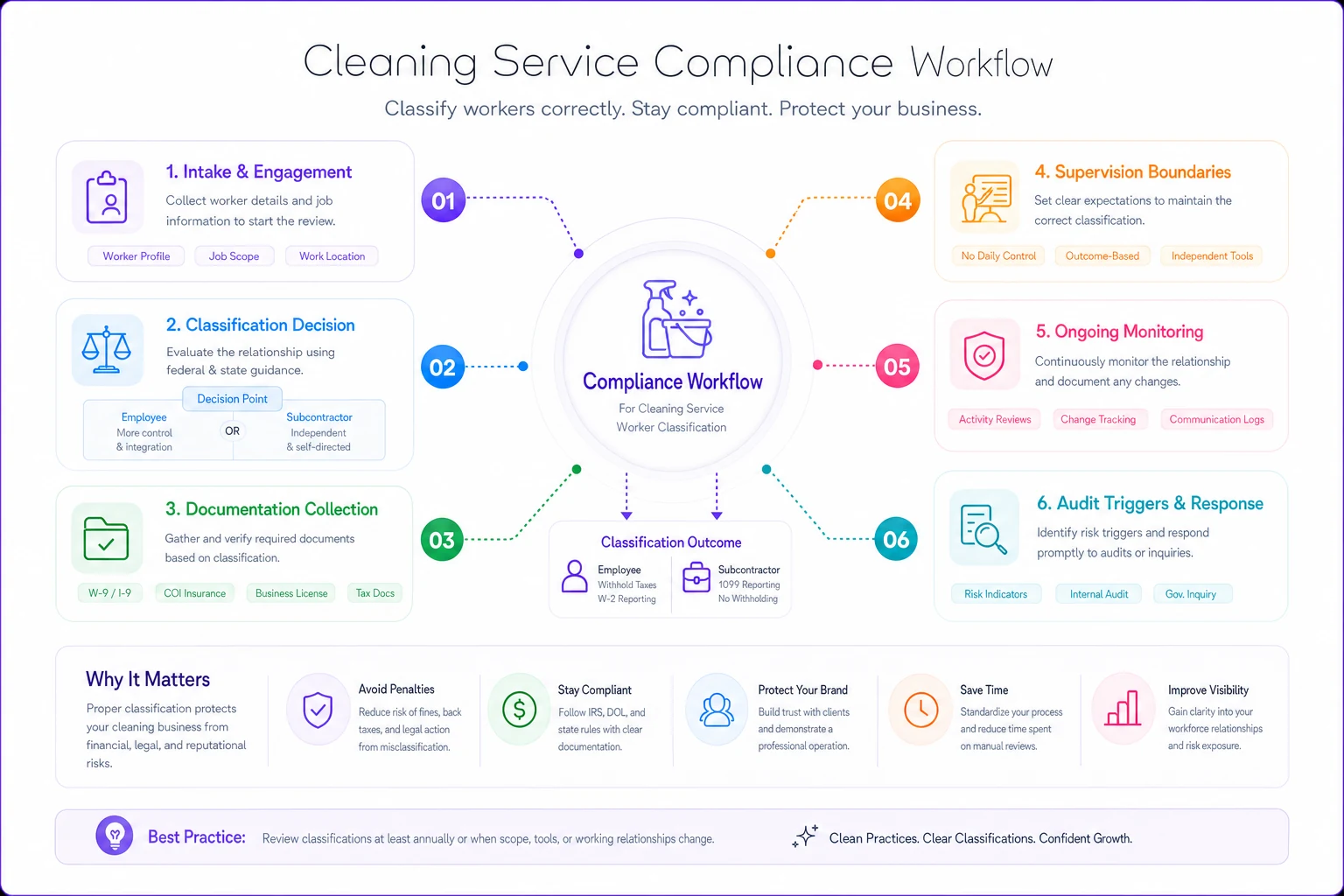
Here's a simple compliance workflow visualization to keep these requirements organized.
For W-2 Employees:
Management structure:
-
Detailed initial training program (40-80 hours)
-
Written cleaning protocols and checklists
-
Daily route assignments and scheduling
-
Active field supervision or team leads
-
Performance reviews and corrective action process
Compliance requirements:
-
I-9 employment verification
-
W-4 tax withholding forms
-
State new hire reporting
-
Payroll records retention (4 years federal, varies by state)
-
Time tracking for all hours worked
-
Overtime calculations for 40+ hour weeks
Quality control process:
-
Random job inspections (10-15% of jobs)
-
Customer feedback tracking by employee
-
Photo documentation of completed work
-
Performance improvement plans for issues
-
Clear termination procedures
Clear termination procedures
The reclassification trap and how to avoid it
The IRS uses a 20-factor test, but cleaning businesses typically fail on behavioral control. The killer combination is requiring specific cleaning methods while calling workers contractors. State agencies often use the ABC test, which is even stricter—you have to prove the worker operates a genuinely independent business.
Red flags that trigger audits:
-
Contractor files for unemployment after you stop giving them work
-
Workers comp claim from an uninsured "contractor"
-
Competitor reports suspected misclassification
-
High contractor payments trigger a state agency review
-
Client complaint mentions your "employee" to the labor board
Protection strategies:
-
Get a classification determination from the IRS (Form SS-8)
-
Maintain clear contractor independence documentation
-
Consider worker classification insurance
-
Regular legal review of contractor relationships
-
Voluntary reclassification before a forced audit
One cleaning service in Denver voluntarily reclassified after their attorney flagged multiple risk factors. The proactive move cost them around $8,000 in back taxes—painful, but nowhere close to the $40,000+ they'd have faced in an audit with penalties and interest stacked on top.
Legal disclaimer and implementation guidance
Critical disclaimer: This article provides operational perspectives based on common patterns across cleaning businesses. It does NOT constitute legal or tax advice. Classification rules vary significantly by state and change frequently. You MUST consult qualified legal counsel and tax professionals before making classification decisions for your specific business situation.
The operational frameworks here assume proper legal classification has already been determined through professional consultation. Using these workflows with misclassified workers could result in significant penalties, back taxes, and legal liability.
Implementation timeline for classification changes:
Weeks 1-2: Legal consultation and classification determination
-
Employment attorney review of current structure
-
CPA analysis of tax implications
-
State-specific requirements review
-
Document all factors supporting chosen classification
Weeks 3-4: Operational restructuring
-
Adjust management procedures to match classification
-
Update contracts and agreements
-
Revise quality control processes
-
Modify scheduling and dispatch systems
Weeks 5-6: Financial system updates
-
Set up proper payroll processing if going W-2
-
Adjust pricing models for new cost structure
-
Update cash flow projections
-
Implement time tracking if needed
Weeks 7-8: Worker transition
-
Communicate changes clearly
-
Gather required documentation
-
Process new paperwork
-
Train on new procedures
Train on new procedures
The software piece: Where automation actually helps
The classification decision creates distinct operational needs. For 1099 operations, you need platforms that coordinate independent contractors without controlling them—job boards, rating systems, and outcome tracking rather than time monitoring. For W-2 operations, you need integrated HR functions, time tracking, and performance management.
AI-powered operational software helps either model by handling the compliance-heavy pieces automatically. Classification checklists can flag risky behaviors before they become audit triggers. Smart scheduling can respect contractor independence boundaries while still optimizing routes for employees. Document management keeps the paper trail that proves your classification choice was deliberate.
Where it gets genuinely useful is in the grey areas—automatically routing customer complaints to contractors as feedback rather than directives, or generating performance reports that track outcomes for contractors versus behaviors for employees. Those nuanced differences matter a lot during an audit.
This decision isn't really about taxes or legal compliance in isolation—those are just constraints you have to work within. It's about choosing the operational model that actually matches your growth vision, service promise, and market reality.
A lot of cleaning businesses start with contractors for flexibility, then gradually shift to employees as route density improves and operational control becomes more critical. Others scale successfully with contractors by focusing on premium deep-cleaning work where that independence fits naturally.
The expensive mistake is trying to have it both ways—controlling contractors like employees, or giving employees the inconsistent work patterns meant for contractors. Pick your model, build your operations around it, and put systems in place that keep you compliant as you grow.
Your classification choice shapes every operational decision downstream. Make it deliberately, with a clear understanding of the tradeoffs, and with proper legal guidance behind you.
Ready to elevate your cleaning business?
Join 500+ cleaning services using Maidufy to save time, reduce scheduling errors, and deliver exceptional client satisfaction.