

Most cleaning businesses that use subs don't have an audit problem because they're lazy. They have one because audits feel like a full-time job nobody has time for. So the "system" becomes a vague memory of who's reliable and who isn't, held together by which subs got complaints last month.
That works right up until it doesn't. A sub lets a certificate of insurance lapse. Another one quietly starts sending a cousin to do the jobs. A client's hardwood gets scratched and suddenly you're asking yourself whether that crew was ever actually licensed to begin with. The answer, too often, is "I'm not sure."
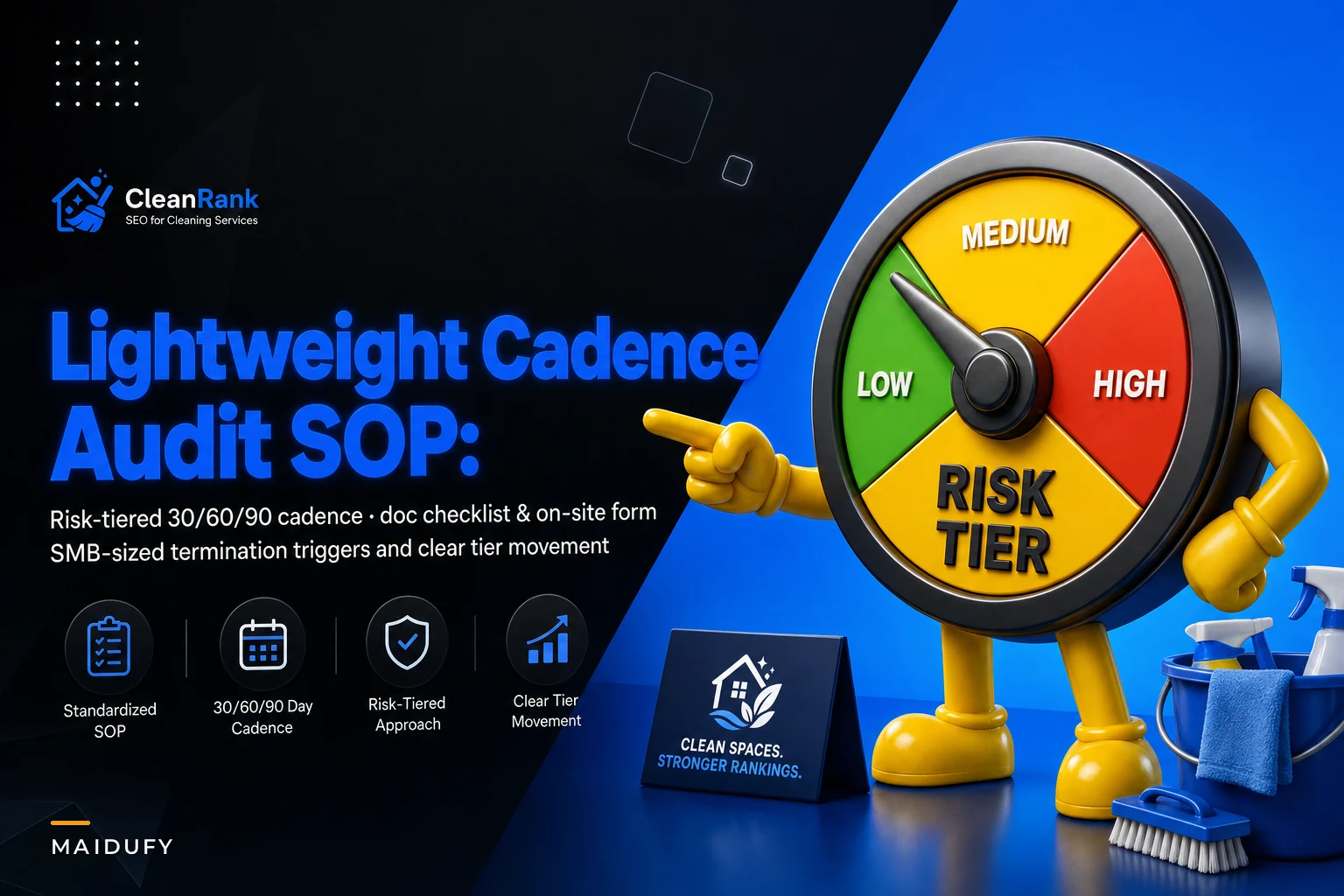
The fix isn't a bigger audit. It's a smaller, repeatable one tiered by risk, so you spend your limited time on the subs who can actually hurt you. Below is a subcontractor audit SOP built for cleaning businesses running real schedules, not compliance departments.
Why most subcontractor audits quietly collapse
The usual pattern looks like this: an owner sets up a solid onboarding checklist, collects everything at signup, then never looks at it again. Onboarding is a snapshot. Risk is a movie. Insurance expires. Workers change. Background checks age out. A sub who was spotless in January can be a liability by September, and a one-time intake catches none of that.
The second failure is treating every sub the same. A new subcontractor handling move-out deep cleans in luxury homes is a very different risk profile than a sub you've worked with for two years doing recurring maintenance cleans on small apartments. If your audit effort is spread evenly, you're over-checking the safe ones and under-checking the dangerous ones.
And the third — the one that kills the whole thing — is cadence. People confuse "we audit our subs" with "we audited a sub once." Without a scheduled rhythm, audits only happen after something goes wrong, which is the most expensive possible time to find out.
If you haven't already nailed down the classification side of this, it's worth revisiting the operational decision matrix for subcontractor vs employee, because an audit SOP only works when the relationship is structured correctly in the first place. Auditing someone you've functionally turned into an employee creates a different kind of exposure entirely.
Tier your subs before you audit anything
The whole point of a lightweight SOP is that you don't audit everyone the same way. You sort subs into risk tiers and let the tier decide the cadence. Here's the breakdown that tends to work for crews running somewhere between 3 and 25 subcontractors.
Never miss a cleaning appointment again.
Maidufy helps you book, confirm, and manage every cleaning service seamlessly.
- Centralized booking management
- Automated client reminders
- Optimized staff scheduling
No credit card required
| Risk tier | Who lands here | Audit cadence | Depth |
|---|---|---|---|
| High (30-day) | New subs (first 90 days), anyone handling keys/alarm codes, high-value homes, move-outs, any sub with a recent complaint | Every 30 days | Full doc check + on-site spot audit |
| Medium (60-day) | Established subs, standard recurring residential, no incidents in 90+ days | Every 60 days | Doc check + rotating on-site |
| Low (90-day) | Long-tenured subs (12+ months), clean record, low-complexity jobs | Every 90 days | Doc check + light on-site sample |
Two things make this work. First, movement between tiers is the whole game.
A low-risk sub who gets a complaint jumps back to high-risk 30-day cadence until they earn their way back down. Second, new subs always start high. No exceptions. Reliability is earned over months, not assumed at signup.
A common mistake is over-engineering the tiers. You don't need five levels and a scoring rubric. Three buckets and a clear rule for moving between them covers the vast majority of real risk.
The required document checklist
Documents are where most of the quiet liability hides, because paperwork expires silently. Nobody sends you a notification when a sub's general liability policy lapses. You find out when you file a claim and get denied.
-
Certificate of insurance (general liability, with your business named as additional insured where possible)
-
Workers' comp coverage or valid exemption — depending on your state and how the sub is structured
-
Business license / registration current for their operating area
-
W-9 on file and matching the entity actually being paid
-
Signed subcontractor agreement with current scope, rates, and quality standards
-
Background check on the sub and any workers they send (dated, with a re-check interval)
-
Proof of any required certifications — bonding, specialty cleaning certs if you offer them
-
Vehicle insurance if they're driving to/from jobs on your behalf
The non-negotiable rule: track expiration dates, not just possession. "We have their COI" is meaningless. "Their COI expires March 14 and we flag it 30 days out" is a control. A typical example of how this goes wrong — a sub's policy lapses in February, you don't notice, they cause $4k in damage in April, and the carrier denies the claim because coverage ended two months earlier. Now it's your policy or your pocket.
For the broader regulatory side of this — what's actually legally required versus nice-to-have — the health, safety and legal compliance system for residential cleaners pairs directly with this document list and keeps you from auditing against the wrong standard.
A sample on-site audit form
Paperwork tells you if a sub is legal. The on-site audit tells you if the work is real and matches what the client is paying for. Keep this short enough that a lead can run it in 10–15 minutes during or right after a job.
Subcontractor On-Site Audit — Sample Form
Header: Sub name / Job address / Date / Auditor / Tier
Section 1 — Identity & crew
-
Is the person on-site the approved sub or an approved worker? (Y/N)
-
Any unlisted workers present? (list names)
-
Uniform / ID / branding correct? (Y/N)
Section 2 — Work quality (score 1–5)
-
Kitchen surfaces and appliances
-
Bathrooms (grout, fixtures, mirrors)
-
Floors (edges and corners, not just centers)
-
Dusting including high/low touchpoints
-
Attention to client-specific notes
Section 3 — Safety & chemicals
-
Products match approved list? (Y/N)
-
Proper dilution / storage / labeling? (Y/N)
-
No prohibited chemical mixing observed? (Y/N)
-
PPE used where required? (Y/N)
Section 4 — Client-facing
-
Keys/access handled per protocol? (Y/N)
-
Any client complaints raised on-site? (notes)
-
Before/after photos captured? (Y/N)
Section 5 — Result
-
Pass / Pass-with-notes / Fail
-
Follow-up required by
(date)
-
Tier change triggered? (Y/N)
The insight most owners miss: the identity check in Section 1 catches more fraud than the quality scores do. The most common sub problem isn't bad cleaning — it's a sub subcontracting your work to someone you've never vetted, never background-checked, and never insured. That's the person who actually scratches the hardwood.
The audit workflow, start to finish
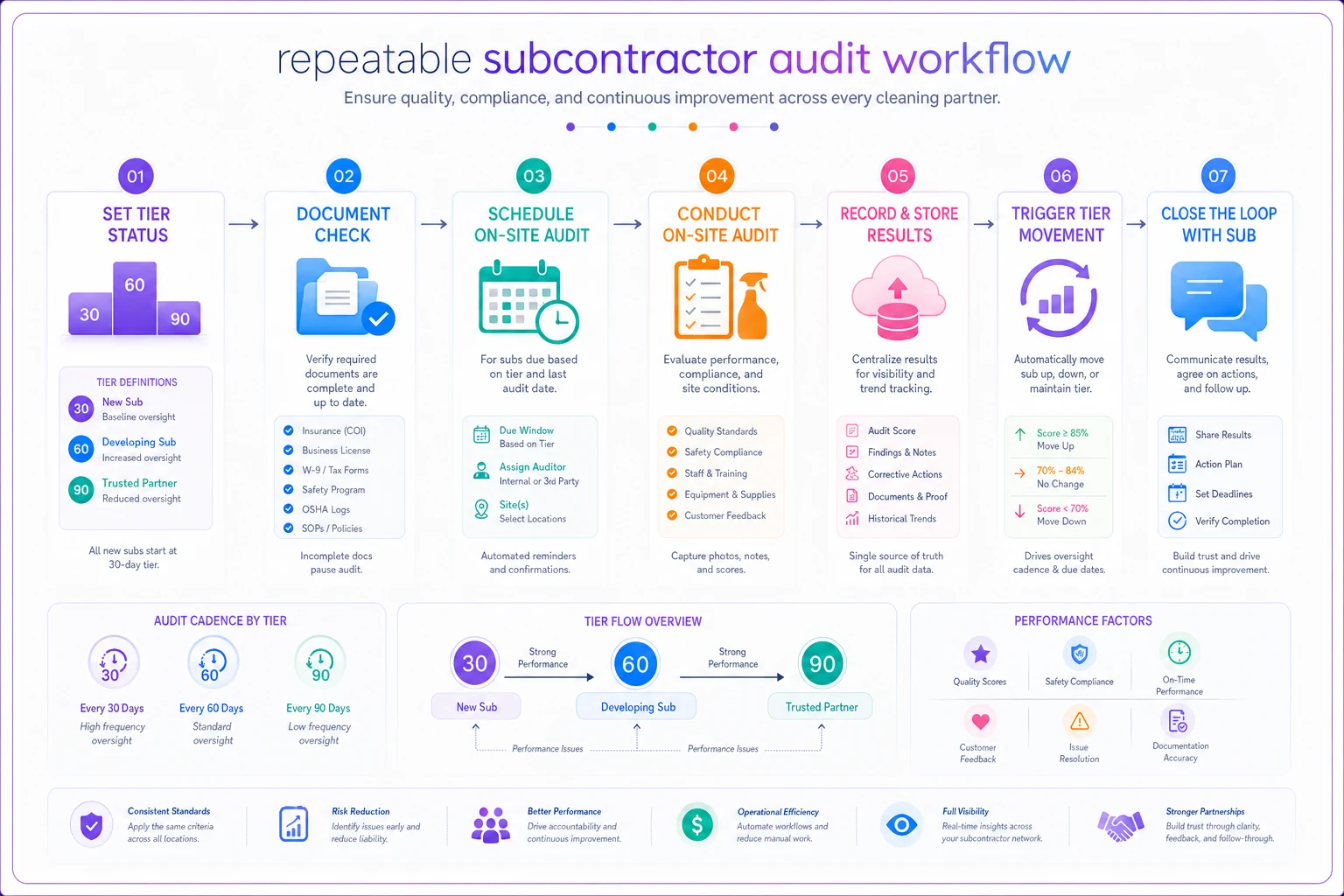
Here's how the pieces move together in practice — as a repeatable monthly rhythm rather than a one-off project.
A quick visual of the audit workflow can help teams follow the cadence.
-
Monthly, pull the tier list. Each sub falls into their 30/60/90 bucket. Only the subs due this cycle get touched.
-
Run the document check first. It's fast and it's binary. Expired or missing doc = immediate hold on new assignments until resolved.
-
Schedule on-site audits for due subs. High-tier subs get a full on-site; medium and low get rotated so you're sampling, not auditing every single job.
-
Record results in one place. Pass, pass-with-notes, or fail — with the form attached and photos stored.
-
Trigger tier movement. A fail or a serious note bumps the sub up a tier. A clean streak earns a move down.
-
Close the loop with the sub. Pass-with-notes means a short conversation and a re-check next cycle. Silence here is how small issues become patterns.
The workflow only stays lightweight if due-date tracking isn't living in your head. In real operations, that's where it breaks: an owner means to check which subs are due this month, gets slammed with scheduling, and the cycle quietly skips. The audit SOP has to run off a calendar and a document-expiry tracker, not memory.
Plenty of cleaning ops software can flag an upcoming COI expiry or a due audit automatically — which genuinely is the difference between a system that runs and one that only exists on paper — but the SOP itself matters far more than whatever tool you track it in. AI-powered operational platforms that handle scheduling and subcontractor records can surface these flags without anyone manually checking a spreadsheet, but even a shared Google Sheet with conditional formatting beats nothing.
Termination triggers: decide the line before you need it
The hardest part of managing subs isn't finding problems. It's deciding which problems end the relationship. Owners who don't define this in advance end up rationalizing — "they're usually good," "it was probably a one-off" — and keep a liability on the roster because firing a sub mid-schedule is inconvenient.
-
Immediate termination sending an un-vetted, un-approved worker to a client home; lying on the audit form; letting insurance lapse and working anyway; theft or safety incident; prohibited chemical mixing creating a hazard
-
Two-strike termination repeat quality failures across consecutive audits; repeat no-shows; refusing an on-site audit; chronic late or incomplete documentation
-
Escalation-then-exit declining quality scores over three cycles; rising client complaints that don't improve after a documented conversation
The pattern worth naming: the dangerous triggers are the ones that only show up on-site. Document violations are easy to catch and easy to fix. Identity fraud, safety hazards, and dishonesty on audits are the ones that generate claims and lawsuits — and they only surface when someone actually looks at the job. That's the entire argument for keeping an on-site component instead of running a purely paperwork audit.
A real scenario
A maid agency running around 15 subcontractors across a suburban metro had never done structured audits — just reacted to complaints. Over a slower stretch they decided to actually run the tier system. The document check alone surfaced three subs with expired or missing COIs, including one who'd been working uninsured for close to four months.
The on-site piece caught the bigger problem. A sub rated as "reliable" turned out to be rotating in two workers the agency had never vetted on higher-value move-out jobs. One of those jobs had already generated a damage complaint the owner had chalked up to bad luck.
After roughly three months on the 30/60/90 cadence, the picture changed in a concrete way. Complaint volume dropped noticeably, the uninsured subs were either corrected or cut, and the agency stopped getting surprised. The owner's description of the change wasn't dramatic — just that they finally knew, at any given moment, which subs were actually safe to send into a client's home. That's the real return: not perfection, but the end of guessing.
When this SOP makes sense — and when it's overkill
When it makes sense: You run 3+ subcontractors, you handle keys or access to client homes, you do any high-value or move-out work, or you've had even one surprise that made you realize you didn't actually know what was happening on a job.
When it's probably overkill: You run a single long-term sub you've worked with for years on low-complexity jobs and you're already close to the work. A full tier system for one person is bureaucracy for its own sake — though even then, tracking document expiry is still worth doing.
Who should not lean on this instead of fixing structure: If your "subcontractors" are functionally employees — fixed schedules, your tools, your exclusive control — no audit SOP fixes the underlying misclassification risk. Sort the relationship out first, then audit.
The point of keeping it lightweight
Most audit programs don't fail because they're too weak. They fail because they're too ambitious, run once, and die.
A 30/60/90 cadence works precisely because it accepts that you have limited time and spends it where the risk actually lives — new subs, high-value jobs, and anyone who's given you a reason to look twice. Start with the tier list. Add document expiry tracking. Run the short on-site form on the subs due each month. Define your termination triggers before you're forced to use them.
That's a system an owner or a lead can actually sustain. It catches the problems that quietly turn into claims, lost clients, and uninsured damage — the ones you'd otherwise only discover when it's far too late to do anything about them.
Ready to elevate your cleaning business?
Join 500+ cleaning services using Maidufy to save time, reduce scheduling errors, and deliver exceptional client satisfaction.