
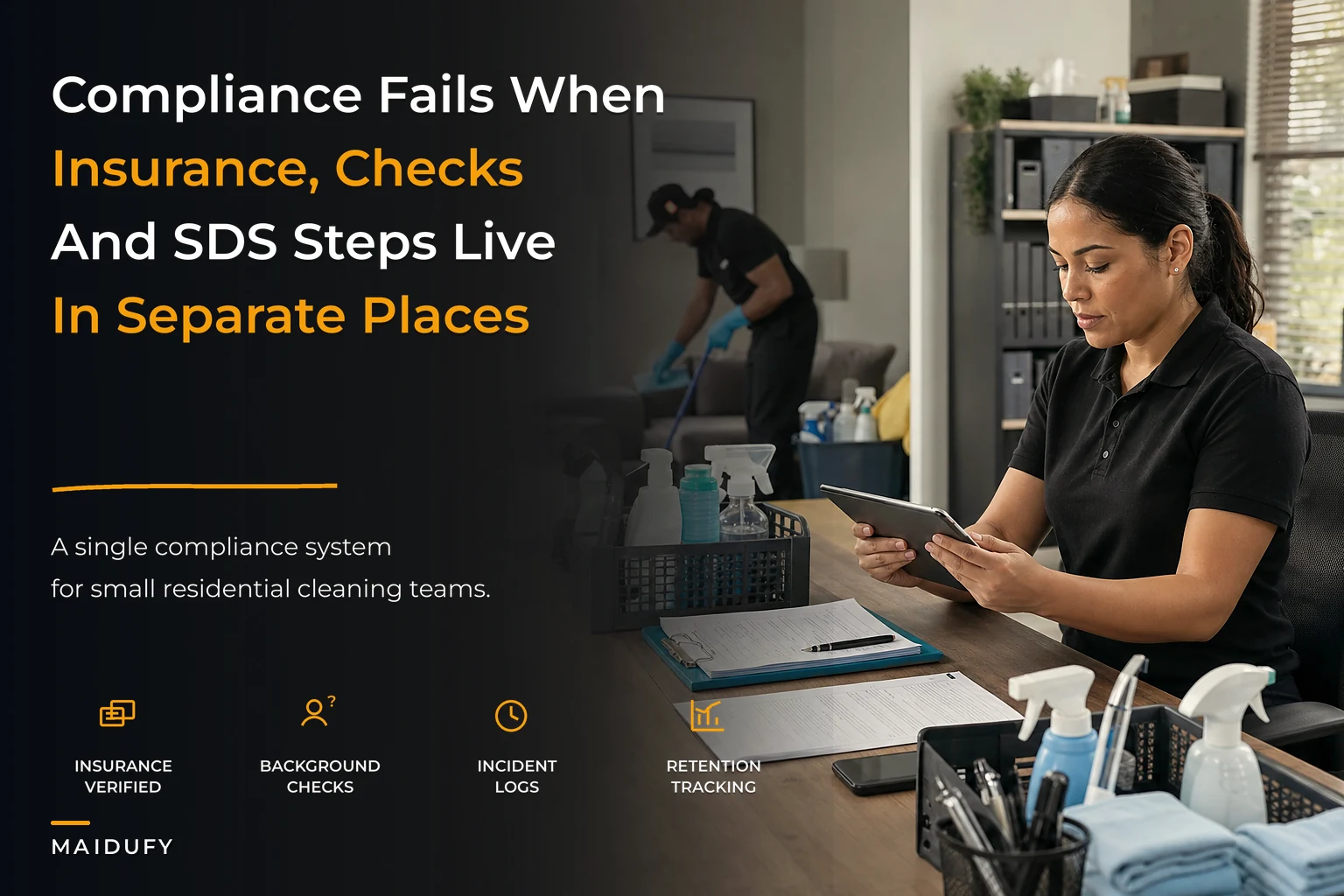

Most residential cleaning companies run on thin margins with compliance treated as an afterthought. Then something breaks—a worker gets injured without proper documentation, a client's pet reacts to cleaning products, or an insurance audit reveals your contractors aren't properly qualified. Suddenly you're looking at thousands in fines, legal fees, or dropped coverage.
Cleaning businesses get blindsided by compliance failures that seemed minor at first. A maid service in Denver had been operating for three years when OSHA showed up after a contractor fell off a ladder. No incident report. No safety training records. No proper contractor agreements. What started as a workers' comp claim turned into $12,000 in fines and months of mandatory operational changes.
The real problem isn't any single compliance failure—it's the absence of a unified cleaning business compliance system that handles everything from contractor qualification to chemical safety documentation. Most operators piece compliance together as problems arise, creating gaps that only become visible during audits or after something goes wrong.
Why compliance breaks down in residential cleaning operations
Cleaning businesses face a genuinely unique compliance challenge. You're sending workers into private homes with hazardous chemicals, operating across multiple jurisdictions with different rules, and often mixing employees with contractors. Each element creates requirements that compound as you grow.
A typical 15-person cleaning operation might handle:
-
8-12 different cleaning chemicals requiring Safety Data Sheets
-
3-5 contractor relationships needing qualification tracking
-
200+ client homes with varying access and safety considerations
-
Multiple municipal business licenses and insurance requirements
-
Worker safety protocols across residential environments
Without a systematic approach, compliance becomes reactive. You update insurance when it expires. You grab Safety Data Sheets when someone asks. You write incident reports after something happens. This scattered approach works until it doesn't—usually when multiple compliance issues surface at the same time.
It gets worse as you grow. A solo cleaner can keep basic compliance in their head. But once you're managing multiple teams across different territories, the complexity multiplies fast. Different cities require different business licenses. Insurance carriers demand different contractor qualifications. Chemical regulations vary by state.
The contractor qualification trap that costs cleaning businesses
Contractor versus employee classification creates massive exposure for cleaning services. Many operators assume that using contractors reduces compliance burden. The opposite is actually true—contractors require more documentation, not less.
Never miss a cleaning appointment again.
Maidufy helps you book, confirm, and manage every cleaning service seamlessly.
- Centralized booking management
- Automated client reminders
- Optimized staff scheduling
No credit card required
Here's what typically happens: You bring on contractors for overflow work or new territories. They seem professional, claim to have insurance, and start working. Six months later, an audit reveals they lack proper coverage, never provided certificates of insurance, or have been working outside their stated qualifications.
Initial qualification requirements:
-
Current general liability insurance (minimum $1M per occurrence)
-
Valid business license for operating jurisdiction
-
Background check completed within 90 days
-
Signed contractor agreement with clear scope
-
Workers' compensation coverage or exemption documentation
-
Equipment and chemical usage authorization
Ongoing verification protocols:
-
Insurance renewal tracking with 30-day advance alerts
-
Annual background check updates
-
Quarterly performance reviews with documentation
-
Incident reporting requirements
-
Territory and service scope confirmations
The administrative burden adds up fast. A cleaning service with 8 contractors might process 200+ compliance documents annually. Miss one insurance renewal or background check update, and you're exposed to liability your own insurance might not cover.
Automate contractor insurance renewal alerts to avoid lapses.
Most operators discover these gaps during worst-case scenarios. A contractor damages expensive property. Their insurance lapsed two weeks prior. Your carrier denies coverage because you didn't maintain proper qualification records. Now you're personally liable for damages that a simple tracking process would have prevented.
Chemical safety compliance beyond basic SDS collection
Safety Data Sheets represent the minimum requirement, not comprehensive safety management. Every cleaning business knows they need SDS documentation. Few maintain the complete chemical safety infrastructure that regulations actually require.
The full chemical compliance framework includes:
Documentation requirements:
-
Current SDS for every chemical used (including client-supplied products)
-
Chemical inventory lists by location/vehicle
-
Hazard communication program documentation
-
Training records for each worker on each chemical
-
Exposure incident documentation
-
Annual chemical hazard assessments
Operational protocols:
-
Proper labeling for all secondary containers
-
Chemical storage and transport procedures
-
Personal protective equipment standards
-
Spill response procedures
-
Client notification requirements for chemical usage
A residential cleaner using 10 common products might need 40+ separate compliance documents. Add in the variability of client-supplied products and the documentation burden becomes substantial. One cleaning company had been operating for years thinking they had decent SDS coverage—turned out they were using 47 different chemical products across their teams and only 12 had current documentation.
The enforcement reality makes this critical. OSHA fines for SDS violations start at $15,625 per chemical. An inspection finding 5 chemicals without proper documentation means $78,000+ in potential fines. But the bigger cost often comes from workers' compensation claims when injuries occur without proper safety documentation.
Chemical mixing presents another layer. Many cleaners create custom solutions by combining products. Each mixture requires its own safety assessment and documentation. Using a bleach-based cleaner after an ammonia-based product without proper ventilation protocols isn't just dangerous—it's a compliance violation waiting to trigger an incident.
Building an incident reporting system that actually protects you
Incident documentation failures cost cleaning businesses more than most other compliance gaps. Not because incidents happen constantly, but because poor documentation turns minor issues into major liabilities.
A cleaner slips on wet stairs at a client's home. Minor bruising, no immediate medical attention needed. Two months later, that minor fall becomes a workers' compensation claim for chronic back pain. Without proper incident documentation, you can't prove the original injury was minor or that proper safety protocols were followed.
Immediate response protocols:
-
Injury assessment and first aid procedures
-
Emergency contact activation thresholds
-
Client notification requirements
-
Photo and video documentation standards
-
Witness statement collection
Documentation templates:
Every incident needs structured capture:
-
Date, time, and precise location
-
Weather and environmental conditions
-
Equipment and chemicals involved
-
Detailed injury description and body part mapping
-
Treatment provided or refused
-
Worker statement in their own words
-
Supervisor investigation findings
-
Corrective actions implemented
Retention and accessibility:
-
Digital storage with timestamp verification
-
7-year retention minimum for all incidents
-
30-year retention for chemical exposure events
-
Encrypted storage for medical information
-
Instant retrieval for legal or insurance requests
The real challenge is field implementation. Cleaners working in homes need simple, fast ways to document incidents while managing injured workers and concerned clients. Paper forms get lost. Overly complex digital systems don't get used. The time-tracking and audit systems that work for scheduling can actually be adapted well for incident capture.
Insurance and bonding requirements across jurisdictions
Insurance compliance involves more than buying a general liability policy. Different jurisdictions, client types, and service offerings create a surprisingly complex web of coverage requirements.
Core coverage requirements:
-
General liability ($2M aggregate typical)
-
Professional liability for specialized services
-
Commercial auto for all vehicles
-
Workers' compensation (state-specific requirements)
-
Bonding ($10,000-$25,000 typical)
-
Umbrella policy for high-value clients
Each city or county can impose different requirements. One might require a $5,000 surety bond. Another mandates specific pollution liability coverage. State lines create even more complexity—workers' compensation that's optional in Texas is mandatory in California.
Client-specific requirements:
-
Commercial property managers often demand additional insured status and higher coverage limits.
-
Government contracts require specific bonding amounts.
-
High-net-worth residential clients sometimes request excess liability coverage.
The tracking complexity multiplies with growth. A 20-person cleaning service might maintain:
-
1 general liability policy
-
3 commercial auto policies for different vehicle types
-
2 workers' compensation policies across state lines
-
5 surety bonds for different municipalities
-
12 additional insured endorsements for property managers
-
15 certificates of insurance for various clients
Missing renewal dates or coverage gaps creates immediate operational risk. One lapsed auto policy means that vehicle can't operate. An expired bond means you can't legally work in that jurisdiction. These aren't just compliance problems—they're revenue stoppers.
Background check protocols and privacy compliance
Background screening for cleaning workers means navigating federal Fair Credit Reporting Act (FCRA) requirements, state privacy laws, and client expectations. Get it wrong, and you're looking at both legal liability and damaged customer trust.
Pre-screening requirements:
-
Written disclosure separate from application
-
Signed authorization before running checks
-
Clear statement of rights under FCRA
-
State-specific additional disclosures
Screening scope decisions:
Criminal history presents genuinely complex choices. Seven-year lookback? Exclude certain misdemeanors? Consider arrest records? Each decision needs documented policy justification. Some states ban criminal history questions until after conditional offers.
Adverse action protocols:
-
Pre-adverse action notice with copy of report
-
Reasonable time for candidate response (typically 5 days)
-
Final adverse action notice if not hired
-
Specific reason for employment decision
-
Documentation of entire process
Ongoing monitoring considerations:
Initial screening isn't enough for workers with regular home access. Annual rechecks? Continuous monitoring services? Client notification of changes? Each option adds complexity and cost.
The privacy compliance layer makes this harder. Screening records contain sensitive personal information requiring secure storage, limited access, and eventual destruction. Mix in state laws like California's CCPA or Illinois's BIPA for biometric data, and compliance gets genuinely difficult to manage.
A typical screening file might include:
-
Federal criminal search
-
State criminal records
-
County court records
-
Motor vehicle reports
-
Sex offender registry checks
-
Reference verifications
-
Identity verification documents
Each document type has different retention requirements. Some need destruction after hiring decisions. Others require seven-year retention. The photo documentation and privacy systems you use for client work can actually provide a useful framework for employee records management.
Creating your integrated compliance management system
Building a cleaning business compliance system means connecting all these elements into a manageable operational workflow. The goal isn't perfection—it's consistency and documentation that protects your business during audits or incidents.
Start with a compliance inventory:
-
Insurance policies and expiration dates
-
Contractor agreements and qualifications
-
Employee handbooks and training records
-
Chemical inventories and SDS files
-
Incident reports from the past two years
-
Background check authorizations and results
-
Business licenses and bonds
Identify critical gaps:
Map what you have against requirements. Missing contractor insurance certificates? Outdated SDS files? No incident reporting template? Each gap is immediate risk.
Build systematic captures:
-
Monthly contractor insurance verification
-
Quarterly chemical inventory updates
-
Annual background check refreshers
-
Semi-annual safety training sessions
-
Weekly incident report reviews
Centralize documentation:
-
Insurance folder with all policies and certificates
-
Contractor qualification binder with current documents
-
Chemical safety station with SDS and training records
-
Incident report file with investigation documentation
-
Personnel files with screening and training records
The automation opportunity becomes clear when managing this volume of documentation. AI-powered platforms can track insurance expirations, flag missing contractor documents, organize SDS files, and generate incident reports from field inputs. Instead of manually managing hundreds of compliance documents, operational software triggers alerts when something actually needs attention.
The diagram below shows a simple workflow for integrating compliance tasks into daily operations.
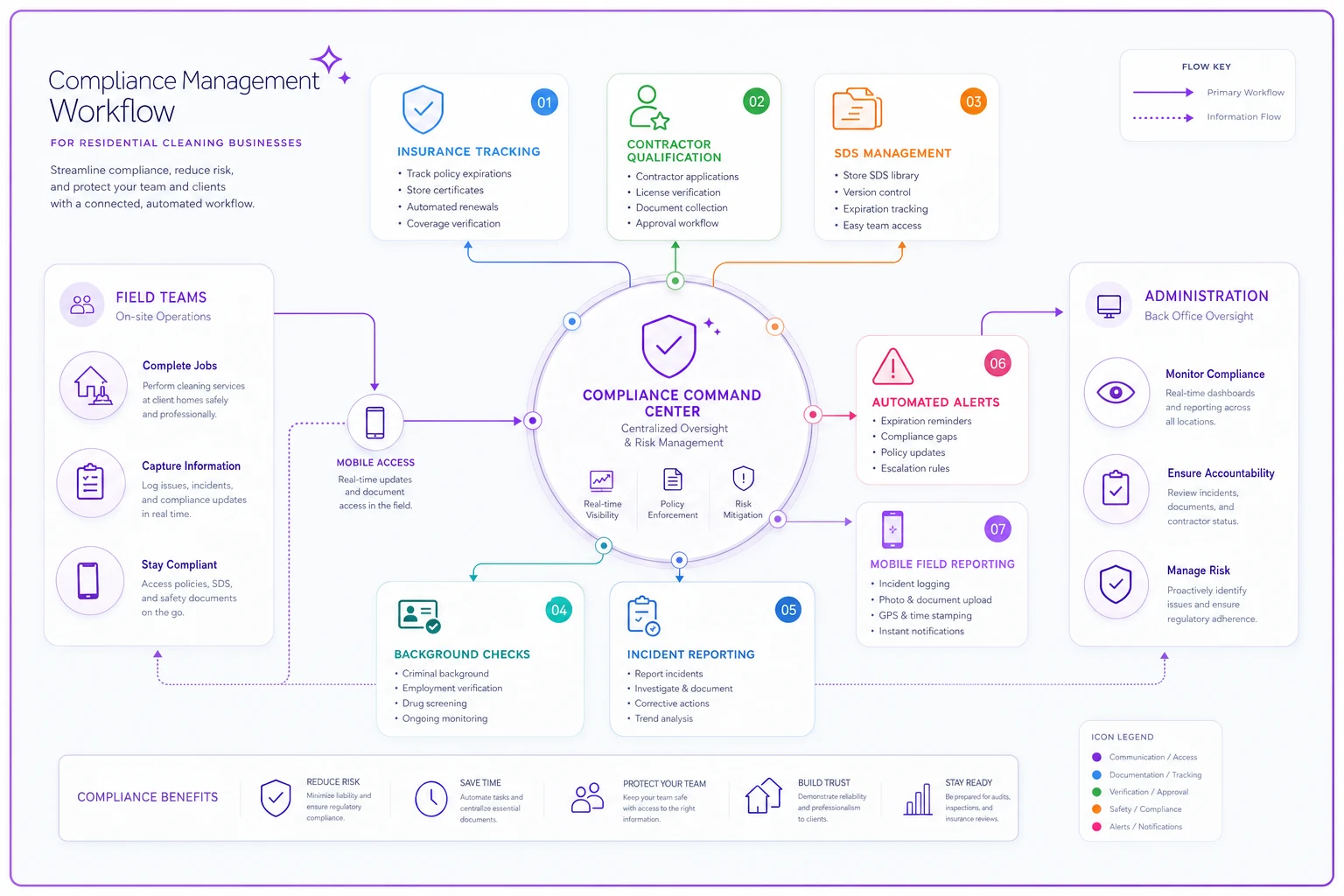
This systematic approach turns compliance from reactive scrambling into a proactive operation. When OSHA shows up for an inspection, you have organized documentation ready. When a client questions your insurance, you can provide certificates immediately. When an incident occurs, everyone knows the reporting process.
The real cost of compliance gaps versus system investment
Cleaning businesses often avoid comprehensive compliance systems because of perceived cost and complexity. But the financial reality strongly favors proactive investment.
Consider typical compliance failure costs:
Direct penalties and fines:
| Violation | Cost |
|---|---|
| OSHA SDS violation | $15,625 per chemical |
| Worker misclassification | $5,000+ per contractor |
| Unlicensed operation | $1,000-$10,000 per infraction |
| Privacy violation (CCPA) | $2,500-$7,500 per incident |
| Workers' comp fraud | Criminal penalties plus civil damages |
Indirect operational costs:
-
Lost revenue during license suspension
-
Higher insurance premiums after claims
-
Legal fees for compliance violations
-
Reputation damage from public enforcement
-
Employee turnover from unsafe conditions
A small cleaning company going through a routine audit might discover $50,000+ in potential violations from documentation gaps alone. Add an actual incident without proper reporting, and costs can reach six figures quickly.
The investment in compliance systems looks minimal by comparison:
-
Basic compliance software
$200-500 monthly
-
Document management system
$50-150 monthly
-
Background screening service
$30-75 per check
-
Insurance monitoring service
$100-300 annually
-
Safety training programs
$500-1,500 annually
Total annual compliance system cost for a 15-person operation: roughly $8,000-12,000. That's less than a single OSHA chemical violation.
Moving from reactive to proactive compliance management
Most cleaning businesses can't pause operations to rebuild compliance from scratch. Instead, layer improvements onto existing workflows.
Phase 1: Stop the bleeding (Month 1)
-
Verify all contractor insurance is current
-
Collect missing SDS for active chemicals
-
Create a basic incident report template
-
Document current safety training
Phase 2: Build core systems (Months 2-3)
-
Implement contractor qualification checklist
-
Organize chemical compliance documentation
-
Deploy incident reporting across teams
-
Centralize insurance and licensing records
Phase 3: Strengthen and automate (Months 4-6)
-
Add automated insurance expiration tracking
-
Implement digital incident reporting
-
Create compliance audit schedules
-
Build training documentation systems
Each phase provides immediate risk reduction while setting up the next improvement. By month six, you've shifted from reactive scrambling to something that actually runs like a system.
AI automation accelerates this transition in practical ways. Instead of manually tracking dozens of insurance expiration dates, automated systems send renewal alerts. Rather than digging through filing cabinets for SDS sheets, digital platforms organize and retrieve them instantly. When incidents occur, mobile apps guide workers through proper reporting while automatically organizing documentation.
The operational difference becomes obvious during scaling. A manual compliance system that works for 5 cleaners breaks at 15. A systematic approach with automation support scales smoothly—the same protocols, documentation, and verification processes simply handle more volume.
Compliance as competitive advantage
Most cleaning businesses treat compliance as a necessary evil—cost without benefit. But solid compliance infrastructure actually creates competitive advantages beyond risk mitigation.
Professional property managers and high-value residential clients increasingly demand proof of comprehensive compliance. When you can immediately provide current insurance certificates, detailed safety protocols, and organized incident reporting procedures, you stand apart from competitors scrambling to find paperwork.
Employees prefer working for companies that prioritize safety and proper documentation. Lower workers' comp claims mean better insurance rates and more room for competitive wages. Proper contractor qualification reduces the chaos of unreliable subs. Good incident reporting protects workers from unfair claims.
The insurance benefits compound over time. Carriers offer better rates to businesses with documented safety programs and clean claims history. Some provide discounts specifically for systematic compliance management. Those savings flow directly to the bottom line.
Building a cleaning business compliance system isn't about perfection or paranoia. It's about creating sustainable operations that protect your business, workers, and clients while enabling profitable growth. The same systematic thinking that improves scheduling, quality control, and customer service applies directly to compliance management.
The question isn't whether you need comprehensive compliance—it's whether you'll build it proactively or after an expensive failure forces your hand. The cleaning businesses that survive long-term tend to choose the former, turning regulatory requirements into operational discipline that supports real growth.
Ready to elevate your cleaning business?
Join 500+ cleaning services using Maidufy to save time, reduce scheduling errors, and deliver exceptional client satisfaction.