


Every cleaning company hits this wall around 15-20 recurring clients. Your Tuesday crew knows Mrs. Chen expects them at 2pm sharp every other week. But then a $450 move-out clean drops in for the same Tuesday afternoon. You take it because bills need paying. Mrs. Chen gets bumped. She's understanding the first time, annoyed the second, and gone by the third.
The math is brutal. That $450 one-off feels smart until Mrs. Chen's $140 biweekly service disappears. Over a year, you traded $3,640 in recurring revenue for a single $450 job. Multiply that across your client base when this becomes a pattern and you've got a serious problem.
Most cleaning companies try solving this with calendars and memory. They'll block time for regulars, then override it when cash gets tight or a big job comes in. By month three, the recurring schedule looks like swiss cheese. Clients drift away quietly. Revenue becomes unpredictable. Growth stalls because you're constantly replacing lost recurring customers instead of adding new ones.
Why standard scheduling breaks down when mixing booking types
The core issue isn't laziness or poor planning. It's that one-off and recurring bookings have completely opposite operational needs. Recurring clients value consistency above everything else — same day, same time, same crew when possible. One-offs care about availability and price. They'll take any slot that works.
When you treat both the same in your schedule, recurring clients always lose.
A recurring client has their regular Thursday 10am slot. Wednesday night, a deep clean request comes in offering good money for Thursday morning. The scheduler thinks "I'll just shift Mrs. Johnson to Friday this one time." But Friday's traffic adds 25 minutes to travel. The crew shows up late. Mrs. Johnson notices different team members. The whole service feels off.
After two or three bumps like this, she stops feeling like a valued regular. She becomes just another appointment that gets shuffled around. When her neighbor mentions trying a different service, she's ready to switch.
The operational damage extends beyond lost clients too. Crews lose efficiency when routes get scrambled. A carefully built Tuesday route covering one neighborhood turns into a zigzag across town. Drive time goes up, fuel costs rise, and crews finish late — which hits morale and sometimes overtime.
Building protected capacity zones that actually work
The fix requires treating recurring slots as protected inventory, not flexible calendar space. Think of it like airlines blocking seats for premium passengers. Those seats don't open up just because someone offers more money.
Never miss a cleaning appointment again.
Maidufy helps you book, confirm, and manage every cleaning service seamlessly.
- Centralized booking management
- Automated client reminders
- Optimized staff scheduling
No credit card required
Core Protected Hours Designate specific time blocks as recurring-only. For a company with around 30 recurring clients, this might look like:
-
Monday
8am–12pm (recurring only)
-
Tuesday
8am–2pm (recurring only)
-
Wednesday
8am–12pm (recurring only)
-
Thursday
8am–2pm (recurring only)
-
Friday
flexible for one-offs
Protect a morning block in the densest neighborhood to maximize route efficiency.
Dynamic Crew Allocation Instead of mixing booking types within crews, dedicate teams to specific work types during protected hours.
Crew A handles recurring clients Monday and Wednesday mornings. They develop relationships with these clients, learn the houses, and maintain consistency.
Crew B floats. Tuesday and Thursday mornings they might support recurring routes. Afternoons and Fridays they handle one-offs exclusively.
This separation prevents a really common mistake — sending your best recurring crew to handle a profitable one-off and leaving less experienced staff with your loyal customers.
Sample weekly schedule with accept/reject rules
Here's an actual weekly schedule structure that balances both booking types:
Monday Schedule Framework
-
8
00am – 10:00am: Protected recurring block (4–5 clients)
-
10
00am – 11:00am: Buffer zone (catch-up or small one-offs)
-
11
00am – 1:00pm: Protected recurring block (3–4 clients)
-
1
00pm – 2:00pm: Lunch and travel buffer
-
2
00pm – 5:00pm: Open for one-offs
Accept Rules for One-Offs:
-
Must generate minimum $200 revenue
-
Cannot require crew overtime
-
Must fit within unprotected time blocks
-
Location must be within existing route zones — no special trips across town
Reject Rules for One-Offs:
-
Any request requiring recurring slot displacement
-
Jobs needing your recurring-specialized crews
-
Bookings that break geographic route efficiency
-
Requests under minimum revenue threshold during peak seasons
Buffer Management: Build 30-minute buffers between protected blocks. If a recurring appointment runs long, you have cushion. If everything runs smooth, crews get a short break. Small one-offs under 45 minutes can slot into buffers without disrupting the flow.
Tuesday through Thursday follow similar patterns, with slight variations based on how your recurring clients cluster geographically. Friday becomes your pressure release valve — fully open for one-offs, deep cleans, and special requests that don't fit elsewhere.
Here's a simple visual of the weekly scheduling flow.
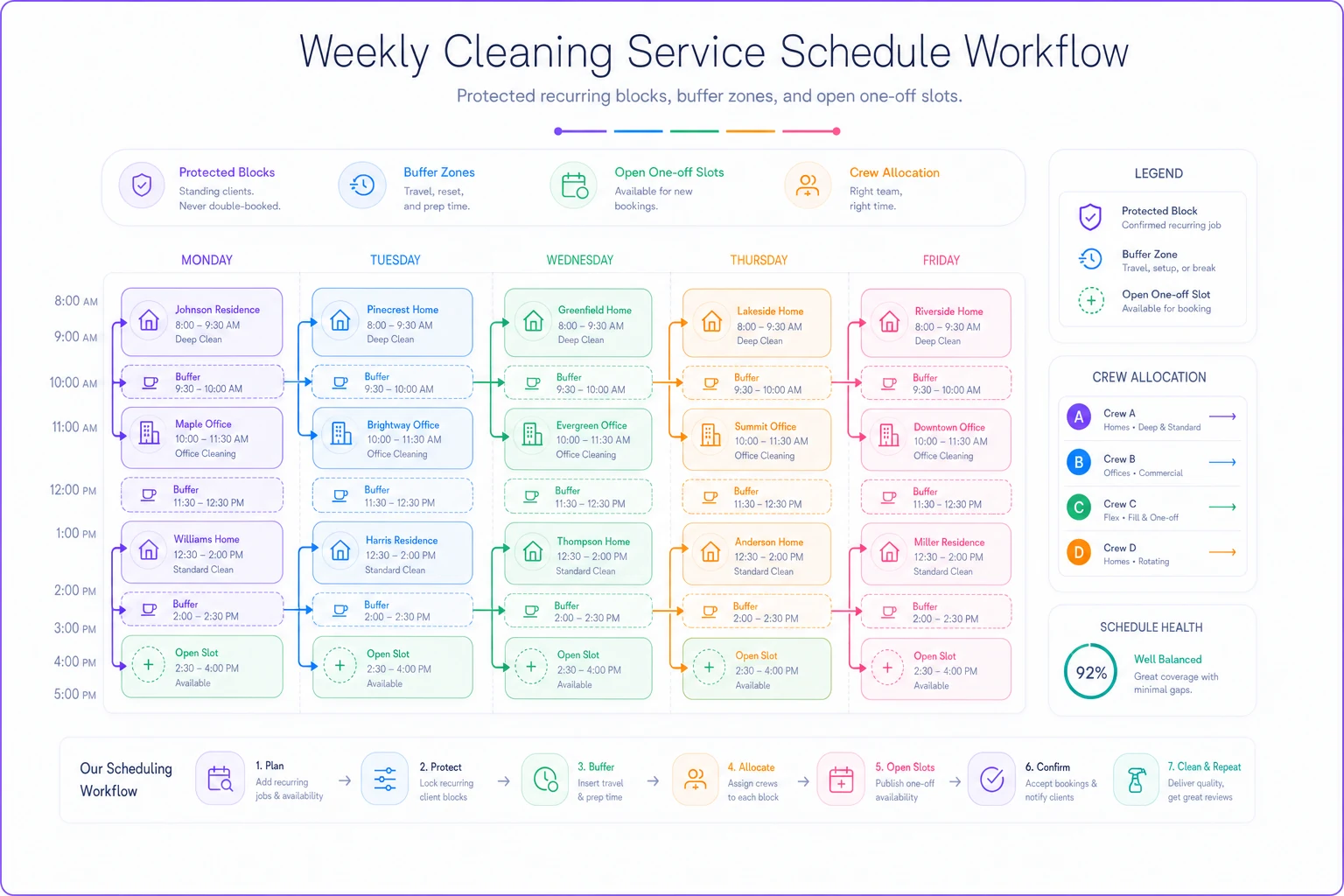
Use this to align schedulers and visualize where buffers and open slots exist.
Decision matrix for booking conflicts
When conflicts arise (and they will), you need clear decision criteria rather than gut calls made during a busy phone conversation. Here's a practical matrix:
| Conflict Scenario | One-Off Value | Recurring Impact | Decision | Alternative Action |
|---|---|---|---|---|
| High-value one-off vs. single recurring | >$400 | One client affected | Reject one-off | Offer Friday slot or next week |
| Same-day urgent vs. recurring block | Any amount | Multiple clients affected | Reject one-off | Refer to partner company |
| One-off in buffer zone | >$150 | None if contained | Accept | Monitor timing closely |
| VIP one-off request | >$500 | One client affected | Reject one-off | Offer to adjust crew allocation for non-protected time |
| Recurring client cancels last-minute | N/A | Slot opens | Accept small one-off | Must fit within original time window |
The monetary value of the one-off rarely justifies disrupting recurring schedules. A $400 one-off seems attractive until you calculate the lifetime value of the recurring client you're putting at risk.
Dynamic hold quotas and crew-specific rules
As your operation grows, rigid rules start becoming constraints. You need systems that adjust based on capacity and demand.
Seasonal Quota Adjustments During slow seasons — typically January and February — you might open 60% of your schedule to one-offs. During busy seasons like March through May, protect 80% for recurring clients who sustain you year-round.
-
Recurring slot utilization (target
90%+)
-
One-off rejection rate (acceptable
40–50%)
-
Recurring client displacement count (target
fewer than 2 per month)
-
Revenue per crew hour by booking type
Crew-Specific Capacity Rules Different crews have different limits. Your experienced Team A might handle 8 recurring clients daily without issues. Newer Team C might max out at 5 with extra buffer time needed.
-
Team A
Maximum 8 recurring, minimum 1-hour buffer between blocks
-
Team B
Maximum 6 recurring, can flex to one-offs after 2pm
-
Team C
Maximum 5 recurring, no complex one-offs, extra buffer time
This prevents overloading newer crews just because calendar space exists.
Technology enhancement without full automation
You don't need complex software to start implementing these systems. But certain tools reduce the manual effort required to manage recurring and one-off cleaning bookings significantly.
Start with basic calendar blocking. Use different colors for protected vs. open time. That visual separation alone helps schedulers quickly spot where one-offs can fit without cross-referencing multiple spreadsheets.
Add a simple scoring system for decisions. Each one-off request gets points for value, location fit, and timing flexibility. Recurring impacts get negative points. If the score stays positive, accept it. This takes emotional decision-making out of the equation during busy phone calls.
Once you're past 50 recurring clients, manual tracking becomes genuinely unsustainable. The mental load of remembering which clients are sensitive to schedule changes, which crews know which houses, and which routes are optimized just gets too heavy.
Operational software built with AI automation can codify your rules directly into the booking flow. Protected slots won't accept one-off bookings. Buffer zones adjust automatically based on historical job completion times. Crew assignments follow capability rules without manual intervention every single day.
The real value isn't the automation itself — it's that your carefully built decision framework gets applied consistently, even when you're not in the room.
Measuring success beyond revenue
Most cleaning companies track revenue and call it good. Mixing booking types requires going deeper.
Recurring Retention Rate Track monthly cohorts. If clients who started in January show 85% retention by June, you're protecting them well. Below 80% means one-offs are causing too much disruption.
Schedule Density Calculate drive time as a percentage of total crew hours. Keep it below 20% even with mixed bookings. If it climbs past 25%, your geographic route planning is breaking down from too many one-off insertions.
Crew Overtime Frequency If crews hit overtime more than once a week, your buffer policies aren't working. Either protected blocks are running long or one-offs are consistently underestimated.
Client Lifetime Value by Type Track this quarterly. Recurring clients should show somewhere between 8x and 12x higher lifetime value than one-offs. If that ratio drops below 6x, you're either underpricing recurring services or giving one-offs too much operational priority.
Common pitfalls that break the system
The "Just This Once" Exception Every exception becomes precedent. When you move Mrs. Peterson "just this once" for a big one-off, schedulers remember. Next time, the decision gets easier. Within two months, "protected" slots become suggestions.
Geographic Creep A one-off pays extra for service outside your normal zones. You take it. Then another. Soon you're accepting bookings 45 minutes from your core territory. Route efficiency collapses and crews spend more time driving than cleaning.
The Superstar Crew Trap Your best crew handles all the difficult one-offs because they're reliable. But they also know your recurring clients best. Pulling them from recurring routes solves today's problem and creates next month's retention crisis.
Buffer Elimination Under Pressure Busy periods tempt schedulers to cut buffers. "We'll just run tight today." But cleaning isn't manufacturing. Houses vary. Traffic happens. One delay without buffer time cascades through the entire rest of the day.
Adapting the framework as you scale
What works at 30 recurring clients breaks at 100. The protection framework has to evolve.
Early stage (under 50 recurring): Focus on rigid protection. Better to reject one-offs than erode your recurring base.
Growth stage (50–150 recurring): Introduce flexibility through dedicated crews and dynamic quotas. Some teams handle only recurring, others mix.
Scaled stage (150+ recurring): Separate the operations. Different phone lines, different schedulers, potentially even different brands. One-offs become a distinct business unit that doesn't interfere with recurring operations at all.
The companies that successfully navigate this progression understand that recurring and one-off bookings aren't just different appointment types — they're fundamentally different businesses. The ones that fail try to run both through the same operational box and can't figure out why loyal clients keep leaving.
Making protection policies stick
The best framework fails without team buy-in. Schedulers need to understand why turning down a $400 one-off makes sense. Crews need to understand why consistency matters more than squeezing maximum revenue out of a single day.
Share the math openly. Show them that Mrs. Chen's $140 biweekly service is worth $3,640 annually. Show them that acquiring a new recurring client costs roughly $85 in marketing and onboarding. Every lost recurring client is closer to a $3,700 problem when you account for both sides.
Align compensation with what actually matters. If scheduler bonuses depend on monthly revenue, they'll always choose one-offs. Tie compensation to recurring retention and lifetime value instead.
Give crews ownership of their recurring relationships. When the same team services the same clients consistently, they naturally protect those slots. They'll push back against disruptions because these feel like their clients — not just assigned appointments.
Without solving the recurring vs. one-off conflict, most cleaning companies plateau around $30–40k monthly. They can't scale because they're constantly replacing churned recurring clients. Cash flow stays unpredictable because the booking mix shifts weekly. Owners burn out trying to serve two different business models with one system.
Companies that implement protected capacity zones, clear decision frameworks, and the right operational tools regularly push past $75k monthly — and do it with predictable operations rather than constant scrambling.
The path forward isn't choosing recurring or one-offs exclusively. It's building systems that respect the real differences between these booking types while capturing value from both. That starts with accepting that your Tuesday 2pm recurring slot isn't just calendar space — it's inventory that needs protection.
Ready to elevate your cleaning business?
Join 500+ cleaning services using Maidufy to save time, reduce scheduling errors, and deliver exceptional client satisfaction.