



Most cleaning companies don't have a pricing problem. They have a packaging problem. The quotes go out fine, the jobs get booked, the crews show up — and somewhere between the estimate and the invoice, margin quietly leaks out. Not in big dramatic chunks. In small, repeated concessions: the free extra bathroom, the "sure we'll do the fridge this time," the deep clean priced like a standard visit because nobody had a clean way to charge for it.
The fix isn't tightening every individual quote. It's building a package structure that makes the right price the default and makes upgrades feel natural instead of awkward. Think of your menu less like a list and more like a portfolio — a small set of tiers, a predictable set of modifiers, and clear rules for what happens when a client's situation changes. That's where service packaging monetization for cleaners actually lives: not in raising prices across the board, but in structuring offers so clients self-select into the tier that fits them.
Why packaging leaks margin almost everywhere
The leak usually starts with good intentions. An owner builds a single "house cleaning" price based on square footage or bedroom count, then handles everything unusual as a verbal exception. For a solo operator, that works — you remember who gets the discount, who has the big dog, who always adds the oven at the last minute. The exceptions live in your head.
Then you hire. The estimator who answers the phone doesn't have your context. They quote off the base number, say yes to the add-ons to close the deal, and don't log any of it. The crew lead shows up to a house that takes 40% longer than the quote assumed, does the work anyway because the client's standing right there, and the whole thing gets invoiced at the original number. Nobody did anything wrong. The system just had no container for the extra work.
The leak scales faster than revenue. A solo operator giving away $15 of extra work per job is annoying. A five-crew operation doing 300+ cleans a month, each quietly absorbing a modifier that should've been priced, is bleeding real money — and worse, it's invisible, because the jobs still look profitable on a per-line basis. The margin math only shows up at the bottom of the P&L, long after you could've caught it. If you haven't built a proper owner-ready unit-econ dashboard yet, packaging leakage is exactly the kind of thing that hides in blended averages.
The anchor-based three-tier template
The cleanest structure for a residential cleaning menu is three tiers with a deliberate anchor. Not two (no room for the client to feel they're choosing). Not five (decision paralysis, and your crews can't memorize the scopes). Three.
Never miss a cleaning appointment again.
Maidufy helps you book, confirm, and manage every cleaning service seamlessly.
- Centralized booking management
- Automated client reminders
- Optimized staff scheduling
No credit card required
The trick is which tier does the work. The middle tier is your target — the one you actually want most clients to buy. The top tier is the anchor; its real job is to make the middle tier look reasonable. The bottom tier is the floor — deliberately a little bare, designed so that price-shoppers who choose it still clear your cost, and so that most people look at it and decide they want a bit more.
| Tier | Purpose | Scope | Typical price index | Who picks it |
|---|---|---|---|---|
| Essential (floor) | Catch price-sensitive buyers at a safe margin | Core surfaces, floors, bathrooms, kitchen wipe-down | 1.0x | Budget-first, usually one-time |
| Signature (target) | The tier you want most clients on | Everything in Essential + interior details, baseboards, light fixtures | ~1.35x | Recurring clients, the bulk of your book |
| Premium (anchor) | Make Signature feel like the sensible choice | Everything in Signature + inside appliances, cabinet fronts, extra detailing | ~1.9x | High-expectation clients, move-related, event prep |
Notice the price jumps aren't even. The gap between Essential and Signature is smaller than the gap between Signature and Premium — on purpose. You want the step up from the floor to feel cheap and the step up to Premium to feel like a real decision. When the anchor is priced far enough above the target, the target reads as the balanced, grown-up choice, which is exactly where you want your margin concentrated.
One common mistake: owners build the three tiers but then let the scopes bleed into each other during the sales conversation. If your estimator throws in Premium details to close a Signature sale, you've just destroyed the whole structure. The tiers only protect margin if the scope boundaries are enforced — and that's a training and tooling problem, not a pricing one.
Neighborhood-modifier rules: pricing the same job differently on purpose
Two houses with identical square footage do not cost the same to clean, and they don't carry the same willingness to pay. Travel time, parking, building access, pet load, clutter, the age of the home — all of it changes your true cost. The error most companies make is baking these into a vague "we'll see when we get there" and then eating the difference.
-
Travel/zone modifier — a flat or percentage bump for addresses outside your dense core. This ties directly into route profitability; if a neighborhood is 25 minutes past your cluster, the modifier should cover the dead windshield time, not hope to.
-
Pet modifier — shedding animals add real minutes. A small flat add is cleaner than arguing about it later.
-
Condition modifier — tied to a quick condition rating at booking (light / standard / heavy). Heavy adds a percentage, not a guess.
-
Access modifier — walk-up buildings, gated entry, street-only parking with a load-in. Minutes you'll never get back, so price them in.
-
First-clean modifier — the initial visit almost always runs long. A one-time bump protects you before the account settles into its recurring rhythm.
The important design rule: modifiers are rules the estimator applies, not prices the estimator invents. If every rep is free-handing a travel surcharge, you're back to the exception-in-the-head problem, just with extra steps. Write the modifier table down. Make it the only way those adjustments get applied. The point of a portfolio is that any two people quoting the same house land within a few dollars of each other.
Write the modifier table down. Make it the only way those adjustments get applied.
And yes — in dense urban zones, you may genuinely price the same Signature clean 15–20% higher one neighborhood over. That's not price gouging; it's your cost structure honestly reflected. The companies that pretend a cross-town client costs the same as a next-door one are the ones subsidizing their worst routes with their best ones.
Migration and grandfather scripts, tied to the costing math
Here's the part almost nobody plans for: what happens to your existing clients when you roll out new packaging. You've got a book full of people on old, often underpriced arrangements. Flip everyone to the new structure overnight and you spook your most loyal accounts. Never migrate anyone and your new structure only applies to new business while the leak continues on 70% of your revenue.
You need two things: a migration path (how old clients move to new tiers) and a grandfather policy (who you intentionally leave alone, and for how long).
Start from the costing math, not from guilt. Pull your actual time-per-visit on each recurring account and compare it to what the account pays. If you don't have a reproducible way to do this, the costing method for cleaners is the prerequisite — you can't migrate accounts fairly if you don't know which ones are actually underwater. Sort every recurring client into three buckets:
-
Underwater — paying below cost, or at a margin you can't sustain. These must migrate.
-
Thin — profitable but below target. Candidates for migration at renewal or at the next natural touchpoint.
-
Healthy — at or above target margin. Grandfather these; don't touch a good thing.
> "We've updated our service packages to keep quality consistent as our costs have changed. Your current plan maps most closely to our new Signature package. Starting [date], your rate will be [new price] — and because you've been with us since [year], we're holding that at [small concession below rack rate] as a thank-you."
That last clause matters. A grandfather concession — a modest discount off the new rack rate, held for a defined window — gives loyal clients a reason to stay while still moving them off a losing price. The mistake is open-ended grandfathering with no expiration. "Loyalty pricing forever" just converts a one-time leak into a permanent one. Put a date on it: six months, a year, whatever fits your situation — but a date.
Worth being honest about the numbers here: when a cleaning company runs this exercise, it's common to find somewhere between 15–30% of recurring accounts sitting in the underwater or thin buckets. Migrating even half of those to appropriate tiers often recovers a few thousand dollars a month in margin without adding a single new client. The revenue was always there — it was just scoped and priced wrong.
The packable table: making this live in your quoting flow
A pricing portfolio only works if it's packable — if the whole thing (tiers, modifiers, migration rules) exists as a structured reference your team can actually use, rather than tribal knowledge in someone's head.
-
Tier scopes — exact line-item inclusions for Essential / Signature / Premium, so nobody adds Premium detailing to a Signature sale.
-
Base price by home size — a grid (bedroom/bath or square-foot bands) for each tier.
-
Modifier table — the fixed adds and percentages for travel zone, pets, condition, access, first clean.
-
Migration mapping — old plan names → new tier → grandfather concession → expiration date.
When this lives inside your quoting software as structured rules rather than a PDF someone squints at, two things happen. First, quotes become reproducible — the same house gets the same price regardless of who's on the phone. Second, the system can flag when someone overrides a tier scope or waives a modifier, which is exactly where margin walks out the door.
Visual: how the quoting workflow should apply tiers, modifiers, and migration mapping in real time.
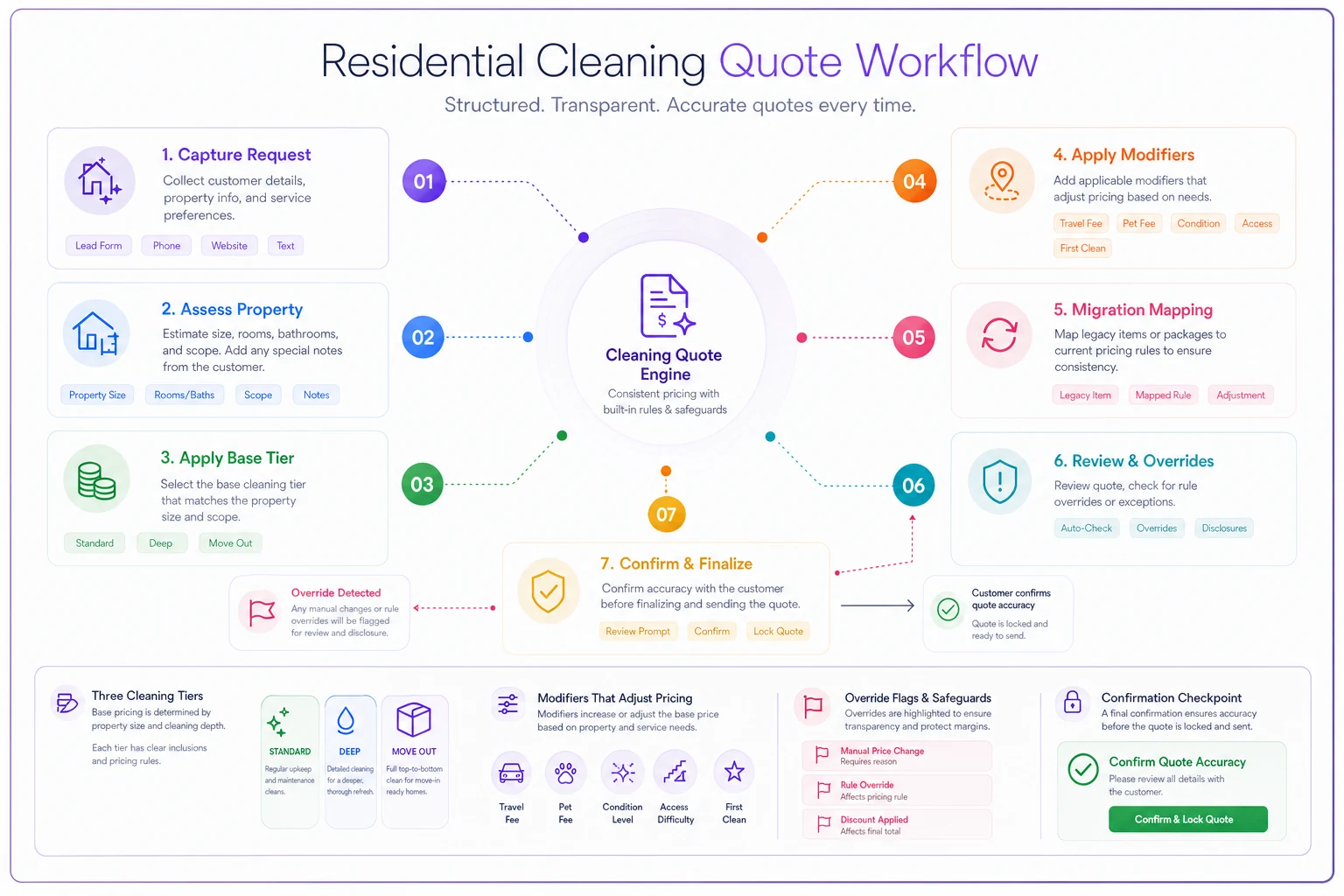
You don't need anything exotic here. You need the packaging logic encoded so the default path is the profitable one and the exceptions are visible. The best quoting setups quietly surface something like "this quote applied no condition modifier on a flagged-heavy home — are you sure?" before the price ever reaches the client. That single prompt, at the right moment, catches more margin leakage than any amount of post-job reviewing.
When this makes sense — and when it doesn't
When the three-tier portfolio is worth building:
-
You're past solo-operator stage and other people quote on your behalf.
-
You offer anything beyond a single standard clean (deep cleans, move-outs, add-ons).
-
Your margins look fine on paper but the bottom line keeps disappointing.
-
You've got a book of legacy clients on inconsistent, improvised pricing.
When it's premature or a bad idea:
-
You're a true solo with 10 clients you know by name. The overhead of formal tiers outweighs the benefit — though you should still write your modifier rules down before you hire.
-
Your base pricing itself is wrong. Tiers built on a broken cost model just multiply the error. Fix the costing first.
-
You'd use tiers to upsell past what a client needs. A portfolio works because each tier is honest. If Essential is deliberately so bare it's unusable, clients feel the manipulation and the trust goes with them.
The subtle failure mode worth naming: companies that build beautiful tiers and then don't enforce the scope. The portfolio isn't the table — it's the discipline of making the table the only way prices get set. A three-tier menu that your crews and estimators treat as a suggestion is just a prettier version of pricing in your head.
A short real scenario
A maid agency running around 280 cleans a month had a flat per-visit model with verbal add-ons. Every estimator quoted a little differently, deep cleans went out at near-standard rates, and the owner couldn't explain why revenue was up year-over-year but net margin was flat.
They rebuilt around three tiers with a Premium anchor, wrote a five-line modifier table covering travel zone, pets, condition, access, and first clean, then ran their recurring book through a costing pass. About a quarter of accounts came back thin or underwater. Rather than a mass price hike, they migrated the underwater accounts first with a dated grandfather concession and let the healthy ones ride untouched.
Within roughly two months the changes showed up where it mattered: deep cleans finally carried a Premium or heavy-condition price instead of leaking, estimators stopped free-handing add-ons because the modifier table handled it for them, and the migrated accounts recovered somewhere in the range of $3k–$4k a month in previously lost margin. Client churn from the repricing was minor — a handful of accounts left, nearly all from the underwater bucket they were losing money on anyway.
The number that mattered most wasn't the recovered margin. It was that two different estimators now quoted the same house to within a few dollars of each other. That's what the portfolio was supposed to do: make the profitable price the default one.
The takeaway
Packaging is where a lot of cleaning businesses quietly decide their own margins without realizing it. Treat your menu as a portfolio — a deliberate three-tier anchor, a written set of neighborhood and condition modifiers, and an honest migration plan tied to your real costs — and you stop depending on every estimator's judgment and every crew lead's generosity to protect your bottom line.
None of this requires raising prices on everyone or squeezing clients. It requires structure: making the right price easy, the upgrade natural, and the exception visible. The companies that get this right aren't charging more for the same work. They're finally charging correctly for the work they were already doing — and keeping the margin that used to leak out between the quote and the invoice.
None of this requires raising prices on everyone or squeezing clients. It requires structure: making the right price easy, the upgrade natural, and the exception visible. The companies that get this right aren't charging more for the same work. They're finally charging correctly for the work they were already doing — and keeping the margin that used to leak out between the quote and the invoice.
Ready to elevate your cleaning business?
Join 500+ cleaning services using Maidufy to save time, reduce scheduling errors, and deliver exceptional client satisfaction.