

Most cleaning companies handle damage claims the exact same messy way. A client texts a photo of a scratched countertop or a chipped picture frame, the owner panics, and then it becomes an awkward back-and-forth where nobody knows who's actually paying for what. Sometimes the owner eats the cost to save the relationship. Sometimes the client files a chargeback. Either way, you lose money and you lose goodwill.
A protection plan fixes this — but not the way most people assume. The point isn't really to "insure" the client against damage. It's to pre-decide how disputes get resolved before they happen, so the emotional, expensive, improvised part disappears. Done right, a protection plan for a cleaning service becomes a small monthly revenue stream and a dispute-reduction tool at the same time.
Here's how to design one that actually holds up.
Why "we're insured" isn't the same as a protection plan
Almost every cleaning business already carries general liability. That's not what we're talking about, and confusing the two is where a lot of owners go wrong.
General liability is a backstop for big, rare events — a flooded apartment, a broken flat-screen, a fall. It has deductibles that are usually higher than the damage you'd actually claim. Nobody files a $600 liability claim for a scratched hardwood floor when their deductible is $1,000. So those small-to-medium incidents fall into a gap: too big to shrug off, too small to claim.
That gap is exactly where disputes live. And it's exactly what a client-facing protection plan covers.
The protection plan is a per-visit or per-month add-on the client pays for. In exchange, you commit to a defined, fast, no-argument resolution for a specific list of incidents up to a capped amount. You're not selling insurance in the legal sense — you're selling certainty and speed. That distinction matters for how you word everything, which we'll get to.
The economics: why an attach-rate add-on beats absorbing costs
Let's run the actual math, because this is where owners either get it or dismiss it.
Never miss a cleaning appointment again.
Maidufy helps you book, confirm, and manage every cleaning service seamlessly.
- Centralized booking management
- Automated client reminders
- Optimized staff scheduling
No credit card required
Say you run around 300 recurring cleaning visits a month. In a typical operation, you'll see somewhere between 3–6 small damage or dissatisfaction incidents monthly — a knocked-over vase, a streak someone insists is a scratch, a "you missed under the bed" complaint that escalates. Average out-of-pocket resolution (refunds, replacements, redo visits, comped cleans) tends to land somewhere around $80–$180 per incident once you count labor.
So you're bleeding maybe $400–$900 a month on incidents you handle reactively and inconsistently.
Now introduce a protection plan at, say, $6 per visit or $12/month. If even 35% of your recurring clients attach it, that's roughly 105 clients paying ~$12 = ~$1,260/month in new revenue. Your actual claim payouts against that pool stay small because the covered list is capped and defined. The plan doesn't just cover its own claims — it turns a cost center into a margin line.
The bigger win is behavioral, though. When a client has paid for the plan, disputes stop being adversarial. They stop feeling like they need to "win" against you and start treating it like a benefit they're using. That psychological shift is worth more than the premium.
Designing the coverage: keep the covered list boringly specific
The single biggest mistake is vague coverage. "We'll cover accidental damage" invites arguments about what counts as accidental. Instead, list exactly what's in and exactly what's out.
Here's a coverage structure that holds up in real operations:
| Coverage tier | Monthly price | Per-incident cap | What's covered | What's excluded |
|---|---|---|---|---|
| Basic | $8/mo | up to $150 | Accidental breakage of household items, minor surface marks, one free re-clean per quarter | Pre-existing damage, electronics, jewelry, items over cap |
| Plus | $14/mo | up to $400 | Everything in Basic + priority claim handling (48-hr resolution), electronics up to $250 | Jewelry, cash, structural damage, pet-related incidents |
| Premium | $22/mo | up to $750 | Everything in Plus + same-day re-clean, satisfaction guarantee with no-questions redo | Items over cap, intentional damage, code violations |
A few deliberate choices worth noting. Electronics only appear at higher tiers because that's where your risk concentrates. Jewelry and cash are excluded across the board — you never want to be adjudicating whether a ring "went missing." And "satisfaction guarantee" is a coverage line, not a vague promise, because folding it into the plan turns fuzzy quality complaints into a defined benefit with rules.
The caps are the load-bearing wall. A capped plan can never blow up your economics. If a $3,000 event happens, that's what your general liability is for — and your disclosure needs to make that boundary crystal clear.
The disclosure copy: what to actually say (and where)
Disclosure is where cleaning businesses either protect themselves or expose themselves. You need language that explains the benefit plainly, sets limits, and doesn't accidentally position you as a licensed insurer — which triggers regulation in most states.
Use "service protection plan" or "service assurance," never "insurance." Avoid the words "insured," "policy," and "premium" in client-facing copy.
At the point of sale (booking form / quote):
> Add our Service Protection Plan for $__/month. If something covered goes wrong during a clean — an accidental breakage, a surface mark, or a re-clean you need — we handle it fast, up to your plan's coverage cap, with no back-and-forth. This is a service benefit, not an insurance product, and covers only the items and amounts listed in your plan details.
In the plan terms (linked, one screen):
> This Service Protection Plan is an optional benefit offered directly by [Company]. It provides expedited resolution and coverage for the specific incidents and dollar caps listed above. It is not an insurance policy and does not replace [Company]'s general liability coverage, which applies to major incidents outside this plan. Claims must be reported within 72 hours of the service visit and include a photo of the affected item. Coverage does not apply to pre-existing damage, excluded item categories, or amounts above your plan cap.
Two lines that save you repeatedly:
-
The 72-hour reporting window. Without it, you'll get claims about damage from three weeks ago that nobody can verify.
-
The photo requirement. No photo, no claim. This single rule kills the majority of unverifiable disputes.
If you're already running a solid before/after photo workflow with proper consent language and retention rules, your claim disclosures plug right into it — the pre-visit photos become the evidence baseline that proves what was and wasn't already damaged.
The claim workflow: pre-decide every step
The whole value of a protection plan collapses if claims are still handled by improvisation. You need a workflow tight enough that a new office coordinator could run it without you.
-
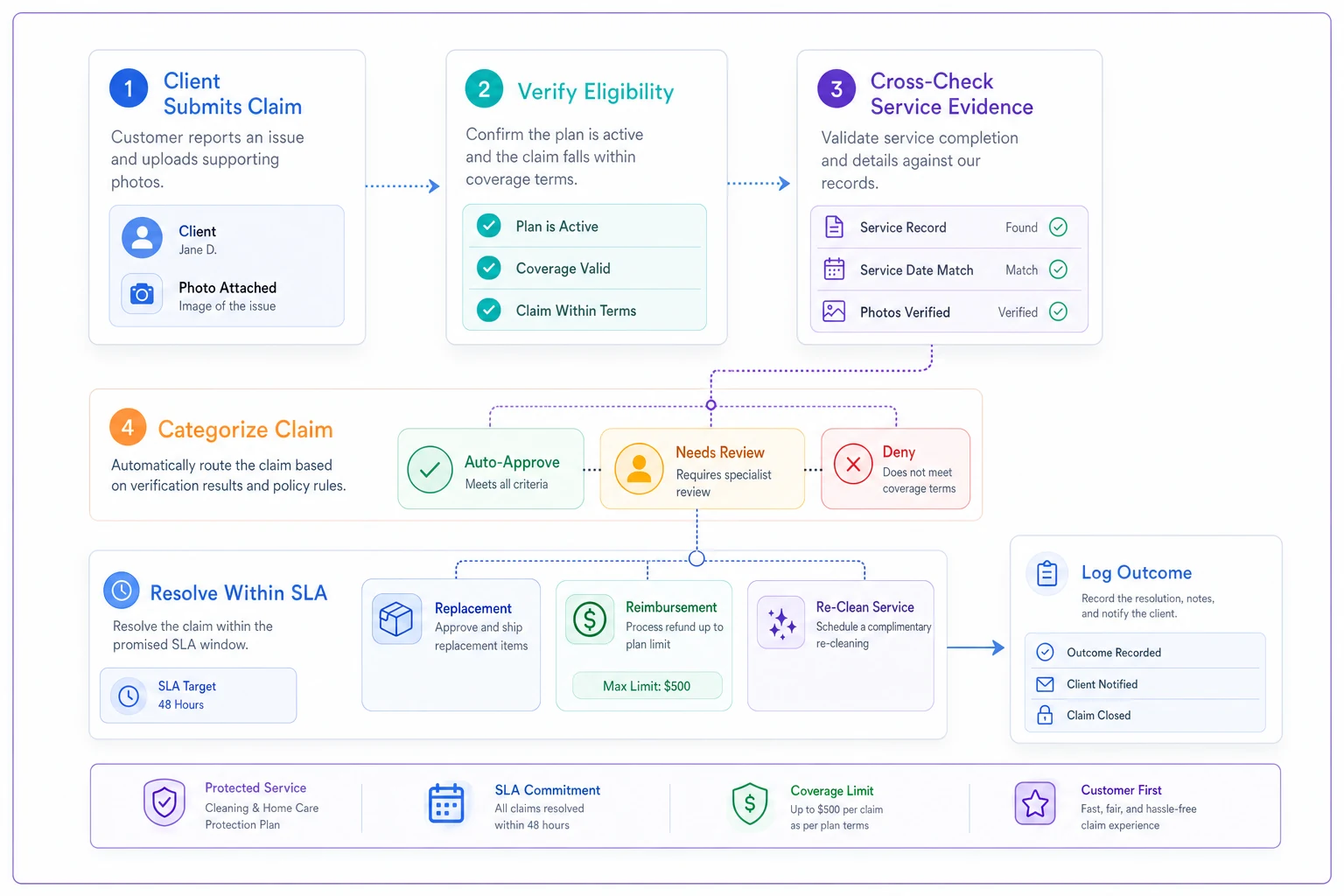
Client submits claim through one channel (form, text-to-number, or email) with a photo and the visit date. Anything missing gets an auto-reply requesting it — the clock doesn't start until it's complete.
-
Verify eligibility in under 5 minutes
Is the client on an active plan? Is it within 72 hours? Is the item on the covered list and under the cap?
-
Cross-check against service evidence — the crew's completion photos and any pre-visit condition notes. This is the step that resolves "was it already like that."
-
Categorize the claim Auto-approve, needs-review, or deny.
-
Resolve within the plan's SLA (48 hours for Plus, same-day for Premium). Resolution is one of: replacement, reimbursement up to cap, or a scheduled re-clean.
-
Log the outcome with the reason and dollar amount, so you can track claim rate per tier over time.
The categorization step (#4) is what keeps this fast. Set clear auto-approve rules — for example, any covered item under $75 with a photo gets approved instantly, no owner sign-off. You'd be surprised how much time disappears when small claims stop needing a decision-maker in the loop.
Here's a simple visual of the claim workflow.
For anything heading toward a payment dispute, your claim log becomes the evidence trail. This ties directly into the pre-billing evidence packages and dispute-response templates approach — a well-documented, promptly-resolved protection claim is your best defense if a client tries to reverse a charge anyway.
A claim-handling ruleset your team can memorize
Keep the operating rules short enough to fit on one card:
-
No photo = no claim. Every time, no exceptions.
-
Report within 72 hours or it's outside the plan.
-
Under $75 and clearly covered → auto-approve. Speed beats scrutiny on small stuff.
-
Excluded categories are never negotiable — jewelry, cash, pre-existing damage, over-cap items. Point to the terms, don't argue the merits.
-
Same client, third claim in 90 days → owner review. Watch for pattern abuse without accusing anyone.
-
Never say "insurance," "policy," or "premium" in any claim conversation.
-
Resolution always beats being right. If it's within cap and borderline, approve it and keep the client.
That last rule sounds soft, but it's economically sound. A borderline $60 approval that keeps a $200/month recurring client is one of the best trades you'll make.
A real scenario
A three-crew residential cleaner running about 280 recurring visits a month was losing somewhere around $500–$700 monthly to comped cleans, refunds, and the occasional replacement — plus two chargebacks a quarter that ate hours of the owner's time to fight.
They rolled out a two-tier protection plan ($9 and $15/month) as an opt-in on every recurring agreement, with a 72-hour window and mandatory photos. Attach rate settled around 40% after a couple months of the crew mentioning it at the first visit.
Within a quarter: plan revenue came in around $1,100–$1,300/month. Actual claim payouts ran under $300/month because the caps and covered list did their job. Just as important, disputes stopped escalating — clients on the plan filed calm, documented claims instead of angry ones, and the owner stopped having to personally referee small incidents. The chargebacks basically stopped, because every claim now had a photo, a timestamp, and a logged resolution.
Net effect: a reactive $500–$700 monthly loss turned into a roughly $800–$1,000 monthly gain, before counting the retention benefit from clients who felt taken care of.
When this actually makes sense
A protection plan pays off when you have recurring clients (attach-rate math needs repeat billing), when you're already eating small incident costs reactively, and when you have some form of service evidence — completion photos, condition notes — to verify claims against.
If you have those three things, this is close to free money with a dispute-reduction bonus.
When it's a bad idea
Skip it, or delay it, if:
-
You have no photo/evidence discipline yet. Without verification, a plan just becomes a coupon for free stuff. Fix your documentation first.
-
You're mostly one-off deep cleans. Attach rate on non-recurring work is weak and the admin overhead isn't worth it.
-
Your state regulates this as insurance. A few states scrutinize "protection plans" closely. If you're unsure, a quick call to a local attorney to review your terms is cheap insurance against a real problem.
-
Your quality is genuinely inconsistent. If you're generating a lot of legitimate complaints, a protection plan will get overwhelmed by claims. Fix the service problem before you monetize the fallout.
Fix the service problem before you monetize the fallout.
Who should not run this
If you're a solo operator doing under roughly 40 visits a month, the revenue is too small to justify building and maintaining a claim workflow — just handle incidents case by case and keep good photos.
This becomes worth the operational weight once you're managing crews and volume, because that's exactly when improvised claim-handling starts costing real money and real hours.
Rolling it out without friction
Don't launch it as a big announcement. Add it as a checkbox on new recurring agreements and a one-line mention at the first clean: "We also offer a protection plan that covers accidental damage and re-cleans — most of our regulars add it, it's about $12 a month." Let it attach quietly.
Track three numbers after launch: attach rate, claim rate per tier, and average resolution time. If claim payouts creep above roughly 25–30% of plan revenue, tighten your covered list or caps. If attach rate is under 25%, your crew probably isn't mentioning it — that's a script problem, not a product problem.
Coach crews with a short script if attach rate is under 25%.
The whole design goal is to make the expensive, emotional, improvised part of damage disputes disappear. You pre-decide the rules, cap your exposure, require evidence, and resolve fast. The client gets certainty, you get a margin line, and the ugly back-and-forth that used to cost you money and goodwill mostly stops happening. The revenue is almost a side effect.
The whole design goal is to make the expensive, emotional, improvised part of damage disputes disappear. You pre-decide the rules, cap your exposure, require evidence, and resolve fast. The client gets certainty, you get a margin line, and the ugly back-and-forth that used to cost you money and goodwill mostly stops happening. The revenue is almost a side effect.
Ready to elevate your cleaning business?
Join 500+ cleaning services using Maidufy to save time, reduce scheduling errors, and deliver exceptional client satisfaction.