



Most cleaning companies don't fail their equipment budget because they forgot to change a filter. They fail it because a $600 vacuum dies on a Tuesday, there's no cash set aside, and now the owner is putting a replacement on a personal card while three crews wait. The maintenance calendar and the money calendar live in completely separate universes, and that gap is where margins quietly bleed out.
This is a money problem disguised as a maintenance problem. So we're going to treat it like one — with maintenance schedules that feed directly into a monthly reserve number you can actually put in your books.
Why equipment planning breaks down in cleaning businesses specifically
Cleaning fleets are weird compared to most equipment-heavy businesses. You don't have five big machines you baby for a decade. You have dozens of small-to-mid items — commercial uprights, backpack vacs, carpet extractors, floor buffers, pressure washers, cordless tools, and a pile of batteries — spread across crews who don't own any of it and don't treat it like they do.
-
Nobody logs runtime. A backpack vacuum rated for a certain motor life gets run hard on commercial jobs and light on residential, but since nobody tracks hours, you find out it's dead when it's dead.
-
Repairs go invisible. A tech says "the extractor's acting up," someone jiggles it, it works for two weeks, then fails mid-job. There was a warning. It just never got written down anywhere the owner would see it.
-
Replacement is always a surprise. Because there's no amortization schedule, every dead machine feels like an emergency instead of something you saw coming twelve months out.
The pattern underneath all of this: cleaning equipment is cheap enough individually that owners don't build a system around it, but expensive enough in aggregate that not having a system costs real money. A 6-crew operation can easily be running $18k–$30k of active equipment, and replacing it reactively costs noticeably more than replacing it on a plan.
Start with the runtime reality, not the manufacturer's number
The manufacturer says a commercial upright motor lasts 1,000–1,500 hours. That number is close to useless on its own because your machines don't experience "hours" — they experience your specific jobs.
Never miss a cleaning appointment again.
Maidufy helps you book, confirm, and manage every cleaning service seamlessly.
- Centralized booking management
- Automated client reminders
- Optimized staff scheduling
No credit card required
Here's the observation that actually changes how you budget: residential recurring cleans and one-time deep cleans destroy equipment at completely different rates. A vacuum on light recurring homes might see 1.5 hours of actual motor time per visit. The same vacuum on move-out deep cleans full of drywall dust and pet hair might see 3+ hours and clog its filters constantly.
So before you build any schedule, sort your equipment by duty cycle, not by type:
| Duty tier | Typical use | Realistic runtime before major service | Realistic replacement window |
|---|---|---|---|
| Heavy | Deep cleans, construction cleanup, daily commercial | 250–350 hrs between servicing | 18–30 months |
| Standard | Mixed recurring + occasional deep | ~500 hrs between servicing | 3–4 years |
| Light | Light recurring residential only | 700+ hrs between servicing | 4–6 years |
The mistake most owners make is buying identical machines for every crew and expecting identical lifespans. Your deep-clean crew's equipment should be on a completely different replacement clock than your light-recurring crew's, and your budget should reflect that.
The preventive maintenance schedule (built around triggers, not just dates)
Date-based maintenance — "service every quarter" — is better than nothing but ignores usage entirely. The stronger approach mixes calendar triggers with usage triggers. Here's a working schedule for a typical residential fleet:
Daily / end-of-shift (crew responsibility, 3–4 minutes):
-
Empty canisters/bags, don't wait for "full"
-
Check brush roll for hair/string wrap and cut it out
-
Wipe cords, check for nicks or exposed wire
-
Note anything that felt "off" during the day
Weekly (crew lead, ~15 minutes per crew):
-
Rinse or replace washable filters
-
Check wheels, belts, and hose seals
-
Test extractor spray and vacuum pressure
-
Charge and rotate batteries so none sit dead
Monthly (whoever owns equipment):
-
Deep filter cleaning or replacement
-
Belt inspection and tension check
-
Log approximate runtime per machine
-
Review any repeated "felt off" notes from crews
Usage-triggered (whenever hours hit the tier threshold):
-
Motor brush inspection on heavy-duty machines
-
Full extractor pump service
-
Battery capacity test — batteries are the sneaky killer. They degrade before they die and quietly slow crews down.
The single most valuable habit here isn't any specific task. It's capturing those "felt off" notes and actually reviewing them monthly. That's where you catch the failure before it becomes a mid-job emergency. Field time-tracking habits and equipment logging go hand in hand — if you're already tightening how crews record their day, folding a 30-second equipment check into that flow is nearly free. Same logic behind low-friction field time-tracking and reconciliation: the data only helps if capturing it doesn't slow anyone down.
Build a spare-parts list that prevents downtime, not one that fills a shelf
There's a wrong way to do spare parts: buy one of everything "just in case." That ties up cash and half of it goes obsolete when you switch equipment models.
The right approach is stocking only the parts that (a) fail predictably and (b) cause a crew to lose billable time when they fail. Everything else you order as needed.
A lean, high-leverage spare-parts kit for a residential fleet usually looks like:
-
Belts — cheap, fail regularly, and a broken belt kills a vacuum instantly. Stock 2–3 per machine model.
-
Filters (HEPA + foam) — the most common cause of "weak suction" complaints. Keep a full rotation set.
-
Brush rolls — wear out fast on hair-heavy homes. One spare per two machines is usually enough.
-
Extractor spray tips and O-rings — pennies each, and a leaking O-ring can end a carpet job.
-
Charging cables and one spare battery per battery-dependent crew — a dead battery with no backup is a half-day of lost capacity.
-
Power cords / plug ends — cord damage is constant in real field use.
Notice what's not on the list: motors, pumps, control boards. Those are repair-or-replace decisions, not shelf items. If a motor dies on a machine that's past its duty-tier window, that's your signal to replace, not repair.
A rule that holds up across a lot of fleets: if the repair costs more than about 40% of a new unit and the machine is past half its expected life, replace it. Repairing old equipment feels frugal but it usually just buys you another breakdown at the worst possible moment.
Turn capex into a monthly reserve number
This is the part almost nobody does, and it's the whole point. You already know roughly what your equipment costs and roughly how long it lasts. So convert that into a monthly amount you set aside — same way a landlord reserves for a roof they know is coming.
Here's a worked example for a small fleet. Numbers are illustrative but built the way you'd actually build yours.
Equipment inventory and amortization:
| Item | Qty | Unit cost | Expected life | Monthly reserve (per group) |
|---|---|---|---|---|
| Commercial uprights | 6 | ~$450 | 3 yrs | ~$75 |
| Backpack vacuums | 3 | ~$350 | 3 yrs | ~$29 |
| Carpet extractor | 2 | ~$1,400 | 4 yrs | ~$58 |
| Floor buffer | 1 | ~$900 | 5 yrs | ~$15 |
| Pressure washer | 1 | ~$650 | 4 yrs | ~$14 |
| Cordless tools + batteries | — | ~$1,200 total | 2 yrs | ~$50 |
Add those up and you're at roughly $240 per month in equipment reserve for this fleet. Round it to $250, set it aside automatically every month into a separate sub-account, and move on.
The math is simple: (unit cost × quantity) ÷ (expected life in months) = monthly reserve. Do it per equipment group, sum the groups, and you have a target.
When the extractor dies in month 20, it's not a crisis. The money's already there. You've been paying the extractor its replacement cost a little each month the entire time it was earning revenue for you. That's the whole game — matching the cost of equipment to the period it actually serves.
One thing worth layering in: bump your reserve by around 10–15% above the pure amortization number. Equipment prices creep up, and you'll occasionally kill something early. A slightly padded reserve absorbs both without drama.
A replacement-budgeting workflow you can run quarterly
The reserve fund is the money. The replacement decision is the trigger. Here's the loop that ties them together — run it once a quarter, takes maybe 30 minutes:
-
Pull the runtime logs and "felt off" notes for every machine.
-
Flag anything past its duty-tier hour threshold or with repeated complaints.
-
Score each flagged item
repair cost vs. the 40%-of-new rule, plus how central the machine is to daily capacity.
-
Check the reserve balance against your flagged replacements.
-
Pre-approve the next 1–2 replacements so that when the item dies, the purchase is already decided — no scrambling, no comparison shopping mid-emergency.
-
Adjust the monthly reserve if your fleet grew or your duty mix shifted (more deep cleans = faster wear = higher reserve).
Step 5 is the underrated one. Emergency replacements cost more not just because of the money — it's that you buy whatever's in stock at full retail price because a crew is stalled. Pre-deciding the replacement removes that premium entirely.
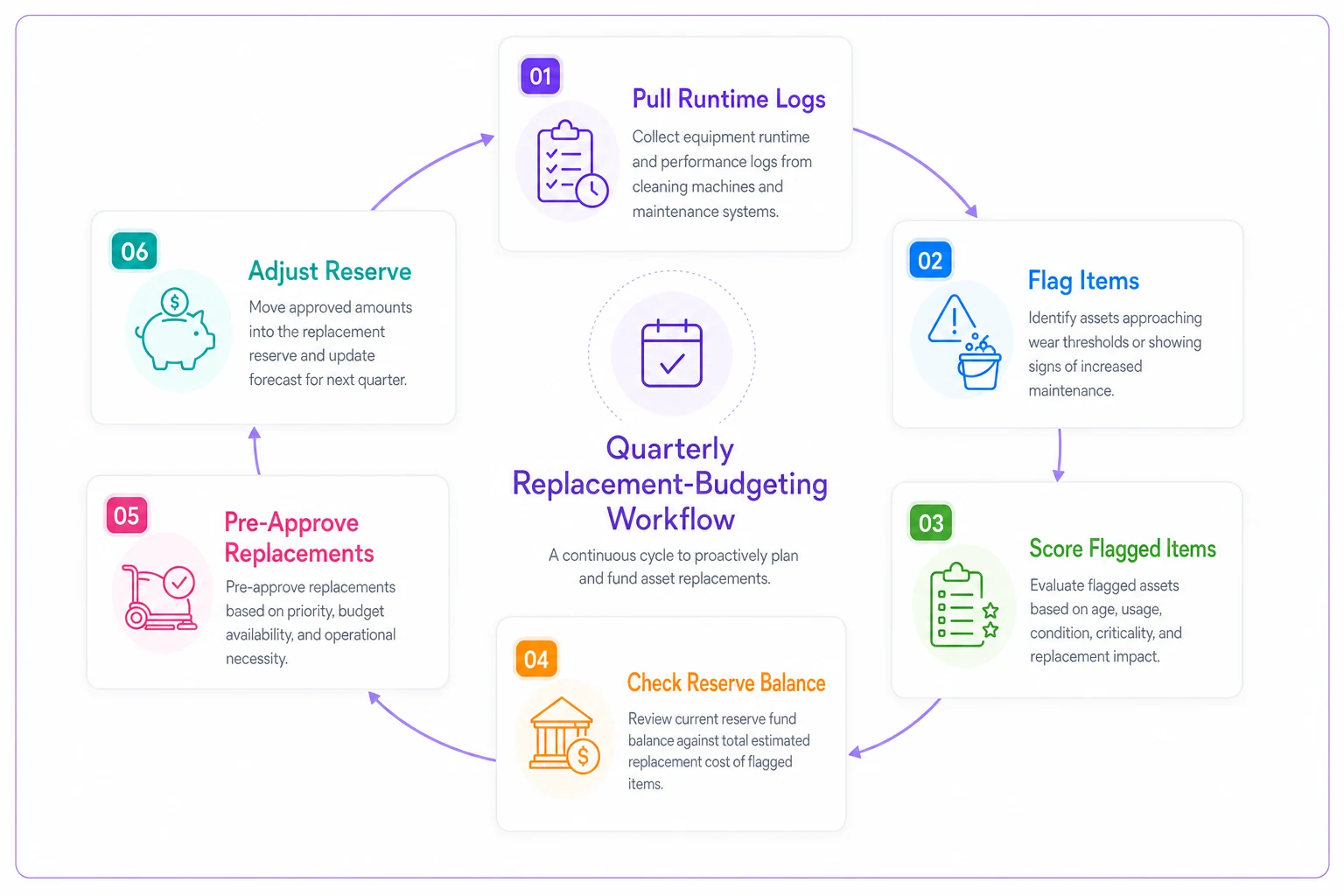
A simple visual of that loop can make it easier to run consistently.
Running this quarterly loop consistently is what separates operators who feel in control of their equipment costs from ones who are constantly reacting. It doesn't have to be perfect to be useful — even a rough review catches the machines that are quietly circling the drain.
Where a management platform actually earns its keep
You can run all of this on a spreadsheet and a shared note. Plenty of solid operators do. But the friction point is data capture — getting runtime and "felt off" notes logged consistently across crews who are busy and don't care about your spreadsheet.
This is where operational software helps in a way that's genuinely practical. If crews are already checking into jobs through a platform, an equipment log field can ride along on that same check-in — a quick "which machine, roughly how long, anything off?" tap. That data rolls up automatically, so your quarterly review is reading real numbers instead of rough guesses. AI-assisted logging can also surface patterns you'd miss manually — like the same machine generating "felt off" notes across three different crews, which almost always means it's about to fail.
The point isn't automation for its own sake. A maintenance plan is only as good as the data feeding it, and the cheapest way to get clean data is to attach it to something crews are already doing.
When this level of planning makes sense — and when it's overkill
Do this if: you run more than 2–3 crews, do a meaningful share of deep cleans or commercial work, or have ever been caught short by a dead machine on a booked day. At that scale, reactive replacement is quietly costing you both cash and capacity.
You can keep it lighter if: you're a solo operator or a single crew with two vacuums. A simple reserve of $40–$60/month and a monthly filter/belt check is plenty. Don't build a quarterly workflow for two machines.
Who should skip most of this: anyone whose equipment is genuinely disposable-tier. Some very light residential operations run cheap consumer vacuums and replace them annually. If your unit cost is under ~$150 and you're not doing heavy jobs, a formal amortization schedule is more overhead than it's worth. Budget a flat annual number and move on.
A real scenario
A residential cleaning company running 5 crews — mostly recurring homes with a steady stream of move-out deep cleans — kept hitting the same wall. A machine would die roughly every 6–8 weeks, always mid-week, and each time the owner spent a rushed afternoon buying a replacement at retail, usually $50–$100 more than a planned purchase would have cost, plus partial crew capacity lost that day.
They added two things: a 30-second equipment check on the existing job check-in, and a monthly reserve of about $230 pulled automatically into a separate sub-account. Within a couple of quarters, the "felt off" notes started catching failures early. An extractor pump flagged three times got serviced before a big job instead of dying during one. Emergency purchases dropped to nearly zero because replacements were pre-approved and funded. Nothing dramatic happened — things just stopped catching fire. Over the year they estimated they saved somewhere in the low four figures on premium emergency buys and avoided a handful of half-day capacity losses.
That's the whole return: not a huge windfall, just the steady disappearance of a recurring, avoidable cost.
The bottom line for your fleet
A cleaning equipment maintenance plan isn't really about maintenance. It's about refusing to be surprised. When you sort equipment by how hard it actually gets used, log runtime through habits crews already have, keep only the spare parts that prevent downtime, and convert your gear into a monthly reserve number — dead equipment stops being an emergency and becomes a scheduled, funded event.
The same discipline that helps you decide when a route stops paying for itself applies to your machines: know the real cost, watch the real usage, and make the call before the situation makes it for you. Set the reserve, run the quarterly loop, and the equipment side of your business gets a lot quieter — which is exactly what you want it to be.
A cleaning equipment maintenance plan isn't really about maintenance. It's about refusing to be surprised. When you sort equipment by how hard it actually gets used, log runtime through habits crews already have, keep only the spare parts that prevent downtime, and convert your gear into a monthly reserve number — dead equipment stops being an emergency and becomes a scheduled, funded event.
Ready to elevate your cleaning business?
Join 500+ cleaning services using Maidufy to save time, reduce scheduling errors, and deliver exceptional client satisfaction.