


Most cleaning disputes don't happen because the work was bad. They happen because nobody agreed, in the moment, that the work was done. A client walks in three hours after the crew left the driveway, notices a smudge on the fridge, and now the entire visit is in question. There's no record of what the kitchen looked like at 2:14pm when the crew locked up. No confirmation the client even saw the finished space. It becomes memory versus memory, and the person paying almost always wins that argument.
A proof of service receipt for cleaning fixes this at the exact moment it matters — before the crew leaves the driveway. Not a paper slip, not an emailed invoice that lands in spam. A short digital record that captures what was done, when, and by whom, plus a single tap from the client that says "yep, looks good." That one tap is worth more than a five-page contract when a dispute lands.
This post is narrow on purpose. It's only about the receipt itself: what goes on it, why less is more, and what to do when the client doesn't tap accept.
Why the invoice you already send isn't proof
A lot of owners assume the invoice is the record. It isn't. An invoice proves you billed, not that you delivered to satisfaction. Those are two different events, and the gap between them is where chargebacks live.
Here's a typical breakdown. Crew finishes a recurring biweekly clean at 1:40pm. The office batch-sends invoices that evening around 6pm. The client opens it, and by then their memory of the house has drifted — dinner was cooked, kids came home, the dog tracked in mud. Now the invoice arrives asking for $145 and the house doesn't feel like $145 anymore. The client's brain quietly blames the cleaner.
The invoice created distance between the work and the acknowledgment. Every hour of that distance increases the odds of a dispute. What you want is the opposite — acknowledgment while the crew is still standing in a spotless kitchen and the client can literally see it.
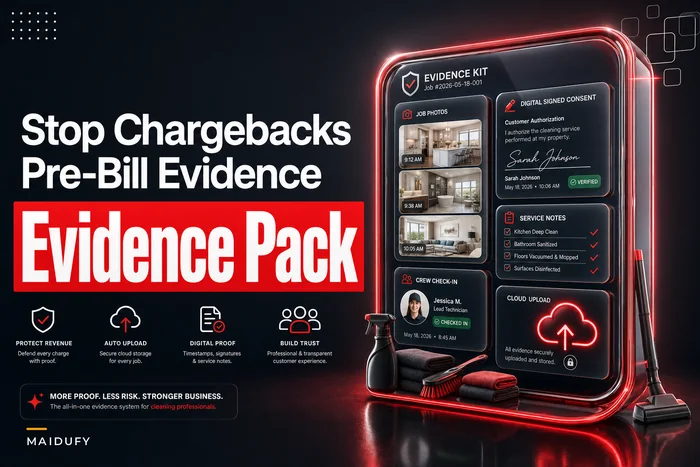
We've written before about building pre-billing evidence packages to stop chargebacks — the receipt is the front door of that whole system. It's the piece the client actually touches.
The minimal receipt: what to put on it (and what to cut)
The instinct is to load the receipt with everything — line items, chemical safety notes, room-by-room breakdowns, terms of service. Resist that. A cluttered receipt lowers acceptance rates because clients don't read walls of text on their phone. They just close it.
Never miss a cleaning appointment again.
Maidufy helps you book, confirm, and manage every cleaning service seamlessly.
- Centralized booking management
- Automated client reminders
- Optimized staff scheduling
No credit card required
What works across most residential operations is a receipt that fits on one phone screen with no scrolling. Roughly four things:
-
2–3 photos of the finished work — the rooms clients care most about (kitchen, main bathroom, entry). Not fifteen photos. Three good ones.
-
A visible timestamp — the actual time the crew marked complete, not the invoice date.
-
The crew member's name (or first name + initial) — this single detail changes client behavior more than people expect.
-
One tap to acknowledge — a big, obvious "Looks good" button. That's it.
Everything else — the price, the terms, the next appointment — can go below the fold or in a separate email. The top of the receipt has one job: get the tap.
Why the crew name matters more than you'd think
When a client sees "Cleaned by Marisol," the interaction stops being with a faceless company and becomes with a person who did real work in their home. Acknowledgment rates go up. Complaints get softer. Nobody wants to file a harsh dispute against Marisol; they'll happily dispute "the cleaning company."
It also protects the crew. If a client later claims nothing was done, you have a named person tied to a timestamped, photo-backed completion. That's a very different conversation with a payment processor than "our records show a visit occurred."
What "acceptance-optimized" actually means
Acceptance-optimized just means the receipt is designed so the client actually taps accept, quickly, without friction. A receipt nobody acknowledges is just another photo folder.
A few things move the acceptance rate:
| Design choice | Low acceptance | High acceptance |
|---|---|---|
| Delivery timing | Sent hours later with invoice | Sent within minutes of crew completion |
| Length | Full itemized page, scrolling | One screen, no scroll |
| Action required | "Reply to confirm" | Single tap button |
| Photos | None, or a dump of 15 | 2–3 clear finished shots |
| Attribution | Company name only | Named crew member |
| Ask | Payment + acceptance bundled | Acceptance first, payment separate |
The biggest lever on that list is bundling. The moment you combine "accept the work" with "pay now," acceptance drops. Clients hesitate to tap anything that feels like it commits them to money before they've looked around. Keep the acknowledgment tap free of any payment ask — let them confirm the work looks good first. Payment can follow, and now it follows an acknowledgment you already have on record.
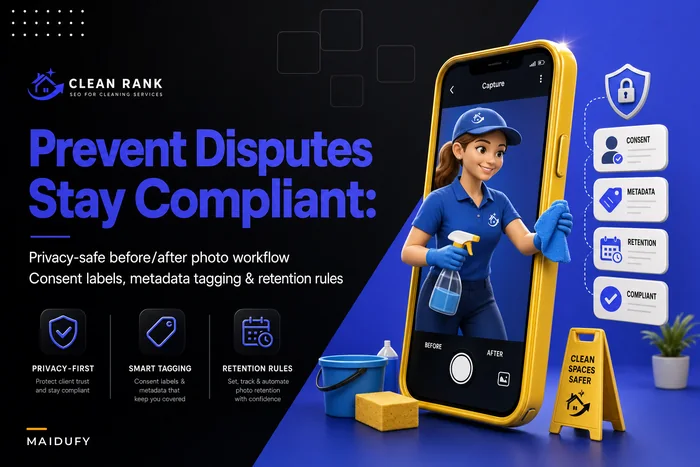
On the photo side, be careful about privacy. Finished-room shots should avoid personal items, mail, faces, and screens. We covered the full approach in the privacy-safe before/after photo workflow, and the same consent and framing rules apply to receipt photos.
The part everyone skips: what to do when nobody taps accept
Most receipt systems fall apart here. They're built assuming the client will acknowledge. But in real operations, a meaningful chunk of clients won't — not because they're unhappy, but because they're at work, or the house was empty during the clean, or they just didn't see it. Silence is normal. The mistake is treating silence as approval and doing nothing.
An unacknowledged receipt isn't a failure. It's a signal that needs a follow-up path. If you have no escalation steps, that silent receipt gives you almost none of the dispute protection you wanted — because a client can later say "I never saw it, I never agreed."
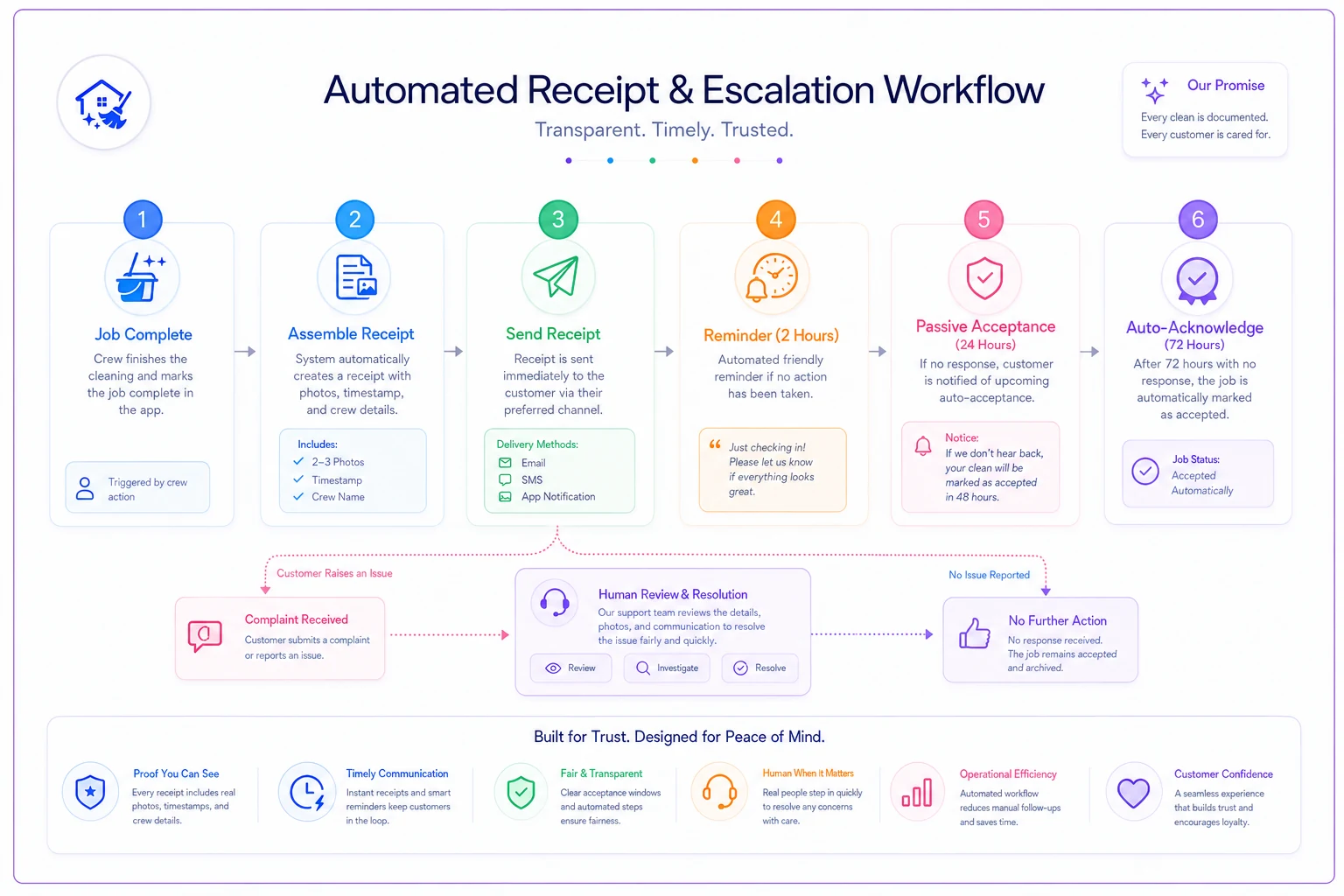
So you need a clear, boring escalation ladder. Here's a version that works well for residential and maid agency operations:
-
Minute 0 — Receipt delivered. Crew marks complete, receipt goes out with photos, timestamp, name, and the accept button.
-
Hour 2 — Gentle nudge (if unopened). A short reminder
"Your cleaning summary from today is ready to view." No pressure, just a bump for people who missed the first notification.
-
Hour 24 — Passive acceptance notice. If still no tap
"If everything looks good, no action needed. If something's off, reply here within 48 hours." This is the key move — you're converting silence into a documented window.
-
Hour 72 — Auto-acknowledged with record. After the stated window closes with no complaint, the receipt is marked "accepted (no response within window)." You now have a timestamped record showing the client had the chance to object and didn't.
-
Any complaint before the window closes → routed to QA, not billing. A raised issue during the window skips straight to a re-clean or resolution flow instead of becoming a payment fight.
That step 3 language does a lot of work. It gives the client a fair, clearly-stated chance to object, and it turns non-response into something defensible instead of an ambiguous gap.
Why the 48-hour window beats "accept or nothing"
Some owners want a hard yes/no: either the client taps accept or the receipt is worthless. That's too rigid for how clients actually behave. The passive-acceptance window respects that most people won't respond when they're happy — silence usually means satisfaction — while still protecting you. You're not forcing an action; you're documenting an opportunity to object.
A real scenario
A mid-size maid agency running around 380–400 residential visits a month had a recurring problem with a specific slice of clients — the ones who worked during the day and came home to a cleaned, empty house. Those clients generated the bulk of "you missed the baseboards" and "the crew left early" complaints, usually surfacing a day or two later, with a handful escalating to card disputes each month.
They switched to a minimal receipt sent at crew completion: three finished-room photos, the timestamp, the lead cleaner's first name, and one accept button, followed by the escalation ladder above. Nothing fancy.
Within a couple of months, the pattern shifted. A large share of clients started tapping accept the same afternoon — often from work, just glancing at the photos on their phone. The late-day "was this even done?" complaints thinned out because clients had already seen and confirmed the finished home hours earlier. Card disputes for that empty-house segment dropped to roughly one every couple of months, and even those were easier to contest because there was a timestamped record showing the client either accepted or let the objection window pass. The dollar impact wasn't dramatic on its own — maybe a few hundred dollars a month in recovered disputes and avoided re-cleans — but the reduction in back-and-forth arguing was the real win for the office staff.
Where automation quietly helps (and where it shouldn't)
You can run this whole thing manually, and small operators do. The crew texts photos to the office, someone assembles the receipt, someone remembers to nudge at hour 2, someone marks it accepted at hour 72. It works until volume climbs, and then the follow-up steps get dropped because they're nobody's clear job.
This is the natural place where operational software earns its keep. The receipt assembly — pulling the crew's completion photos, stamping the time, attaching the crew name — and the escalation timing are exactly the kind of repetitive, time-triggered steps that shouldn't depend on someone remembering. AI-assisted workflow platforms can handle the delivery and follow-up ladder in the background while a person stays in the loop for anything flagged as a complaint.
Below is a simple workflow that shows automated sending and the escalation ladder in action.
The rule though: automate the sending and reminding, never the judgment. A raised complaint should always land on a human. The software's job is making sure the receipt goes out on time, the reminders fire, and the record gets stamped — not deciding whether a client's issue is legitimate.
Automate reminders and record-keeping, but route any customer dispute to a named staff member for human triage.
You can run the sending and escalation fully automatically, but keep humans in the loop for resolution and quality decisions.
When this is worth it — and when it isn't
This makes sense when:
-
You run recurring residential work with clients who aren't home during the clean
-
You've eaten chargebacks or "it wasn't done right" complaints that surfaced hours later
-
You have multiple crews and need per-job accountability tied to a name
-
Disputes cost you more in staff time arguing than in actual refunds
This is overkill when:
-
You're a solo operator with a handful of long-term clients who trust you completely and are always home
-
Your clients pay cash on the spot and there's zero payment-dispute exposure
-
You do mostly one-off deep cleans where the client walks through with you before you leave — that walkthrough already is your acknowledgment
Who should skip it entirely: if your entire client base is present at the end of every visit and does a live walkthrough, you already have real-time acknowledgment. Adding a digital receipt on top is friction without payoff. The receipt system exists to solve the absent-client problem — that's its whole reason to exist.
The one thing to get right
Collapse the distance between the work and the acknowledgment. Every hour between "crew locks up" and "client confirms" is an hour where memory fades, mud gets tracked in, and a clean home starts looking less clean in the client's mind. A minimal receipt — a few honest photos, a real timestamp, a named crew member, and one easy tap — closes that gap.
Build the escalation ladder before you need it, not after your first chargeback. The receipt that gets ignored is only useful if silence turns into a documented, defensible acceptance instead of an empty question mark. Get those two pieces right and most of the "he-said-she-said" disputes simply stop happening — not because your cleaning got better, but because your record did.
Build the escalation ladder before you need it, not after your first chargeback. The receipt that gets ignored is only useful if silence turns into a documented, defensible acceptance instead of an empty question mark. Get those two pieces right and most of the "he-said-she-said" disputes simply stop happening — not because your cleaning got better, but because your record did.
Ready to elevate your cleaning business?
Join 500+ cleaning services using Maidufy to save time, reduce scheduling errors, and deliver exceptional client satisfaction.