


Most payroll runs are boring. Clock in, clock out, hours match the schedule, everyone gets paid. That's the 90% you don't think about.
The problem is the other 10% — the missed punches, the "I forgot to clock out," the crew that shows a job at 47 minutes when it was booked for 90, the GPS ping that lands two miles from the client's house. These exceptions are where payroll actually goes wrong, and where owners either overpay quietly or start arguments with cleaners over $18.
What shows up again and again across small cleaning operations is that there's no real system for these. Every exception gets handled from scratch, by memory, usually by the owner, usually late on a Thursday night. Same problem, different day, no consistent rule for what evidence is required or who gets to approve the fix.
This is a playbook for that — not a broad payroll guide, but specifically the triage layer that sits on top of your time data and decides, fast, which exceptions get auto-corrected, which need a photo or GPS check, and which actually need you involved. It assumes you've already got some kind of time-tracking going. If you haven't, the reconciliation side is covered in the low-friction field time-tracking and audit piece — this article picks up where that leaves off.
Why exceptions are the expensive part of payroll (not the hours themselves)
A normal timesheet costs you nothing to process. An exception costs somewhere between 4 and 12 minutes of thinking, deciding, and usually a text message back and forth. If you run a crew of 8 and even 6% of shifts generate an exception in a two-week period, that's dozens of small decisions stacking up before every payroll run.
The money leak isn't the individual mistake. It's that without a rule, you default. And owners default in two predictable directions:
-
Trust-default "Just pay what they submitted, I don't have time to check." This quietly pays for time not worked. A crew member adding a phantom 15 minutes per exception, a couple times a week, adds up to real money across a year.
-
Fight-default "That doesn't look right, we're not paying that." This creates friction with your best cleaners over small amounts, which is a solid way to lose someone who was otherwise happy.
Neither is actually a decision. They're just what happens when there's no triage rule. The point of a triage matrix is to replace "how do I feel about this today" with "what does the rule say for this type of exception."
There's also a hidden category most owners miss: exceptions that favor the business and never get corrected. A cleaner works 20 extra minutes because the client added a room, forgets to note it, and gets paid the scheduled time. That's an underpayment. If it happens repeatedly you've got a wage compliance risk sitting in your records — not just an annoyed employee.
The triage matrix: sort every exception into one of three lanes
Every payroll exception should land in exactly one of three lanes based on two things: the dollar size of the discrepancy and whether evidence already exists to resolve it automatically.
Never miss a cleaning appointment again.
Maidufy helps you book, confirm, and manage every cleaning service seamlessly.
- Centralized booking management
- Automated client reminders
- Optimized staff scheduling
No credit card required
| Lane | Trigger | Evidence required | Who approves | Turnaround |
|---|---|---|---|---|
| Auto-resolve | Small variance (e.g. under ~10 min) AND GPS/timestamp already confirms the visit | Already captured — no action needed | System rule / lead cleaner | Same day |
| Evidence check | Medium variance OR missing punch on a confirmed job | Photo of completed work + GPS at site, or client confirmation | Manager | 24–48 hrs |
| Owner review | Large variance, repeat offender, or evidence conflicts | Full record + written explanation | Owner only | Before payroll cutoff |
The magic isn't the table itself — it's committing to it. Once "under 10 minutes with a matching GPS ping auto-resolves," you stop touching hundreds of tiny discrepancies a year. Your attention goes only to the exceptions that actually deserve a human.
One quick note on thresholds: don't set them by percentage, set them by minutes and dollars. A 20% variance on a 30-minute job is 6 minutes. A 20% variance on a 4-hour deep clean is 48 minutes. Percentages make small jobs look scarier than they are and big jobs look safer than they are. Absolute minutes keep your triage honest.
What "evidence" actually means, and where owners overreach
The single biggest mistake here is demanding too much evidence for small stuff. If you require a photo and a client signature and a written note for every 10-minute overage, your cleaners will stop reporting overages at all — and you'll be back to the trust-default, just with more paperwork.
Match the evidence weight to the lane:
-
Auto-resolve The evidence is passive. GPS put them at the address, the timestamp falls inside a reasonable window of the scheduled slot. No one has to do anything. This is the lane you want most exceptions falling into.
-
Evidence check One concrete artifact. A before/after photo tied to the job, a GPS trail showing arrival and departure, or a one-tap client confirmation. One clean piece of evidence, not three.
-
Owner review This is where you assemble the full picture, because the money or the pattern actually justifies the time.
A realistic example of the evidence-check lane doing its job: a cleaner submits 2h 10m on a job scheduled for 90 minutes. That's a 40-minute overage — too big to auto-resolve. The manager pulls the GPS trail, which shows the cleaner on-site for about 2 hours, plus a photo timestamp of a fridge interior that wasn't on the original scope. The overage is real; the client added work. It gets approved, and the client gets billed for the add-on separately. That second step is the one people forget — the payroll fix and the rebilling are the same event, and if you only handle the first, you just ate the labor cost.
The correction workflow, step by step
The triage matrix decides the lane. The correction workflow is what happens after. Keep it boring and consistent:
-
Flag — The exception is detected against the schedule (missing punch, variance beyond the auto-resolve threshold, GPS mismatch). It gets a status, not a resolution. Nothing is "wrong" yet, it's just flagged.
-
Route — Based on the matrix, it goes to the lead cleaner, the manager, or you. Routing should be automatic; the whole point is that owners aren't the first stop for every exception.
-
Attach — The person handling it attaches the required evidence for that lane. If evidence can't be produced, the exception drops down to owner review rather than moving forward.
-
Decide — Approve as submitted, correct to a specific number, or reject with a reason. Every decision writes a note. "Approved 2h10m — client added fridge, rebilled" is a complete record.
-
Reconcile — The corrected number flows into the payroll run, and any billing consequence (add-on charge, credit) gets logged at the same time.
-
Close — The exception is timestamped closed, with who decided and why. This is what makes your next audit take minutes instead of an afternoon.
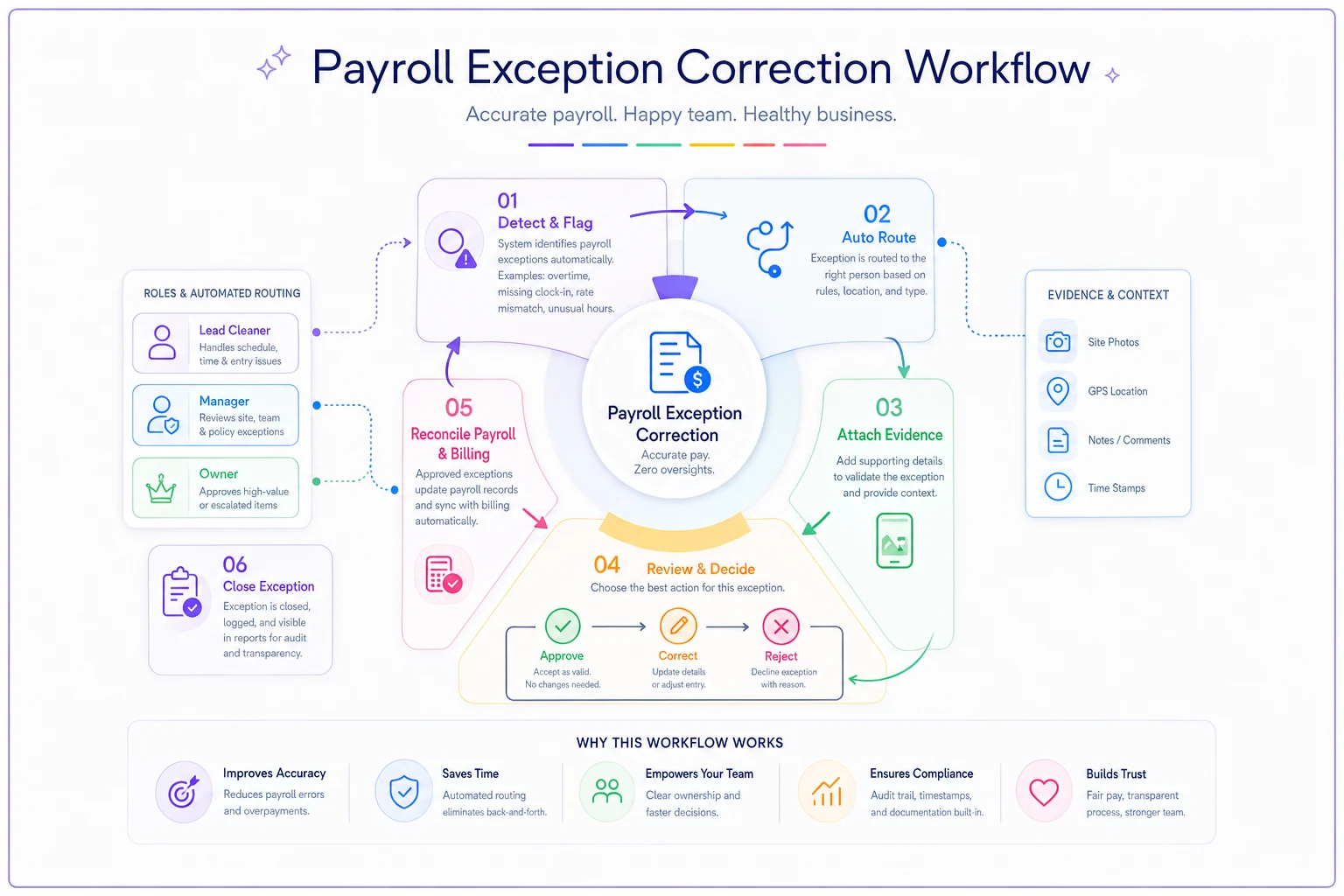
The diagram above shows the correction workflow at a glance.
The step people skip is step four's note. An approval without a reason is worthless three weeks later when the same cleaner has the same variance and you can't remember if last time was legitimate or not. The note is the difference between a system and a pile of guesses.
Approval thresholds: who's allowed to say yes to what
Thresholds aren't just about dollar size — they're about who can approve, which is really a delegation question. If everything routes to the owner, you don't have a system, you have a bottleneck with extra steps.
-
Lead cleaner can confirm auto-resolve exceptions — tiny variances with matching GPS. No dollar authority, just verification.
-
Manager can approve evidence-check exceptions up to a set cap — corrections worth under roughly $40 in labor — as long as the required artifact is attached.
-
Owner approves anything above the cap, anything from a repeat-flag cleaner, or anything where evidence conflicts with the submission.
The threshold that matters most isn't actually the dollar amount — it's the repeat-offender flag. A cleaner with one $30 overage is noise. A cleaner with six $12 overages in a month is a pattern, and it should route to you regardless of size. Set your system so cumulative small exceptions from one person escalate automatically. That's where quiet leakage actually lives — not in the one big variance you'd catch anyway.
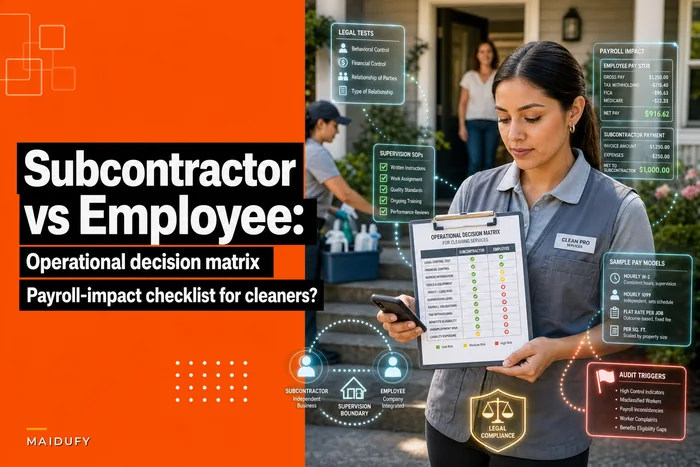
Worth flagging: how you classify workers changes what these thresholds even mean. Subcontractor time and employee time carry different correction and compliance implications, and if you're running both, the subcontractor vs employee decision matrix is worth reading alongside this — a "correction" on a 1099 invoice is a different animal than an adjustment on a W-2 timesheet.
A real scenario
A residential cleaning company running about 6 cleaners and somewhere around 330–350 jobs a month had a familiar pattern: payroll took the owner most of Thursday evening every two weeks, and most of that time was spent chasing exceptions by text. "Did you really stay till 4?" "Why does this one show 12 minutes?"
They mapped their exceptions for one pay period and found roughly 22 of them across the run. About 14 were tiny variances that a GPS-match rule could have auto-resolved. Around 6 were real evidence-check cases — added rooms, legitimate overages. Only 2 actually needed the owner.
After setting the three-lane matrix and a repeat-offender flag, the picture shifted pretty quickly. The 14 small ones stopped hitting the owner at all. The manager handled the evidence-check lane during the week, so nothing piled up for Thursday. The owner's time on payroll exceptions dropped from most of an evening to well under an hour — and they caught two recurring small overages from one cleaner that the old trust-default had been quietly paying for months.
The number that mattered wasn't some dramatic dollar figure. It was that the owner stopped being the first responder for 90% of exceptions, and the ones that did reach them were actually worth the attention.
When a strict triage matrix is a bad idea
This isn't for everyone. A few honest cases where you shouldn't bother:
-
Solo operator or two people. If it's just you and one other person, you don't need routing lanes — you need a shared calendar and a five-minute check. The overhead of a matrix outweighs the benefit.
-
Salaried teams with fixed pay. If your cleaners aren't paid by tracked hours, exception triage on time data doesn't move any money. Focus your energy on scope and quality instead.
-
When your time data is unreliable. A triage matrix built on bad punches just automates bad decisions faster. Fix the capture layer first. Auto-resolving based on a GPS signal you don't trust is worse than checking manually.
The matrix earns its keep when you've got enough cleaners that exceptions become a weekly stream, and enough tracking that the evidence lanes are actually populated with real data.
The payroll data you're already sitting on
Most cleaning businesses already capture the raw material for this — GPS from a phone app, before/after photos for QA, scheduled times in a booking system. The exceptions problem usually isn't missing data. It's that the data lives in three different places and never gets compared automatically.
When time-tracking, job scheduling, and photo or GPS evidence sit in one operational platform, the triage process mostly runs itself. Small variances with clean GPS never surface as issues. The ones needing a photo route straight to a manager with the photo already attached. Only the genuine judgment calls reach the owner. That's the whole game — not eliminating exceptions, but making sure each one gets exactly as much attention as it deserves, and no more.
You don't need software to start, though. Print the three-lane table, pick your minute and dollar thresholds, decide who approves what, and commit to writing a one-line reason on every correction. Do that for two pay periods and you'll already spend less time arguing about timesheets — and you'll finally see which of your "small" exceptions were never small at all.
Ready to elevate your cleaning business?
Join 500+ cleaning services using Maidufy to save time, reduce scheduling errors, and deliver exceptional client satisfaction.