


Most cleaning businesses don't have an incident problem. They have an incident response problem.
A broken vase, a scratched hardwood floor, a client who swears their missing earrings were "right there before your crew came" — these things happen in every operation that sends humans into other people's homes. The businesses that survive them aren't the ones that never break anything. They're the ones that can calmly produce timestamped photos, a signed service receipt, a clear claims process, and a reply to the angry client within the hour — all without the owner dropping everything to firefight.
The ones that struggle treat each incident like a brand-new emergency. No evidence. No script. No insurer-ready bundle. Just panic, a defensive text message, and a claim that gets denied because nobody documented anything.
This is a system article. Incident response in a cleaning business isn't one checklist — it's four moving parts that have to connect: prevention, evidence, claims handling, and post-incident learning. When any one of them breaks, the others get overloaded.
Why incident response breaks down (and it's almost never the cleaner's fault)
The pattern across small cleaning operations is pretty consistent: the owner is also the quality inspector, the customer service rep, and the person who talks to the insurance company. At 3 cleans a day, that works. At 30 cleans a day across four crews, it collapses.
The breakdown usually isn't a bad cleaner. It's that incidents arrive unstructured. A text comes in — "your team damaged my cabinet" — and now the owner has to reconstruct what happened from memory, chase down which crew was there, figure out if there are any photos, and respond before the client leaves a one-star review. Every single incident becomes a research project.
The part most owners miss: the quality of your incident response is decided before the incident ever happens. If your crews aren't capturing before/after photos routinely, you have nothing to work with when a claim lands. You're negotiating blind. Either you pay out to make it go away (margin gone) or you fight it and look like you're hiding something (reputation gone).
In practice, the damage from a single mishandled incident usually isn't the repair cost. A $180 cabinet repair is nothing. The real cost is the review that scares off six prospects, the three hours the owner spends untangling it, and the insurance claim that gets denied for lack of documentation.
The four parts of the system
Think of incident response as a pipeline. Each stage feeds the next.
Never miss a cleaning appointment again.
Maidufy helps you book, confirm, and manage every cleaning service seamlessly.
- Centralized booking management
- Automated client reminders
- Optimized staff scheduling
No credit card required
| Stage | What it does | What breaks without it |
|---|---|---|
| Prevention & QA | Catches problems before the client does; creates routine photo evidence | You find out about damage from an angry client, not your own inspection |
| Evidence capture | Timestamped photos, service receipts, crew logs | Claims become "your word vs. theirs" |
| Claims playbook | Internal triage + insurer-ready bundle | Every claim is handled differently, slowly, and emotionally |
| Post-incident audit | Turns one incident into a process fix | The same mistake repeats across crews |
The mistake owners make is investing in only one stage. They buy insurance but never build evidence capture. Or they obsess over QA but have no script for talking to an upset client. A strong operation needs all four, and they have to hand off cleanly to each other.
Stage 1: Prevention is your cheapest claim
Every incident you prevent is one you never have to document, argue about, or pay for. That's the highest-ROI stage in the whole pipeline, and it's the one most owners underinvest in.
Prevention here isn't just "clean carefully." It's building a routine where evidence gets captured whether or not anything goes wrong. Crews that only take photos when they notice damage are the crews with no photos when a dispute shows up weeks later.
-
Pre-existing condition photos on arrival for any home flagged as high-risk (new client, luxury finishes, prior complaint)
-
After photos of the same items at close-out
-
A one-tap service receipt the client acknowledges before the crew leaves
-
Crew notes on anything unusual ("client's dog knocked over plant stand while we worked")
A 20-second note at the time of service beats a 40-minute phone reconstruction three days later.
That last one matters more than people think. A 20-second note at the time of service beats a 40-minute phone reconstruction three days later.
Stage 2: Build the evidence bundle *before* you need it
When a claim lands, you shouldn't be assembling evidence — you should be retrieving it. That's the whole difference between a 15-minute response and a two-day scramble.
An insurer-ready evidence bundle is a standard package you can produce for any incident. Define it once, and every claim gets handled the same way.
The standard evidence bundle should contain:
-
Service record — date, time in/out, crew members assigned, service type
-
Before/after photos — timestamped, including any pre-existing condition shots
-
Signed service receipt — client's acknowledgment at close-out
-
Crew incident note — if anything was flagged during service
-
Client communication log — the original complaint, verbatim, with timestamps
-
Chain of custody for any disputed items — especially for alleged theft or missing items
-
Relevant SOP excerpt — showing the crew followed procedure
Insurers don't pay out on stories. They pay out on documentation. A tight evidence bundle also protects you against fraudulent or exaggerated claims. The "you broke my $900 lamp" conversation ends quickly when you can produce a timestamped before-photo showing the lamp was already cracked.
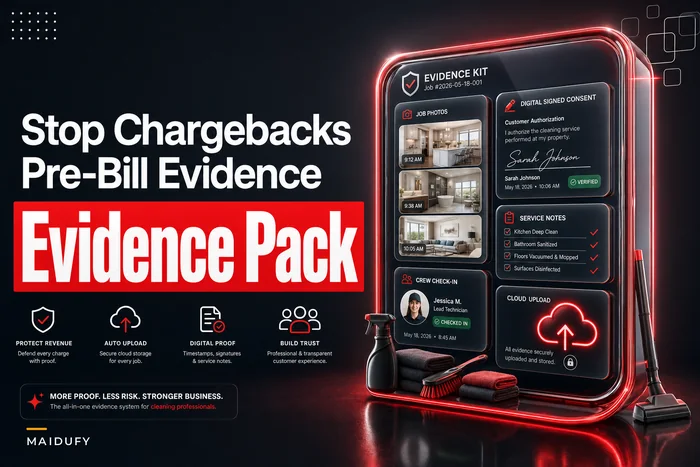
This same discipline is why solid pre-billing evidence packages stop chargebacks before they start — it's the same muscle. Evidence you capture routinely protects you across disputes, chargebacks, and insurance claims. One system, three payoffs.
Evidence capture workflow:
Crew arrives → photographs pre-existing conditions on high-risk items → completes service → photographs same items at close-out → client signs service receipt → notes logged for anything unusual → all photos, receipt, and notes attached to the appointment record → bundle retrievable instantly if a claim is filed
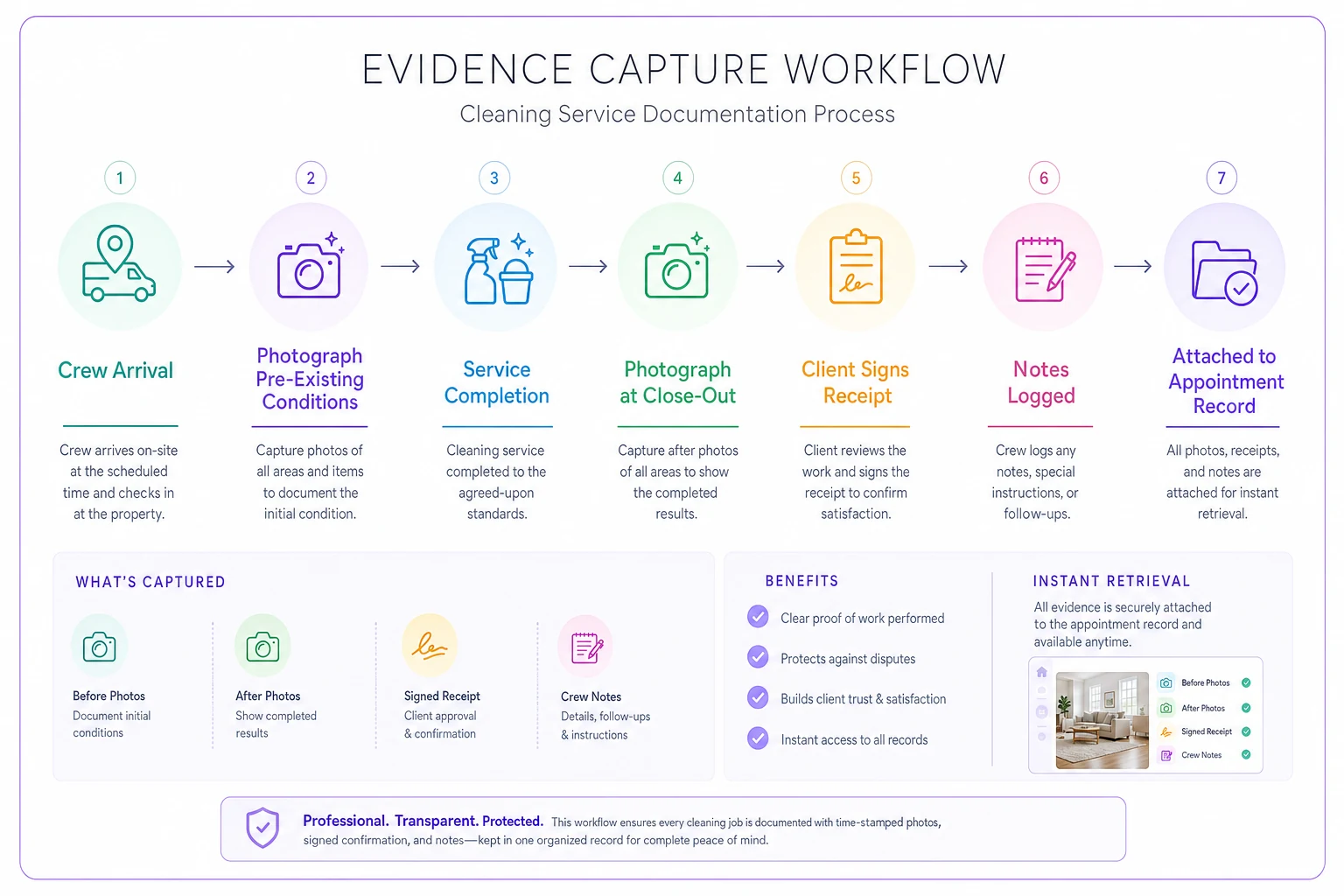
The whole sequence takes a few minutes per job. The payoff shows up months later when someone claims you damaged something and you can disprove it in a single message.
Stage 3: The claims playbook — triage before you react
This is where emotion ruins good businesses. A client sends an accusatory message, the owner's stress spikes, and they fire back something defensive — or they panic and over-promise a payout. Both are bad.
A claims playbook removes the emotion by deciding in advance how each type of incident gets handled.
Triage the incident first
Not every "incident" is a real claim. Sort them fast:
-
Minor (handle on the spot) small items, under ~$100, clear fault. Resolve directly, document it, move on.
-
Moderate (manager review) damage roughly $100–$500, or disputed fault. Pull the evidence bundle, decide repair vs. reimburse.
-
Major (owner + insurer) high-value damage, injury, or theft allegations. Open a formal claim, notify your insurer, keep all communication documented.
The split matters because treating every incident as a major event burns you out, and treating every incident as minor gets you sued. Most incidents are minor. Build a process that resolves those fast so your attention stays on the rare serious ones.
Insurer intake — what to send, in what order
When an incident crosses into insurer territory, the speed and completeness of your intake decides how the claim goes. A clean intake template looks like:
-
Policyholder + policy number
-
Date, time, and address of incident
-
Nature of loss (damage / injury / theft) in two or three factual sentences
-
Estimated value and basis for that estimate
-
Attached evidence bundle (the standard package above)
-
Crew statement if relevant
-
Requested next step (adjuster assignment, coverage confirmation)
Keep the tone factual. No speculation, no admitting fault beyond what's documented, no emotional language. Adjusters move faster on clean, organized intakes — and your documentation habits here overlap heavily with broader health, safety, and legal compliance systems that protect you when something serious happens.
The public response — what the client actually sees
Client script — initial response (within the hour):
> "Thank you for letting us know, and I'm sorry this happened. We take this seriously. I've already pulled our service records and photos from your appointment and I'm reviewing them now. I'll follow up by [specific time] with next steps. You matter to us and we're going to make this right."
Manager script — close-out after resolution:
> "Here's what we found and what we're doing. [Factual summary.] We've [repaired / reimbursed / arranged X]. We've also updated our process so this is less likely to happen again. We truly value having you as a client and appreciate your patience."
That last line — we updated our process — is what turns an incident into retention. Clients forgive mistakes. They don't forgive feeling ignored or brushed off.
When fighting a claim makes sense — and when it doesn't
Owners get this wrong in both directions. Some fight every claim on principle and bleed reviews. Others pay out everything and get picked clean by bad-faith clients.
When it makes sense to contest:
-
Your evidence clearly contradicts the claim (timestamped before-photo of pre-existing damage)
-
The claimed value is wildly inflated
-
There's a pattern of this client making repeated claims
When it's smarter to just resolve it:
-
The amount is small relative to the client's lifetime value
-
Fault is genuinely unclear and the client is otherwise solid
-
The reputational cost of fighting exceeds the payout
Who should not try to fight a claim alone: any incident involving injury, theft allegations, or high-dollar damage. Those go to your insurer and, where relevant, counsel — immediately. Don't negotiate injury claims over text.
A simple rule many operators land on: resolve anything small and defensible-either-way out of pocket within 24 hours, and save the formal fight for inflated or fraudulent claims where your evidence is strong.
A real scenario
A residential cleaning company running four crews — somewhere around 300 cleans a month — had no real incident system. Everything was handled over text by the owner, reactively, case by case.
Over one quarter they had three incidents: a scratched countertop, a disputed "missing" bracelet, and a cracked picture frame. The countertop and frame were legit — roughly $240 and $60. The bracelet was a stretch; the client claimed it vanished during service.
Without evidence, the owner paid out all three to avoid reviews: around $600 total, plus a $200 "goodwill" gesture on the bracelet just to make the client stop. More painful was the time — the bracelet dispute alone ate most of a day, and the client still left a lukewarm review.
After building out the four-stage system — routine before/after photos on high-risk items, a standard evidence bundle, a triage rule, and set client scripts — the next quarter looked different. Two incidents came up. Both resolved inside a day. When a client claimed a pre-existing scratch was new, the crew's arrival photo settled it in one message — no payout, no argument, and the client actually apologized.
The dollar savings were modest, maybe a few hundred. The real win was the owner getting their day back and the reviews staying clean. That's the pattern: the system pays off less in avoided payouts and more in avoided chaos.
Stage 4: The 7-day post-incident audit ritual
This is the stage almost everyone skips, and it's why the same incidents keep repeating. An incident isn't closed when the client is satisfied. It's closed when you've turned it into a process change.
Run this over the week following any moderate or major incident:
-
Day 1 — Capture the facts. Write down exactly what happened while it's fresh. What, where, which crew, what evidence exists.
-
Day 2 — Verify the evidence. Was the bundle complete? What was missing? Missing evidence is the finding.
-
Day 3 — Trace the root cause. Not "the cleaner was careless." Why was the risk there? No pre-existing photo? Rushed schedule? No SOP for that surface?
-
Day 4 — Check for pattern. Has this crew, home type, or service type produced incidents before? One incident is noise; three is a signal.
-
Day 5 — Fix the process. Update the SOP, add a photo requirement, re-train, or re-price the risky service. One concrete change.
-
Day 6 — Communicate the change. Tell the crews what changed and why. People follow rules they understand.
-
Day 7 — Confirm resolution with the client. Final check-in. Make sure they feel handled, not forgotten.
Teams that run this ritual see incident rates actually decline over time, because every mistake teaches the operation something. The teams that skip it stay stuck in the same loop — paying out the same kinds of claims every quarter, wondering why nothing improves.
Worth sitting with: most repeat incidents trace back to a missing standard, not a bad employee. The crew that scratched a floor often wasn't given a photo-first protocol for delicate surfaces. Fix the standard, and the "careless" problem usually disappears.
Where software fits — quietly
You can run all four stages on a phone camera and a shared folder when you're small. It works. But the handoffs get expensive as you scale, because the whole system depends on evidence being captured consistently and retrievable instantly.
That's the realistic case for operational software: keeping timestamped photos, service receipts, crew logs, and client communication attached to the right appointment automatically — so when a claim lands six weeks later, the evidence bundle is already assembled. AI-assisted workflows can flag high-risk appointments that need extra photos, nudge crews who skip the before/after step, and surface whether a complaining client has a pattern of claims. None of that replaces judgment. It just removes the frantic reconstruction that turns a 15-minute response into a lost day.
The point isn't the tooling. It's that your incident response can only be as fast as your evidence is retrievable. Whether that's a disciplined folder system or a platform that handles it automatically, the principle holds either way.
Pulling it together
Incident response isn't a binder you write once and forget. It's a loop: prevent what you can, document everything routinely, respond with a calm script and a ready evidence bundle, then audit so the operation actually learns. Each stage protects the next. Weak prevention overloads your claims process. Weak evidence makes every claim a coin flip. No audit means you repeat the same mistakes forever.
Start where you're weakest. If your crews aren't taking routine photos, fix that first — it's the foundation everything else stands on. If you have photos but handle every complaint in panic mode, write your triage rules and scripts this week. You don't need all four stages perfect at once. You need them connected, and you need to stop treating every incident like it's the first one you've ever seen.
Start where you're weakest. If your crews aren't taking routine photos, fix that first — it's the foundation everything else stands on. If you have photos but handle every complaint in panic mode, write your triage rules and scripts this week. You don't need all four stages perfect at once. You need them connected, and you need to stop treating every incident like it's the first one you've ever seen.
Ready to elevate your cleaning business?
Join 500+ cleaning services using Maidufy to save time, reduce scheduling errors, and deliver exceptional client satisfaction.