

The November–December stretch is a trap dressed up as an opportunity. Phones ring off the hook with one-time deep cleans, move-outs tied to holiday travel, and "can you fit me in before my in-laws arrive" requests that pay well and feel like free money. Then January hits and you realize three of your best recurring clients quietly dropped because their Tuesday 9am slot got bumped twice in December by a one-off that paid more that week but is long gone.
That's the core tension of holiday staffing for a cleaning business. The demand spike is real, but your capacity is fixed, and the clients who make your margins predictable are the easiest to accidentally burn during the exact weeks you're most distracted. This kit is about running the peak window with enough guardrails that you catch the surge revenue and keep the recurring book intact.
The part most owners get backward
During peak windows, owners optimize for revenue this week and forget that recurring clients are an annuity. A $280 one-off deep clean looks better than a $140 biweekly on the same Thursday. But that biweekly is worth around $3,600 a year if they stay. Bump them for the one-off and you're potentially trading thousands in future revenue for a job that's already off the schedule by the time you're reconciling payroll.
So the whole system below starts from one rule: recurring slots are protected inventory, not flexible inventory. Everything else — staffing caps, pricing tiers, floater rules — exists to service surge demand around the recurring book, not on top of it.
If your recurring scheduling discipline is already shaky, this gets ten times harder in December. Tightening that base system first is basically a prerequisite for everything here — we've written separately about keeping recurring schedules from breaking when you mix one-offs into protected slots, and it's worth working through that before layering on surge strategy.
Step one: set your staffing cap before you set your revenue goal
Most owners do this in the wrong order. They look at December, see demand, and say "let's book as much as we can." Then quality drops, floaters burn out, and January becomes a scramble of comped visits and refund requests.
Never miss a cleaning appointment again.
Maidufy helps you book, confirm, and manage every cleaning service seamlessly.
- Centralized booking management
- Automated client reminders
- Optimized staff scheduling
No credit card required
Calculate your real ceiling first.
Your effective cap for peak isn't just crew count times hours. It's crew count times hours, minus recurring commitments, minus a quality buffer, minus expected sick and no-show shrinkage — which spikes in December because half your team is either traveling or coming down with something by mid-month.
A rough way to lay it out:
| Capacity component | Example (6-cleaner shop) |
|---|---|
| Total available cleaner-hours/week | 6 × 32 = 192 |
| Recurring commitments (protected) | 118 |
| December shrinkage buffer (illness, travel, no-shows ~12%) | −23 |
| Quality buffer (don't run at 100%) | −15 |
| Real surge capacity available | ~36 hours/week |
Here's a simple workflow for calculating and booking to your surge cap:
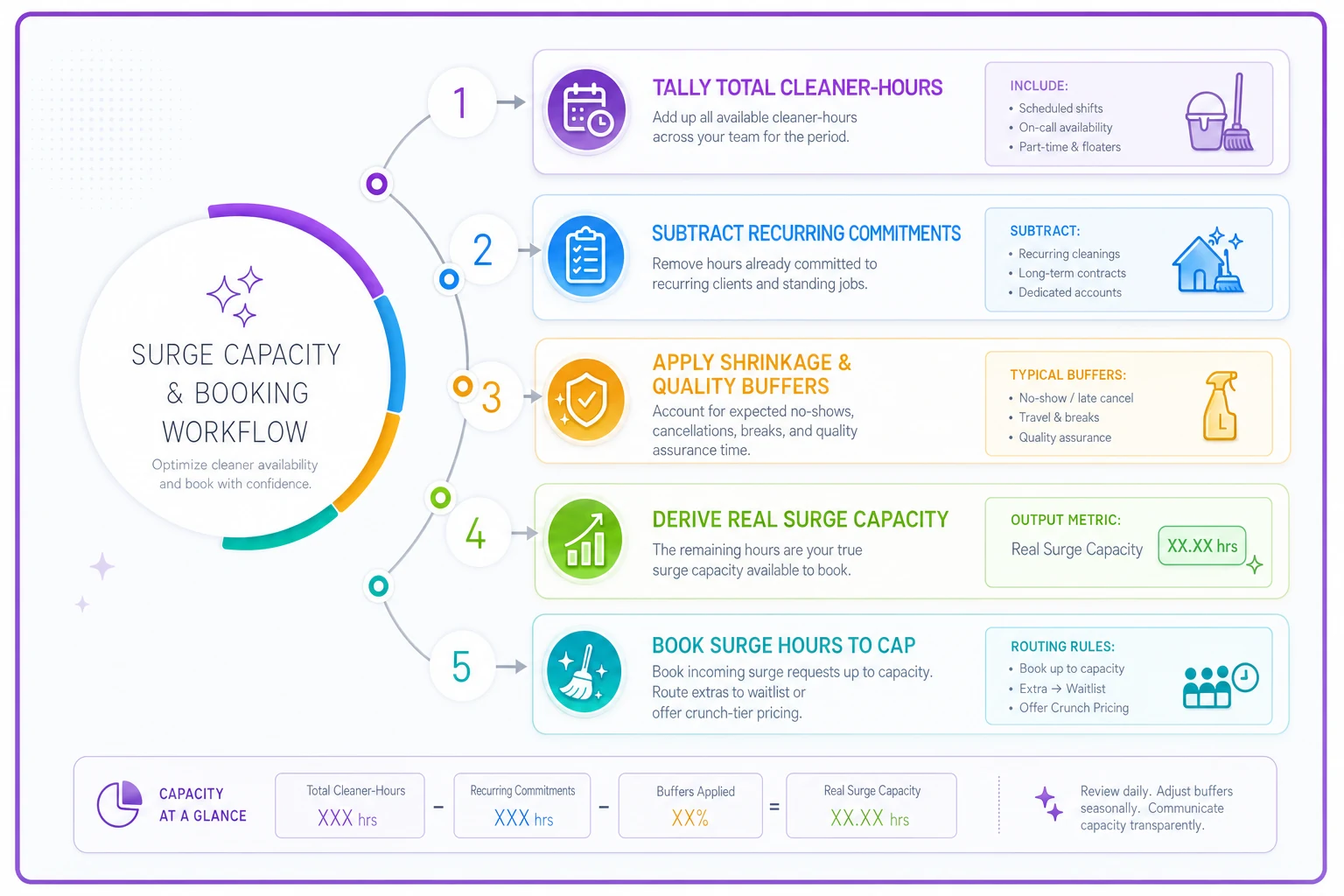
That 36 hours is your actual surge inventory. Not 74. Thirty-six. The number matters because the single biggest December mistake is selling capacity you don't have, then cannibalizing recurring work to cover it.
Once you know the cap, you book to it and stop. When surge hours are gone for a given week, new one-offs either go to a waitlist, get pushed to the following week, or get quoted at your top pricing tier. What they do not do is displace a recurring visit.
Step two: build temporary pricing tiers, not one flat "holiday rate"
A flat holiday surcharge is lazy and leaves money on the table while also annoying the wrong people. What works better is a tiered structure that prices by how much the job strains your system — not just by what month it is.
Three tiers that hold up well in practice:
-
Protected recurring clients — no surcharge. This is deliberate. Your recurring base should feel rewarded during the rush, not hit with an extra fee. Keep their slot, keep their price. It's cheap loyalty insurance.
-
Standard surge tier — roughly 15–20% premium. Applies to one-off bookings in peak weeks that fit into your available surge hours without heroics. Normal deep clean, reasonable scheduling flexibility, books at least a few days out.
-
Crunch tier — 30–40% premium. For the "I need it Thursday and it's Tuesday" jobs in your most constrained weeks — usually the five to seven days before major holidays. High strain on routing, high floater dependency, low flexibility. Price it so that if they say yes, it's genuinely worth disrupting your flow. If they say no, that's fine too.
The tiers do real work: they self-select. A lot of price-sensitive callers will just pick a January date once they hear the crunch-tier number, which moves demand off your most constrained days without you having to say no directly. The ones who pay crunch pricing are paying enough to justify a floater and some scheduling gymnastics.
One detail people miss: publish the tier end date. "Holiday surge pricing in effect through December 31" prevents the awkward February conversation where a client thinks the elevated rate is your new normal. Temporary means temporary, and you want that visible upfront.
When tiered surge pricing is a bad idea
If your base pricing is already soft or your reputation for quality is shaky, layering a 35% surcharge on top is going to generate complaints and reviews you don't want during your highest-visibility weeks. Fix the base first. Surge pricing amplifies whatever reputation you already have — it doesn't create a premium one out of thin air.
Step three: floater activation SLAs (the piece almost nobody formalizes)
Floaters — your on-call or flexible cleaners who fill gaps — are the hinge the whole peak window swings on. And most shops treat floater activation as a panicked group text at 7:15am when someone calls out. That's not a system; that's a prayer.
A floater SLA just means you've decided, in advance, the rules for how and when floaters get pulled in. Write it down before December so you're not improvising during the exact weeks when improvising is most expensive.
A workable floater SLA looks something like this:
-
Response window Floater confirms availability within 30 minutes of an activation request during peak weeks — tighter than the looser standard you might run the rest of the year.
-
Activation trigger order Know who to call first. Usually by proximity to the open job, then by quality tier, then by remaining hours before overtime kicks in.
-
Guaranteed minimum During peak, offer a floor — something like "if we call you in, you're paid for at least 3 hours even if the job runs short." Floaters who feel jerked around in December won't pick up your call in July.
-
Overtime ceiling Define the point where pulling an exhausted floater into their sixth straight day costs more in quality drops and burnout than the job is worth. Past that line, the job goes to waitlist or crunch pricing.
The pattern that shows up repeatedly: shops without floater SLAs end up leaning on their two most reliable cleaners for everything, who then quit in January. The whole point of SLAs is to spread the load fairly and know your real activation ceiling before you blow past it.
There's also real overlap here with broader surge-staffing mechanics — forecast heuristics, floater pools, and how temporary pricing interacts with staffing costs — so it's worth reading the surge staffing playbook for cleaners alongside this for the forecasting side of the equation.
A realistic example of how this holds together
Take a two-crew residential shop doing around 330 monthly cleans, with roughly 70% recurring. Last December they ran without any of this structure: booked every one-off that called, bumped recurring clients three or four times across the month, and burned their best floater into the ground by Christmas week.
The aftermath: two biweekly clients churned in January — roughly $7k in annual recurring revenue, gone — plus around $600 in comped or discounted visits to smooth over the bumped appointments, and a floater who went from 20 hours a week to zero because she was done.
-
Surge one-offs were slightly lower in volume but higher in revenue per job, because crunch-tier pricing filtered out the low-value panic bookings.
-
Zero recurring clients bumped, so January churn from scheduling basically disappeared.
-
Comps and goodwill refunds dropped to near nothing because nobody got disrupted.
-
Net peak-window revenue came out modestly higher — not a dramatic jump, but noticeable — and the January number was dramatically healthier because the recurring book stayed whole.
The lesson isn't that surge pricing makes you rich in December. It's that the December number and the January number are connected. Protecting the recurring base is what makes the whole quarter work.
Step four: pre- and post-holiday reconciliation
This is the unglamorous part that determines whether the peak window was actually profitable or just felt busy.
Pre-holiday reconciliation (run it in mid-November):
-
Confirm every recurring client's December schedule in writing, including anyone traveling who wants to skip or shift. Travelers who don't tell you create phantom open slots you could've sold.
-
Lock your surge capacity number per week based on confirmed recurring commitments.
-
Pre-brief floaters on the SLA and get soft availability for the known crunch weeks.
-
Set your tier pricing and the published end date.
Post-holiday reconciliation (run it the first week of January):
-
Reconcile surge bookings against actual hours worked — did you honor the cap, or did you quietly blow past it and eat the quality cost?
-
Audit for any recurring client who got bumped, even once, and reach out to them proactively before they churn silently.
-
Reconcile floater pay against the guaranteed minimums and overtime ceilings you promised. Underpaying a floater who saved your December is the fastest way to lose them for next year.
-
Tally comps, refunds, and goodwill adjustments so you know the real net on the surge — not the gross.
That post-holiday audit is where most shops discover the uncomfortable truth: the December gross looked great, but after comps, churn, and floater overtime, the surge margin was thinner than a normal recurring month. Reconciliation is how you find that out in time to fix it next year instead of repeating it.
Who should skip most of this
If you're a solo operator or two-person shop with no floater bench and a fully booked recurring calendar, don't try to chase surge at all. Your best December move is to protect your recurring clients, maybe take one or two premium one-offs you can actually fit, and politely waitlist the rest. Trying to run tiered surge pricing and floater SLAs with no float capacity just means you overpromise and underdeliver during your most reputation-sensitive weeks.
The full kit makes sense once you have at least a small flexible labor pool and a recurring book large enough that protecting it is the main risk. For most agencies, that's exactly when the December scramble starts doing real damage.
The one thing to take away
Peak-window revenue is seductive because it shows up as cash right now, and the cost of chasing it — churned recurring clients, burned floaters, January comps — shows up weeks later when the connection is easy to miss. The staffing cap, tiered pricing, floater SLAs, and reconciliation steps all exist to make that delayed cost visible before you incur it.
Set the cap first. Protect the recurring slots. Price the crunch high enough that disruption is worth it. Treat your floaters like you'll need them again in six months, because you will. Do that, and the holiday rush becomes a quarter you actually look forward to instead of one you spend January cleaning up after.
Ready to elevate your cleaning business?
Join 500+ cleaning services using Maidufy to save time, reduce scheduling errors, and deliver exceptional client satisfaction.