


Scope creep rarely announces itself. It shows up as "oh, while you're here, can you also do the oven?" at the door. It shows up as a recurring client who quietly added two bathrooms over six months without anyone touching the price. It shows up as a crew finishing 40 minutes late because they had no good way to say no without sounding rude.
And honestly, most of it isn't the client being difficult. It's that nobody on your side had a clean sentence ready in that moment. So the default became "sure, no problem" — and your margin walked out the door one favor at a time.
What follows is a set of short, reusable scripts tied to specific moments in the booking-to-handoff timeline, with the rough minutes-and-dollars math behind each one. Not customer-service platitudes. The specific phrasings that let a crew hold the line while still sounding like the kind of company people actually recommend.
Where the minutes actually leak
Before the scripts, it helps to see where the creep enters. Across a typical residential operation, the add-ons that blow up a visit tend to cluster in four spots:
| Moment | Typical creep | Minutes lost | Who should handle it |
|---|---|---|---|
| Booking confirmation | Client assumes "deep clean" includes inside fridge, oven, windows | 20–35 | Office / intake |
| On arrival | "While you're here, can you also…" | 15–40 | Crew lead |
| Mid-visit | Client points to a room that wasn't on the sheet | 10–25 | Crew lead |
| Handoff / next booking | Recurring scope silently grows over months | 10–20 per visit, compounding | Office + crew notes |
The expensive one is that last row. A one-time 15-minute favor costs you 15 minutes. A recurring client who permanently gained a room costs you that time every two weeks, forever, usually at the old price. That leak doesn't show up on a single invoice, but it shows up clearly when you finally look at hours-per-visit trending up on a route that isn't earning more.
The scripts below are organized by moment, because the right words at arrival are useless if the booking confirmation already set the wrong expectation.
1. Booking confirmation: lock scope before the crew ever leaves the shop
Most scope creep is pre-loaded at booking. The client hears "deep clean" and pictures something enormous. You hear "deep clean" and picture your standard checklist. Nobody closes that gap until the crew is standing in the kitchen.
Never miss a cleaning appointment again.
Maidufy helps you book, confirm, and manage every cleaning service seamlessly.
- Centralized booking management
- Automated client reminders
- Optimized staff scheduling
No credit card required
The fix is a confirmation message that lists what's included and — this is the part people skip — names the common add-ons as paid extras up front, before anyone's feelings are involved.
Booking confirmation template (SMS or email):
> "You're booked for a Deep Clean on Thu 3/14, 9–11:30am. This covers all rooms, bathrooms, kitchen surfaces, floors, and dusting. Popular add-ons people often want: inside oven (+$35), inside fridge (+$30), interior windows (+$40). Want any added? Just reply and we'll block the extra time."
Two things are doing work here. First, you've converted "surprise requests" into a menu, which reframes them as normal paid options instead of favors. Second — and this matters operationally — you've told them replying adds time to the booking, so the crew shows up with the right window already blocked.
Naming the three most-requested extras in the confirmation catches a large share of the would-be at-the-door asks. The client either pre-pays or decides they don't need it. Either way the crew isn't ambushed.
The one-tap add-on version: if your booking system supports quick replies, the single most effective phrasing is a yes/no with the price baked in:
> "Add inside oven for $35? Reply YES to add 20 min."
People say yes to a tapped number far more readily than to a vague "do you want any extras?"
You're not upselling harder, you're just removing the friction of them having to ask and you having to quote on the spot.
2. On-arrival deflection: the "while you're here" script
This is the moment that eats the most unbilled minutes. The crew arrives, the client walks them through, and somewhere between the entryway and the kitchen comes the request. "Oh, and could you do the baseboards in the hallway too? And maybe the inside of the microwave?"
The crew's instinct is to say yes. Saying yes feels like good service. But a crew lead with no script will either (a) do it for free and run late, or (b) say an awkward "um, I don't think that's on here" that makes the client feel cheap.
The deflection script has three parts: acknowledge, locate the authority away from the crew, offer the path.
On-arrival add-on script (crew lead):
> "Yeah, we can definitely do that. That one's an add-on, so let me text the office to add it to today's visit — it's $30 and runs about 15 extra minutes. Want me to go ahead?"
The crew lead isn't the bad guy — "that's an add-on" is just a fact, like a menu price. The office (or the system) is the authority, not the person standing in the kitchen. And the client gets a clear yes/no with time and money attached, so they can make a real decision instead of assuming it's free.
> "No problem at all — I'll leave it off today, and if you ever want it added for next time just let us know and we'll build the time in."
The pattern underneath all of this: never let the person holding the mop be the person negotiating the price. The crew confirms, the office (or the booking record) owns scope. That separation is what lets a crew lead stay friendly while still protecting the schedule.
3. Mid-visit: the "that wasn't on the sheet" script
Different from the arrival ask. This is when the crew is halfway through and the client gestures at a room — a finished basement, a spare bedroom, a sunroom — that simply wasn't in the booking. Sometimes it's an honest miss on intake. Sometimes the client is quietly expanding scope.
> "I want to make sure we get that room right — it wasn't on today's sheet, so I'll check with the office on time and pricing. If we can fit it in today I'll let you know, otherwise we'll get it booked properly so it gets the full clean it deserves."
"So it gets the full clean it deserves" is doing real work in that sentence. You're not refusing; you're framing the refusal as quality protection. Rushing an unplanned room at the end of a visit produces exactly the kind of half-done work that generates complaints. Declining to cram it in is actually the higher-quality move, and the script says so without making it weird.
This is also where good intake records pay off. If the booking clearly listed "3 bed / 2 bath, main floor only," the crew has a clean reference point and the conversation is factual, not a he-said-she-said. Tight intake notes are the foundation the whole client relationship sits on — the same reason a solid stepwise onboarding flow with welcome packs and QA triggers reduces friction for months afterward.
4. Crew handoff language: stop recurring scope from creeping silently
The slowest, most expensive creep happens between visits on recurring accounts. A client adds a home office. The next crew does it without comment. The crew after that treats it as standard. Six months later your "90-minute biweekly" is a 115-minute biweekly at the 90-minute price, and nobody made a decision — it just drifted.
Handoff note format (left on the job record, not in someone's head):
-
In scope, priced main floor, 2 baths, kitchen, master
-
Added last visit, NOT yet priced home office — flagged to office 3/14
-
Client tends to ask for inside microwave (decline politely, offer as add-on)
-
Time budget 90 min. If running over, skip detailing on [X], note it, don't eat the time silently.
That last line is the one owners forget to write down. Crews need explicit permission to stop and flag rather than quietly absorb overages. Without it, the default is always "just finish it," and the overage never becomes a conversation about re-pricing.
When a flagged item like that home office shows up, the re-price script to the client is short and references the drift directly:
> "Hey Maria — your crew's been including the home office for the last couple of visits, which we're happy to keep doing. To build in the extra time properly, we'll adjust the biweekly to $[new] going forward. Sound good?"
Here's a simple handoff workflow to make that process repeatable.
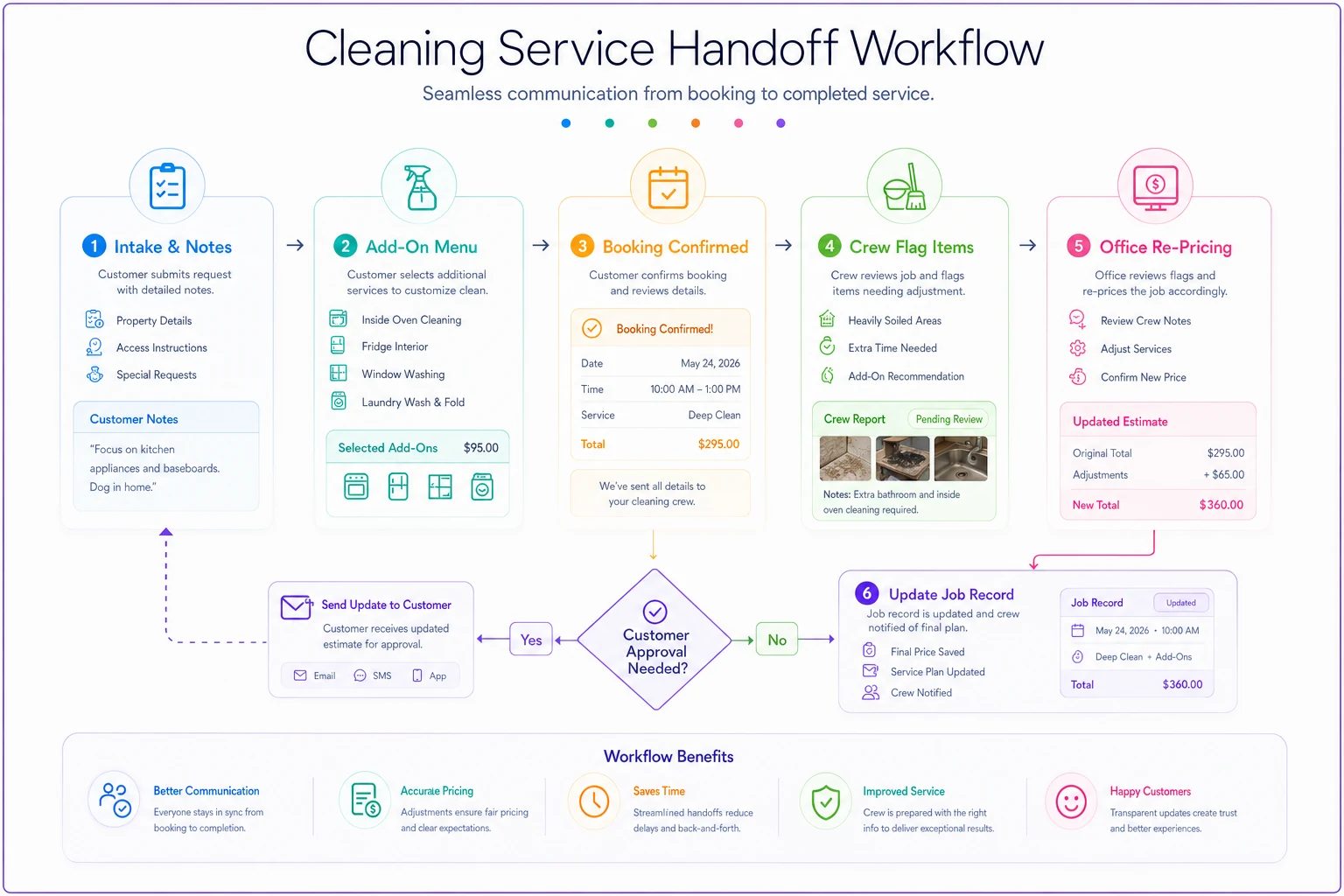
Use this on every recurring job so the next crew always knows what to do.
A real scenario, with the math
A two-crew residential operation running roughly 330 visits a month noticed hours-per-visit creeping up on their recurring book without matching revenue. When they tracked it for a few weeks, the pattern was obvious: crews were absorbing an average of around 12–18 "free" minutes per visit in at-the-door add-ons and silently-expanded recurring scope.
Call it 15 minutes across even half those visits. That's roughly 40 hours a month of unbilled labor — most of a full-time week — disappearing into favors nobody decided to give.
They rolled out exactly the scripts above: the add-on menu in every booking confirmation, the "let me text the office" deflection for crews, and a mandatory flag line in handoff notes. Nothing complicated, just consistent words everyone used.
Over the following couple of months, two things moved. Hours-per-visit on the recurring book settled back toward planned times, and the add-on menu in confirmations started converting — somewhere in the range of $600–$900 a month in extras that used to be done for free or skipped entirely. Crews also reported fewer awkward door conversations, because "that's an add-on, let me get it added" is a much easier sentence than inventing an excuse on the spot.
No price complaints spiked. That's the part owners worry about most and it rarely materializes, because the scripts lead with "yes, we can" and only then attach the number.
The one-page script sheet to put in every crew folder
If you do nothing else, laminate this and hand it to crew leads:
-
At-the-door add-on request "Yeah, we can do that — it's an add-on, let me text the office to add it. It's $[X] and about [Y] extra minutes. Want me to go ahead?"
-
If they decline "No problem — I'll leave it off today. If you want it next time, just say the word and we'll build in the time."
-
Room not on the sheet "That one wasn't on today's visit, so I'll check with the office on time and pricing so it gets the full clean it deserves."
-
Running over on a recurring visit Don't absorb it silently. Flag it. Note what you skipped. The office handles the re-price.
-
Never negotiate price while holding the mop. Confirm, don't quote. The office/record owns scope.
Never negotiate price while holding the mop. Confirm, don't quote. The office/record owns scope.
When to hold the line — and when to just do it
Scripts aren't a rule that every favor gets refused. A crew that robotically prices a 90-second "wipe the one shelf" request will annoy good clients. The judgment call is roughly this:
Just do it, no script needed: genuinely tiny asks (one spot, under a few minutes), a long-loyal client's occasional small favor, anything that obviously builds goodwill and doesn't touch the schedule.
Use the deflection script: anything that adds real time (10+ minutes), anything on the common-add-on list, any whole-room request, and — critically — anything that would repeat on a recurring account. Repeating favors are the ones that have to be formalized, because the compounding cost is the real killer.
Who should not rely on these scripts alone: if your intake is vague to begin with — "general cleaning, see you Thursday" — no door script will save you, because there's no agreed scope to defend. Fix the booking record first. The language only works when there's a clear, written baseline to point back to.
Keeping scope honest without babysitting every visit
The practical hard part isn't writing the scripts — it's making sure the agreed scope, the add-ons, and the "client tends to ask for X" notes actually travel with the job instead of living in one person's memory. When a crew swaps or a new lead covers a route, that context disappears unless it's attached to the booking itself.
This is where having scope, add-on pricing, and handoff notes sitting on the job record — rather than in texts and heads — quietly removes most of the friction. The crew sees exactly what's included, what's a paid extra, and what to flag. The "let me text the office" step becomes a quick tap, and the office isn't re-litigating scope on every visit. Clear records are also what keep disputes from turning into he-said-she-said — the same logic behind a disciplined before/after photo and consent workflow.
The point isn't more software. It's that the words only hold if the agreed scope is visible to whoever's standing in the kitchen that day.
Scope creep isn't a client problem. It's a language gap — the few seconds where nobody on your side had a clean, friendly sentence ready, so "sure, no problem" became the policy by accident. Fix the words at four moments (confirmation, arrival, mid-visit, handoff), make the office own the scope instead of the crew, and write the boundaries down where the next person can actually see them. The minutes come back fast, and the clients who'd recommend you still recommend you — because at no point did anyone feel like they got told no.
Ready to elevate your cleaning business?
Join 500+ cleaning services using Maidufy to save time, reduce scheduling errors, and deliver exceptional client satisfaction.