

Failure clusters don't show up one at a time. They show up in threes and fours — a missed kitchen, a wrong product on a sealed stone countertop, a crew that left early, and a client who texts a photo of dust on the baseboards all in the same week. By the time the owner notices, three recurring clients have already gone quiet, and one of them is drafting a review.
The instinct is to apologize, send a free re-clean, and move on. That buys you nothing. A single apology against a cluster of failures reads as a one-off gesture, not a change in behavior. What clients are actually watching for — consciously or not — is whether the pattern changes. And patterns only change when you run a focused, visible, timebound effort that forces quality back to the center of the operation.
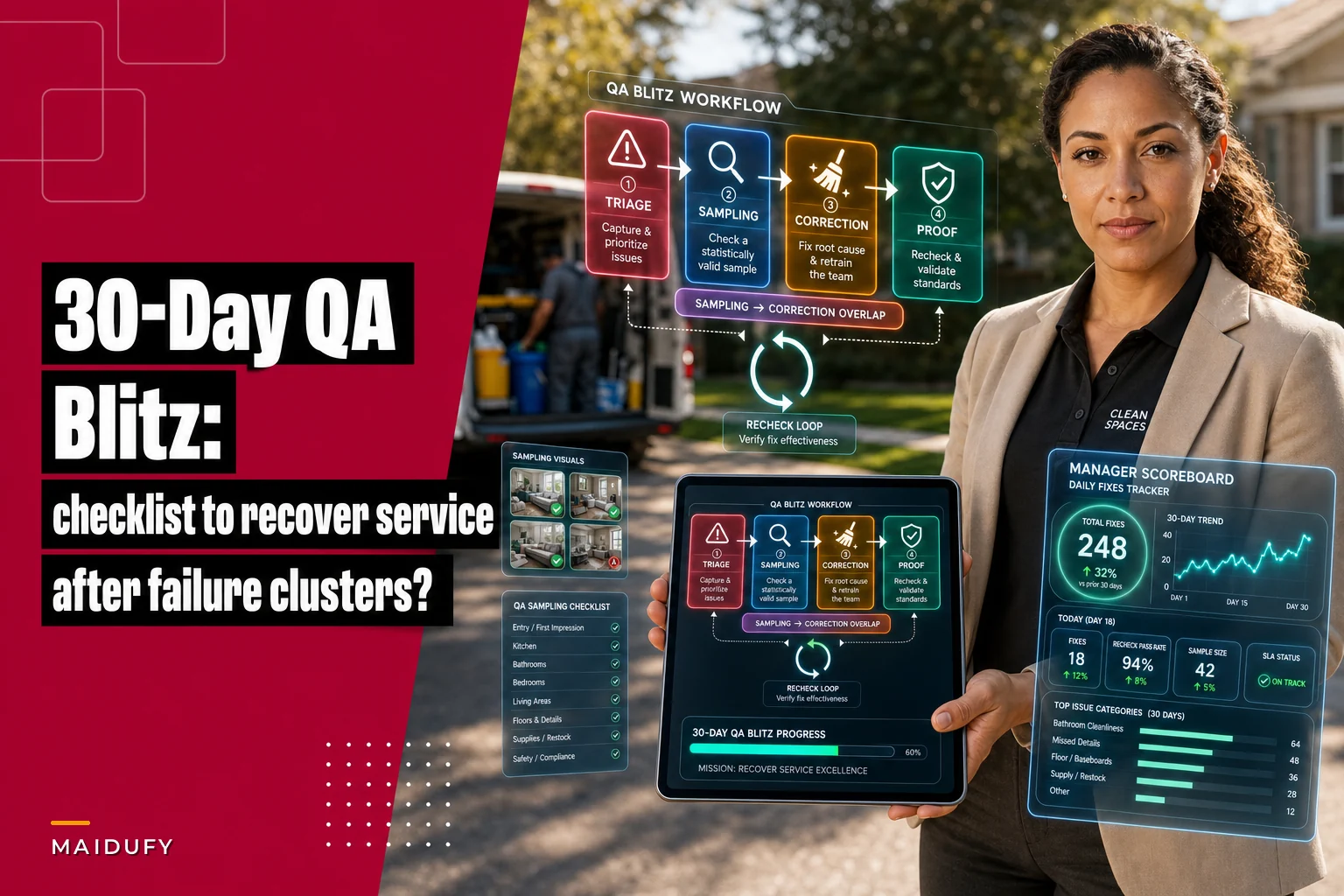
That's what a QA blitz is. Not a permanent new process. A 30-day sprint with a start, a finish, and a scoreboard. The point is to stop the bleeding, prove to yourself and your clients that service is back under control, and leave behind a few habits worth keeping.
Here's the version that actually works for a small cleaning business or maid agency.
Why failure clusters happen (and why one-off fixes miss)
Clusters almost never come from a single bad cleaner. In real operations, they come from a shared upstream cause that affects multiple jobs at once. A few common ones:
-
A new hire ramped up too fast and got put on solo routes before they were ready, so three or four homes drop in quality the same week.
-
A supply swap — a new all-purpose cleaner, a different mop head — changed results across every crew that received it.
-
A schedule got overloaded (holiday surge, someone quit) and crews started cutting visit times to stay on route.
-
A long-tenured cleaner started coasting, and because nobody was spot-checking their homes, the slide went unnoticed until clients complained in a batch.
The reason one-off fixes fail is that you're treating four symptoms as four accidents. You re-clean four houses, pat yourself on the back, and the fifth one fails next week because the supply or the staffing or the ramp problem is still sitting there.
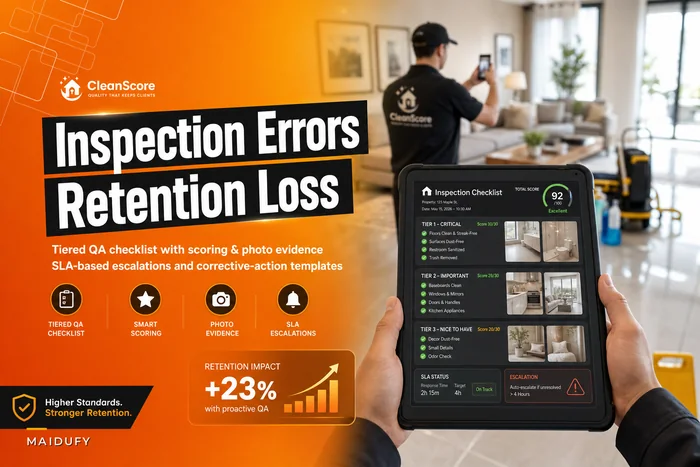
A blitz works because it forces you to sample broadly — not just the homes that complained, but a cross-section of everything — so the upstream cause surfaces. Same logic behind a good tiered QA checklist with scoring and photo evidence, just compressed into an urgent 30-day window with a recovery goal attached.
The real cost of letting a cluster sit
Owners underestimate how expensive a quiet cluster is because the damage is delayed.
Never miss a cleaning appointment again.
Maidufy helps you book, confirm, and manage every cleaning service seamlessly.
- Centralized booking management
- Automated client reminders
- Optimized staff scheduling
No credit card required
A typical residential cleaner running recurring clients at around $140–$180 a visit on a biweekly cadence is looking at roughly $3,600–$4,700 a year per client. Lose three to a bad month and you've knocked out somewhere around $11k–$14k of annual revenue — and that's before the referral loss, which is harder to see but usually bigger.
Then there's the review problem. One detailed one-star review during a cluster can dent your inbound leads for months. People shopping for a cleaner are nervous by default — they're letting strangers into their home — so a recent, specific complaint carries outsized weight.
And the internal cost nobody talks about: a cluster quietly tells your good cleaners that quality doesn't get noticed. If the home that failed and the home that sparkled get treated the same, your best people stop trying as hard. That's the slow one, and it's the most dangerous.
The 30-day structure at a glance
The blitz runs in four phases. Each has a job and a handoff.
| Phase | Days | Primary job | What "done" looks like |
|---|---|---|---|
| Triage | 1–3 | Find the real cause, stabilize at-risk clients | At-risk list built, root cause identified, apologies out |
| Sampling | 4–14 | Inspect a wide cross-section, not just complainers | 30–40% of active homes sampled and scored |
| Correction | 10–24 | Fix the upstream cause, retrain, recheck | Failing homes re-scored and passing |
| Proof | 25–30 | Show clients the pattern changed, measure results | Success criteria met, blitz closed or extended |
Notice the overlap between Correction and Sampling — you don't wait for all sampling to finish before you start fixing obvious problems. Clusters move fast; your response has to run partly in parallel.
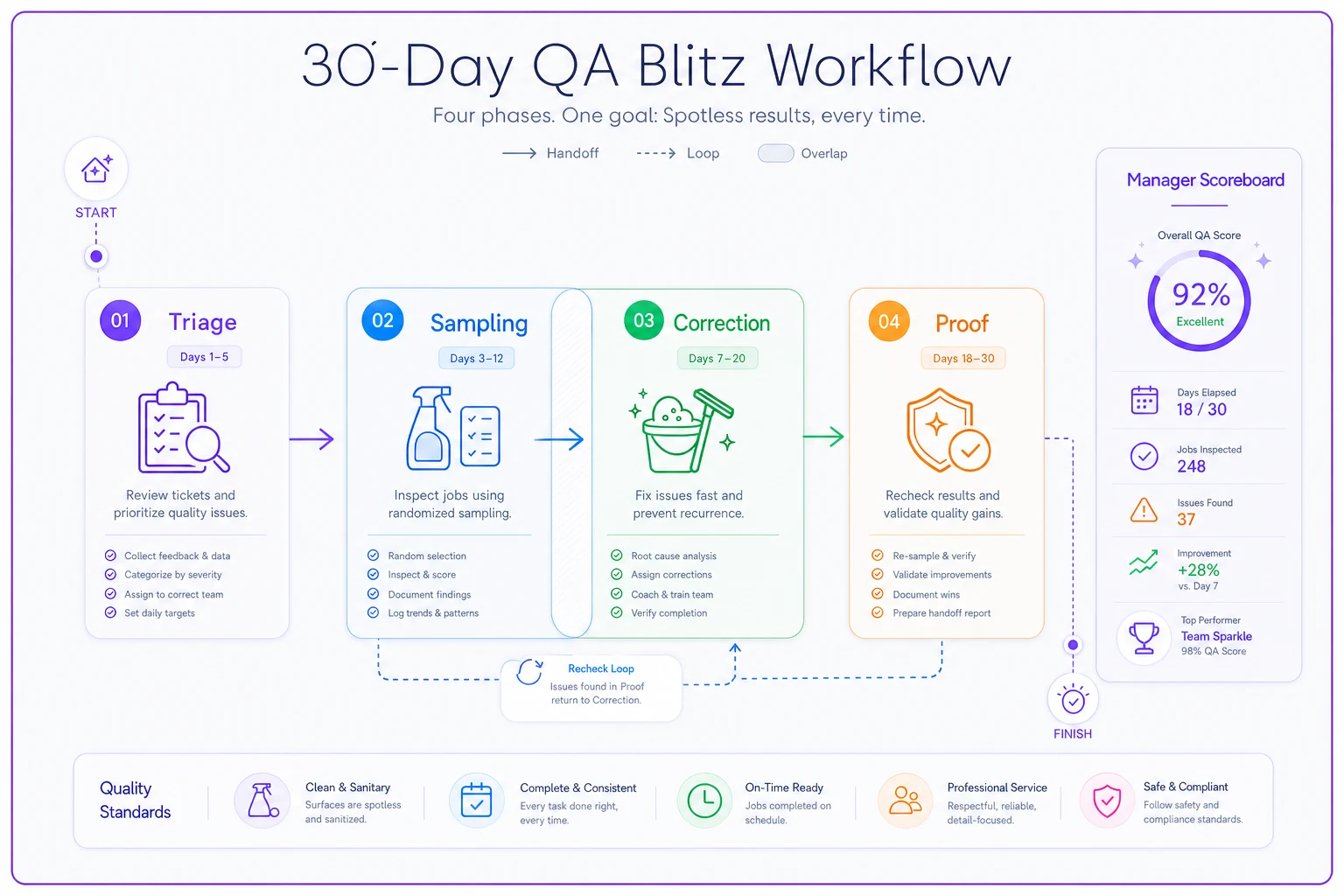
A simple visual like this helps teams see the handoffs and where to focus daily checks during the sprint.
Phase 1 — Triage (Days 1–3)
The first 72 hours are about containment, not perfection.
Day 1 — Build the at-risk list. Pull every client who has complained, gone quiet, dropped frequency, or scored low on a recent inspection in the last 45–60 days. Don't limit it to the loud ones. The client who silently downgraded from weekly to monthly is often closer to leaving than the one who texted you an angry photo — at least the angry one is still talking to you.
Day 2 — Identify the likely upstream cause. Lay the failing jobs side by side and look for what they share. Same cleaner? Same day of the week? Same supply batch? Same part of the route that got added when you took on new work? You're hunting for the overlap. A typical example: four of six failures all happened on homes that got reassigned after a cleaner quit — the cause isn't the homes, it's the understaffed route.
Day 3 — Send recovery contact. Reach out personally to every at-risk client. Not a mass email. The script matters here, so it's below.
Client script: the recovery call/text
> "Hi [Name] — this is [Owner] from [Company]. I'm reaching out personally because I noticed your last couple of visits weren't up to the standard we hold ourselves to, and I want to fix that directly. I'd like to send a senior cleaner to redo [specific area], at no charge, and I'll personally review the results before we call it done. Would [day] work?" Three things make this script work: it's specific (names the area), it's personal (owner, not a bot), and it promises verification, not just a redo. That verification line is what separates this from the generic "we're sorry, here's a free clean" that clients have heard a hundred times.
Phase 2 — QA sampling (Days 4–14)
This is the engine of the blitz. The goal is to inspect enough homes that you can tell the difference between an isolated miss and a systemic one.
Sampling template
-
Every home on the at-risk list (100% coverage)
-
All homes serviced by any cleaner tied to the cluster (100%)
-
A random sample of everyone else — roughly 1 in 4 — to confirm the rest of the book is healthy
For each inspected home, score on a simple sheet:
-
Core areas (kitchen counters, sink, stovetop, bathroom fixtures, toilet, floors): pass/fail each
-
Detail areas (baseboards, blinds, under furniture edges, interior glass): pass/fail each
-
Finish signals (streak-free mirrors, visible lines on vacuumed carpet, trash emptied, staged towels): pass/fail
-
Photo evidence on anything that fails
-
Overall score out of the total checked
Keep the scoring binary where you can. "Mostly clean" is how clusters hide. A counter is wiped or it isn't.
The thing most owners get wrong in sampling
They only inspect the failures. If you sample 100% of complainers and 0% of the quiet book, you'll confirm you have problems — which you already knew — and learn nothing about scope. The random cross-section is what tells you whether this is a two-cleaner problem or a whole-operation problem. That distinction changes your entire Correction phase.
Phase 3 — Correction (Days 10–24)
Now you fix the cause you found in triage and confirmed in sampling.
-
Ramp/training cause → pair the struggling cleaner with your strongest for 3–4 ride-alongs, then re-sample two of their homes before they go solo again.
-
Supply cause → revert the swap immediately, re-clean affected homes, and note which product or batch caused it so it doesn't come back.
-
Staffing/route-overload cause → this is the hard one. You either reduce the route, add a hand, or renegotiate frequency. Pretending a 9-home day is still a 7-home day is how the cluster restarts in week five.
-
Coasting/tenure cause → a direct conversation backed by the photo evidence, a re-inspection schedule, and a clear standard. Evidence beats opinion every time; nobody argues with a photo of their own baseboards.
The recheck loop
Every home that failed sampling gets re-cleaned and re-scored. A home isn't "fixed" because you sent someone back — it's fixed when it passes a fresh inspection. Log the before score, the action taken, and the after score. That log becomes your proof in Phase 4.
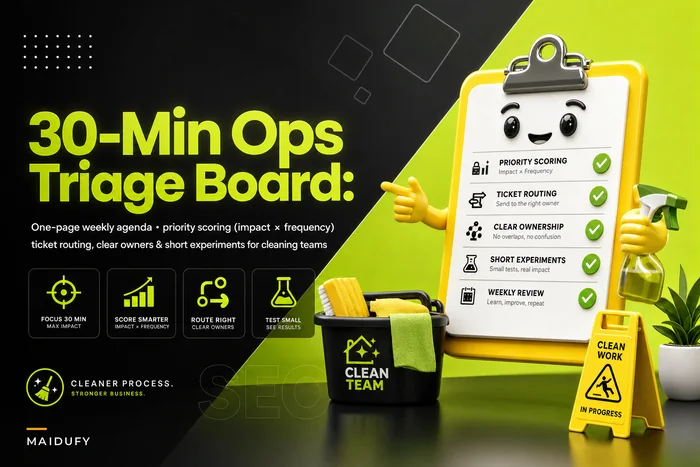
A running tally during this phase — how many failing homes have cleared re-inspection — is exactly the kind of thing worth putting in front of the team at your weekly QA triage ops board so progress stays visible and nobody loses the thread mid-sprint.
Daily manager playbook
The blitz lives or dies on daily rhythm. A manager should be able to run the same 15-minute loop every morning:
-
Review yesterday's inspection scores — flag any new fails.
-
Confirm today's sampling targets — which homes, which inspector.
-
Check the recheck queue — which corrected homes are due for re-scoring.
-
Scan at-risk client responses — any recovery visits to confirm, any new silence to chase.
-
Update the scoreboard — pass rate, homes sampled, at-risk clients retained.
-
One escalation question "Is anything still failing for the same reason as last week?" If yes, the root cause isn't fixed yet.
That last question is the whole game. A blitz that keeps failing for the same reason hasn't found the real cause — it's just re-cleaning symptoms faster.
Success criteria: how you know the blitz worked
Close the sprint against numbers you set on Day 1, not against a vague feeling that things seem calmer. Reasonable targets for a 30-day window:
-
Sampling pass rate climbs to 90%+ on core areas by Day 30 (from whatever your cluster-week baseline was — often somewhere in the 60s–70s).
-
At-risk client retention you keep roughly 70–80% of the at-risk list active. Losing a couple is normal; losing most means the recovery contact came too late.
-
Zero repeat failures from the original root cause in the final 10 days.
-
No new review damage — and ideally one or two recovered clients updating or softening earlier feedback.
If you hit those, close the blitz and keep the two or three habits that carried it — usually the sampling cadence and the recheck loop. If you miss them, don't just extend blindly. Re-run the Day 2 root-cause step, because you almost certainly diagnosed the wrong upstream cause.
A real scenario
A three-crew maid agency with about 95 recurring homes hit a bad stretch after a cleaner quit mid-month. Her route got split across the remaining crews with no time adjustment. Within two weeks, five clients complained and two dropped to monthly. Baseline sampling that first week came back around a 68% core pass rate on the affected routes.
The owner ran a 30-day blitz. Triage traced four of the five failures to the overloaded reassigned route — a staffing cause, not a skill cause. Sampling covered about 35% of the book and confirmed the rest was healthy, which meant they didn't need to retrain everyone, just rebalance. They brought in a part-timer for three weeks, trimmed the overloaded route back to a sane size, re-cleaned and re-scored every failed home, and the owner personally confirmed the recovery visits. By Day 30, core pass rate on those routes was back near 92%. They kept six of the seven at-risk clients, including both that had dropped frequency — one went back to biweekly after the owner's follow-up call. The one they lost had already booked elsewhere before the first contact. Not a clean sweep, but a recovered book and a root cause that stayed fixed.
When a 30-day blitz is the right call — and when it isn't
Run the blitz when failures arrived in a cluster, you can point to a probable shared cause, and you still have most of the affected clients talking to you. That's the sweet spot — fixable, timebound, and clients are still reachable.
Don't run a blitz when the "cluster" is actually a slow, months-long decline across the whole book. That's not a sprint problem; that's a standards-and-staffing problem that a 30-day push will only paper over. Fix the underlying operation first.
Who should skip this entirely: a solo operator with a handful of clients. If you're cleaning every home yourself and two go wrong, you don't need a sampling template — you need a direct conversation and a careful week. The blitz structure earns its keep once you have crews and routes and the quality signal gets blurry at a distance.
Keeping the pattern from coming back
The blitz ends; the vulnerability doesn't. Clusters tend to recur at the same pressure points — a new hire, a supply change, a surge, a departure. The cheap insurance is to keep a light version of the sampling habit running: a handful of random inspections every week, scored the same binary way, logged somewhere you'll actually look.
The cheap insurance is to keep a light version of the sampling habit running: a handful of random inspections every week, scored the same binary way, logged somewhere you'll actually look.
Most small shops track this in a notebook or a messy spreadsheet, which works right up until the week you're slammed — and the busy weeks are exactly when clusters form. Keeping inspections, scores, photos, and client recovery notes in one place where the pattern is visible at a glance is what turns a reactive blitz into an early-warning system. The tooling matters less than the discipline, but the discipline is far easier to hold when the scoreboard updates itself instead of depending on someone remembering to write it down.
The real win from a QA blitz isn't the 30 days of recovered service. It's that you walk away knowing exactly how your quality fails, how fast you can catch it, and what it takes to pull it back — so the next cluster gets solved in a week instead of a quarter.
Ready to elevate your cleaning business?
Join 500+ cleaning services using Maidufy to save time, reduce scheduling errors, and deliver exceptional client satisfaction.