



The Fed just held rates steady at 3.50%-3.75%, but what caught my attention was the 9-3 split, with three members pushing for a hike. That kind of internal disagreement tells you more about where things are headed than the decision itself. For cleaning companies, this isn't just another Fed announcement to scroll past. It's a signal about cash flow, customer behavior, and margin pressure that's going to land differently than most owners expect.
Cleaning companies that survive rate cycles aren't the ones who wait to see what happens. They're the ones who adjust now — repricing services, tightening cash management, and locking in recurring revenue before customers start trimming discretionary spending.
Why steady rates are actually worse than a hike
A rate hike at least gives you clarity. Costs go up, customers understand prices need to move, and everyone adjusts. This holding pattern creates something more frustrating — a toxic kind of uncertainty for service businesses.
Equipment financing stays expensive. That new van you need for expanding routes is costing you an extra $140-180 per month compared to two years ago. Working capital lines, if you can get them, are sitting at 9-11% instead of the 5-6% you used to pay. And your customers are stuck in the same fog, which makes them hesitant to commit beyond next month.
The real damage shows up in customer psychology. When the Fed keeps rates elevated but doesn't move, households go into a holding pattern. They keep the biweekly recurring service, but that move-out deep clean gets pushed. The quarterly window washing becomes "maybe next season." Those add-ons that bump your average ticket by $35-45? Gone first.
Interest rates affect cleaning business operations well beyond your own borrowing costs — they shape every financial decision your customers are making. When mortgage rates stay high, fewer homes sell. Fewer sales means fewer move-in/move-out cleans. When credit card rates hover near 24%, that discretionary monthly deep clean looks a lot more cuttable.
The cash crunch nobody talks about
Most cleaning operators don't realize this until it's already a problem: your cash conversion cycle gets destroyed in this environment.
Never miss a cleaning appointment again.
Maidufy helps you book, confirm, and manage every cleaning service seamlessly.
- Centralized booking management
- Automated client reminders
- Optimized staff scheduling
No credit card required
Commercial clients — the office buildings and property managers making up 30-40% of your revenue — start stretching payment terms. Net-30 becomes net-45, then net-60. They're managing their own cash issues, and you're the one financing it. Meanwhile, your suppliers want faster payment because they're dealing with the same pressure. That chemical supplier who gave you net-30? Now they want net-15 or COD.
So you're floating more receivables while paying suppliers faster. That gap is your working capital evaporating. A typical $400k annual cleaning business used to need around $25-30k in working capital. In this environment, you're closer to $40-50k just to run the same operation.
It compounds quickly. You can't take on new commercial contracts because you don't have the cash to float the receivables. You can't bulk-buy supplies for discounts because that cash is needed for payroll. Growth actually makes your cash position worse.
Repricing without losing customers
Most cleaning companies handle repricing backwards. They send a blanket 8% increase letter and hope for the best. Around 15-20% of customers leave, and then they scramble to backfill with discounted new-customer offers. It's a bad cycle.
Start with your cost structure, not your competition. Your actual cost per cleaned square foot has probably increased 18-22% over the past two years when you factor in labor, supplies, fuel, and insurance. Not all services have the same increase, though. Basic maintenance cleans might be up 15%, while deep cleans requiring specialized equipment and chemicals are up closer to 25-30%. Price by service tier, not across the board:
-
Weekly and biweekly recurring customers get a 4-6% increase. These are your core — you can't afford to lose them.
-
Monthly customers get 8-10%. They're already more price-sensitive and less profitable per visit due to higher cleaning time requirements.
-
One-off services get the full 15-20% increase. People booking single deep cleans are solving an immediate problem and are generally less price-sensitive about it.
Timing matters too. Don't reprice everyone at once. Start with your least profitable 20% — typically monthly customers in harder-to-service areas, or ones who consistently add requests without paying more. If you lose some, you've actually improved margins. Wait three weeks, check retention, then move to the next tier.
The part that actually works: bundle the increase with something visible. Add a quarterly appliance cleaning. Throw in a doormat wash. Offer "priority booking" that guarantees their preferred time slot. The cost to you is minimal, but it shifts the conversation from "price increase" to "service upgrade."
A simple rollout workflow helps keep pushes controlled and measurable.
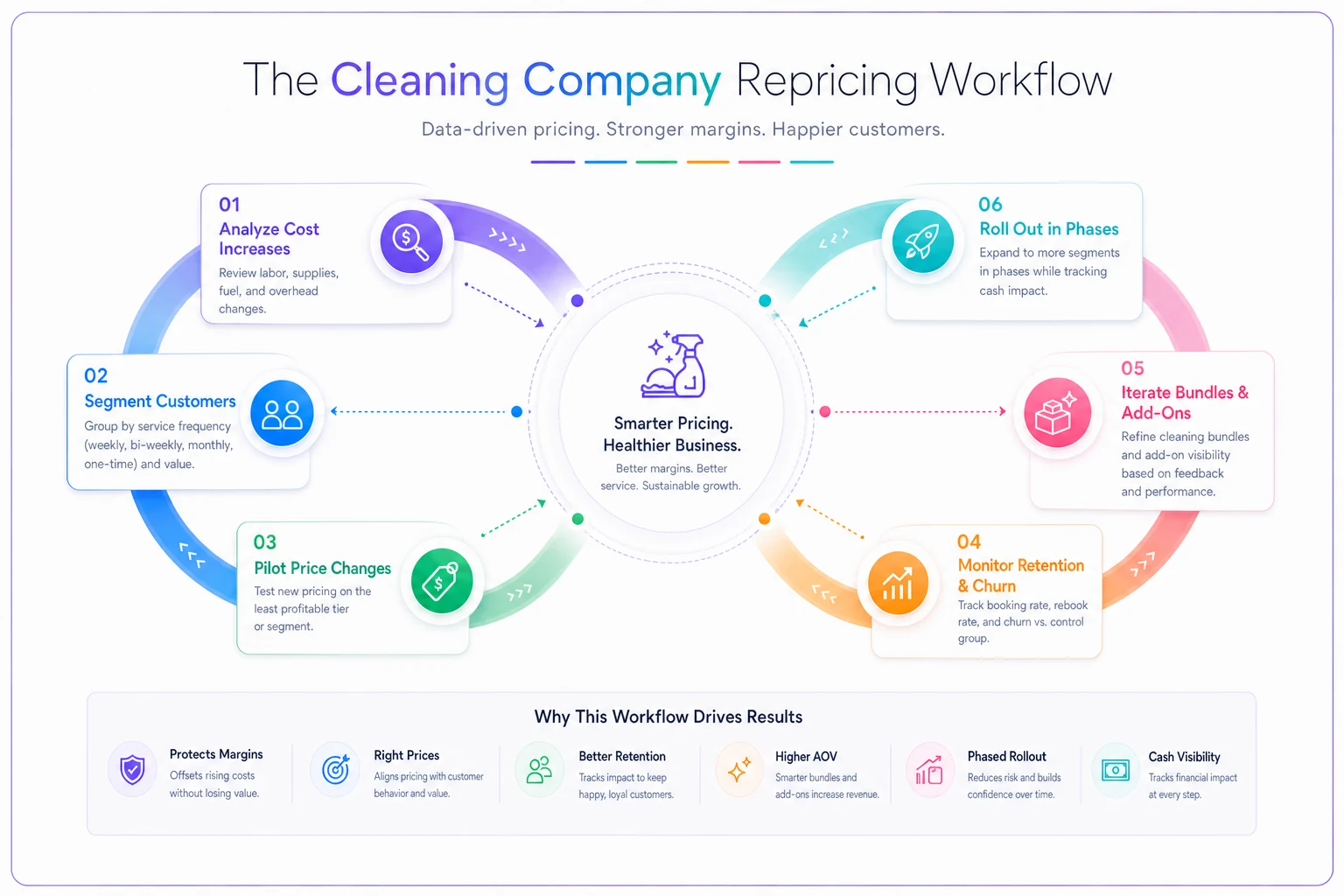
Bundle the increase with something visible. Add a quarterly appliance cleaning. Throw in a doormat wash. Offer "priority booking" that guarantees their preferred time slot. The cost to you is minimal, but it shifts the conversation from "price increase" to "service upgrade."
Building a retention system that holds up
Your existing customers are worth 3-4x more than new acquisitions right now, and most cleaning companies treat retention like an afterthought. That's a problem in any environment, but it's especially bad when customers are already looking for things to cut.
Payment flexibility is underrated. ACH payments with a 2% discount aren't charity — ACH saves you 2.9% in credit card fees and reduces failed payments by roughly 40%. Quarterly prepayment at 5% off is even better. You're essentially borrowing from customers at favorable terms, and prepaid customers almost never cancel mid-term.
Offer quarterly prepayment at 5% off — prepaid customers almost never cancel mid-term.
Build switching friction through small, consistent touches. Log every customer's communication preference — text, email, or call. After each clean, send a photo of one specific area, not a generic wide shot, but something personal like their organized bathroom counter or clean kitchen sink. It takes your cleaner 20 extra seconds and reduces cancellations noticeably.
One retention tactic that works better than it should: service date protection. Tell customers that if they pause service, they lose their preferred time slot. In practice you can usually accommodate them if they return, but the fear of losing that Tuesday 2pm slot keeps a lot of people from pausing in the first place. Pause requests can drop significantly just from this one policy change.
Track churn by segment, not just overall. Break it down by service frequency, zip code, payment method, crew. You'll find patterns fast — maybe your Thursday crew has 3x the churn rate, or one neighborhood consistently cancels after 3 months. Fixing those specific issues does more than any broad retention campaign.
Smart staffing when demand gets unpredictable
Labor runs 55-65% of your costs, so getting staffing wrong here hurts fast. The traditional approach — keeping full crews and hoping for steady bookings — doesn't hold up when demand swings 20-30% week to week.
Split your workforce into core and flex. Core — roughly 60% of your labor force — gets guaranteed hours, handles all recurring clients, and are your best cleaners. They're more expensive, but they're your quality foundation. Flex works differently: partner with 2-3 staffing agencies that specialize in hospitality and cleaning. Agency labor runs 35-40% more per hour, but if you're only pulling them in two days a week during slow periods, the math still works compared to carrying full-time staff at low utilization.
Cross-train everyone. Every cleaner should handle maintenance cleans, deep cleans, and move-outs. But also build in adjacent skills — carpet spot cleaning, basic organization, changing air filters. When bookings dip, these become add-ons that can turn a $120 basic clean into a $165 service visit.
Scheduling is where operational software earns its keep. Manual scheduling breaks down quickly when you're juggling core staff, flex workers, and variable service types. AI-powered operational platforms can match worker skills to job requirements, factor in travel time, and optimize routes without someone spending two hours on it manually. Building a strong recurring base helps here too — predictable weekly and biweekly services let you guarantee hours to core staff while flexing for variable demand.
Payment terms that protect your cash
You can't afford to be anyone's bank right now. But most cleaning companies are extending 30-60 day terms to commercial clients while paying their own expenses weekly. That gap is dangerous.
Residential customers go on card-on-file. No exceptions. Offer ACH discounts if you want, but stop invoicing residential work. The administrative cost of sending invoices, chasing payments, and processing checks adds $8-12 per transaction. On a $120 cleaning, that's a real margin hit.
Commercial takes more finesse. For new contracts, require net-15 for the first 90 days, framed as a trial period. Around 70% of clients will stick with net-15 after the trial because it just becomes the routine. For existing commercial clients stretching past terms, run a staged response:
| Days Past Terms | Action |
|---|---|
| Net-35 | Friendly reminder |
| Net-40 | Call from office manager |
| Net-45 | Service goes on hold |
No exceptions, regardless of client size. One major client sitting at net-60 can destabilize your entire cash position.
Factoring is a real option, but use it strategically. If you land a large commercial contract — say a 30-unit complex at $8,000 monthly — factoring those invoices at 2-3% gets you cash to fund growth rather than waiting on payment. Don't factor everything. Use it for large, creditworthy clients where the acceleration justifies the cost.
Finding opportunity in the chaos
While a lot of operators are frozen waiting for clarity, there's real market share available right now.
Target distressed segments. Real estate agents are dealing with longer listing times — homes that sold in 20 days are now sitting for 60. Bulk pricing on staging cleans is an easy offer. Property managers facing higher vacancy rates want reliability; give them a dedicated cleaner and priority scheduling in exchange for volume commitments.
Counter-cyclical services work well when consumer spending tightens. People do more themselves but still need help with the hard stuff. A "DIY Support" package — you handle bathrooms and kitchen, they handle the rest — priced at 40% of a full clean actually improves your margins because you're focused on high-value areas. Customers feel like they're saving money. You're doing less but earning more per hour.
Consolidation is worth looking at seriously. Smaller operators are struggling to get financing, their cash is tied up, and a lot of them are burned out. Customer lists are going for 2-4x monthly revenue right now, down from 6-8x a couple years ago. Structure deals as service takeovers, not asset purchases — you get the customers and maybe one key employee, they keep their equipment and liabilities.
Automation as your force multiplier
Not the "AI will revolutionize your mop bucket" version — practical operational automation that actually reduces cost and improves service.
Scheduling optimization alone is meaningful. Every hour saved on manual scheduling is roughly $25 in administrative cost. But the bigger win is utilization — automated scheduling improves crew utilization 15-20% just by eliminating gaps and reducing travel time. On a five-crew operation, that's effectively adding capacity without adding headcount.
Customer communication should mostly run without human involvement. Appointment reminders, confirmations, quality check surveys — automate all of it. But make it adaptive. If a customer always confirms immediately, stop sending reminders. If they don't respond to texts, switch to calls. That kind of logic reduces no-shows while actually cutting message volume.
Dynamic pricing is underused in cleaning. Your pricing should respond to demand patterns — discount Tuesday afternoon slots in low-demand areas, apply premium pricing to Saturday mornings in high-demand neighborhoods. Basic rules can handle this. One operation increased revenue by around 12% with no additional marketing spend, purely through smarter pricing logic.
Quality tracking doesn't need to be complicated. A photo-per-room requirement with automated storage saves significant time in dispute resolution while keeping crew accountability high. Basic image recognition to flag obvious issues — missed trash cans, visible stains — gives you quality control that scales without adding supervisory headcount.
Moving forward when nobody else will
The Fed's hesitation is actually your opening. Competitors are waiting for clarity that isn't coming. You can use this window to build a more resilient operation.
Start with your cash position. Run a real 13-week cash flow forecast — week-by-week receipts and disbursements. Know exactly when cash gets tight. Then fix it through payment terms, factoring, or a working capital line before you actually need it.
Lock in your recurring revenue base. Every customer on biweekly service is worth roughly 4x one on monthly. Every customer on ACH is worth about 2x one paying by card. Converting just 20% of your monthly customers to biweekly at a small discount can increase revenue while taking pressure off acquisition.
Stop planning for rates to drop soon. Even if they do, consumer behavior lags by 6-12 months. The pullback in discretionary spending is already happening. Your options are to adapt now or spend next year explaining to creditors why you didn't.
The cleaning companies that come out of this environment well won't necessarily be the biggest or the best funded. They'll be the ones who built operations that flex with demand rather than crack under pressure — and who understood that in a high-rate environment, operational discipline isn't just a competitive edge. It's how you stay in business.
Ready to elevate your cleaning business?
Join 500+ cleaning services using Maidufy to save time, reduce scheduling errors, and deliver exceptional client satisfaction.