

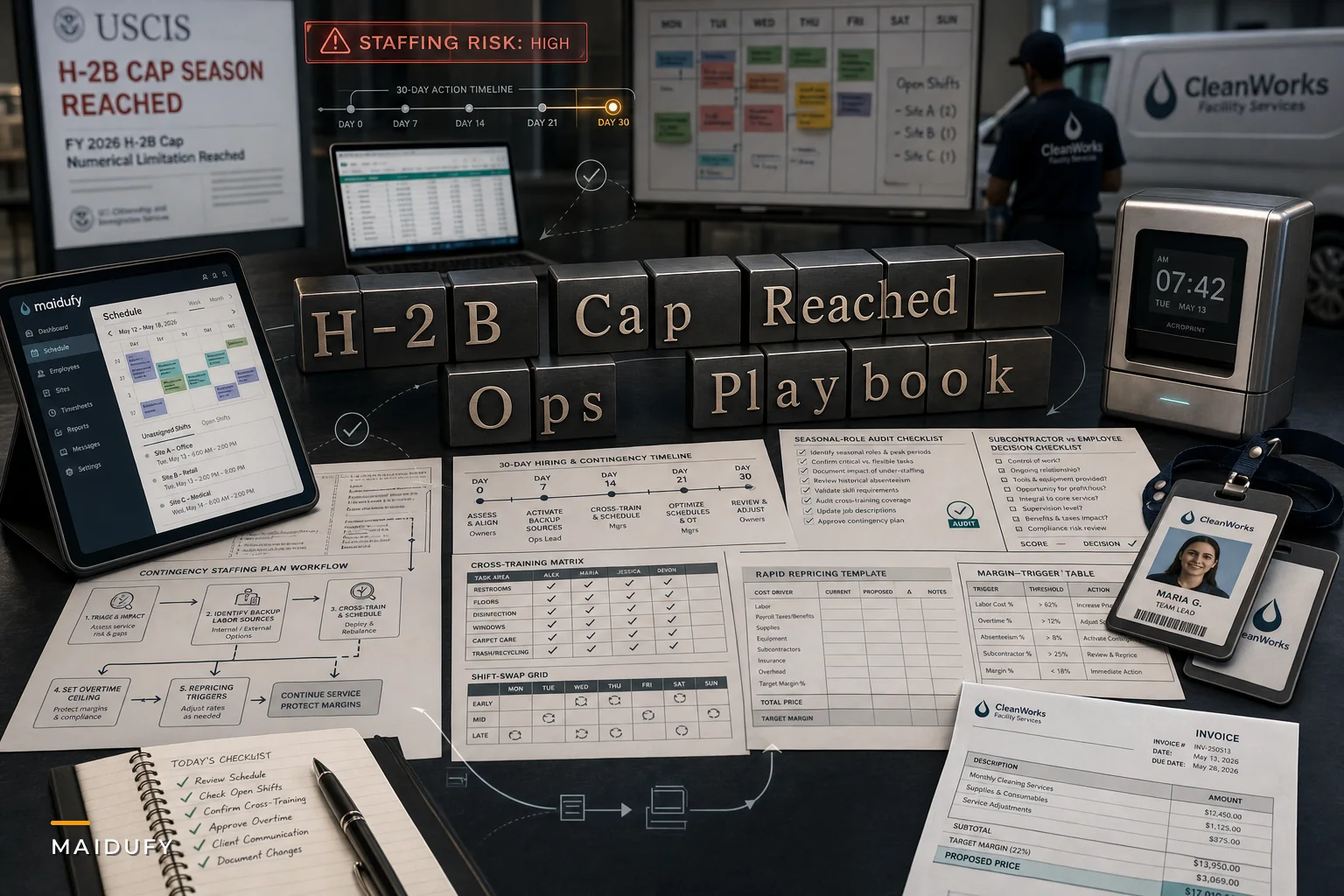

If part of your summer or shoulder-season workforce runs on H-2B workers, the September 11 announcement from USCIS probably landed hard. The agency confirmed it reached the congressionally set H-2B cap for the first half of fiscal year 2027, which means new cap-subject petitions with start dates before April 1, 2027 are being rejected outright. For cleaning operators who time their hiring around vacation-rental turnovers, event cleanup, back-to-school moves, and spring deep-clean demand, that's a planning problem hitting at the worst possible moment.
The news itself is simple. What it does to your schedule, your labor costs, and your margins is not. So skip the explainer — here's what actually matters: keeping service levels intact without blowing up your P&L.
First, understand what actually breaks when the cap hits
A lot of owners treat this as a hiring problem. It isn't. A missing seasonal crew ripples through three systems at once: scheduling, pricing, and payroll. Fix only one, and the other two leak.
When H-2B seasonal staffing plans fall apart, you tend to see the same pattern. An operator who planned on 8 seasonal workers suddenly has 3. The instinct is to cover gaps with overtime from existing W-2 crews. That works for maybe two weeks. Then overtime quietly eats the margin you built into your seasonal pricing, your best cleaners start burning out, quality slips, and you lose recurring clients during the exact window you were supposed to be making your year.
The real exposure isn't "we're short-handed." It's "we're short-handed in a way that silently turns a profitable season into a break-even one."
A rough way to see the damage:
| Scenario | Labor cost per seasonal job | Jobs/week covered | Quality risk |
|---|---|---|---|
| Full H-2B crew as planned | Baseline | Full | Low |
| Overtime-only backfill | +20% to +35% | ~70–80% | Rising after 2–3 weeks |
| Rushed local hires, untrained | +10% to +15% | Partial | High early, improves slowly |
| Subcontractor coverage | +15% to +25% | Variable | Depends on vetting |
None of these options are free. The point is picking the right mix deliberately instead of defaulting to overtime because it's the easiest call in the moment.
Move 1: Triage your routes before you touch hiring
Before you spend a dollar replacing labor, figure out what actually has to get covered. Not every job deserves emergency staffing.
Never miss a cleaning appointment again.
Maidufy helps you book, confirm, and manage every cleaning service seamlessly.
- Centralized booking management
- Automated client reminders
- Optimized staff scheduling
No credit card required
Pull your job list for the affected weeks and sort it into three buckets:
-
Protect at all costs — high-margin recurring clients, anchor commercial accounts, anything with a contractual SLA.
-
Flexible — one-off cleans and clients with loose scheduling who'll accept a shifted date.
-
Deprioritize or decline — low-margin one-offs, far-flung jobs that wreck your route density, trial bookings you were lukewarm on anyway.
What usually surprises operators is how much slack lives in that third bucket. A cleaning company running 300–350 jobs a month often has 10–15% of bookings that quietly lose money once travel time and setup are factored in. A staffing crunch is actually a decent excuse to cut them.
A cap shortage is painful, but it forces the route-profitability discipline most owners put off. Trim the dead weight and the gap you actually need to fill shrinks before you've hired anyone.
Move 2: Cross-train now, not when someone calls out
If your seasonal workers handled specialized tasks — post-construction, high-turnover rental resets, floor work — that knowledge shouldn't live only with people you can no longer hire.
-
List the 4–6 task types your seasonal crews specialized in.
-
Identify which year-round cleaners are closest to competent on each.
-
Pair them for 2–3 shadowed jobs — not a classroom session.
-
Record the actual steps as a short checklist while the work is happening.
-
Have the trainee run the next job solo with the checklist, trainer on call.
It's not elegant, but it's fast, and it spreads capability across your bench instead of leaving you one resignation away from a service failure. The operators who handle seasonal volatility best aren't usually the ones with the biggest teams — they're the ones where more people can cover more tasks.
Move 3: Decide the worker-classification question deliberately
This is the move most likely to cost you if you rush it. When H-2B labor dries up, operators scramble to backfill with local subcontractors or convert roles to W-2 employees — and most make that call on instinct instead of math.
The two paths have very different cost and risk profiles. Subcontractors give you flexibility and no overtime liability, but you give up control over quality and scheduling, and misclassification carries real legal exposure. W-2 employees give you control and consistency, but you take on payroll taxes, overtime rules, and fixed cost even in slow weeks.
Before you commit either direction, run the numbers and the control requirements side by side. There's a full breakdown on exactly this tradeoff — the subcontractor vs. employee decision matrix and payroll-impact checklist — and it's worth 20 minutes before you sign anyone up. Short version: if the work is recurring, quality-sensitive, and central to your brand, lean employee. If it's spiky, specialized, and short-duration, subcontractors often make more sense. Mixing them without clear rules is where owners get into trouble.
When subcontractors make sense here
-
The seasonal peak is genuinely temporary (6–10 weeks).
-
You can vet and onboard crews that already meet your standards.
-
The work is less brand-critical — one-time event cleanup versus recurring residential.
When they're a bad idea
-
You'd be directing their hours, methods, and tools like employees — that's a classification risk.
-
The accounts are long-term recurring clients who expect consistency.
-
You don't have time to properly vet, and you'd essentially be taking whoever's available.
Mixing them without clear rules is where owners get into trouble.
Move 4: Reprice the affected work — quietly and selectively
If your labor cost per job is climbing 15–30% because you're covering with overtime or premium subcontractors, your old seasonal pricing is underwater. But a blanket price hike during a demand peak is clumsy and invites churn.
Reprice at the margins instead:
-
New seasonal one-off bookings get updated rates immediately.
-
Add a modest premium for tight-turnaround or same-week requests — that's where your cost spikes hardest anyway.
-
Leave protected recurring clients alone unless the shortage runs long. Those relationships are worth more than a few margin points this season.
A practical example: a company facing a 25% labor bump on vacation-rental turnovers raised its per-turnover rate by roughly $18–$25 on new bookings only. Most clients didn't push back because turnaround speed matters more to them than a modest price change. The ones who did were mostly the low-margin accounts worth losing.
Move 5: Lock down payroll controls before overtime gets away from you
Overtime is the silent killer in a staffing crunch. When crews are stretched, hours drift — a few extra minutes logged here, a rounded-up shift there — and because everyone's busy, nobody's watching the timesheets closely until payroll runs.
A tight weekly control loop during the crunch:
-
Set an overtime threshold per crew and flag anyone approaching it mid-week.
-
Reconcile logged hours against actual job durations weekly, not monthly.
-
Require a brief note for any shift that ran significantly long.
-
Watch for jobs that consistently blow their time estimate — that's usually a pricing or crew-sizing problem, not a labor one.
A decent field time-tracking and scheduling platform earns its keep here — not because it's fancy, but because it surfaces overtime drift and route gaps while you can still act on them.
When you're down several seasonal workers, catching a cost leak on Tuesday versus finding it on the next pay run is real money.
Move 6: Build a written contingency staffing plan
A mid-sized residential cleaner in a coastal rental market planned on 6 H-2B workers for its summer turnover season. When the cap situation left it with 2, the owner had no written fallback — just a mental list. The first three weeks were chaos: missed turnovers, two lost rental-management accounts, and enough overtime to push a normally 20%+ margin season down near break-even.
The following year, same market, same cap uncertainty — but this time there was a one-page plan. A pre-vetted subcontractor list, a cross-training schedule run in early spring, route-triage rules written down, repriced seasonal rates ready to deploy. The shortage still happened. But the margin held in the mid-teens instead of collapsing, and the anchor accounts stayed.
The difference wasn't more workers. It was having decisions made before the pressure hit.
Your contingency plan should fit on a single page and cover: which routes get protected, who your backup labor sources are, your overtime ceiling, and your repricing triggers. That's it.
Here's a simple visual of the one-page contingency staffing plan workflow.
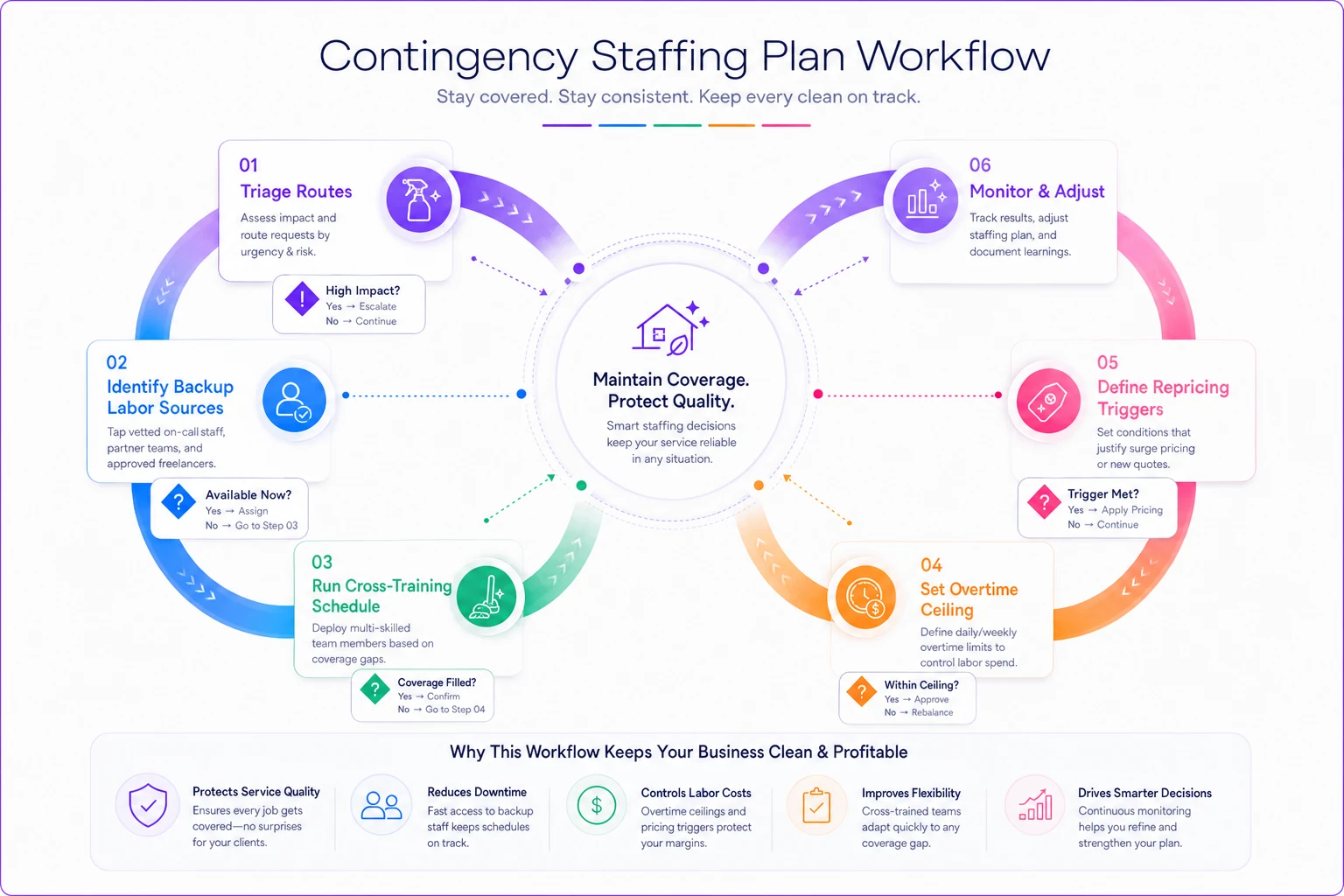
The shortage still happened. But the margin held in the mid-teens instead of collapsing, and the anchor accounts stayed.
Move 7: Rework the schedule around density, not headcount
With fewer workers, every mile of travel time costs more because it's capacity you can't spare. Tighten scheduling around geographic clusters so remaining crews spend time cleaning, not driving.
Simple adjustments that recover meaningful capacity:
-
Batch same-day jobs by neighborhood even if it means offering clients a narrower window.
-
Offer a small incentive for clients willing to shift to your lighter days, which smooths the peaks.
-
Protect recurring slots and stop letting one-offs fragment your routes.
When you're short-staffed, cutting drive time by 15–20% is effectively free labor. It doesn't replace missing workers, but it buys back real hours.
The deeper issue this exposes
Visa caps, minimum-wage changes, labor shortages — they all expose the same underlying weakness. Cleaning businesses that are structurally dependent on a single labor source have no shock absorber. When that source dries up, there's nothing to catch the fall.
The companies riding out this H-2B cap without wrecking their season aren't the ones who found a clever loophole. They're the ones who already had cross-trained crews, written contingency plans, route discipline, and payroll controls tight enough to catch cost drift early. The cap is the trigger, but the resilience — or the fragility — was built long before the announcement.
Use this season as the push to build that resilience. Prune the unprofitable routes. Spread skills across your bench. Write down the decisions so you're not improvising under pressure. Watch overtime and job-level costs weekly. Do that, and the next labor disruption — whatever form it takes — becomes a manageable bump instead of the thing that eats your year.
Ready to elevate your cleaning business?
Join 500+ cleaning services using Maidufy to save time, reduce scheduling errors, and deliver exceptional client satisfaction.