

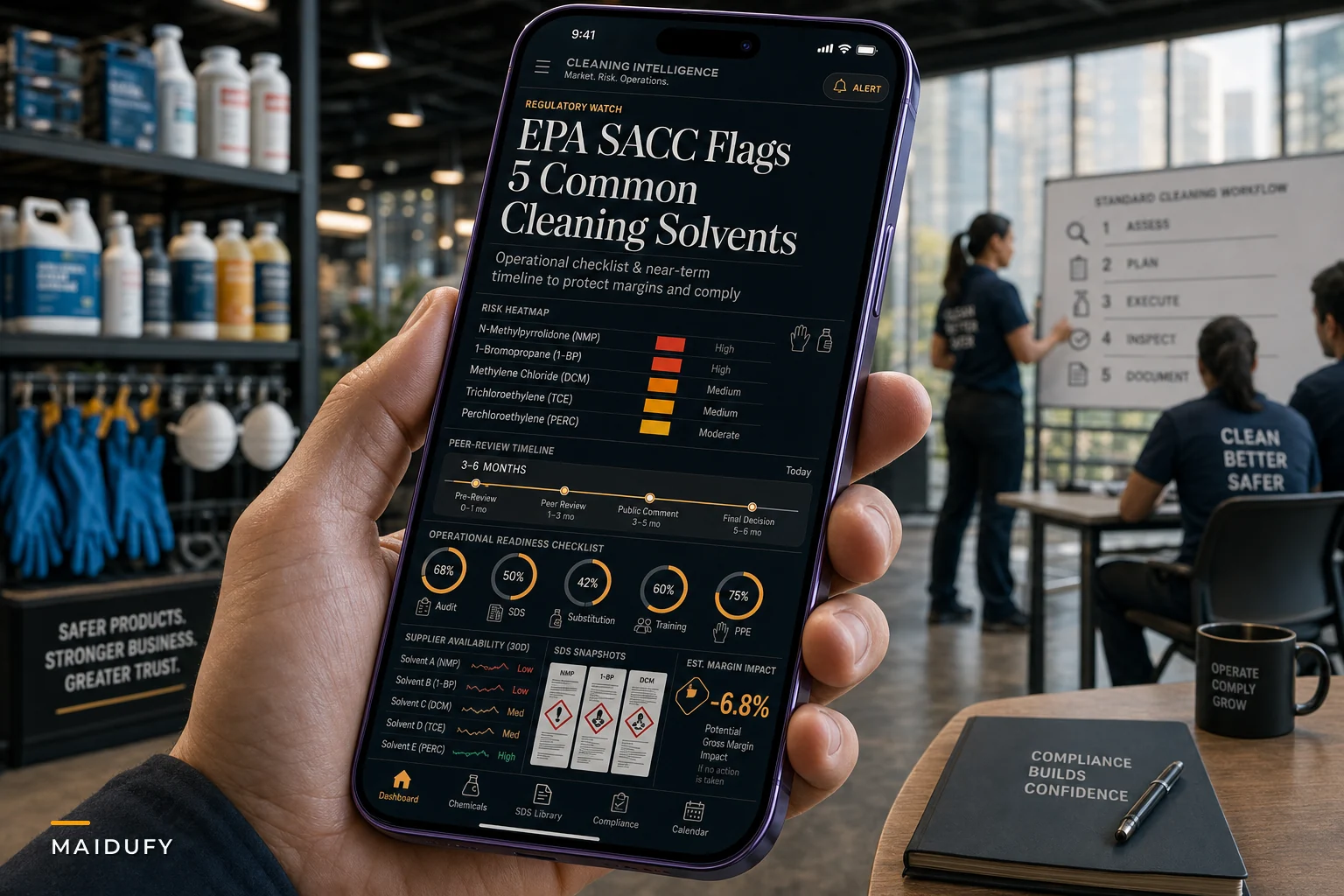

The EPA just dropped something that's going to mess with your supply closet pretty badly. They're running peer-review meetings this July and August on five chemicals that show up in a ton of commercial cleaning products — especially 1,2-dichloropropane and trans-1,2-dichloroethylene.
These aren't obscure chemicals. Walk into any janitorial supply warehouse and you'll find them in heavy-duty degreasers, spot removers, and industrial-strength solvents that actually cut through kitchen exhaust grease. The kind of products that turn a twenty-minute scrub into a two-minute wipe.
If you've been through chemical restrictions before, the next part is predictable. Suppliers start rationing. Prices jump — usually somewhere in the 40-60% range within a few months. Reformulated products show up that cost more and work worse. By the time final regulations land, half your go-to products have either vanished or changed formulas completely.
What most cleaning companies miss isn't the chemical change itself. It's that they have zero visibility into which products they actually depend on, which clients need specific solvents, and how much a product switch will disrupt their crews.
The inventory blind spot that turns regulations into emergencies
Most cleaning operations don't really know what chemicals they're using. You know you buy "heavy-duty degreaser" and "bathroom disinfectant" — but do you know which ones contain dichloropropane? Do your crews? Does anyone track which products work for which client situations?
A 15-crew operation scrambled badly when Arizona restricted a common floor stripper ingredient last year. They had maybe three days of product left when they found out. Their supplier had been sending notices for two months, but nobody connected "methylene chloride restrictions" to the stripper they'd been using for eight years. They ended up sending crews out of state to buy cases at retail prices just to finish out the week.
The bigger problem is how cleaning businesses treat supplies — like they're infinitely available and interchangeable. Order when you're low, grab whatever's on sale, assume everything works roughly the same. That mindset falls apart completely when regulations target specific chemical classes.
You need three levels of tracking that most operations skip:
Chemical-level visibility: Not just "glass cleaner" — the actual active ingredients. Pull the SDS sheets for your top 20 products right now. Build a simple spreadsheet: product name, active chemicals, EPA registration number.
Client-specific requirements: Some properties require specific products or chemical classes. Healthcare facilities often mandate quaternary ammonium compounds. Food service needs NSF-certified degreasers. Schools increasingly ban anything above certain VOC thresholds. Document these requirements before you can no longer get the products that meet them.
Crew competency mapping: Different products mean different techniques, dilution rates, dwell times, and safety procedures. When you switch from a dichloropropane-based degreaser to a citrus alternative, your crews need retraining — or quality drops fast.
Why supplier relationships determine who survives chemical transitions
Your distributor knows what's coming months before you do. They sit in manufacturer meetings, see reformulation timelines, know which products are getting discontinued. But they're not calling every small account to walk them through the implications.
Never miss a cleaning appointment again.
Maidufy helps you book, confirm, and manage every cleaning service seamlessly.
- Centralized booking management
- Automated client reminders
- Optimized staff scheduling
No credit card required
The Small Business Administration's advocacy office noted that these EPA reviews affect thousands of small cleaning businesses who don't have dedicated compliance staff. Your bigger commercial competitors have people whose entire job is tracking regulatory changes. You've got whoever answers the phone also ordering supplies between scheduling jobs.
-
Schedule quarterly supply reviews — not just price negotiations but actual availability conversations. Ask about reformulations, discontinuations, and anything on their regulatory radar.
-
Diversify before you're forced to — If 80% of your supplies come from one distributor, you're one allocation decision away from not being able to service clients. Build relationships with at least two or three suppliers, including one that specializes in green or alternative products.
-
Lock in allocation agreements — When you identify critical products that might face restrictions, negotiate guaranteed allocation now. Paying slightly more to ensure supply later is usually worth it.
-
Track alternatives proactively — For every critical product, identify two substitutes that could work. Test them on lower-stakes jobs. Document the performance differences, cost variations, and any training adjustments needed.
Building real supplier intelligence means treating your distributor like a business partner instead of a vending machine:
The training debt that compounds during product switches
Switching cleaning products isn't like switching coffee brands. Every product change creates a cascade of adjustments that most businesses underestimate.
-
Dilution ratios (affects cost per job)
-
Dwell time (affects time per task)
-
Application method (spray vs. mop vs. foam)
-
PPE requirements (gloves, goggles, ventilation)
-
Surface compatibility (what it damages)
-
Residue characteristics (rinsing requirements)
-
Disposal procedures (hazardous vs. standard)
Multiply that across every crew member, every client type, every surface they clean. A 10-person operation switching three products means roughly 200 individual procedure adjustments that need to happen correctly.
In practice it gets messier. Crews mix old procedures with new products. Someone applies the new degreaser using the old dwell time and it doesn't perform, so they just use twice as much. Quality drops. Callbacks increase. Your inspection failure rate climbs and it's hard to explain why until you trace it back to the product switch.
This connects directly to the inspection protocols that determine client retention. When you change products without updating QA checklists, inspectors end up checking for results that new products can't deliver using old methods. The kitchen exhaust that used to come clean with a five-minute soak might need 15 minutes with the reformulated degreaser — but your checklist still says five minutes.
Building chemical compliance into operations, not scrambling after warnings
The companies that handle regulatory changes without much drama have systems that most cleaning businesses think are overkill — until they actually need them.
Product approval workflows: Every new product goes through a documented approval process. Test it across multiple surface types, measure actual cleaning effectiveness, calculate true cost-per-use, verify client acceptability. Takes maybe four hours per product but saves weeks of chaos during forced transitions.
Substitution matrices: A simple table — if you can't get X, use Y, and here's what changes. Dilution adjustments, time modifications, specific warnings. Print it, laminate it, put it in every supply closet.
Regulatory monitoring: Assign someone, even part-time, to check EPA announcements monthly and state chemical restrictions quarterly. Set up Google Alerts for your critical chemical names combined with "EPA," "restriction," or "shortage."
Client communication templates: Draft the emails now that explain why you're switching products, how you tested alternatives, and what clients might notice. During actual transitions, you fill in specifics instead of writing panicked explanations from scratch.
Honestly, most of this isn't complicated. It's just boring. And boring is exactly what you want when suppliers start rationing product and your competitors are in full scramble mode.
The procurement reality: why December matters more than the final rule
EPA peer reviews in July and August typically lead to draft findings by October, with industry response periods running through December. Manufacturers don't wait for final rules — they start reformulating or discontinuing products as soon as draft findings point toward likely restrictions.
| Phase | Timing | What Actually Happens | Your Action |
|---|---|---|---|
| Peer Review | July-Aug | Scientists argue about risk levels | Download SDS sheets, audit inventory |
| Draft Findings | Sept-Oct | EPA publishes likely restrictions | Contact suppliers about availability |
| Industry Panic | Oct-Nov | Distributors start allocating inventory | Lock in 6-month supply of critical products |
| Reformulation | Nov-Jan | Manufacturers change formulas | Test alternative products aggressively |
| Price Spike | Dec-Feb | Existing inventory prices jump 40-60% | Adjust client contracts for cost increases |
| New Normal | Mar-Apr | Reformulated products become standard | Retrain crews on new procedures |
Businesses that wait for final regulations end up buying reformulated products at premium prices with no time to test or train. The ones that move during peer review have six months to transition without the chaos.
When switching solvents breaks your pricing model
Chemical restrictions can quietly destroy your cost structure. You bid a medical building assuming $47 in monthly supplies per floor. The new EPA-compliant degreaser costs $31 per gallon instead of $19. Your crews use 40% more of it because it's less concentrated. That $47 assumption quietly becomes $78.
But you can't raise prices 65% overnight. Contracts lock you in. Competitors still have old inventory they're using to underbid you. Clients think you're gouging them when you mention chemical regulations.
The labor math compounds things. A bathroom that took 12 minutes with the old quaternary disinfectant now takes 17 minutes with the alternative that requires longer dwell time. Across 50 bathrooms per day, you've added over four hours of labor — but the client still expects the same service window.
-
Add chemical adjustment clauses to new contracts, similar to fuel surcharges
-
Build a 15% supply buffer into base pricing
-
Create separate line items for specialty EPA-compliant products
-
Offer clients a choice
standard products at base price, upgraded products at a premium
-
Document everything — old product costs, new costs, productivity differences — for future price justifications
A bathroom that took 12 minutes with the old quaternary disinfectant now takes 17 minutes with the alternative that requires longer dwell time. Across 50 bathrooms per day, you've added over four hours of labor — but the client still expects the same service window.
The small operator advantage nobody mentions
This is counterintuitive: small cleaning operations often handle chemical transitions better than mid-size companies. You'd think bigger operations would have more resources to absorb the change, but they also have more complexity to coordinate.
A solo operator or small crew can switch products in a week. Buy new supplies, run a quick training session, test on a couple of jobs, done. A 30-person operation needs to coordinate inventory across multiple storage locations, retrain crews on different shifts, update dozens of client-specific protocols, and manage the whole thing without disrupting service.
Use that size to your advantage:
Direct supplier relationships: Smaller operations can often buy directly from manufacturers for critical products, bypassing distributor allocation games. Manufacturers actually like working with smaller, agile businesses who can test new formulations quickly.
Rapid testing cycles: You can test a product on Tuesday and roll it out Friday if it works. Larger operations need committee meetings and approval cycles.
Client communication: You probably know your clients personally. A quick call or text beats a corporate email nobody reads.
Flexible pricing: You can adjust job-by-job instead of waiting for contract cycles. Something like, "The EPA restricted our usual degreaser. The new one costs a bit more but works well — it'll add about $20 to your monthly service." Most clients respect that when it comes from someone they trust.
Making chemical compliance systematic, not reactive
The cleaning companies that come out fine through regulatory changes treat chemical management like route planning or staff scheduling — a core operational function, not an afterthought.
-
Monthly chemical audits
First Monday of the month, verify SDS sheets are current for every product, check EPA registration status, flag any supplier warnings.
-
Quarterly substitution testing
Every quarter, test one alternative for your highest-volume products. Document results even when you don't switch.
-
Annual contract reviews
Update chemical adjustment language, verify client-specific requirements still match available products.
-
Standardized product documentation
Every product gets a one-page operational sheet — what it cleans, dilution rates, safety requirements, disposal methods, acceptable alternatives.
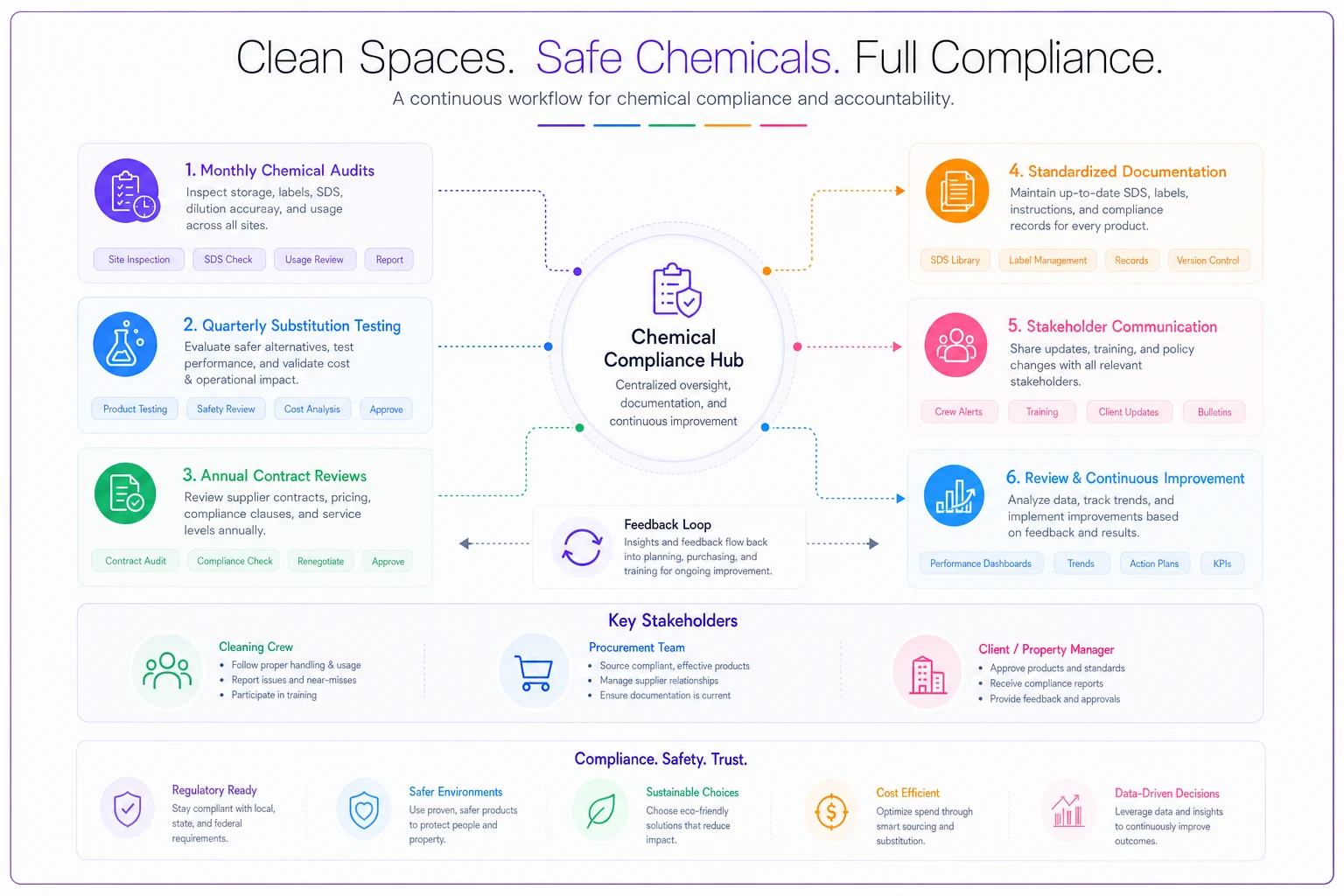
Visualizing this workflow helps teams follow the steps.
The same operational habits that prevent missed appointments also prevent chemical crises. You wouldn't wait until a crew calls in sick to think about coverage. Don't wait until products disappear to identify alternatives. This kind of thinking is also where operational software with built-in workflow tracking helps — not because it's magic, but because it forces you to actually document the stuff you'd otherwise keep in your head.
What happens next and what to do about it
The EPA solvent review will follow a path that creates both problems and opportunities depending on how prepared you are. Businesses that act now avoid the scramble. Those that wait get stuck with whatever products remain at whatever price suppliers decide to charge.
Your immediate checklist:
-
Pull SDS sheets for your top 10 products by volume
-
Highlight any containing dichloropropane or dichloroethylene
-
Call your primary supplier about availability through Q1 2025
-
Test one alternative product this week
-
Update one client contract with chemical adjustment language
-
Document current costs now for future price justifications
Beyond the immediate chemical issue, this is really about operational resilience. Businesses still running well after 15 years have systems for handling regulatory changes, supply chain disruptions, and market shifts — because their operations run on documented process, not tribal knowledge and habit.
Start with the chemical audit. Build from there. By the time these EPA restrictions finalize, you'll either be scrambling for supplies or already transitioned to alternatives that work. That choice gets made now, not when the rules change. The companies that survive aren't necessarily bigger or smarter. They just pay attention to operational details before those details become emergencies.
Ready to elevate your cleaning business?
Join 500+ cleaning services using Maidufy to save time, reduce scheduling errors, and deliver exceptional client satisfaction.