

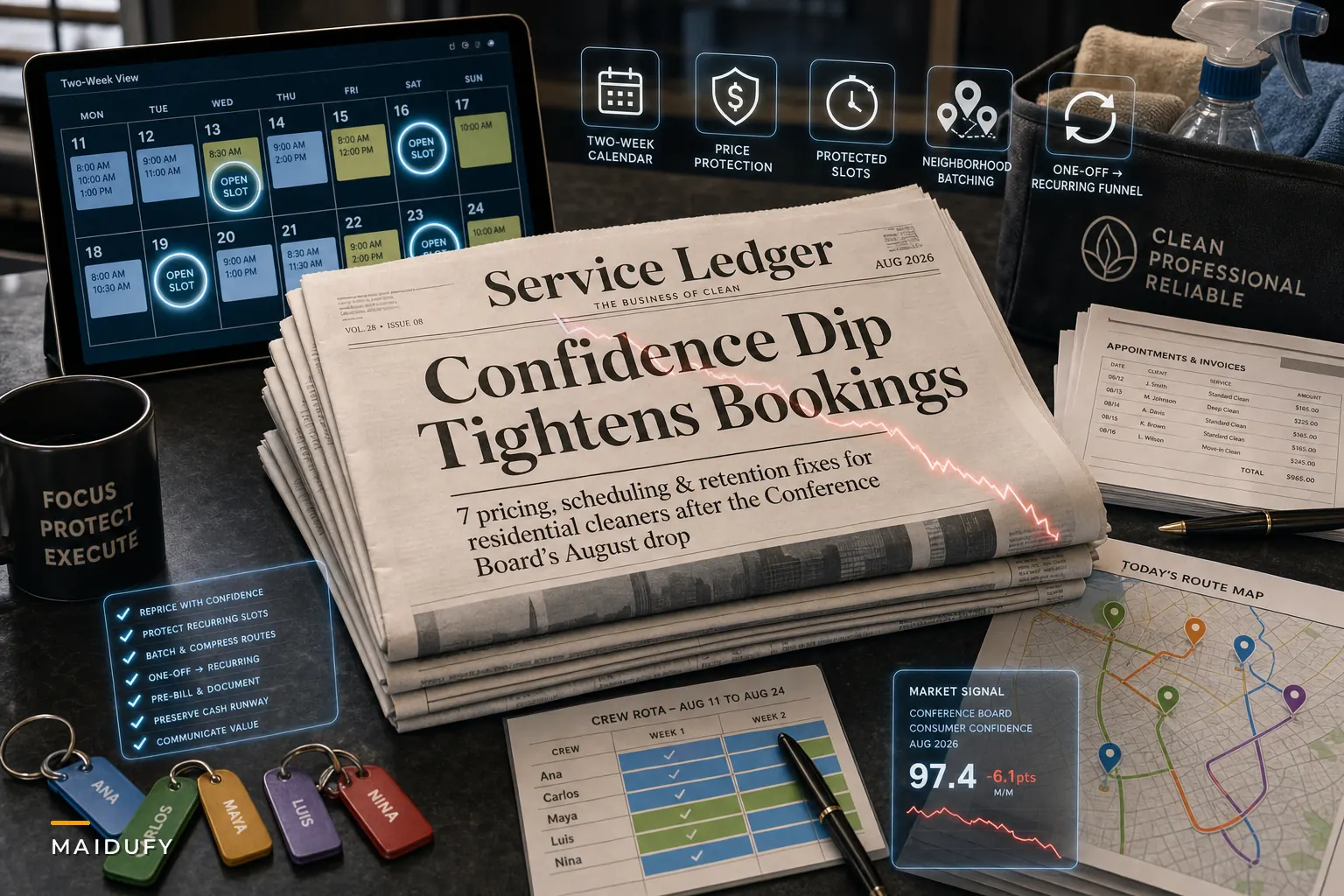

The Conference Board's August reading came in at 89.4, a seven-month low, according to reporting from Reuters. That number doesn't mean much on its own for a cleaning company running 40 recurring homes and a handful of deep cleans a week. What matters is what a dip like this predicts about client behavior in the six to ten weeks that follow.
Home cleaning sits squarely in the discretionary bucket. When people get nervous about money, the first cuts aren't rent or groceries — they're the "nice to have" services. That's the bracket you're in. And the pattern is pretty consistent: the one-off deep clean gets postponed, the biweekly client asks to go monthly, and the add-ons (inside oven, fridge, baseboards) quietly disappear from the ticket.
So the useful question isn't "is consumer confidence going to tank cleaning demand." It's "which parts of my book are most exposed, and what do I change this week to protect cash." Below are seven fixes ordered by how fast they move the needle.
First, figure out which clients are actually at risk
Not every client reacts to a confidence dip the same way. Lumping them together leads to panic discounting across the whole book, which just trains your best clients to expect lower prices.
Your exposure breaks down into a few clear groups:
| Client type | Cancellation risk in a soft period | What they respond to |
|---|---|---|
| Weekly recurring, 2+ years | Low | Consistency, small loyalty gestures |
| Biweekly, under 6 months | Medium-high | Value framing, flexible cadence |
| Monthly / occasional | High | Bundling, prepay incentives |
| One-off deep clean leads | Very high | Speed, clear scope, financing-style splits |
| Move-in/move-out | Event-driven, stable | Availability, reliability |
The clients who churn first are almost always the newer biweekly and monthly ones — people who haven't built the habit yet. Your two-year weekly clients rarely leave over a headline. So your retention energy should be lopsided, aimed at the middle of that table, not spread evenly.
A quick way to sort this: pull your client list and tag each by tenure and cadence. Anything under six months on a biweekly-or-longer schedule goes on a watch list. That's where your outreach and any promotional spend should concentrate.
Fix 1 — Convert one-offs and occasional clients into recurring slots
This is the single highest-leverage move in a soft demand period, and it's worth doing before you touch pricing.
Never miss a cleaning appointment again.
Maidufy helps you book, confirm, and manage every cleaning service seamlessly.
- Centralized booking management
- Automated client reminders
- Optimized staff scheduling
No credit card required
A one-off deep clean is revenue you have to re-earn every single time. When confidence drops, that re-earning gets harder — lead volume thins out and the people who do call are more price sensitive. A recurring client is revenue you've already locked. The whole game in a downturn is shifting as much of your book as possible from "re-earned" to "locked."
The mechanics matter here. Don't just ask a one-off client to "sign up for recurring." Offer them a concrete downgrade path that feels like a deal, not a commitment — their first recurring clean at the deep-clean price they already paid, then a lower maintenance rate after. That reframes recurring as "you already did the hard part, now it's cheaper to keep it this way."
The full step-by-step on turning one-offs into steady recurring revenue is worth reading if you want the complete conversion flow. In a low-confidence stretch, that system stops being a nice-to-have and becomes your main defense.
Fix 2 — Reprice with tiers instead of cutting your rate
The reflex when demand softens is to drop prices. Almost always the wrong call. A blanket price cut hits your margin across the entire book, including the loyal clients who never asked for one.
The better move is introducing a lower-priced tier without touching your standard rate. Give price-sensitive clients a way to stay that involves less service, not cheaper service.
-
Standard clean — your current scope and price, untouched
-
Essential clean — kitchen, bathrooms, floors, high-touch surfaces only; skip the extras; priced maybe 20–25% lower because it's genuinely less time
-
Add-on menu — the stuff you stripped out of Essential, priced à la carte
This protects margin two ways. Clients who were going to cancel now have a way to downgrade instead of leaving. And your standard-rate clients see no discount, so you're not eroding the anchor price. When confidence recovers, upgrading someone from Essential to Standard is far easier than raising a rate you already cut.
Fix 3 — Tighten scheduling to avoid paying for empty capacity
Your crew is still fully staffed while bookings soften. You end up paying wages against a schedule with gaps in it. That's where margin quietly bleeds.
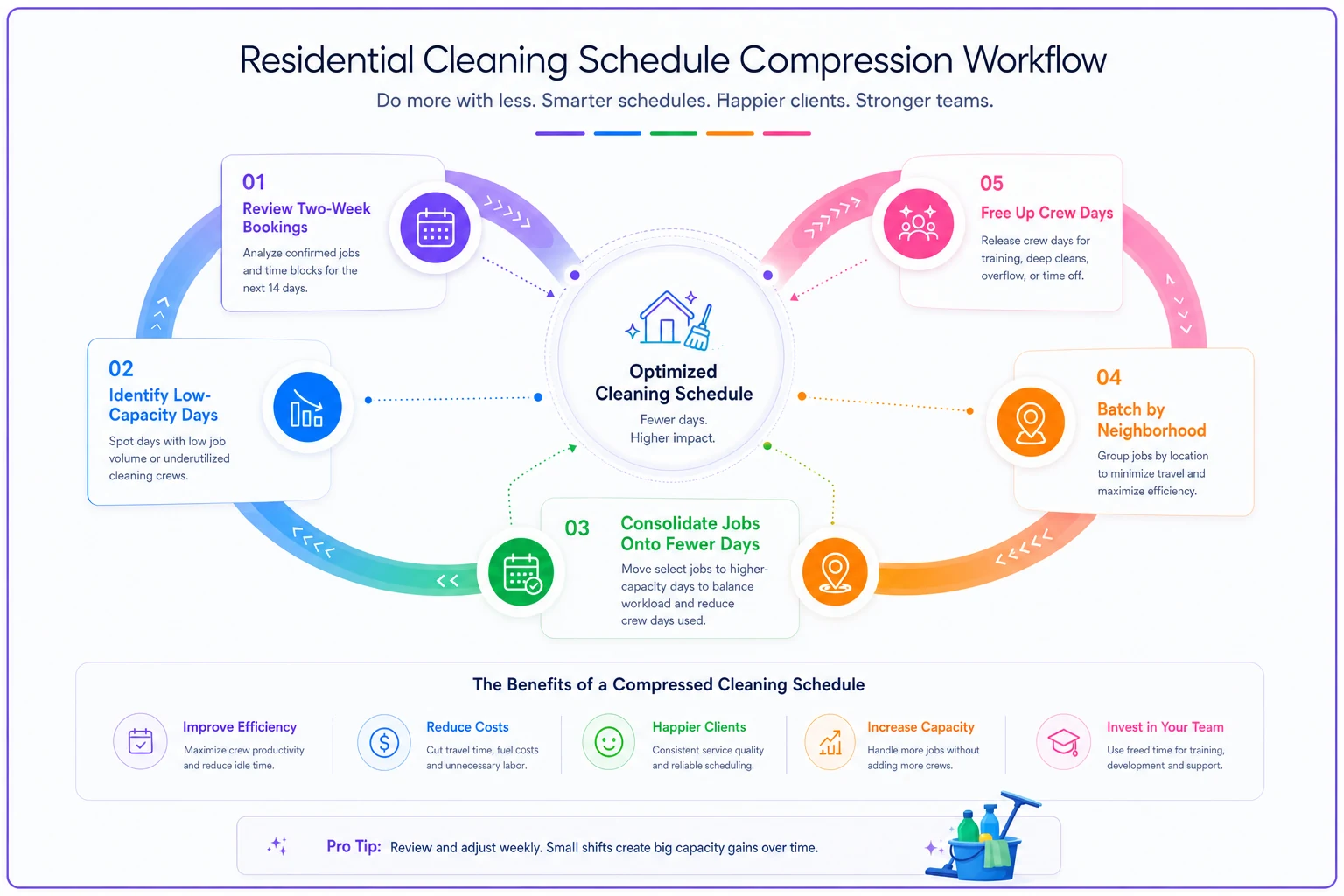
The fix is to compress the schedule geographically and by day rather than spreading a thinning book across a full week.
A simple approach:
-
Look at your next two weeks of confirmed bookings.
-
Identify the days running below 70% of normal capacity.
-
Consolidate those jobs onto fewer days, batched by neighborhood.
-
Give crews the freed-up days as flex — training, deep-clean overflow, or unpaid-by-choice time if they want it.
You want to avoid the half-full Tuesday where a two-person crew drives across town for one $140 clean and you eat the drive time and idle hours. In a strong market you absorb that. In a soft one it's the difference between a profitable week and a break-even one.
Here's a quick visual of the scheduling consolidation workflow.
Batch by neighborhood to cut drive time and protect margin.
This is also the moment to protect your recurring slots aggressively. If you have to trim days, trim the ones heavy with occasional and one-off work, not the days anchored by long-tenured recurring clients.
Fix 4 — Get ahead of the "downgrade conversation" before clients start it
When money gets tight, clients don't always cancel outright. They start hinting — "we might need to cut back," "let's skip next time," "can we do every three weeks instead." Each hint is a client edging toward the door.
Waiting for them to bring it up is the mistake. By the time they do, they've usually half-decided.
Reach out to your watch-list clients proactively with a flexibility message before they feel cornered. Something plain: "Wanted to check in — if your schedule or budget shifts this fall, we can move you to a lighter plan or a longer interval instead of pausing entirely. Just let us know."
This does two things. It signals you're easy to work with, which reduces the anxiety that drives cancellations. And it plants the downgrade path in their head as the default alternative to leaving — so when they do feel the squeeze, "go to monthly" is the thought instead of "cancel altogether."
When this is a bad idea
Don't send this to your rock-solid long-tenured clients. Offering a downgrade to someone perfectly happy at their current cadence can accidentally plant the idea that they should be cutting back. Save the proactive flexibility outreach for the medium-and-high-risk groups only.
Fix 5 — Rework marketing spend toward retention and value
Lead volume typically thins during a confidence dip, and the leads that do come in cost more and close slower. Pouring the same acquisition budget into a shrinking pool is how you burn cash for little return.
Keeping a client is cheaper than replacing one, and the math isn't close. A small referral incentive or a prepay-and-save offer aimed at existing clients tends to return more than an equivalent spend chasing cold leads.
Practical reallocation:
-
Pause or reduce broad cold advertising that was already producing marginal leads.
-
Fund a referral offer for current clients — existing clients trust you, and their referrals close faster and stick longer.
-
Fund a prepay incentive (e.g., prepay three months, get a modest credit) to pull cash forward and lock cadence.
-
Keep any channel producing move-in/move-out work, since that demand is event-driven and holds up better than discretionary spending.
The messaging shift matters too. In a nervous market, "spotless home" sells worse than "reliable, one less thing to worry about." People buying in a downturn want dependability and predictability, not luxury framing.
Fix 6 — Protect cash with prepay and clear cancellation terms
Soft demand periods punish businesses running thin on cash reserves, because revenue gets lumpier right when you need it steady. Two levers help here, both operational rather than promotional.
First, lean into prepay. Offering a small credit for clients who pay a month or a quarter ahead does two things at once — it pulls cash forward and it psychologically locks that client in, since they've already paid.
Second, revisit your cancellation and reschedule terms. This isn't about being rigid with people going through a rough patch. It's about making sure last-minute cancellations don't leave you eating idle crew time. A clear window (say 48 hours) and a modest late-cancel policy, communicated kindly, cuts down on the same-day cancellations that spike when clients get anxious and impulsive about spending.
Be careful with tone, though. Rolling out stricter terms in the middle of a demand dip can feel like squeezing people. Frame it around fairness to your crew's scheduled hours, not around protecting your revenue.
Fix 7 — Watch the leading indicators, not just the bank balance
By the time a demand dip shows up in your monthly revenue, you're already a month behind on reacting. The businesses that navigate soft periods well are watching earlier signals.
Worth tracking weekly during a stretch like this:
-
Reschedule and skip requests — a rising rate here precedes cancellations by a few weeks.
-
Add-on attach rate — when clients stop adding the fridge or the oven, wallets are tightening.
-
Cadence-change requests — biweekly-to-monthly downgrades are an early churn signal.
-
New lead volume and close rate — thinning leads and slower closes confirm the market is softening.
-
Deep-clean inquiry volume — usually the first thing to fall.
None of this requires fancy tooling. A shared board or a simple spreadsheet reviewed once a week is enough. What matters is that someone actually looks at the trend, not just the raw numbers. A single reschedule means nothing. A reschedule rate creeping from 4% to 9% over three weeks is a signal to accelerate the retention moves above.
Where operational software helps is mostly in surfacing these numbers without someone hand-tallying them every Friday — flagging which clients skipped, which downgraded, which add-ons dropped off. But the tool is secondary. The discipline of looking weekly is what actually protects the book.
A real scenario
A two-crew residential cleaning company running around 60 recurring homes noticed reschedule requests climbing and deep-clean inquiries falling off through late summer. Instead of discounting across the board, the owner did three things: built a watch list of newer biweekly clients, introduced an "Essential" tier at roughly 22% below standard, and sent a proactive flexibility note to the at-risk group.
Over the following six weeks, a handful of clients who likely would have canceled moved to Essential or monthly instead. A few one-off deep-clean clients took the "keep it clean for less" recurring offer. Revenue still dipped slightly — you can't fully fight a soft market — but the recurring base held, and the company avoided the half-empty scheduling days that would have eaten the most margin. The bigger win was structural: more of the book was locked into recurring cadence heading into fall, which is exactly where you want to be when demand is uncertain.
The underlying point
A confidence reading like the one the Conference Board reported for August is just a prompt. What it actually reveals is that a lot of cleaning businesses are more dependent on one-off and occasional work than they realize — and that revenue is the first to vanish when households get cautious. The fix isn't a clever promotion. It's shifting the shape of your book toward recurring, protecting your loyal clients from unnecessary discounts, and tightening scheduling so you're not paying for empty capacity. Do that work now, while the dip is still mild, and a soft fall becomes a manageable quarter instead of a scramble.
Ready to elevate your cleaning business?
Join 500+ cleaning services using Maidufy to save time, reduce scheduling errors, and deliver exceptional client satisfaction.