

Most winback campaigns in cleaning businesses are built backwards. Someone pulls a list of "clients we haven't seen in a while," blasts a 30%-off email, and calls it a reactivation strategy. A few people come back. The owner feels good. Nobody notices the real cost: a chunk of those "reactivated" clients were already warm and would have rebooked at full price. The discount didn't recover them — it just cut the margin on people who were coming back anyway.
That's the quiet failure mode of client reactivation in a cleaning business. The campaign looks like it worked because bookings went up. But when you actually separate true dormant recoveries from clients who were never really gone, the math gets ugly. You spent margin to recover revenue you already had.
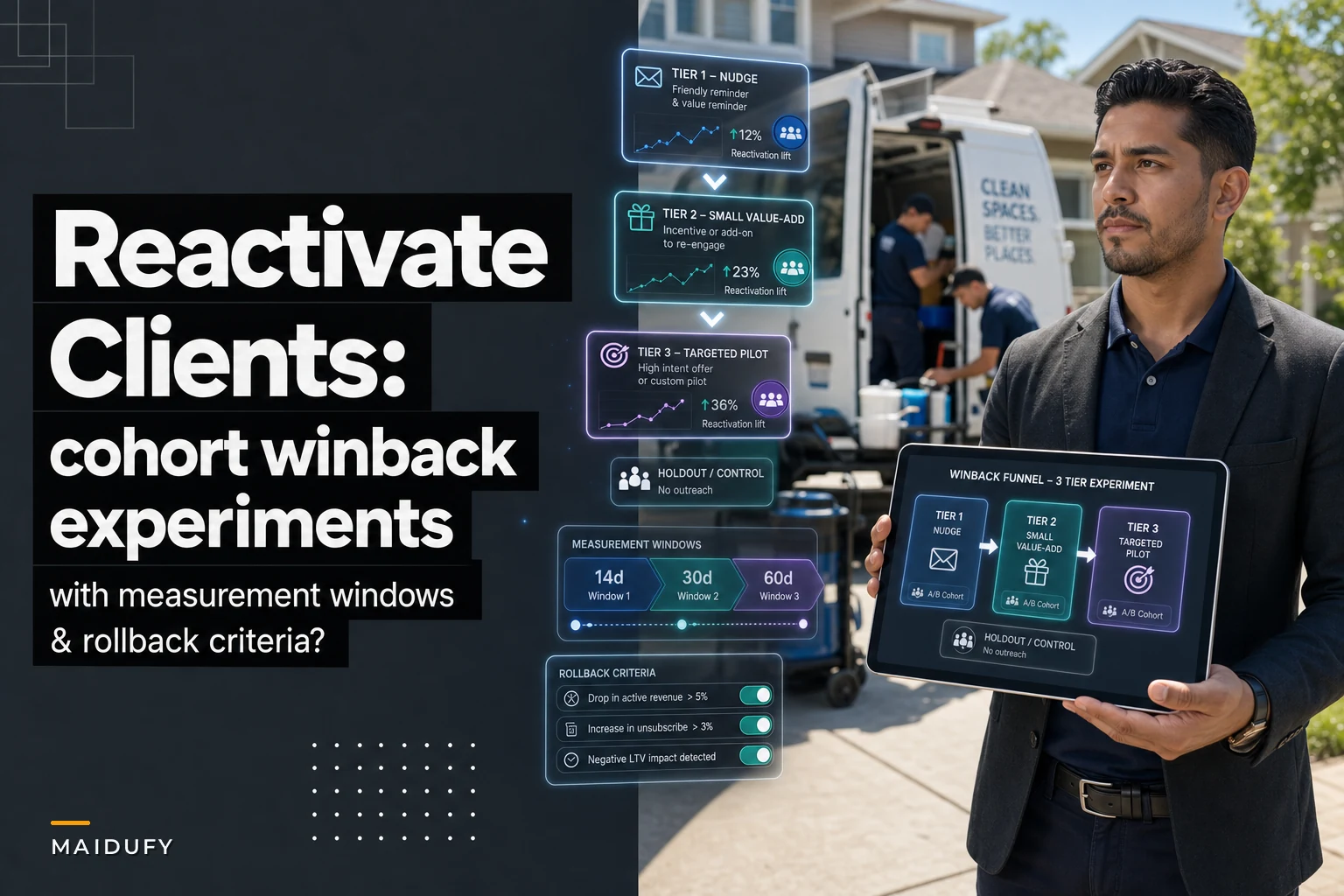
This post is about doing it the opposite way — a three-tier winback funnel with strict cohort rules, defined measurement windows, and rollback criteria, so you recover genuinely dormant accounts without cannibalizing your active base.
The core problem: your "dormant" list is lying to you
A single gap between visits doesn't mean a client left. In residential cleaning, there are at least four different reasons an account goes quiet, and they need completely different treatment:
-
Natural rhythm clients — they book every 8–10 weeks, and your CRM flags them as "lapsed" at week 6 because your default cadence assumed every 4 weeks.
-
Paused-but-loyal — travel, a new baby, a renovation. They fully intend to come back and a discount teaches them to wait for one next time.
-
Quietly dissatisfied — something went wrong, they didn't complain, they just stopped. A discount won't fix the reason they left.
-
Genuinely gone — moved, switched providers, canceling for cost. These are your real reactivation targets.
If you treat all four groups as one list, your campaign results are meaningless. You can't tell whether a tier worked because you mixed people who needed persuading with people who just needed a reminder.
The whole point of cohort rules is to stop paying full winback incentives to clients who only needed a nudge.
The three-tier funnel, and why it escalates
The funnel is built so that the cheapest intervention goes first, and only clients who don't respond move up to a more expensive offer. You never want to open with your strongest discount. If you lead with the pilot offer, you give it to everyone — including the people a simple text would have recovered for free.
Never miss a cleaning appointment again.
Maidufy helps you book, confirm, and manage every cleaning service seamlessly.
- Centralized booking management
- Automated client reminders
- Optimized staff scheduling
No credit card required
Here's the escalation logic:
| Tier | Intervention | Cost to you | Target cohort | Goal |
|---|---|---|---|---|
| 1 | Light nudge (reminder, re-check-in message) | ~$0 | Recently quiet, no complaint on file | Recover natural-rhythm and paused clients at full price |
| 2 | Small value-add (free add-on, priority slot, no price cut) | Low | Non-responders to Tier 1, still no service issue | Recover the on-the-fence without touching base rate |
| 3 | Targeted pilot offer (discounted trial visit, bundled first booking) | Higher margin hit | Confirmed long-dormant, higher churn risk | Recover genuinely gone clients worth the subsidy |
The key discipline: a client only sees Tier 2 if they ignored Tier 1, and only sees Tier 3 if they ignored Tier 2. Each tier is a filter. By the time someone reaches the pilot offer, you've already proven they won't come back for free — which is exactly when the discount is justified.
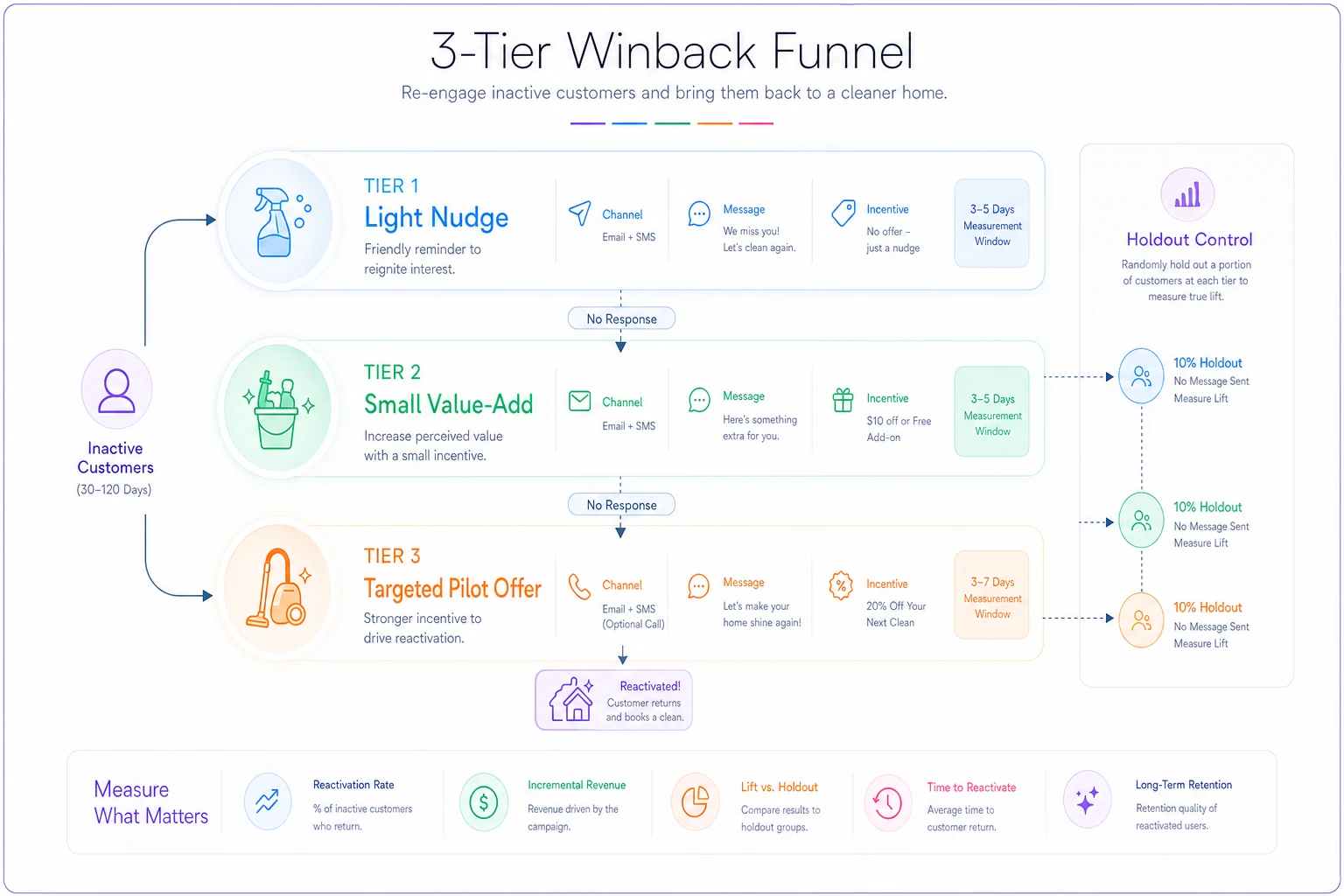
A simple visual of the escalation flow helps teams apply the filter logic consistently.
Tier 1 — light nudges
This is a plain, non-promotional touch. "Hey, it's been a bit since your last clean — want me to hold a spot for the week of the 14th?" No discount, no urgency gimmick. You're just testing whether the account needed a reminder.
What you tend to find across most cleaning operations is that a surprisingly large share of "lapsed" accounts — often somewhere between a quarter and a third — rebook on a nudge alone. These are almost pure margin recoveries. If you'd led with a discount, you'd have given away margin on every single one of them.
Tier 2 — small value-add
For the ones who don't respond, you add value without cutting price. Examples that work well in residential cleaning:
-
A free interior-fridge or oven clean on the next booking
-
Priority access to a protected recurring slot
-
A one-time extra room at no charge
The reason this works better than a discount: a value-add costs you labor minutes, not permanent price erosion. It also doesn't train the client to expect a lower rate on every future visit. A client who comes back for a free oven clean still comes back at your normal price next time.
Tier 3 — targeted pilot offer
Only now do you bring out a real incentive, and only for a tightly defined cohort. This is a discounted or bundled trial visit meant to re-anchor a genuinely gone client into the recurring habit. Because you're subsidizing this one, you want it going to accounts where the lifetime value clearly justifies the hit — not to someone who booked twice last spring and was never a strong fit.
If you want the backend that turns a recovered client into a stable recurring one, that's a separate system worth getting right — the lifecycle system for recurring customers covers how to make the pilot actually stick instead of fizzling after one visit.
Cohort selection rules (this is where margin is won or lost)
The funnel only protects margins if the cohorts are defined precisely. Loose rules re-introduce the cannibalization problem you were trying to avoid.
-
Rhythm-adjusted dormancy, not calendar dormancy. Measure each client against their own historical interval, not a global default. A client whose average gap is 9 weeks isn't dormant at week 7. Flag dormancy at roughly 1.5× their personal interval.
-
Exclude anyone with an open or recent service issue. If there's an unresolved complaint, a winback discount is the wrong tool — they need remediation first. Route these to a recovery conversation, not the funnel. The review recovery funnel is the better path for dissatisfied accounts.
-
Exclude anyone who already has a future booking. Obvious, but constantly violated by batch exports. Never send a winback to an active client.
-
Tier 3 eligibility requires a value floor. Only include accounts whose historical booking value or frequency makes the subsidy worth it. Low-value one-timers don't earn a discount.
-
Hold out a control group. Randomly withhold the campaign from roughly 10–15% of each cohort. This is the only way to know whether the tier caused the rebook or whether those clients were coming back regardless.
Randomly withhold about 10–15% of each cohort as a control so you can measure true incremental lift.
That last rule is the one almost nobody does, and it's the single most important one for protecting margin. Without a holdout, you can't distinguish real reactivation from clients who'd have returned anyway — which means you have no idea whether your discounts are working or just leaking.
Measurement windows: give each tier time, but not forever
Each tier needs a defined window before you judge it and escalate. Too short and you move people up who were about to respond; too long and dormant clients drift further away.
-
Tier 1 window 10–14 days. Natural-rhythm clients respond fast. No booking, no reply — escalate.
-
Tier 2 window 14 days. Value-adds need a slightly longer think.
-
Tier 3 window 21–30 days, with a hard expiration on the pilot offer so it doesn't sit open indefinitely.
Measure two things per tier against your holdout: incremental rebook rate (how many more came back vs. the control) and margin per recovery (revenue recovered minus incentive cost). A tier can have a high rebook rate and still be a loser if the incentive was too generous relative to the lift over control.
A realistic read looks like this: Tier 1 might show a modest lift over control but near-zero cost, so it's almost always profitable. Tier 3 might show a big raw rebook number but only a small lift over control — meaning you discounted a lot of people who'd have returned anyway. That's your signal to tighten the cohort or shrink the offer.
Rollback criteria: when to kill a tier
Define, before you launch, the conditions that make you pull a tier. This is the part that keeps winback from quietly eating your base.
-
Incremental lift over control is near zero. If the treated group rebooks at roughly the same rate as the holdout, the tier isn't causing anything — you're just spending money. Especially damning for Tier 3.
-
Margin per recovery goes negative. The incentive is costing more than the recovered revenue is worth over a reasonable horizon.
-
Active-base contamination shows up. If current clients start mentioning the discount, stop immediately and fix the exclusion rules.
-
Discount-waiting behavior appears. If previously full-price clients start delaying rebookings to wait for a winback offer, your Tier 3 is leaking into client expectations. Scale it back.
Tier 1 and Tier 2 rarely need rollback because their cost is so low. Tier 3 is the one you watch closely, because it's the only tier capable of damaging margins at scale.
A real scenario
A mid-sized residential cleaning company — roughly 300–350 active recurring clients — had a dormant list of about 90 accounts they'd been ignoring. Their previous approach was a twice-a-year 25%-off email to everyone on the list.
When they rebuilt it as a tiered funnel with a holdout:
-
The plain Tier 1 nudge recovered somewhere around 20 accounts at full price — clients who'd mostly just drifted past their normal interval.
-
The Tier 2 value-add pulled back another handful, again with no base-rate cut.
-
Only about 30 genuinely gone accounts ever reached the Tier 3 pilot offer, and it recovered roughly a third of them.
The important finding wasn't the total recovered — it was the holdout. Their old blanket discount had been going to the exact clients Tier 1 now recovered for free. By escalating instead of blasting, they protected the margin on those full-price returns and reserved the discount for the people who actually needed it. Overall margin on the campaign improved noticeably even though the raw headcount of reactivations was similar.
When this makes sense — and when it doesn't
This makes sense when: you have a real dormant list (a few dozen accounts or more), you can track per-client booking intervals, and you're willing to run a holdout. The funnel's whole value comes from precision, and precision needs at least a little data.
This is a bad idea when: your dormancy is actually a quality problem in disguise. If clients are leaving because service is inconsistent, no winback tier fixes that — you'll recover them briefly and lose them again, now at a discount. Fix the service issue first.
Who should not run Tier 3 at all: very small operations where almost every dormant account is really a natural-rhythm client. If a Tier 1 nudge recovers most of your list, you don't need a discount tier, and adding one only creates discount-waiting behavior in a client base that was never going to need it.
Pulling it together
The difference between a winback campaign that recovers dormant accounts and one that quietly bleeds margin comes down to three things: escalate from cheapest to most expensive, define cohorts tightly enough to exclude clients who were coming back anyway, and always run a holdout so you can tell real recovery from noise.
The blanket-discount email feels productive because something always comes back. But "something came back" isn't the metric. The metric is how much additional revenue you recovered beyond what you'd have gotten for free — minus what the incentives cost you. Build the funnel so the answer to that question is always clear, and reactivation stops being a margin leak and starts being a genuine profit lever.
Ready to elevate your cleaning business?
Join 500+ cleaning services using Maidufy to save time, reduce scheduling errors, and deliver exceptional client satisfaction.