

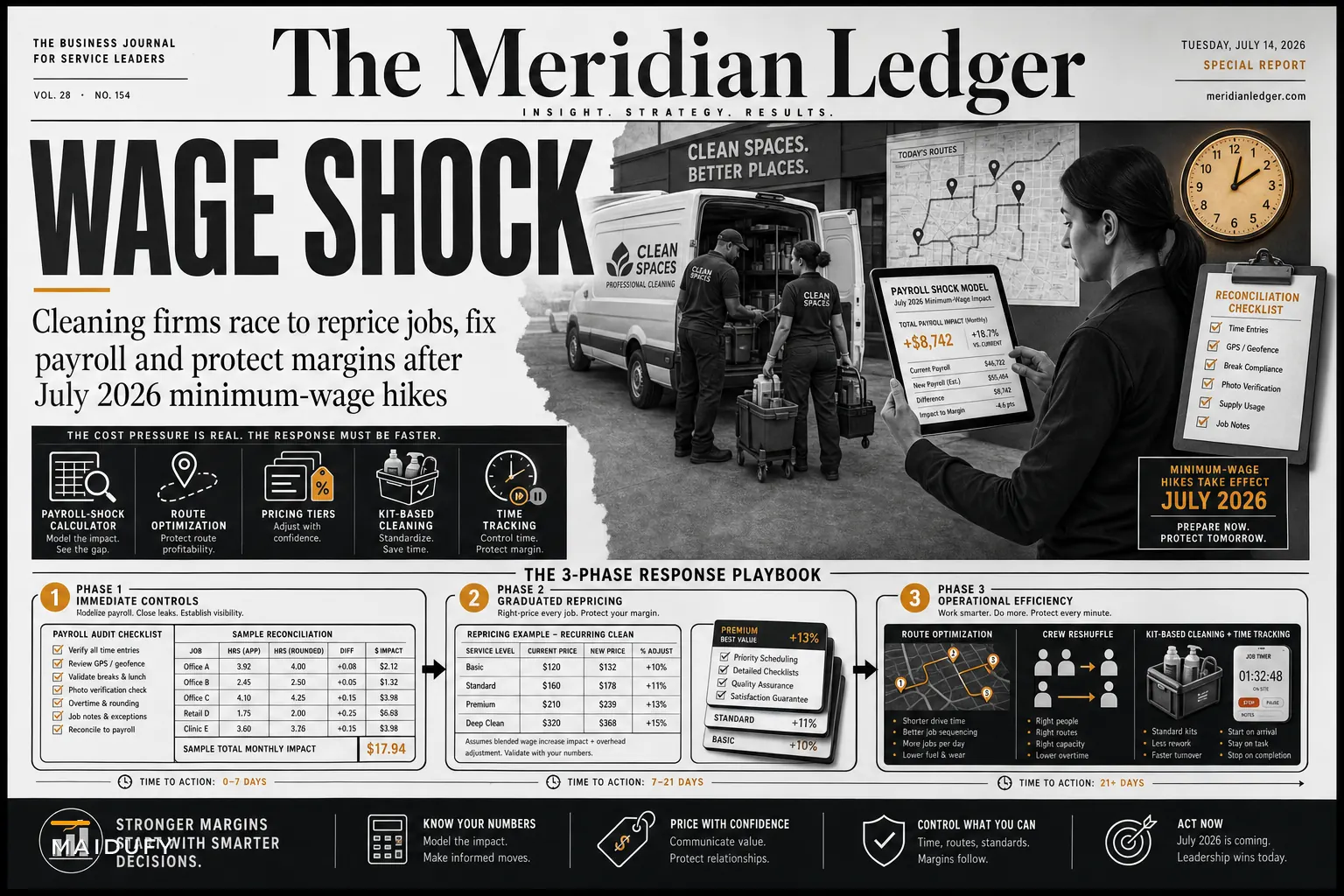

The July 2026 minimum wage increases hit cleaning company payroll hard. D.C. jumped to $18.40, Alaska hit $14.00, and dozens of cities pushed through their own increases, according to the Department of Labor's updated wage tables. If you're running a cleaning business in any of these jurisdictions, your direct labor costs probably went up somewhere between 8% and 15% overnight.
A lot of cleaning companies are scrambling right now—throwing together emergency price hikes or cutting hours to make payroll. Those reactions almost always backfire. You lose customers to competitors who planned better, or you create scheduling chaos that tanks service quality.
The real problem isn't the wage increase itself. It's that most cleaning businesses run on margins thin enough that any labor cost spike exposes every inefficiency you've been letting slide. Those five extra minutes crews spend between jobs? That now costs you an extra $1.53 per stop. Inefficient routes adding 20 minutes of drive time? Another $6.13 per crew per day, gone.
Why cleaning businesses get crushed by wage hikes (and others don't)
Labor typically runs 55-65% of a cleaning company's total operating costs. Compare that to landscaping at around 40% or plumbing at 35%. When minimum wage jumps, cleaning businesses feel it fast and directly.
The structure of cleaning work makes this worse. You can't just "work faster" to compensate—a three-bedroom house still takes roughly the same time to clean properly. You can't easily pass massive price increases to customers who already view cleaning as a commodity. And unlike a restaurant that can shrink portions or a manufacturer that can swap materials, your primary input (labor hours) is basically fixed.
What really destroys margins is how these wage increases ripple through your cost structure. Your experienced cleaners who were earning $2 above minimum? They expect raises too, otherwise they're suddenly making starter wages again. Your team leads sitting at $18? They want separation from the new floor. Before you know it, you're looking at a 12-15% total payroll increase, not just the 8% minimum wage bump.
Then there's the overtime trap. Higher base wages mean time-and-a-half hits harder. A cleaner in D.C. working overtime now costs you $27.60 per hour. If you've been running lean crews to save on base labor, those overtime hours during busy stretches just became profit killers.
The three-phase response plan that actually works
Phase 1: Immediate bleeding control (Week 1-2)
Never miss a cleaning appointment again.
Maidufy helps you book, confirm, and manage every cleaning service seamlessly.
- Centralized booking management
- Automated client reminders
- Optimized staff scheduling
No credit card required
First priority is stopping the bleeding without blowing up the business. That means surgical cost control, not panic cuts.
Pull your last three months of payroll data and figure out your actual labor cost by job type. Most cleaning companies find they're losing money on certain job categories—usually small one-time deep cleans or recurring appointments way out at the edges of their service area. With higher wage floors, those marginal jobs have become actively unprofitable. Build a simple job profitability matrix:
| Job Type | Old Labor Cost | New Labor Cost | Current Price | New Margin |
|---|---|---|---|---|
| 2BR recurring | $38 | $43.50 | $95 | $51.50 |
| 3BR deep clean | $76 | $87 | $180 | $93 |
| Studio monthly | $19 | $21.75 | $65 | $43.25 |
| 4BR bi-weekly | $57 | $65.25 | $140 | $74.75 |
Any job showing less than 35% margin after the new labor costs needs immediate attention. Reprice it, restructure it, or drop it.
Next, do emergency schedule optimization. Cluster jobs tighter geographically—even if it means calling customers to shift their regular days. Every 10 minutes of drive time you eliminate saves roughly $3 per crew at the new wage rates. For a company running 5 crews doing 6 jobs a day, tightening routes by just 15 minutes per job is around $2,700 back in your pocket every month.
Phase 2: Strategic repricing without losing everyone (Week 2-4)
The standard advice is "just raise prices to cover wage increases." But if you blast out 15% increases to your entire customer list, expect mass cancellations. Cleaning customers hit a sensitivity threshold pretty quickly.
High-value recurring clients (weekly/bi-weekly for 12+ months): 5-7% increase, positioned as a "loyalty rate" that's still below new customer pricing. These customers are cheaper to serve and have higher lifetime value.
Standard recurring clients (monthly or newer bi-weekly): 10-12% increase, closer to your actual cost increase. Frame it around maintaining service quality.
One-time and sporadic clients: 15-20% increase or eliminate entirely. These are your least profitable customers anyway.
New customers: Full new margins from day one, no grandfathering.
Stagger these increases over 60 days rather than hitting everyone at once. Start with one-time clients, then monthly, then bi-weekly. This reduces the shock and gives you time to adjust if cancellation rates spike.
For deep cleans specifically, move to condition-based pricing tiers. A "light" deep clean on a well-maintained home might hold close to old prices. A "heavy" deep clean with significant buildup gets a 25% premium. You stay accessible while protecting margins on the jobs that actually eat labor hours.
Phase 3: Operational efficiency improvements that stick (Week 4-12)
Once pricing is stabilized, focus on efficiency improvements that actually reduce labor hours without cutting corners on quality.
The biggest opportunity is usually in job staging and handoffs. Track how much time crews spend loading supplies, arriving, getting building access, and transitioning between tasks. A typical two-person crew wastes 35-45 minutes per day on this kind of friction. At $18.40 per hour, that's over $21 daily per crew in pure waste.
"Kit-based" cleaning fixes a lot of this—each job type gets a pre-staged supply kit, no deciding what to bring or making trips back to the van. Sounds obvious, but most companies haven't done it because it takes upfront investment in duplicate supplies.
Another common time leak: crews checking in between every job. Calls or texts to the office eating 5-10 minutes each time adds up fast. Set clear protocols where communication is only needed for actual problems, not routine confirmation.
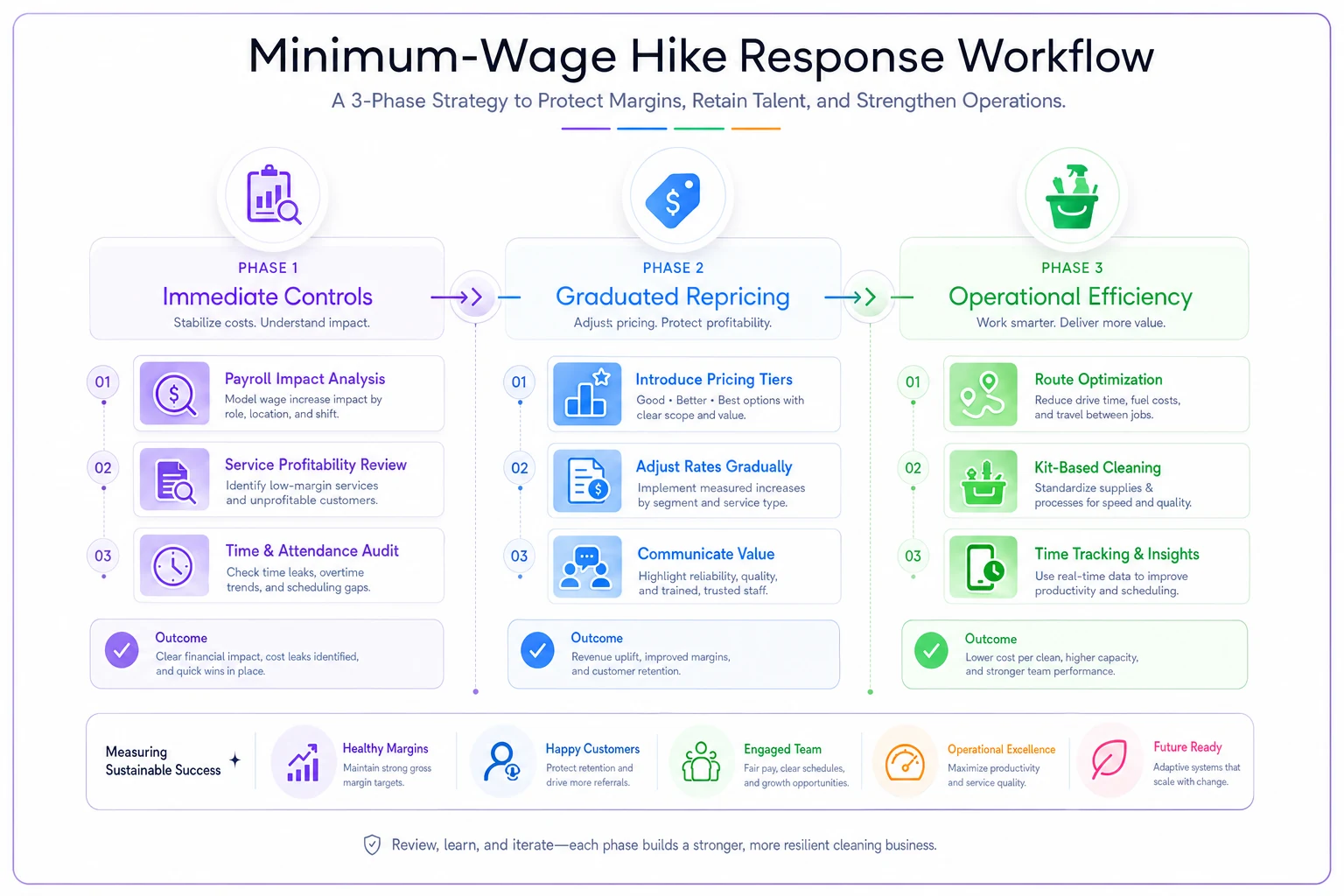
Here's a quick visual of the three-phase workflow.
Finding hidden labor waste in your cleaning operations
Labor waste in cleaning follows predictable patterns, but owners rarely measure it properly. You assume a two-bedroom apartment takes 1.5 hours because that's what you've always scheduled—but the actual cleaning time might be 1 hour and 10 minutes, with 20 minutes of transition waste baked in.
Track "touch time" versus "clock time" for a week. Touch time is when cleaners are actually cleaning. Clock time is what you're paying for. That gap is your efficiency opportunity.
Use timestamped start/stop tracking to separate touch time from transition time so you can target the biggest waste drivers.
Common time sinks worth measuring:
-
Parking and building access
5-12 minutes per job
-
Supply organization and retrieval
8-15 minutes per job
-
Customer interaction and payment
5-10 minutes per job
-
Route confusion and GPS checking
3-8 minutes per job
A crew wasting 40 minutes per day costs you roughly $490 monthly at the new wage rates. Multiply that across multiple crews and it becomes a serious hidden cost center.
This is exactly why accurate field time tracking matters for cleaning businesses. Without real data, you're guessing at where labor dollars actually go versus where you think they go.
When to add technology versus when to restructure manually
Not every efficiency problem needs software. But some operational challenges get genuinely hard to solve when higher labor costs are eating into your margin for error.
Manual scheduling works fine when you have enough cushion to absorb inefficiencies. When every minute costs more, optimizing routes while juggling crew availability, customer preferences, and job requirements becomes a real management burden. Operational software helps here—some cleaning companies discover that certain crew pairings consistently run 20% longer on identical jobs, which is something almost impossible to catch manually.
Pricing optimization has the same problem. Tracking job profitability across hundreds of variables—location, condition, frequency, crew, time of day—isn't really doable by hand. But understanding those patterns becomes critical when margins are thin. AI-powered platforms can surface things like Tuesday deep cleans in certain zip codes consistently running over time, so you can price them accordingly.
Customer communication is another one. Every call or text interrupting your crews or office staff now costs more to handle than it used to. Automated scheduling confirmations, payment processing, and basic customer updates can eliminate a surprising number of daily interruptions.
Converting wage pressure into competitive advantage
Minimum wage increases hit everyone, but they don't hit everyone equally. Companies with tighter operations absorb these costs while inefficient competitors struggle to keep up.
The cleaning companies that come out ahead after wage hikes tend to share three things.
First, they know their true costs at the job level. Not estimates or averages—actual labor cost per customer, per service type, per geographic area. That lets them make precise decisions about what to keep, modify, or cut.
Second, they've eliminated most administrative waste. Crews spend the large majority of paid time actually cleaning, not driving, organizing, or waiting. This efficiency gap becomes a real competitive advantage when labor costs spike across the board.
Third, they've built some pricing power through differentiation. Rather than competing as commodity cleaners, they've established value propositions that justify a premium—specialized services, reliability that stands out, or customer experience that clients notice.
Your 30-day action plan
Week 1:
-
Audit all jobs for profitability at new wage rates
-
Identify and pause or eliminate underwater services
-
Implement emergency route optimization
Week 2:
-
Begin graduated price increases starting with lowest-value customers
-
Introduce condition-based pricing for deep cleans
-
Set up basic time tracking to identify waste
Week 3-4:
-
Roll out pricing changes to monthly customers
-
Implement kit-based cleaning systems
-
Reduce unnecessary check-ins and office communication
Week 5-8:
-
Complete pricing adjustments for bi-weekly customers
-
Analyze time tracking data for efficiency opportunities
-
Evaluate operational software for scheduling and routing
Week 9-12:
-
Implement systematic efficiency improvements
-
Build out differentiated service offerings
-
Set up monitoring systems for ongoing optimization
Cleaning companies that treat these wage increases as an operational wake-up call rather than just a cost problem will come out of this in better shape than they went in. Higher wages are forcing the professionalization of an industry that has operated on thin margins and loose processes for a long time.
The immediate pain is real. Nobody enjoys watching their largest expense category jump by double digits. But the companies that use this pressure to fix their operational foundations will end up with more sustainable businesses, better employee retention, and a genuine edge over new entrants who can't match their efficiency.
Labor costs aren't going back down. States and cities will keep raising minimum wages, and competition for hourly workers will keep intensifying. The question isn't whether you'll adapt—it's whether you'll do it on your terms or under duress.
Ready to elevate your cleaning business?
Join 500+ cleaning services using Maidufy to save time, reduce scheduling errors, and deliver exceptional client satisfaction.