

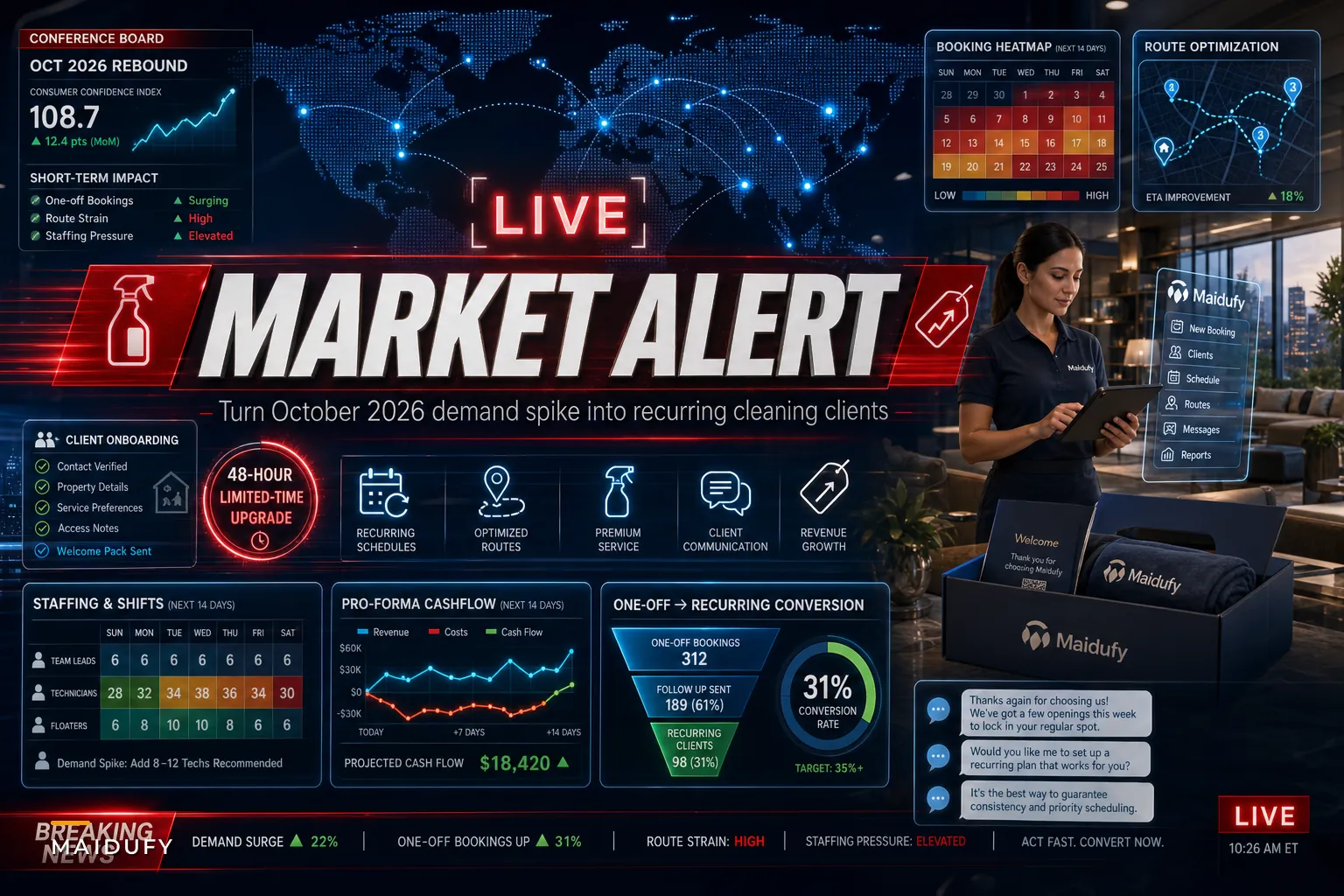

The Conference Board reported that U.S. Consumer Confidence jumped 7.5 points to 91.7 in October 2026 — a sharper rebound than most forecasters expected heading into the quarter. For most industries, that's a footnote in a macro report. For a residential cleaning business, it means something more specific: more people suddenly feel comfortable spending money on getting their house cleaned.
But a confidence rebound doesn't hand you recurring clients. It hands you one‑off bookings — the "we're hosting Thanksgiving and the house is a disaster" crowd. If you handle that wave the way most cleaning agencies do, you'll be slammed for six weeks, exhausted, and back where you started by January with maybe two or three new recurring clients to show for it.
The window matters because sentiment is volatile. The same index that jumped this month has swung hard the other direction plenty of times before. So the real question isn't "how do I get more bookings right now?" It's "how do I make sure this temporary demand actually leaves me with a bigger recurring base once the mood shifts again?"
What a confidence bump actually does to your booking mix
When discretionary spending loosens up, the composition of your inbound requests changes before the volume does. You start seeing more:
-
Pre‑holiday deep cleans
-
"Just once to see how it goes" trial bookings
-
Move‑in / move‑out jobs (people feel confident enough to relocate or buy)
-
Gift bookings (someone buying a cleaning for a parent or friend)
None of these are recurring by nature. They're events. And events have a habit of filling your calendar with low‑retention work that crowds out the slots you'd actually want protected.
During confidence upticks, agencies frequently grow revenue while shrinking recurring percentage. More gross sales, but the base of weekly and biweekly clients — the thing that actually makes your business worth something — stayed flat or dropped as a share of total. You feel busy and successful while the underlying asset doesn't improve. That's the trap.
The underlying problem: one‑offs and recurring clients need different handling, and most agencies run them the same way
Most cleaning businesses have exactly one intake process. A request comes in, you quote it, you schedule it, you clean, you invoice. Same flow for a one‑time deep clean as for a prospective weekly client.
Never miss a cleaning appointment again.
Maidufy helps you book, confirm, and manage every cleaning service seamlessly.
- Centralized booking management
- Automated client reminders
- Optimized staff scheduling
No credit card required
That's the mistake. A one‑off is a sales opportunity disguised as a job. A recurring client is a relationship that needs to be set up correctly from the first visit. When you run both through the same pipeline, the one‑offs never get the conversion push, and the would‑be recurring clients never get the onboarding that makes them stay.
In practice, the conversion from one‑off to recurring almost always breaks at two specific moments:
-
The quote stage — you priced the one‑off as a standalone transaction with no path to a plan.
-
The 48 hours after the first clean — you did great work and then said nothing, so the client had no reason to book again.
Fix those two moments and your conversion rate moves more than any extra marketing spend would.
A triage rule that protects your recurring base during the rush
Before you chase every booking, decide what you're protecting. During a surge, the temptation is to say yes to everything. That's how recurring clients get bumped, rescheduled, or quietly annoyed — and recurring clients leaving during a boom is the quietest, most expensive thing that can happen to your business.
| Booking type | Priority | Slot policy | Conversion goal |
|---|---|---|---|
| Existing recurring client | Highest | Never displaced | Retain, upsell add‑ons |
| New lead with recurring intent | High | Place in a slot you can repeat weekly/biweekly | Convert to plan at visit end |
| One‑off deep clean (local, good fit) | Medium | Fill gaps and edges | Offer trial‑to‑plan incentive |
| One‑off outside your core zone | Low | Only if route allows | Price for profit, no conversion pressure |
The thing people get wrong here is placing a promising new recurring lead into a random open slot they can't actually repeat. If a client loves their Tuesday 10am clean but that slot is only free this one week, you've created a client who wants to come back into a slot that doesn't exist. Place conversion candidates into genuinely repeatable slots from the start.
Scheduling decisions made under surge pressure are the ones that create problems two months later. It's worth slowing down for thirty seconds on each new booking to confirm the slot is real.
The conversion play: turn the one‑off into a plan at the moment it works best
The highest‑converting moment is right after the first clean, when the house looks great and the client is feeling the result. Not three days later in a follow‑up email. Right then.
A practical sequence:
-
At quoting, mention the recurring price alongside the one‑off price. Not as a pitch — just as information. "This one‑time deep clean is $X. If you ever want ongoing, maintenance visits run $Y biweekly." You've planted it without pushing.
-
During the visit, the cleaner or lead notes anything that signals recurring fit — pets, kids, a client who clearly values tidiness, a big house that'll get messy fast again.
-
At handoff, the close is simple and specific
"We'd love to keep it looking like this. If you book your next visit within the week, we'll apply the deep‑clean rate difference as a credit." Tie it to a real, repeatable slot.
-
Within 48 hours, one follow‑up with a single clear option — not a menu. "Here's your Tuesday biweekly spot, want me to lock it in?"
The mistake almost everyone makes is offering too many choices. "Weekly, biweekly, monthly, or custom?" kills momentum. Pick the frequency that fits what you observed and offer that one. People convert on a yes/no decision far more than on an open‑ended one.
A short checklist for the next six weeks
While demand is elevated, run through this before you take on the wave:
-
Freeze your recurring clients' slots — mark them untouchable in the schedule
-
Identify how many genuinely repeatable slots you can offer new recurring clients
-
Write one short conversion script and make sure every cleaner and lead knows it
-
Decide your trial‑to‑plan incentive now (credit, discount, or bonus add‑on) so nobody improvises it on the spot
-
Set a payroll buffer — surges mean overtime and temp help, and that cash hits before the recurring revenue does
-
Track one‑off → recurring conversion rate specifically, not just total bookings
Tag repeatable slots in your scheduling system so they can't be reassigned during a surge.
That last point matters more than it looks. If you only track bookings, a boom always looks like a win. Tracking conversion rate tells you whether the boom is actually building your business or just renting it out for a month.
A realistic scenario
Take a mid‑sized agency running around 240–260 cleans a month, mostly recurring with a steady trickle of one‑offs. When sentiment ticked up, their one‑off requests roughly doubled for about five weeks — holiday prep, a few move‑outs, some gift bookings.
Their old habit would've been to cram everything in and move on. Instead they did two things: protected every existing recurring slot from being rescheduled, and added a plain "next visit credit" close at the end of every one‑off deep clean.
Out of roughly 40 one‑off deep cleans that period, around 11 converted to biweekly plans. Not spectacular on paper — but 11 new recurring clients at $140–$160 per visit biweekly works out to somewhere in the range of $3k–$4k of new monthly recurring revenue that outlasted the spike entirely. The one‑offs paid for the busy season. The conversions paid for the year.
One detail worth noting: their conversion rate on one‑offs where the cleaner delivered the close in person was noticeably higher than on the ones that only got an email follow‑up. The in‑person moment did most of the heavy lifting.
When this makes sense — and when it doesn't
This approach works best when you have the capacity to actually service new recurring clients. Converting a one‑off into a weekly plan you can't reliably staff is worse than letting them stay a one‑off. You'll convert them, then disappoint them, then lose them and eat a bad review.
Be careful converting clients who are a geographic outlier. A recurring client 40 minutes outside your route is a recurring loss, not a win, unless they anchor future density in that area.
Who should skip the hard conversion push: anyone already at full capacity on recurring work. If your repeatable slots are full, run the one‑offs as pure margin plays, price them for profit, and build a short waitlist for recurring. Don't convert people into frustration.
Keeping the systems honest when volume spikes
A surge stresses the parts of your business that are usually fine at steady state — scheduling, payroll timing, and follow‑up discipline. The follow‑up is the one that quietly breaks first, because when everyone's slammed, nobody remembers to send the 48‑hour conversion message.
This is where having the lifecycle mapped out ahead of time — who sends what, when, and with which offer — separates agencies that grow their base from ones that just survive the rush. Operationally, the difference usually comes down to whether the follow‑up sequence is built into the workflow or left to memory. When it's left to memory, it doesn't happen. When it's built in — whether that's a simple checklist, a CRM trigger, or an automated message — it happens consistently regardless of how busy the week got.
Here's a simple workflow you can follow.
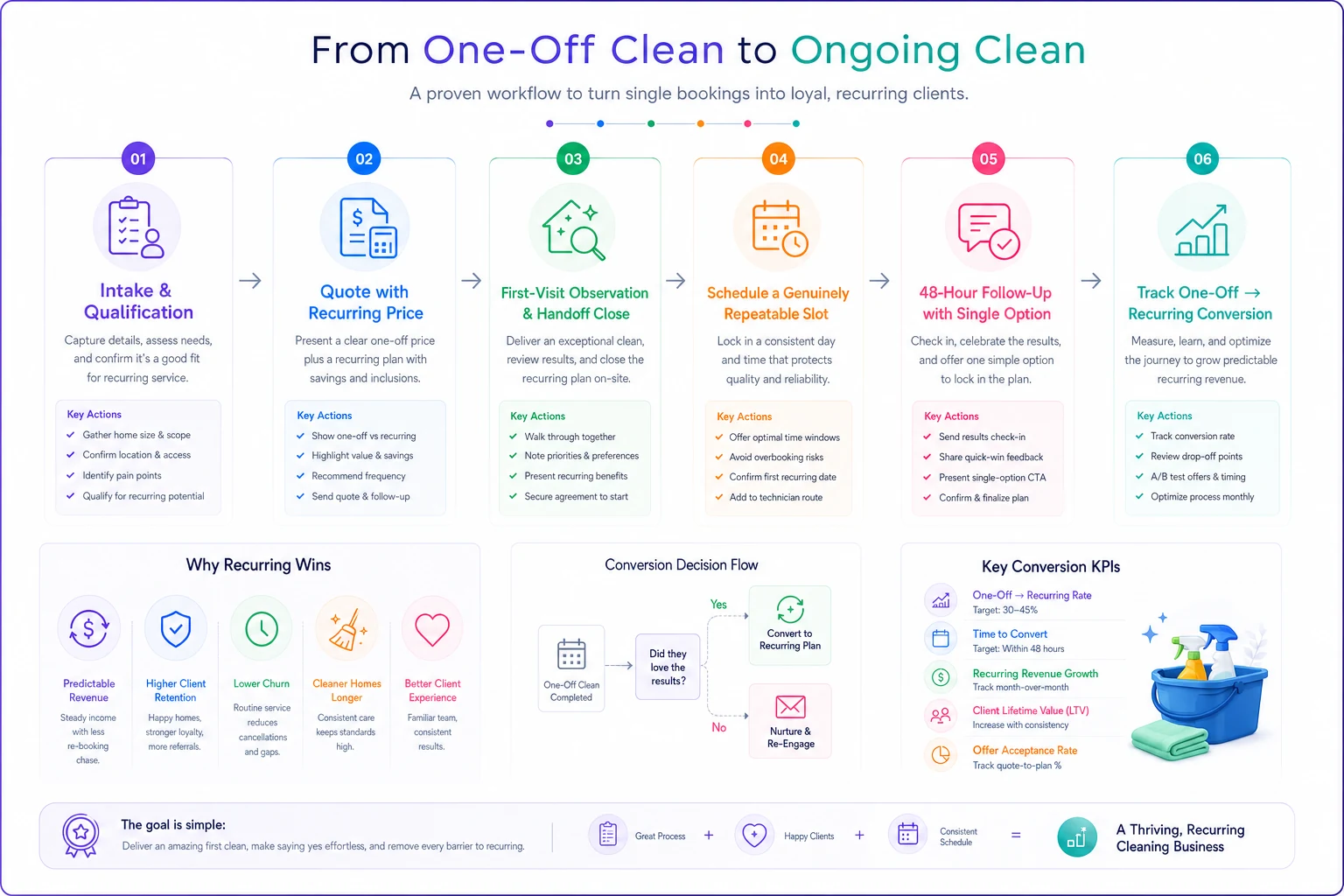
If you want the full framework for moving clients through that journey systematically, we broke it down in our lifecycle system for turning one‑offs into steady recurring revenue, which pairs well with everything above.
The agencies that handle a confidence rebound well aren't the ones who book the most jobs. They're the ones who had a plan for what to do with those jobs before the phone started ringing. The press coverage of the October confidence jump will fade in a news cycle. Whether you converted that wave into recurring clients is something you'll still be feeling next summer.
The takeaway
A demand spike is a test of your systems, not a reward. The confidence rebound gives you more at‑bats — more strangers willing to try you once. What you do in the quoting conversation, during the visit, and in the two days after the first clean decides whether those at‑bats turn into a bigger, steadier business or just a busy month you'll forget by spring. Protect your recurring slots. Price the one‑offs for profit. Convert at the moment the work speaks for itself. And track the conversion rate, not just the booking count — because that number is the only one that tells you whether the boom actually made you bigger.
Ready to elevate your cleaning business?
Join 500+ cleaning services using Maidufy to save time, reduce scheduling errors, and deliver exceptional client satisfaction.