


Most cleaning companies quote deep cleans using their regular cleaning times, maybe tossing on an extra hour or two. Then reality hits—the job drags on twice as long, your crew runs overtime, and that $350 deep clean just ate $400 in labor costs.
The issue isn't that deep cleans are unpredictable. Nobody tracks how long different rooms actually take under different conditions. You guess based on square footage or slap a random multiplier on your regular rates. Meanwhile, your competitors who track their real deep clean times are winning bids you think are underpriced.
Why deep clean estimates fail
Regular cleaning and deep cleaning operate on completely different time physics. A maintained 12x14 master bedroom takes maybe 15 minutes for regular service. Same room during a deep clean? Could be 45 minutes if it's decent, or 90 minutes if nobody's touched the baseboards in three years.
The variance destroys you. A 2,500 square foot house might take anywhere from 6 to 14 hours for a deep clean, depending on factors most companies never document. You quote the 6-hour scenario, arrive to the 14-hour reality, and either eat the loss or have an uncomfortable conversation about additional charges.
Deep cleans are often your entry point with new clients. Screw up that first impression with bad timing, and you lose the recurring contract before it starts.
Room-by-room time benchmarks (based on actual tracked data)
After tracking hundreds of deep cleans across different house conditions, patterns emerge. These aren't perfect—every house throws curveballs—but they give you a realistic starting point.
Never miss a cleaning appointment again.
Maidufy helps you book, confirm, and manage every cleaning service seamlessly.
- Centralized booking management
- Automated client reminders
- Optimized staff scheduling
No credit card required
Kitchen deep clean times
Light condition (maintained within 6 months):
-
Small galley kitchen (under 100 sq ft)
45-60 minutes
-
Standard kitchen (100-200 sq ft)
60-90 minutes
-
Large/open concept (200+ sq ft)
90-120 minutes
Moderate condition (6-12 months since deep clean):
-
Small galley
60-90 minutes
-
Standard
90-120 minutes
-
Large/open
120-150 minutes
Heavy condition (12+ months or never deep cleaned):
-
Small galley
90-120 minutes
-
Standard
120-180 minutes
-
Large/open
180-240 minutes
Kitchens usually represent 25-35% of your total deep clean time. Get this wrong and the whole estimate collapses.
Bathroom benchmarks
Bathrooms vary wildly based on fixture count and condition. A powder room might take 20 minutes in good shape or an hour with years of buildup.
Half bath/powder room:
-
Light
20-30 minutes
-
Moderate
30-45 minutes
-
Heavy
45-60 minutes
Full bathroom (tub/shower combo):
-
Light
35-50 minutes
-
Moderate
50-75 minutes
-
Heavy
75-100 minutes
Master bathroom (separate tub and shower):
-
Light
50-70 minutes
-
Moderate
70-100 minutes
-
Heavy
100-140 minutes
Hard water stains and soap scum destroy your timeline. A glass shower door with two years of buildup might eat 30 minutes alone.
Living spaces and bedrooms
These rooms scale more predictably with square footage, but furniture density matters more than floor space.
Living/family rooms:
-
Under 200 sq ft
30-45 minutes (light), 45-70 minutes (heavy)
-
200-400 sq ft
45-60 minutes (light), 70-100 minutes (heavy)
-
Over 400 sq ft
60-90 minutes (light), 100-140 minutes (heavy)
Bedrooms:
-
Small (under 120 sq ft)
25-35 minutes (light), 40-60 minutes (heavy)
-
Medium (120-200 sq ft)
35-45 minutes (light), 60-80 minutes (heavy)
-
Large/master (200+ sq ft)
45-60 minutes (light), 80-110 minutes (heavy)
A minimalist bedroom with one bed and nightstand cleans faster than a cluttered room loaded with dressers, chairs, and shelving units, regardless of square footage.
Condition modifiers that change everything
Raw room times tell half the story. The real skill comes from identifying condition modifiers during your walkthrough or phone assessment.
The pet factor
Pet hair adds 15-25% to your base time. It's not linear though—two cats don't equal twice the hair of one cat. Three dogs might only add 30% more time than one dog. Type matters too. One husky equals three beagles in fur management.
For homes with pets:
-
1-2 cats
Add 15% to base time
-
1 dog (non-shedding)
Add 10%
-
1 dog (heavy shedder)
Add 20-25%
-
Multiple pets
Add 25-35% max
You're not just vacuuming more. You're dealing with hair wrapped around furniture legs, embedded in carpet edges, and floating in corners the moment you disturb anything.
The smoker surcharge
Nicotine residue changes the entire cleaning chemistry. Your standard all-purpose cleaners barely touch it. Windows take three times longer. Walls might need specialized products.
Indoor smoking homes need:
-
40-60% additional time for surface cleaning
-
Special degreasing products
-
Often multiple passes on windows and mirrors
-
Extra attention to HVAC returns and ceiling fans
Some companies won't even quote smoker homes without a premium charge. The residue fights you on every surface.
Clutter density scoring
Clutter isn't just about moving items—it's about decision fatigue and workflow disruption. A cluttered house might have the same square footage as a minimal one, but take twice as long.
Quick clutter assessment:
-
Low (0-10% time add) Clear surfaces, organized belongings, easy to clean around
-
Medium (15-25% add) Moderate items on surfaces, some reorganizing needed
-
High (30-50% add) Surfaces covered, significant item movement required
-
Extreme (decline or 75%+ add) Hoarding tendencies, paths through rooms
The clutter factor compounds with crew size. Two people in a cluttered space work less efficiently than one person in a clear space.
Neglect multipliers
Time since last deep clean creates exponential, not linear, time increases:
| Time since last deep clean | Multiplier |
|---|---|
| 6 months | Base time |
| 12 months | 1.3x multiplier |
| 18 months | 1.6x multiplier |
| 24+ months | 2x multiplier |
| Never deep cleaned | 2.5-3x multiplier |
Buildup doesn't accumulate evenly. The difference between 6 and 12 months is smaller than between 18 and 24 months. After two years, you're basically doing restoration work.
Crew sizing mathematics
Throwing more people at a deep clean doesn't scale linearly. Two people don't clean twice as fast as one person. Three people might actually slow things down in smaller homes.
Optimal crew configurations
Homes under 1,500 sq ft:
-
1 person for 4-6 hour jobs
-
2 people maximum (efficiency drops with more)
1,500-2,500 sq ft homes:
-
2 people for standard deep cleans
-
3 people for heavy condition or time-constrained jobs
2,500-4,000 sq ft homes:
-
2-3 people standard
-
3-4 for heavy conditions
4,000+ sq ft homes:
-
3-4 people minimum
-
4-5 for heavy conditions or same-day completion needs
The sweet spot is usually 2-3 experienced cleaners. Beyond that, coordination overhead eats into efficiency gains.
Efficiency scaling factors
Real-world efficiency when adding crew members:
-
1 person
100% efficiency (baseline)
-
2 people
170-180% combined efficiency
-
3 people
240-250% combined efficiency
-
4 people
280-300% combined efficiency
-
5+ people
Diminishing returns, coordination problems
This assumes experienced crews who work together regularly. New team combinations might only hit 150% efficiency with two people initially.
Room assignment strategies
Effective crew deployment depends on house layout:
-
Split by floor Works for multi-story homes. One person per floor prevents traffic jams on stairs.
-
Split by wet/dry One person handles all bathrooms and kitchen, others tackle living spaces. Reduces equipment movement.
-
Room rotation Each person fully completes rooms in sequence. Better for quality control but slower overall.
-
Zone defense Assign adjacent room clusters. Minimizes travel time and equipment sharing.
Visualizing crew assignment and equipment flow:
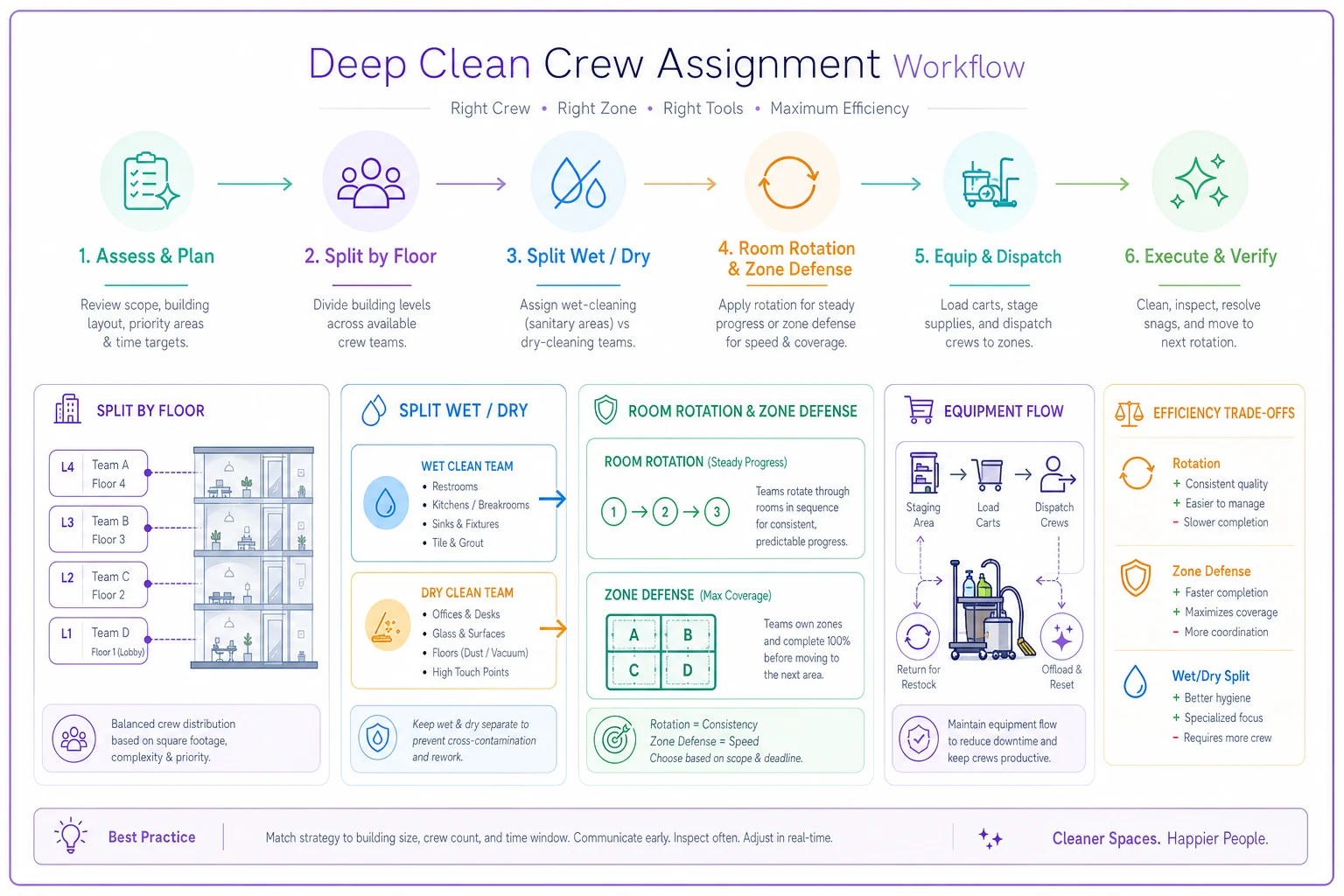
Wrong assignment strategy can add 20-30% to job time. Teams stepping over each other or waiting for shared equipment kills productivity.
Sample estimate worksheet you can steal
Here's a working estimate template based on a real 2,400 sq ft home walkthrough:
Initial Assessment
Basic Information:
| Field | Value |
|---|---|
| Square footage | 2,400 |
| Bedrooms | 4 |
| Bathrooms | 2.5 |
| Last deep clean | 14 months ago |
| Pets | 1 medium-shedding dog |
| Condition | Moderate |
| Clutter level | Medium |
Room-by-room breakdown
Kitchen (150 sq ft, moderate condition):
-
Base time
90-120 minutes
-
Pet modifier (+20%)
18-24 minutes
-
Subtotal
108-144 minutes
Master Bath (heavy condition - visible soap scum):
-
Base time
100-140 minutes
-
Pet modifier
N/A (pets don't access)
-
Subtotal
100-140 minutes
Hall Bath (moderate):
-
Base time
50-75 minutes
-
Subtotal
50-75 minutes
Powder Room (moderate):
-
Base time
30-45 minutes
-
Subtotal
30-45 minutes
Master Bedroom (220 sq ft, moderate):
-
Base time
60-80 minutes
-
Pet modifier (+20%)
12-16 minutes
-
Clutter modifier (+20%)
12-16 minutes
-
Subtotal
84-112 minutes
3 Secondary Bedrooms (avg 140 sq ft each, moderate):
-
Base time each
60-80 minutes
-
Pet modifier (+20%)
12-16 minutes each
-
Total for 3
216-288 minutes
Living Room (350 sq ft, moderate):
-
Base time
70-100 minutes
-
Pet modifier (+20%)
14-20 minutes
-
Subtotal
84-120 minutes
Dining Room (200 sq ft, light):
-
Base time
30-45 minutes
-
Subtotal
30-45 minutes
Hallways/Stairs/Misc:
-
Estimated
45-60 minutes
Total time calculation
Room total: 747-989 minutes (12.5-16.5 hours)
Crew sizing decision:
-
Solo cleaner
2 full days
-
2-person crew
7-9 hours (ideal choice)
-
3-person crew
5-6.5 hours (if rush needed)
Final estimate with 2-person crew:
-
Hours
8 (midpoint, rounded up)
-
Labor cost
$320 (2 people × 8 hours × $20/hour)
-
Supplies
$25
-
Overhead/profit (40%)
$138
-
Quote to client
$483
Track every deep clean for a month to build accurate benchmarks from real jobs.
Most companies would have quoted this at $300-350 and lost money.
Avoiding the death spiral of underquoting
Underquoting deep cleans creates a vicious cycle. You lose money, so you rush the job. Quality suffers. Client's unhappy. No recurring contract. You need more new clients, so you quote lower to win bids. Cycle repeats.
Breaking this starts with actual time tracking. Not guessing, not hoping—real data from actual jobs. Track every deep clean for a month. Note room types, conditions, time spent, problems encountered. Patterns emerge fast.
The uncomfortable truth is that proper deep clean pricing might lose you some bids initially. But the jobs you win become profitable. Your crews aren't rushed. Quality improves. Conversion to recurring service jumps from maybe 30% to 60% or higher.
Some companies now use basic operational software to track these metrics automatically. Your crew logs room completions, the system calculates actual versus estimated times, and you refine your benchmarks with each job. After a few dozen deep cleans, your estimates become surprisingly accurate.
The companies still guessing at deep clean times are competing on price because they don't know their real costs. Once you know your actual times, you compete on reliability and quality instead. Clients pay more for certainty, especially when their last cleaner showed up with two people for a six-person job.
When to decline or refer deep cleans
Not every deep clean makes sense for your business. Knowing when to walk away protects your margins and reputation.
Automatic red flags:
-
Extreme hoarding situations (liability and time issues)
-
Biohazard conditions requiring special certification
-
Client unwilling to pre-declutter high-mess areas
-
Rush jobs requiring 5+ crew members
-
Prices capped below your break-even point
The temptation to take any revenue is strong, especially during slow periods. But one catastrophically underquoted deep clean can wipe out profit from five good jobs. Your crew gets demoralized, potentially damages their relationship with the client, and you still lose money.
Better to refer these to specialized services or competitors who work at different price points. Maintaining profitability on every job keeps your business healthy enough to serve clients well long-term.
Building confidence through operational clarity
The anxiety around deep clean quoting disappears when you have solid benchmarks. Instead of nervous guessing during walkthroughs, you're calculating based on proven data. Clients sense this confidence.
Start with the room-by-room benchmarks above, but treat them as starting points. Your market, crew experience, and cleaning standards might shift times up or down 20%. The modifiers—pets, smoking, clutter—apply fairly universally.
Track everything for your first 20-30 deep cleans. Build your own local benchmarks. Share them with your crew so they understand why accurate time reporting matters. When estimates align with reality, everyone wins—you profit, crews aren't rushed, and clients get what they expected.
The companies thriving in competitive cleaning markets aren't necessarily faster or cheaper. They're more predictable. They know their operational reality and price accordingly. In a business with thin margins, that knowledge is everything.
Ready to elevate your cleaning business?
Join 500+ cleaning services using Maidufy to save time, reduce scheduling errors, and deliver exceptional client satisfaction.